Showing posts with label BBC4. Show all posts

Monday, 15 April 2013

ARNE DAHL'S BLINDED MAN

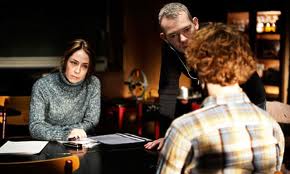
I haven't yet watched BBC4's broadcasts of the TV adaptation of Arne Dahl's novel, but when I read the book a few months ago I was struck by how firmly it was anchored in what I consider the classic Swedish tradition, which flows from Maj Sjowall and Per Wahloo's Martin Beck, and how consciously it seems to address modern society, while still maintaining its suspense as a police procedural.

The Blinded Man begins with two seemingly unconnected events—a well-planned bank robbery and a hostage situation in an immigration office. The first is unexplained. In the second, we follow Paul Hjelm, whose day begins with yet another instance of missed communicaton with his wife. Hjelm then has to deal with the Kosovar Albanian who's been let down by the system in the only way he can figure out how, by shooting him, non-fatally. For that, he is suspended and investigated for misconduct, but in the meantime he is recruited to join a new elite task force being assembled to deal with the murders of two of Sweden's leading businessmen.

You can see familiar elements already: while Hjelm is not quite as depressive as the popular image of Scandinavian detectives dictates, he is serious, inward, and finds communicating a challenge. Most of the best Scandinavian detectives function within a team—which serves as a microcosm of the society and its ethos in which they function. In Hjelm's case, this microcosm is a sort of rainbow coalition: an almost equally serious woman; an aggressive body-builder, who once in roid-rage turned wife beater; a Finnish intellectual (which plays on some Swedish ethnic stereotypes); a plodding Norrlander called Norlander (which plays on others of the same) and a 'new Swede' of Latin American decent. What is particularly interesting is the way Dahl plays, within the group, on generational differences in traditional Swedish values—particularly racism, and not only in regard to immigration. Perceiving minute differences in their own native society, Swedes have been both open to immigration and felt swamped by it, and this is an important side issue throughout the novel.

Meanwhile, the hunt for the serial killer has a somewhat clockwork feel to it—there is actually an Agatha Christie reference which seems somewhat self-conscious. There are secret societies and a clue built around an obscure jazz tape, Monk recorded live, that would be worthy of Michael Connelly or John Harvey had they ever worked in that fashion. Slightly less self-conscious is the analysis Arto Soderstedt, the braniac left-wing Finn, presents of what makes serial killers in the first place. It's worth quoting: 

'Plenty of magazines in the United States make heroes out of serial killers and mass murderers. It's related to the fact that their society is on the verge of collapse. A widespread feeling of general frustration makes it possible for an entire nation to empathise with extremists and sick outsiders...their disregard for all social rules exerts a strong fascination...we need to ask ourselves what sort of effect this sort of mess could have on the national soul of the Swedish people. There's no such thing as a simple act.'

This resonates within the book's approach to Swedish society, if you go back to Beck the whole idea of serial killing hasn't occured, while in Wallander it is a particularly bizarre crime. But it's also crucial
that both Beck (in Murder At The Savoy, to which I wrote the introduction to the Harper Collins edition) and Henning Mankell's Wallander (in The Man Who Smiled) were brought face to face in confrontation with Sweden's upper crust businessmen—Hjelm faces the same challenges, made more intriguing because the businessmen themselves are the targets.


Hjelm reminds me a bit of Leif Persson's Lars Martin Johnsson (who is a Norrlander himself) in that he's not, as previously suggested, as depressive as a Beck or Wallander or Harry Hole. Hjelm is decent, relatively good with people, but, as with most good Nordic detectives, finds his real battles come within the bureaucracy he faces—and that, again, echoes the society the police are supposedly serving.

Hjelm's relationship with his wife Cilla, however, is pure Beck, though Dahl writes it with more emotion than Sjowall and Wahloo. Here's their marriage, and their lives, in a nutshell: 'Did those few moments in the kitchen draw them closer together? Or had the final chasm opened up between them? It was impossible to say, but something decisive had taken place; they had looked right into each other's naked loneliness.'

These are the things television would find hard to adapt. In some ways, I expected The Blinded Man would find its way to television—more along the lines of the Danish Those Who Kill. The ensemble playing can be managed, and the plot itself works well. As with all police procedurals, the question of reveals, and thus managing tension, becomes crucial. But what made the novel most interesting was the inward-looking part, as with the above, and that would be the hardest to transfer to the small screen. I found The Blinded Man a worthy, if unspectacular addition to the line of Scandinavian police procedurals, and Hjelm potentially a major figure. I will turn to the adaptation with keen interest.

The Blinded Man by Arne Dahl, translated by Tiina Nunnally
Vintage £7.99 ISBN 9780999575689 

Note: This review will also appear at Shots (www.shotsmag.co.uk)

Tuesday, 29 March 2011

THE KILLING REACHES THE END OF THE BBC 4 LINE:

In the end, The Killing turned out to be a victim of its own success, and to a lesser extent, its own newly-found hype, as it leapt from the ghetto of BBC4 to mainstream attention (though most of the MSM seemed to be incapable of getting past the same tired points--yes the sweater is an unlikely fashion icon, and at £280 in London, it's unlikely to ever be one here!).

The problem for episode 20 was that the strength of the show was the slow build, the careful distribution of red herrings, and most importantly the combination of political intrigue behind the scenes on one hand, and the breakdown of families and relationships as a result of the crime on the other. But in episode 20, the show had to revert to what, at heart, it was...a whodunit, and reveal who did it, and why, and thus risk tearing down much of the latticework of plot and character that had been developed so carefully.

Because the revelation that Vagn, an almost too-obvious suspect for most of the programme, was indeed the killer raised far more questions than it answered. The most basic one being was he an incredibly clever serial killer, as Sara's boyfriend Bengt suggested (and she conveniently ignored for far too long) --as you would expect from someone who could kill a cop, hang a fellow mover in a Russia coaster's cabin, and indeed leave no DNA traces anywhere while murdering Nanna--or was he someone who simply killed Nanna out of misplaced family loyalty and surrender to an impulse? Unless you believe that his use of Theis for self-destruction was actually part of that fiendishly clever guy.

Similarly, a political subplot which sees civil servants murdered, evidence withheld or destroyed, policewomen stalked, and one party leader killed provides us with few answers. Who was calling the shots to keep Lund's investigation contained? Who was keeping her under watch? We are left to conclude that this is the way business is handled; Brix's exhortations to her not to pursue the ivestigation further (persumably lest she discover Vagn was a major-league serial killer and thus embarrass the police even further) are just business as usual. This is effective, if possibly far too subtly done to register with most of the audience.

These two strands comes together in the question of the car in which Nanna was found. It seemed to yoyo back and forth between people who kept spotting it and finding the keys in the ignition, as if it were a Copenhagen version of a Boris bike, but assuming Vagn found the keys and from them the car, how he managed to leave no traces is beyond me. Similarly, the chain which was found on Nanna: where did it come from? Was it a momento of his first killing? Why didn't Vagn find it? Was it something he gave Hanna when she was younger? Why didn't he find her passport? How did he know where to find the incriminating photo of him with Mette, and why didn't he remove it earlier? The story reveals itself to turn on the most improbably creaky coincidences, clues disappear (remember the ether which was used to drug Nanna?), and we have to hope that Vagn was wearing a mask when he shot Mayer, because if he wasn't it would have been a lot easier for Mayer to croak 'Vagn' than 'Sara 84' as a clue to his killer's identity.

This is what happens when a taut drama turns into an Agatha Christie novel, if only in episode 19. Otherwise, the twin engines driving the show stayed on course throughout. Was Troels a 'different' sort of politician, or was he corrupt, or better, could he be corrupted as Bremer said he would be? And could Sara Lund remain fixated on the killing, and ignore the rest of her life crumbling around her. The more obsessive she became, the more she alienated her boyfriend, her son, her horrible mother, the more popular she became, and she was true to herself in the end.

In fact, one of the most fascinating things about The Killing is the way in which each of the three main female characters is so self-contained. Sara's obsession with solving the crime subsumes all her relationships. Rie appears to believe she can mold Troels in the image she wants (of her politician father, perhaps) and doesn't credit him with either emotions (a weakness) or lack of them (a strength). And Pernille, sometimes Lady Macbeth, sometimes sphinx, fails to communicate her grief to Theis, thus initially prompting revenge and i the end being unable to stop Vagn from getting Theis' revenge. All three women, operating from their own motives, lose their relationships.

And in the end, that's what the show was about, and in that sense the English mis-translation of the title into The Killing may actually be better than 'The Crime', which is the literal translation from Danish. Because the point of the show is that the crime actually kills far more than just Nanna: it kills Lund's relationships, it kills Theis' family, and it kills Troels' relationship with Rie. That is really what the show was about, and it was presented with great precision--not only the way in which it was shot, but the way characters' make up changed from episode to episode to reveal their many sides, and of course in the way the series allowed actors to really work their roles. Apparently, BBC4 paid only $1,000 per episode for this excellence...one imagines series two of the show is going to cost them far more. And maybe Rie makes her comeback. I miss the show already...

Thursday, 15 October 2009

SPIRAL: THE SECOND SERIES BEGINS ON BBC4

BBC Four is five episodes into the second series of Spiral, made in France in 2008, three years after the first (see IT's reaction to that here) and it has a different feel to the first series, while retaining some of the elements, at least at the start, that make it French. Let's just hope BBC4 don't do what they did to the Swedish Wallander series, and stop showing it with just three episodes to go, deciding it was so popular they would make its fans wait until a special holiday showing, and bigger ratings, might be ensured.

If CSI were the early model for Spiral's first season, though not one it adhered to for long, The Wire has obviously been the inspiration for this one. But it is The Wire crossed with something like Chabrol's L'Ivresse du Pouvoir. It is set in the French equivalent of the projects, where the drug dealers and gangsters are largely French Arabs, and the problems the police face with trying to cope with the drug traffic and the gangs' control of the area are much the same as inspired The Wire. It is particularly interesting because Inspector (Capitain) Laure Berthaud is under investigation for a trumped-up charge of police brutality--and it's a very different Caroline Proust in this series. Gone is the gamine quality from the first series; here she looks tired, is all-business (at least so far) and seems stretched to her limits by the pressures of the job.

Similarly, there was a marked change in the character of Pierre Clement (Gregory Fitoussi), the prosecutor at the centre of the first series. There he was idealistic, somewhat naive (not least in the fact that he was being used by his estranged wife and his best friend, which was, if anything, underplayed). But having emerged from that unscathed, he begins this series still idealistic but also rather self-satisfied, smug, and content. He appears to be working his way up the bureaucratic ladder, and just as the most interesting part of the first series was the somewhat Balzacian slicing of the upper levels of French society, here it is Clements' encounters heading up the slippery slope which dominate the early episodes. He is also developing a relationship with the older, wiser, journalist Karine Fontaine (played brilliantly by the actress/director Brigitte Rouan) who is adept at navigating that world, and may well be using Clement before casting him aside.

This series contains more subplots resolved within episodes, and one of them, of a well-connected Air Force officer who murders his gay lover, provides Clement with a reality check. Hung out to dry by his ultimate boss (played like a corporate Marty Feldman by Dominique Daguier) Clement starts to realise that he's not cut out to negotiate that bureaucratic world, and falls again under the wing of Judge Roban (Phillipe Duclos--the thinking man's Arsene Wenger).

One suspects these plots will intertwine more as the series moves on, but the biggest connections now spiral around the defense lawyer Josephine Karlsson (Audrey Fleurot) who represents the
hood making the charges against Berthaud, and comes, via the sleazy Maitre Szabo, to represent the bigger criminals who are the heart of Berthaud's investigation. As the current episode (five) ends, she has brought Szabo to bed, in order to plunder his address book--although we were treated to a glimmer of conscience in an earlier episode, it seems Karlsson is a villaness worthy of Balzac indeed.

I do find it interesting that the two sleazy lawyers both have foreign (European) names--perhaps for that reason they can't be part of the inner circle of corrupt French lawyers? Or am I, as a Carlson, being too sensitive?

The contrast between these two worlds, and the parallels between the twisted justice at the top of French society and the crime at the bottom, are what drives this series so far, and makes it compulsive viewing. As a sideline, I've also been casting lookalikes. If Daguier resembles Marty Feldman, Samir Guesmi (left), playing one of the Larbi brothers who control crime in the projects, is a cross between Jeff Goldblum and Steve Buscemi; Fred Bianconi as the cop Fromentin is Mandy Patinkin, and the Arab detective Samy (a new potential love-interest for Berthaud) is played by Samy Boitard who looks like a Moroccan Benjamin Bratt!

With the temporary demise of Wallander, this is certainly the best crime series on British TV. It's a shame neither of them are British.

NOTE: This review will also appear at www.crimetime.co.uk

Monday, 14 September 2009

SPIRAL: LOOKING BACK AT SERIES ONE

With BBC4 finally showing the second series of the French crime series Spiral, it's a good opportunity to look back on series one, which originally aired in France in the winter of 2005-06, and on BBC 4 in the summer of 2006. The UK DVD version was released last October; I watched it late last year, anticipating I'd hook the review to the debut of the follow-up series, which aired in France in the summer of 2008.

The first series opened with the mutilated body of a Romanian woman being found in a dump. She is assumed to be a hooker, but the case soon becomes more complicated than that, and as magistrate Pierre Clement (played by Gregory Fitoussi) begins to investigate it begins to, well, spiral out of control (the French title, Engrenages, or 'Cogs' adds depth to that, because each development is connected, in the cogs of French society, and Fitoussi is soon disturbing those connections, some of which are very close to home.

It opened looking very much like a French version of CSI, complete with fast-moving POV and explicit gore. This toned down as the series progressed, with a grimmer, more realistic look taking over, contrasted with the slick, shiny camera-work when dealing with the loftier echelons of business or society. In that it may be closer to The Wire, or perhaps to the over-hanging story-arc of corruption behind Homicide.

But it is also very explicitly French, most tellingly in the character of police Capt. Laure Berthaud, played very much as someone almost desperate emotionally, by the enigmatic Caroline Proust. It's sometimes hard to imagine, even in France, that she could be commanding her own investigative unit, but somehow it works, partly because one of her two sidekicks, Gilou, is hopeless himself, addicted to drugs and hookers (it doesn't help that Thierry Godard, the actor playing him is a dead ringer for one of our floor managers on Five's NFL show, and would fit into The Wire perfectly if anyone there spoke French--he's the one sitting in the alley in the publicity shot at the bottom of the page). Proust and Fitoussi will, inevitably, hook-up, but it works in large part because Fitoussi is able to convey his character's befuddlement with the real world.

In fact, as the story line spirals deeper, we realise that Clement is still hung up on his ex-wife, played with wonderful overtones of evil by Anne Caillon. He appears to have always felt awkward trying to fit in with her wealthy family, and as the connections mount up with perhaps too much coincidence, being used by her and them. Coincidence abounds in the storyline, but what makes it work so well is that the coincidences are a product of the structure, the cogs of society if you will, and as each layer of corruption, betrayal, and lie is uncovered, the cogs continue to turn even as they are slipping.

Overseeing all of this is Clerment's boss, Judge Roban, played by Phillipe Duclos almost exactly as a more neurotic gray-haired Arsene Wenger, which makes him a formidable character. As Clement, in effect, blunders downward in his spiral, Roban's motivations are always suspect, which provides exactly the touch of ambiguity the plot needs. On the other side, Audrey Fleurot, as an ambitious lawyer named, eerily, Maitre Karlsson, acts as a sort of balance to the idealistic Clement.

As the series winds to a close it does become melodramatic, with a few twists designed specifically to keep it from being resolved fully, which presumably helps set up series two. Series one was riveting; it's hard to tell whether this qualifies as hard-boiled TV in French terms, but the mix of an almost Chabrolian vision of both societal and personal corruption, with the French version of romantic soap (as unabashed as any American ensemble cop show), a sensationalist attitude to violence and a very dark world of crime high and low is totally compelling television. I'll be watching the second series with great interest, and writing about once I've got a handle on it. For the time being, you can catch up with the first series on DVD, and it's highly recommended.

Spiral, Series One
BBC DVD 2008