 It isn't hard to
understand the popularity of Dunkirk, which comes to us as
part of a celebration of Churchill's early days and the eponymous
evacuation of British forces from France in the early days of World
War II. One could draw the obvious analogy with today's European
crisis, Brexit, and Dunkirk is the easiest of this year's four
films (Churchill, Darkest Hour and Their Finest)
to break down in those terms, but it's more deeply-seated than that.
Because what Dunkirk celebrates, and what the event is
celebrated for, is British understatement, and the stiff-upper lip.
It isn't hard to
understand the popularity of Dunkirk, which comes to us as
part of a celebration of Churchill's early days and the eponymous
evacuation of British forces from France in the early days of World
War II. One could draw the obvious analogy with today's European
crisis, Brexit, and Dunkirk is the easiest of this year's four
films (Churchill, Darkest Hour and Their Finest)
to break down in those terms, but it's more deeply-seated than that.
Because what Dunkirk celebrates, and what the event is
celebrated for, is British understatement, and the stiff-upper lip.
It's an understated
film, especially considering the size of the Dunkirk enterprise,
which here is scaled down to one beach, a couple of ships and a
handful of boats. Everything goes into narrow focus, even the
timeline, which is shifted to allow the three strands of the story to
coincide at their climaxes. As with most Christopher Nolan films,
time is of the essence, and the structure of Dunkirk, while
it seemed to befuddle a number of critics, is not that hard to
follow. I am not sure what it adds in terms of story-telling apart
from perhaps distracting from the narrowness of the strands, as if to
provide them with more collective weight. Those strands are
the story of two 'lost' soldiers trying desperately to get off the
beach, and contrasted with the officers in charge, one boat's journey
across the Channel, and two fliers trying to provide air cover for
the evacuees.
 Understatement is
celebrated along with the stiff upper lip, and they don't come much
stiffer, although this, oddly, is somewhat class-conscious. The
soldiers on the beach, inured to queueing, occasionally moan about their situation, but
the two who are two main figures keep remarkably silent. One for very good
reason, and when that reason is revealed, the British soldiers turn
on him with remarkable xenophobic vigour. Oddly, the ordinary
soldiers are the least convincing in costume: it's hard not to see
them as modern actors. In the officer class, however, the stiff-upper
lip holds. Kenneth Branagh literally has no upper lip, but as is
common with his serious roles, he seems more to be playing Trevor
Howard or Noel Coward playing a naval officer, than an actual naval officer.
Understatement is
celebrated along with the stiff upper lip, and they don't come much
stiffer, although this, oddly, is somewhat class-conscious. The
soldiers on the beach, inured to queueing, occasionally moan about their situation, but
the two who are two main figures keep remarkably silent. One for very good
reason, and when that reason is revealed, the British soldiers turn
on him with remarkable xenophobic vigour. Oddly, the ordinary
soldiers are the least convincing in costume: it's hard not to see
them as modern actors. In the officer class, however, the stiff-upper
lip holds. Kenneth Branagh literally has no upper lip, but as is
common with his serious roles, he seems more to be playing Trevor
Howard or Noel Coward playing a naval officer, than an actual naval officer.
 Upper lips don't
come much more stiff than Mark Rylance's from whose lips words emerge
only after great effort. Were he to play the lead in a Pinter play I
assume time itself might stop. Rylance's pained looks epitomise the
British desire to overcome hardship, including the somewhat
unnecessary hardship he makes for himself in his handling of the
shell-shocked officer he picks up, whose lip has unstiffened to the
point of liquidity. This creates a tragedy which Rylance has to let
go, a symbol of the sacrifices we all must make, and of the creation
of heroic myth (which anticipates Their Finest Hour to a T, or
tea.) For all that, Rylance absolutely steals the show. And finally to Tom Hardy, as the last of the Spitfire pilots,
whose understated tactic is simply not to talk at all, except for a few brief phrases over the
radio to his fellows.
Upper lips don't
come much more stiff than Mark Rylance's from whose lips words emerge
only after great effort. Were he to play the lead in a Pinter play I
assume time itself might stop. Rylance's pained looks epitomise the
British desire to overcome hardship, including the somewhat
unnecessary hardship he makes for himself in his handling of the
shell-shocked officer he picks up, whose lip has unstiffened to the
point of liquidity. This creates a tragedy which Rylance has to let
go, a symbol of the sacrifices we all must make, and of the creation
of heroic myth (which anticipates Their Finest Hour to a T, or
tea.) For all that, Rylance absolutely steals the show. And finally to Tom Hardy, as the last of the Spitfire pilots,
whose understated tactic is simply not to talk at all, except for a few brief phrases over the
radio to his fellows.
So as an exercise in
understatement, Dunkirk is indeed a tour de force, a different
sort of war movie which adapts its structure to celebrate defeat, or
better, victory in defeat. But to think that it somehow avoids the
tropes of war films would be a mistake, and to do so makes certain
moments stand out more. Branagh stays behind, ostensibly to aid the
French who will be evacuated in the next wave, when he knows full
well there will be no next wave. It was tempting to think of him
making an appeasement to the age-old antagonisms which have sprung up
over Brexit, but I think it was more to give us a sense of the Capt.
Scotts, the captain going down with his ship. Think Robert Taylor in
Bataan, without the machine gun, the grave, or the Japs
crawling toward him.
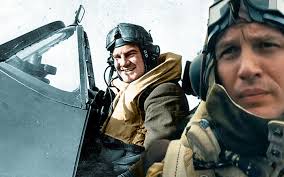 I spent a long time
trying to figure the fuel capacity and range of those Spitfires, and
at five miles per gallon, Tom Hardy would indeed have had plenty of
time to do most of what he does. However the laws of physics make a
couple of scenes dubious: the plane floating on the waves, when it's
engine would tip it forward and then down very quickly indeed, and
Hardy's amazing manoeuvres while in a powerless glide, where English
grit proves too much for gravity. Given his ability to move the plane
I wondered why he bothered to land away from the evacuation point,
and into the middle of the oncoming (somewhat late and without any
urgency) handful of Germans. Perhaps he was being a decoy. But if you
think of this section of the film within its own chronological order,
you see a story-line that is virtually unchanged from Air Force,
apart from the Germans strafing a downed pilot, and that makes one
wonder if the time-shifting is a sort of sleight of hand aimed at
distracting the audience from the familiar tropes the film actually
embraces, not denies.
I spent a long time
trying to figure the fuel capacity and range of those Spitfires, and
at five miles per gallon, Tom Hardy would indeed have had plenty of
time to do most of what he does. However the laws of physics make a
couple of scenes dubious: the plane floating on the waves, when it's
engine would tip it forward and then down very quickly indeed, and
Hardy's amazing manoeuvres while in a powerless glide, where English
grit proves too much for gravity. Given his ability to move the plane
I wondered why he bothered to land away from the evacuation point,
and into the middle of the oncoming (somewhat late and without any
urgency) handful of Germans. Perhaps he was being a decoy. But if you
think of this section of the film within its own chronological order,
you see a story-line that is virtually unchanged from Air Force,
apart from the Germans strafing a downed pilot, and that makes one
wonder if the time-shifting is a sort of sleight of hand aimed at
distracting the audience from the familiar tropes the film actually
embraces, not denies.
But most instructive
was the reaction of the British soldiers to the discovery one of them
is actually French, and thus unworthy of being saved. No matter that
the French are actually holding back the Germans while all this is
happening (though for reasons we still don't understand fully, the
Germans mostly held themselves back, including, crucially, in the
air). This was Brexit in a nutshell: we're getting out of here and we
are not taking any immigrants with us.
This was Brexit in a nutshell: we're getting out of here and we
are not taking any immigrants with us.
This was Brexit in a nutshell: we're getting out of here and we
are not taking any immigrants with us.
When everyone gets
back to Britain they discover the full scale of the success of the
evacuation (though somehow Kenneth Branagh knows the exact total
while he is still on his little beach) and it puts that small story
Nolan has shown us into some sort of context.
Writing before the
Oscars, I can't see Dunkirk winning, Chariots Of Fire-like,
in what would now be an upset. It is apparently the largest-grossing WWII movie, ever, but two-thirds of its takings were outside the US. However I happened to see it in America, and the audience, while not as partisan as a British one, was definitely impressed with the overall dignity and grit of the film's approach. If it were to win it might be because
it speaks to certain virtues in a time of chaos, and America shares
its own sort of chaos with Britain right now. But I guess that Oscar
voters will be split between those who see Dunkirk as an
innovation in war films and those who wonder if such a micro-focus
really does convey a macro picture after all. And there are other
films which get more specifically into our collective malaise, or get
away from it.


