 It seems to be military history week at Irresistible Targets! Operation Market Garden is another of those battles that seems to prompt endless discussion, and though my awareness of it began only with the film A Bridge Too Far, I've followed the debate in casual way for years. A Magnificent Disaster, David Bennett's 2008 study, seems to me the best-balanced account of the failure of the biggest airborne attack of all-time.
The problem with Arnhem is that it combines both our best and worst stereotypes of the British. It is an heroic failure, part of a long tradition that includes Dunkirk, most if not all of World War I, Balaclava and much more. The fact that the failure to reach and relieve Arnhem is counterpointed by the awesome bravery shown by the British First Airborne in holding the town far longer than would have seemed possible has made it easy for British analysts to direct the blame elsewhere: to the Americans, particularly the 82nd Airborne, for getting distracted by one part of their assignment and not completing others, or to the Poles, for an alleged unwillingness to fight. You might also make the argument the British were always willing to assign the greatest risks to others: the Canadians at Dieppe, or Anzacs at Gallipoli being prime examples still remembered in those countries.
The fact that Cornelius Ryan's book was made into a film allowed it to be criticised unjustifiably too, but I was persuaded by Bennett's account that the core of Ryan's analaysis is well-founded. Bennett details exactly where Arnhem went wrong; much of it was in the planning. The film highlights the reluctance of the British to change their plan when intelligence revealed concentrations of SS Panzer units in the area; Bennett shows that Montgomery's concept was based on the false assumption of minimal resistence, and that when the assumption was shown to be false, both Montgomery
 and Browning ignored the warning. The criticism of Monty by American generals was that he was a glory-seeker who wanted battle only under the most advantageous terms: for example you could argue the British beaches at D-Day were not only the easiest in terms of topography and defenses, but also those closest to Germany, making it easier for Monty to be the first into enemy soil. That was the point of the Arnhem operation as well; Monty wanted British troops to steam up the highway and cross the Arnhem bridge first into Germany, after the Yanks had captured all the other bridges along the way. His American counterparts resented the fact that, despite their own needs, materiel was constantly diverted to Monty who complained nonetheless about not having enough. In American eyes, in short, he is another Gen. McClellan (see previous post, on Antietam).
Gen. James Gavin was even more unstinting in his criticism of Browning: 'Why the British units fumble along... becomes more and more apparent. Their tops lack the know-how, never do they get down into the dirt and learn the hard way.'
 British historians would argue that they had seen combat in the Great War, but despite their evident heroism there, this was a different kind of war. This coincides with the argument that, having watched the wholesale slaughter in the trenches, Monty never wanted to waste lives recklessly again, which I can respect.
Those who've seen the film will know Gavin, commander of the 82nd, was amazed by his assignment, since it was work for two divisions, not one. Still, he completed it, though his delays are generally cited by British historians as the key reason the plan failed. Of course not receiving tactical support they required to take their last bridge (remember the famous crossing of the river in rubber boats) played a huge part, as did not dropping units close enough to the targets. The 101st executed its plans more efficiently, but the delays in the British infantry and armour in advancing and meeting up with them played a far bigger part in the failures at the second level and beyond, initiating a deadly knock-on effect.

Bennett is excellent is in showing the ways that, given a plan overly ambitious and requiring for its success that it meet little German resistence, the British airborne drops were the inverse of airborne strategy: rather than dropping into the combat zone and defending, the divisions were dropped outside the zones, and had to fight their way in, and, in the case of the 82nd also secure other drop zones outside their targets. That British communications didn't work was part of the 'it'll be alright on the night' mentality which reinforces the 'lions led by donkeys' mantra of the Great War.
But Bennett also gives far more attention than most commentators have previously to the Garden part of Market Garden, the advance by the ground troops of the British 12th, 30th, and 8th Corps. He points out the remarkable consistency in the soldiers actually fighting well, but their inability to advance with urgency. 'It is not that Horrocks failed to impart a sense of urgency;' he writes, 'he never even tried.' The 18 hour delay at Nijmegen was the most crucial of these moments, and has never been explained satisfactorially. One last positive which Bennett, a Canadian, brings to the tale is to highlight the extraordinary efforts of the Canadian engineers which allowed the evacuation of the British survivors at Arnhem, a truly outstanding accomplishment, and far less than those brave soliders deserved.
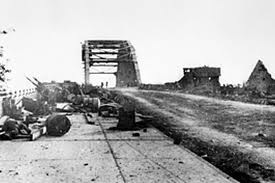 Their days fought holding position in Arnhem remains a remarkable accomplishment, and Frost's refusal to surrender to the Germans, while lacking a quote as pithy as McAuliffe's 'nuts', was every bit as inspiring.
Oddly, Bennett, while praising the film of A Bridge Too Far, thinks it loses much of the drama because it cannot convey the shape of the battle, and in a sense he is right. But what the film does do well is give a sense of the time-line, and though Bennett is excellent with each battle, it is difficult to follow every sector through a progression of days, sometimes seemingly at random. But if you have a general understanding of the operation, and want to understand more of the specifics, and do so in a balanced way, Bennett is your man. He points out too that the fallout from Market Garden was interesting. American airborne divisions wound up fighting primarily as infantry for the rest of the war; Monty seems to have scared the high command off airborne operations entirely. Of course that put the 101st at Bastogne during the Battle of the Bulge. Anthony McAuliffe, as mentioned above, was the American hero of Bastogne, and Bennett wasn't particularly complimentary about the 101st's commander, Maxwell Taylor. As it happens Taylor was spending Christmas with his family while McAuliffe held Bastogne. Bennett, like Gavin, likes leaders who lead from the front. Nothing wrong with that.
A Magnificent Disaster by David Bennett
Casemate, £19.99 ISBN 9781932033854


