Showing posts with label Gnat Coombs. Show all posts

Saturday, 6 July 2019

THE HEFTY LEFTY: JARED LORENZON

I was saddened to hear of the death of Jared Lorenzon, 'The Hefty Lefty', former Kentucky and New York Giants quarterback, aged only 38. His nickname suited him well: he was oversized for a QB, never in great shape, and threw with his left-hand. He was a pretty good player, though, and in a way it's sad his legacy will be built around his weight.

You know players by their nicknames; legendary players often attract more than one. Ted Williams was 'The Kid', “The Splendid Splinter” and “Teddy Ballgame”. George Ruth was 'Babe', “The Bambino” and “The Sultan Of Swat”. Now these are not always real 'nicknames', in the sense that they were coined by sportswriters and hung round the necks of the players: I doubt any of Ted's teammates ever called him “Splinter”. In fact, 'Joltin' Joe DiMaggio, 'The Yankee Clipper', was called 'Dago' by his friends. But the most fitting of those names usually stick. And they are usually, but not always, affectionate.

The Babe was never called 'Beer Belly Babe', not even in an era of derogatory nicknames in baseball, which boasted guys like Fatty Fitzsimmons, Leo the Lip, Tomato Face Cullop, Schnozz Lombardi, Losing Pitcher Mulcahy, Ducky Wucky Medwick, KiKi Cuyler (he was a stutterer) and Grandma Murphy.

Lorenzon, who was listed at 6-4 280 pounds with the Giants, didn't mind The Hefty Lefty. It had a certain ring to it, and wasn't insulting. The sportswriters came up with The Pillsbury Throwboy, which is clever, but trying to hard (for my non-American readers, Pillsbury were America's biggest millers—you can see their huge facility on the Mississippi when you're in the Twin Cities—and their mascot was a pugdy character made of dough, a sort of American version of the Michelin Man, called the Pillsbury Doughboy). The media also tried The Abominable Throwman, The Round Mound Of Touchdown, Mobile Agile Hostile & Hungry, and the other one I thought worked, though it's an inside joke “He Ate Me”.

It was a bit much, especially since Lorenzon was a pretty good player. I saw him when Gnat Coombs and I went to Giants pre-season camp for Channel 5 in 2007, before they appeared at Wembley and won Lorenzon a Super Bowl ring. I had experienced a similar feeling before: when I stayed around UCF in Orlando after a Claymores/Rhine Fire scrimmage, to watch their team practice. 'Who's that D lineman throwing the ball?' I asked. “That's our QB, Daunte Culpepper”. Lorenzon was even bigger, though not in as good shape. He was a bit like Byron Leftwich as well. But where Culpepper had a pretty tight delivery, and Leftwich a very long one, Lorenzon's was anything but consistent. Partly this was because as he put on weight, he threw less with his lower body and partly because he was remarkably athletic (he'd been an excellent high school basketball player, a good baseball player, and Mr Football in Kentucky his senior year) and wound up throwing on the run a lot (the fact Kentucky was usually overmatched against D lines in the SEC didn't help). He spent four years with the Giants, and Eli Manning credited his help, as a pass rusher in practice, in developing his escapability, which served him well on the famous helmet catch by David Tyree.

I liked the fact that Lorenzon wore number 22 in college and high school; more quarterbacks should follow in the footsteps of Bobby Layne, John Hadl and Doug Flutie. He played his first year at Kentucky for Hal Mumme, who developed the 'air raid' offense, but I don't think he was a perfect fit for that. Though if you remember Shane Boyd from NFL Europe, Lorenzon played ahead of him.

After the Super Bowl year the Giants cut him. He was cut by the Colts in 2008 and saw his team, the Kentucky Horsemen, in Arena League 2 fold in 2009. He retired and started coaching at his old high school. But in 2011 he came out of retirement as the General Manager of the Northern Kentucky River Monsters of the Ultimate Indoor League. He soon went back to playing, and was named the league's MVP. He became the first player I know of to go from MVP of a league to being its commissioner, but again he left the desk, and in 2013 played for the Owensboro Rage of the Continental Indoor League until the team ran out of money and folded before the end of the season. Look at these leagues and teams this way: If Justified had a football league....

In 2014 he went back to the River Monsters, who were now also playing in the Continental League. You have to imagine him, probably pushing 350, in the kind of tacky gaudy unis those teams wore, scrambling like the Lorenzon of old as they won they first game, against the Bluegrass Warhorses. His play became a brief sensation (is there any other kind?) on the internet. The next week, he was scrambling again, versus the Erie Explosion, and when he was tackled he broke his leg.

In retrospect, that was the worst thing that could have happened. Not only was his football career, such as it was, ended forever, so to was his mobility and exercise, and his weight ballooned quickly. He did some local radio, he sold 'Throwboy' Tee-shirts, he made you-tube videos about his efforts to lose weight, which went over 500 pounds at its peak. ESPN made a short film about his efforts to lose weight, and he was down to around 400 at one point.

He died from kidney and heart problems, exacerbated by an infection, which may have been down to kidney failure. Obviously his size put great strain on his body. It's so easy to suggest other scenarios by which he might have been more successful early, been put under the care of dieticians, even had a fuller NFL career. Go back and look at his college tape and think about how he might have played in an environment where he wasnt under constant pressure, or if Mumme had stayed four years with him (he had three head coaches in four seasons). Watch some of the later videos: he's a personable, sincere kid, even into his late 30s, never acting like someone whose body is being pushed to its core.

But Lorenzon will always be the Hefty Lefty, and for a short time, that was a hell of a thing to be.

Wednesday, 9 May 2018

THE BEST TIGHT ENDS: JASON WITTEN, ANTONIO GATES & MY GRIDIRON TOP TEN

Last night on Talksport2's Nat Coombs Show starring Gnat Coombs we were talking about Jason Witten's retirement and the Chargers' release of Antonio Gates, and I mentioned the following article which I wrote last August as a Carlson's GOAT (greatest of all time) column for issue 31 of Gridiron (and if you haven't yet subscribed to Gridiron, why not?).

I have left the article as it was written (with one change in the second 11), though of course now Witten is no longer active and he has 11 Pro Bowls to his name, while Gronk is still active (after much soap opera drama by the 'hot takes' bunch) and now has four first-team All Pro selections and five Pro Bowls to his credit, tied with Ditka and more than Mackey or Winslow. Dallas certainly was expecting Witten to return as a full-time player, while although I fully expect a team, probably a very good team, to pick up Gates, he will certainly be much more of a situational player.

Were I writing the piece now, after the 2017 season, I would probably move Witten at least into a tie with Gates at number nine. I realised that the arguments I made in favour of Tony Gonzalez at number one apply similarly to Witten--his longevity at high quality is so unusual for the position it argues in his favour. In fact, although I'm pretty well set on the top five, the next five or six are very much fungible in my mind: the higher peaks for more limited time are balanced off by extended quality. I noted too that when Witten caught his record 110 passes in a season, he was not the consensus All-Pro (that was Gronk), and averaged only 9.4 yards per catch. My feeling is that the top five guys, at their peaks, all had to be accounted for by defenses in ways that separated them from the pack. 


THE TOP TEN TIGHT ENDS


Tight end wasn't even recognised as a position until the Sixties; in 1961 the UPI and NEA all-pro teams chose their first TE (rookie Mike Ditka); the AP followed suit in '62 (Ron Kramer). The growing use of halfbacks as flankers (eg: Lennie Moore, Frank Gifford) meant one end stayed in the line; Vince Lombardi made Kramer, a 250 pound sometimes tackle, that guy on a permanent basis. The position called for a balance of blocking and pass-catching skills; in those early years athletic guys like Ditka, John Mackey, or Jackie Smith gained lots of yards on mis-matches. One beneficiary of the change was Pete Retzlaff, who came into the league as a halfback, became a flanker, then a split end, finally, as he slowed a little, moved in as a tight end. In four seasons, he was all-pro once, could have been twice, and went to the Pro Bowl three times. Rule changes that opened up the passing game in late 70s saw the explosion of Kellen Winslow, Ozzie Newsome and others, until Shannon Sharpe became a prototype for the receiver-first guys we see today.

Ranking tight ends was difficult. Blocking is a skill that is not quantified, where reputation often matters as much as success. Many times the TE with the best stats used to lose out with all-pro voters to someone who was perceived as a better blocker. Some great TE seasons were undervalued by all-pro voters because they came on lousy teams, as if the idea of your TE being your top receiver was a joke (see Bob Tucker 1972). I've tried to balance receiving and blocking, and factor in longevity. One thing that stands out is the demand of the position works against a lot of great seasons, but great tight ends often have long careers filled with seasons less than their peak. There are a number of great TEs whose best seasons always seemed to come when someone else was having a better one (Ozzie Newsome). Finally, I've listed the number of first team all-pro selections and Pro Bowls for each guy. Take them with a grain of salt. There were multiple all-pro teams for most of the history of the NFL; they didn't always agree, and although the AP team is the generally accepted one today, there are a couple of others. The Pro Bowl picks two tight ends from each conference, but is also less reliable every year as the event itself becomes an increasingly irrelevant circus. Note Tony Gonzalez' 14th Pro Bowl came as an alternate! So here's my pick of the position:

Runners-up: 21. Russ Francis (0/3) or Steve Jordan (0/6) 19 (tie) Jerry Smith (1/2) or Jay Novacek (1/4) 18. Bob Trumpy (1/4) 17. Mark Bavaro (2/2) 16. Ben Coates (2/5) 15. Fred Arbanas (3/5 AFL) 14. Keith Jackson (3/5) 13. Pete Retzlaff (1/3) 12. Todd Christensen (2/5) 11. Ozzie Newsome (1/3)

The countdown (active players in bold):
10. (tie) Charlie Sanders (3/7), Jason Witten (2/10): longevity at this position is unusual; most of the greats tend to have five Pro Bowls in their resumes. I thought Sanders' might have been lucky to be chosen in all three of the all-pro seasons, but there was a reason voters respected him, which was partly his blocking. Whitten became the record holder for most catches in a season for a TE with 103 in 2012.

9. Antonio Gates (3/8): Undrafted out of Kent State where he was a basketball player, Gates is the poster-boy for the match-up style pass game of the modern era. Became a decent blocker, and even now with his speed gone can post-up defenders in the end zone as well as anyone in the league.

8. Jackie Smith (0/5): Smith could easily have been first team all pro three times, especially in '68 and '69 (when he also rushed 12 times for 193 yards and 3 TDs). But he was viewed as more of a pass-catcher, and the Cardinals as pass-happy, in a still run-orented era. Forget his famous drop for Dallas; he never should have been playing for the Cowboys anyway.

7. Shannon Sharpe (4/8): The same skill set as Smith, but played in a system and era that encouraged those skills. A willing if not terribly effective blocker, not as good as Smith, but a huge mis-match problem for defenses.

6. Dave Casper (4/5): From '76 through '79 the best in the business, then joined on the Raiders by Ray Chester and Christensen. Ghost to the Post remains as good as Alley-Oop in the list of plays named for specific players.

5. Rob Gronkowski (3/4): Injury is all that is keeping Gronk from consideration for the top spot; he may be the best combination of blocker and receiver of anyone on the list, capable of handling defensive ends one on one, of beating defensive backs downfield, and with reach and hands up there with Gates or Gonzo.

4. John Mackey (3/5): Mackey was the TE on the NFL all-decade team of the 60s; then Mike Ditka replaced him when the NFL chose the 75th anniversary squad. At the time I made the case for Mackey, but looking closely at the all pro selections, I realised in 67 his selection could easily have gone to Jackie Smith or Jerry Smith; in 68 it should have gone to Jackie. He was a ferocious blocker with great speed and running ability; injuries curtailed his career.

3. Mike Ditka (4/5): If you want to call him and Mackey a tie I'd be happy. Ditka's rookie season, 1961, saw him catch an unheard of 56 passes for 1076 yards and 12 touchdowns. He lost the AP all-pro to Kramer in 62 but got UPI's and was clearly better. He wore down as well, but hung on as a blocker with Dallas. Like Mackey, absolutely ferocious after the catch, and teams didn't have what we now call strong safeties in those first years.

2. Kellen Winslow (3/5): Gronk before there was Gronk, though he wasn't the in-line blocker Gronk is. 1980 was his second season, but first as starter and like Ditka in '61 his line 89/1,290/9 revolutionized the game, recognizing the changes in coverage rules made him a match-up nightmare. He had another 1,000 yard season in '82 as did Newsome (1,002) and Joe Senser (1,004), while Dan Ross racked up 910. Winslow simply wore down after nine seasons, but his epic performance against Miami in the 1981 playoffs, catching 13/166 and blocking a field goal to prevent the Dolphins winning, is one of the greatest individual games ever.

THE TOP TIGHT END: TONY GONZALEZ

When you compare players, you have to judge peak performance and career performance. You might make an argument for Winslow, or maybe Ditka, or even Casper at their peaks, but nobody did it so well for so many seasons as Gonzo. You can judge tight ends by the receiving skills, their running skill, their blocking. You'll see Gonzalez referred to as another basketball player converted to tight end, but that's wrong. He was a football player too. As a high schooler he shared the Orange County athlete of the year award with some golfer named Tiger Woods, and for three years at Cal-Berkeley he played football first and then switched to basketball. He was an All-American tight end as a junior, when he came out for the NFL draft; 6-6 power forwards averaging 7 points per game weren't high on the NBA's want list anyway. It took the Chiefs three seasons before they focused on Gonzalez' skills: in his fourth season he registered the first of his four 1,000 yard seasons; Christensen, Winslow and Sharpe had three each.

But what stands out about Gonzalez' career is that longevity. 17 seasons. No major injuries at a position where the wear and tear of blocking, combined with the catching over the middle, invites pain. The consistency of 14 Pro Bowls. The success of moving to Atlanta, where he was unlucky enough to enjoy only one complete season of Julio Jones distracting defenses away from him. Detractors will point to his only adequate blocking, to a perceived lack of breakaway speed; he's more like Gates than Gronk in that sense. They'll point to a lack of a Super Bowl ring, but frankly, that's not a reflection of his play. It's almost impossible to conceive of another career like Gonzalez's. You may prefer a different guy if you're choosing for just one game, but over a career, there's no doubt who ranks number one.

Tuesday, 26 September 2017

THREE THOUGHTS ON THE NEW SEASON: MY LOST NFL PROGRAMME PIECE

As many of you know, I work on the NFLlive every Sunday night and the NFL show Tuesday nights, both for Talksport radio. The host is Nat Coombs, who has also been my partner on Channel 5, Channel 4, the BBC and of course in the Americarnage podcast. Last week, before the kneeling story broke, the NFL office in London asked us to offer some thoughts on the 2017 season, to appear in the programme for this Sunday's Wembley game between the Dolphins and the the Saints.

I wrote my three and passed them over to Gnat, who added his and sent them along. A few days later, the editorial director informed him that the essay wouldn't appear in the programme after all; there would be just a short piece about our shows on Talksport.

My part of the piece was concerned mostly with the macro-level of the game; I was looking for what I thought might be longer term trends recognizable this season. So I thought I'd post my part of the story here, while it still has some relevance. You can check for yourself to see whether the points make sense, and more importantly whether they actually do establish themselves as trends.

IRON MIKE'S THREE THOUGHTS ON THE 2017 SEASON (after two weeks!)


1. THE QUARTERBACK SHORTAGE

It's actually a more complicated issue, because it's really more of an offensive shortage. A lack of quality QBs is exacerbated by a lack of road-ready offensive linemen, running backs who can't pass block, and receivers who burst on the scene because they can win one-on-one match-ups, but can't necessarily read defenses or run the complete route-tree, though as the NFL does move toward a more basketball-like one on one downfield game, more rookie receivers can make an impact. And linemen playing in some pass-happy systems have trouble adjusting to the complexities of NFL line play; often they've played almost no time in a three point stance.

This is down to the growing gap between concepts in college football and the NFL. Although the pros have adapted some of college's recent offensive innovations, spreading the field to find one-on-one matchups, the NFL is too balanced, and teams too talented, to go lock stock and barrel to the various spread systems eliminating from college, just as the NFL never went wishbone when that was all the rage in college 40 years ago. But what is happening is college offenses are featuring offenses whose quarterbacks don't learn the complex reads and don't need arms as powerful and more importantly accurate as the NFL demands. There is a need for quality quarterbacks; there are not 32 quality starters, and there are precious few quality back ups. Yet Colin Kaepernick remains unemployed.

2. A NEW SORT OF PARITY

Given item one above, the concept of parity seems to be changing. Teams who can build long-term, develop players while they are on the roster and fill their rosters with role-players who fit their system have a huge advantage. What do the Steelers, Ravens, Seahawks, Packers and Patriots, to name the most obvious year-in and year-out contenders have in common? Relative stability in the front office and coaching front. You need to understand your system, coach your system, and play the salary cap game well, but it gives you a huge advantage. You also need to have the security to make some mistakes.

The other huge advantage, of which Seattle and Dallas currently can take advantage, is being able to get a rookie quarterback who can deliver play worth $20 million per year on a rookie salary cap budget. Paradoxically, this works against the idea of parity, because it makes the concept of bringing a QB along within the system more wasteful of financial resources with each year your rookie QB doesn't start. So the impetus is to throw your rookie, who may give you a better chance of winning anyway when your starter is a journeyman, into the breach before he's been coached into readiness, and risk, on a bad team, his developing David Carr syndrome, bad habits if not gun shyness after taking beating after beating.


3. VIDEO GAME FOOTBALL

Between Madden, Fantasy Football, and Red Zone, the NFL in the digital age offers a much wider set of entertainment options than just the game at the stadium or on television. But it has, to some extent, changed the sense of what the audience expects from its football. Watching the amazing 49ers-Rams shootout on week three's Thursday Night, a combination of the usual Thursday short-week sloppiness and tiredness, combined with some remarkable throwing from the two unheralded passers, and bullish running from both teams, I thought immediately how this was the best advertisement, in a way, for the 2017 season, and an answer to the many critics who were already trying to write the year off after the first two weeks. Yes, in their colour rush jerseys, the Rams looked like animated bananas, and at times the game looked like Arena ball, so in one sense it was like a Madden game played out in full. But it offered sceptics everything the NFL promises in a game, not just on Red Zone, on any given Sunday. Or Monday. Or Thursday.

Thursday, 27 July 2017

IRON MIKE: THE EARLY YEARS

Nat Coombs had been saying how he wanted to spend some time on his show talking about how I got into the business of sports broadcasting, and I was going to be in the studio this week to try. But thanks to Southwest Trains, I didn't dare try the trip into London to do The Gnat Coombs Show Starring Gnat Coombs on Talksport 2. But thanks to the miracle of modern communications, I called into the show for the second hour. Gnat wanted to talk about how I got into the business, which meant my going through some of my antics as sports editor of UPITN and director of programming in Europe for ABC Sports, and VP Europe for Major League Baseball, and then my first years on camera or microphone for Screensport and Sky.

You can find the programme here, I'm on 53 minutes in if you're listening after the newsier parts of the show are a little dated. I'll be in the studio with Gnat next Tuesday, August 1st, and we'll probably discuss the reaction and I will tell the story of the Transatlantic Wrestling Challenge, and my work as a heel announcer....

Tuesday, 7 June 2016

BRUCE SPRINGSTEEN AT WEMBLEY: BORN TO RUN

Sunday night I went to see The Boss at Wembley. It was about as nice a night as London allows, beautiful weather, easy access, and with 80 some odd thousand like-minded people (actually, many far more single-mindedly Bossy than I was) it was an excellent time. It helped I was with three of the Americarnage Gang of Four, Gnat Coombs and Hollywood Dan Louw (literally just in from the Stockholm marathon and proudly exposing his blisters to the crowd) and muchas gracias Senor Gnat for the tickets.

It was the third time I've seen Springsteen. The first was still the best, at Tanglewood in the Berkshires in August 1975, just before Born To Run broke, just before I moved to Montreal, and just before Annie's and my brief romance was over. I wrote about it last year (you can find that here) when I dug out an old poem to mark the 40th anniversary of Born To Run. It was the best not just because I thought I was madly in love, and we'd gone spur of the moment, and it was outdoors in the mountains; there was an intimacy among the 1,200 or so people there, who shared a knowledge of something great that most of the country didn't really know about. It's still special, and The Wild The Innocent and the E Street Shuffle may still be my favourite Springsteen album.

The second time I saw him was at Wembley in 1985, on July 3rd. I flew to America on the Fourth of July that year, and I suspect the Fourth would have been a bigger thing and better show, but it was still pretty good. Again, I felt it was far more intimate than a stadium show had the right to be, even though my company was nowhere near as compelling as Annie and Bryan, and the seats, high and to the side, meant you couldn't really see the stage, saw only one and a half screens, and heard everything echoing back as if on tape delay. I pretty much resolved then not to go to any more stadium shows, and for 30 years I didn't.

But this one was much better than 1985. The technology is, I suppose, better, and once you got used to the sound it was fine. We were on the field; lined up on our own 10 yard line with the stage in the opposite end zone, meaning you could see the little figures on stage, but you needed the three screens, like watching a TV in a showroom window from across the street.

What's different is the Boss, at 67, is more frenetic, and in better pumped-up shape (& perhaps a little bit scapel'd), than 30 years ago, and the band is, if anything tighter and more versatile. It's great to have Soozie Tyrell fiddling, though every time she got a closeup I thought of Beverly Sills! Violin has always added a lot of texture to the band; I recall Suki Lahav from the 1975 WMMR/Main Point concert which is one of my all-time favourite records, bootleg and all. And it was funny to see Nils and Steve each going for second place in a Keith Richards look alike contest! And I kept watching Max Weinberg, looking at lyrics on a IPad teleprompter as he pounds the skins, and thinking he doesn't need amplification. Interestingly, I read an interviw with Suki Lahav, who returned to Israel soon after leaving the band, and she said Max didn't like being behind Bruce while drumming, in the drummer's usual position, because he couldn't see/hear the words of the song, and he wanted to see what Bruce was singing because the words influenced the way he drums. So that was a problem  solved by technology.

They sounded great, they interacted with the audience with a spontaneous quality, and they played through a huge catalogue of songs, all of which have a Springsteen similarity but which cover a lot of different textures. And changing contexts: 'Tougher Than The Rest' was played as a tribute to Muhammad Ali, and you can't do much better than that, great one to greatest.

Which is the interesting thing, because this crowd was not just people like me out to see a figure from their past. It was not like watching Duran Duran because you loved them when you were a teen and now you're old and they're old and you're both going through the paces. This crowd was made up of people from their teens to, I dunno, older than me, and they all had their favourites from different eras, and many of them could not have come to the Boss long before the previous decade. When I was 20, there weren't many recording stars from 40 years before we were listening to--people who were hot in 1931. But it's different, and has been since the Sixties, maybe even since the Fifties. Again, technology is part of that, but there is a sort of Golden Age of rock which seems to attract and open new ears in every new generation.

As well as turn the original old generation into kids again. Check out the S.E.G. on Iron Mike in the photo on the right.  Do I look Born In The USA or what?

Of course, we have aged. I started to leave after the first encore ('Jungleland') because I had to get a train home, and it was Sunday in Britain, and the last train leaves earlier, and there was a replacement bus service one of whose drivers had nearly taken his bus into a low railway bridge was I was coming back from the BBC that morning. So I played safe and managed to get home before midnight and walk the dog. But the sax solo in 'Jungleland' started to take me back, maybe because I was out of the crowd, and there is a sense where I find the collective experience overkill, and Jake Clemons wasn't playing his uncle's stuff note for note, but the sense of continuity being the thing that mitigates against time passing struck me strongly.

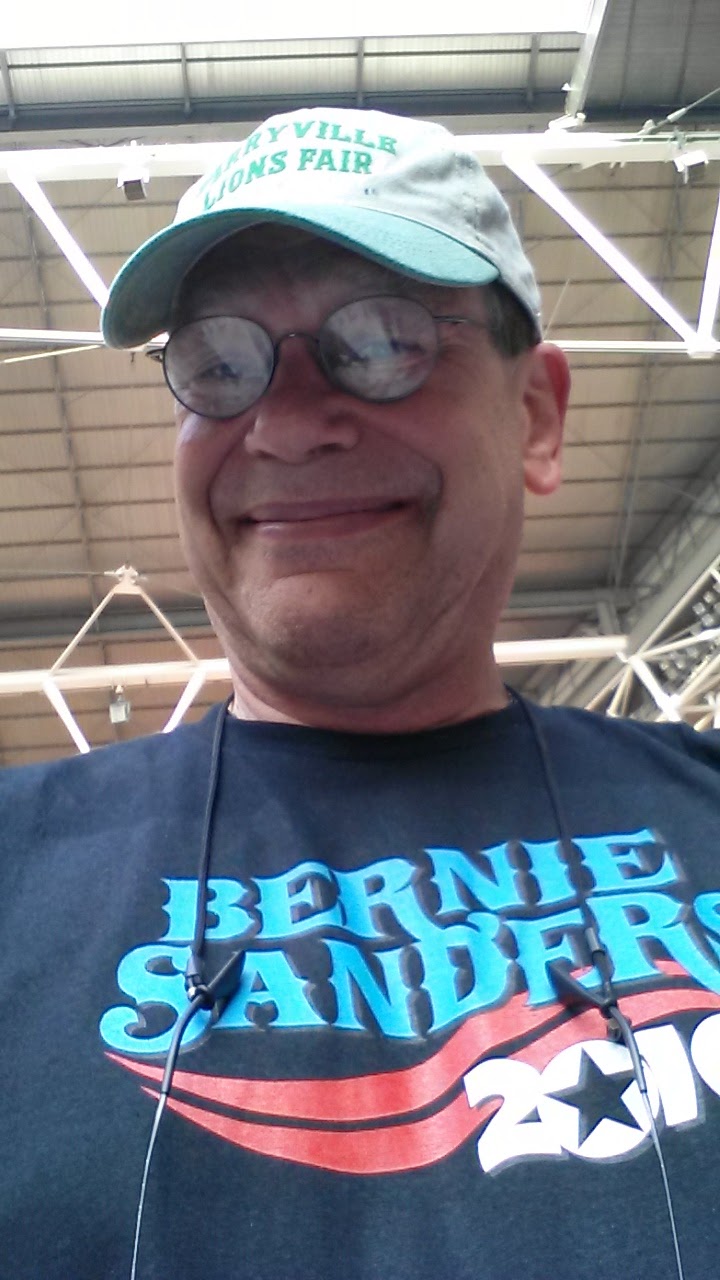
Then people started coming up to me and shaking my hand, or congratulating me, and I thought they might be NFL fans, but they were saying things like 'Feel The Bern' and I realised it was because of my  T-shirt (not my Terryville, Connecticut Lions Fair hat). Thanks folks.

I walked alongside the stadium as they played 'Born To Run', and again the sax solo launched me into reverie, and I stopped and listened. I went back 40 years and 2,600 miles and one old love and one best friend and I don't know how many scratched LPs and awkward record players and Lord knows what else. They started playing Dancing In The Dark and I walked away listening to that, which pushed me back to the 80s again. I missed some more encores, including Tenth Avenue Freeze Out, which I would have pleased Gnat by singing along to. When the changes came uptown, indeed.