Showing posts with label James Bond. Show all posts

Monday, 29 May 2017

ROGER MOORE, MONACO GRAND PRIX, THE SAINT, AND ME

Like many of my generation in America, my first exposure to Roger Moore came in the TV series Ivanhoe. This was shortly after Richard Greene had played Robin Hood on the small screen, and I'm sure it was an attempt to echo the success of that show. The two actors had much in common, particularly their spectacular good looks, and, absent Moore's later bonanza from Bond, their careers were similar in lots of ways, with action movies their main staple.

But it was when Moore appeared as the Saint that I was hooked. It was the first of a group of British shows that eventually made it over to the US, followed by Danger Man, The Avengers, The Prisoner; all of which seemed more inventive, stylish, and smarter than most of our own fare. Looking back at old episodes now, I can see the bare-bones nature of most of it, the crazy accents of English actors, and the formulaic nature, but imagine my thrill when I moved to London, and walking from our flat to Regent's Park walked by the block of flats where Templar's Volvo sports car would pull up when he came home.

Moore was excellent as the Saint, a role that has defeated most of the actors who've tried it (Louis Hayward and George Sanders really being the only exception. Moore's Simon Templar is pitched close to his James Bond, with a certain irony, and less tongue in cheek: there is also the occasional sense of a ruthless presence which Sean Connery brought to Bond, but Moore ditched for that role.

Before Bond, there's one Moore role of which I have only a vague recollection, except that it wasn't very good. He played in a TV movie called Sherlock Holmes in New York, with Patrick Mcnee as Watson, John Huston as Moriarty, and Charlotte Rampling as Irene Adler. You can see why I would have watched. I looked it up and the supporting cast included Gig Young (another I've seen mentioned as a proto-Bond), Leon Ames, Jackie Coogan and David Huddlestone. There is also Moore's son Geoffrey, billed as Scott Adler, which must have been his playing Irene Adler's son, by Holmes, but sadly I can't remember that either. Roger Moore certainly wasn't designed to be Sherlock Holmes.

The Saint to me was his defining role, but of course it was Bond who came to define him. I recall Moore's reply when asked if it was true Ian Fleming wanted him as Bond from the start (which was highly unlikely, as Dr No. predates The Saint). 'Fleming didn't know me from shit,' he laughed. 'He wanted Cary Grant or David Niven.' That was Fleming's image of Bond, although Connery actually captured more of the actual character Fleming wrote: especially the cruelty and the sado-masochism  behind the stories. Connery remains unquestionably the best Bond.

But Moore marked a turning point for the role, which was to take it totally tongue in cheek. Right down to his name, with its built-in double-entendre. Where Connery's Bond had been holding his own against the somewhat bumbling Yanks (Felix Leiter & Co), Moore's Bond was a celebration of Brittania well before Cameron and UKIP appropriated it. It made life impossible for those actors who followed, and, like Piers Brosnan, tried to walk the character back toward Connery. They surrendered, and in Daniel Craig created a new Bond, pure Little-Englander, a Nick Hornby character with muscles, playing Texas Hold Em, not Chemin der fer. Moore's grace and sense of irony was lost completely.

I encountered this once, when I met him while working for ABC Sports at the Monaco Grand Prix. This may have been the same year I met Joan Collins, but I don't think so. That's another story, anyway. My function was to sort out problems, of which there were many, with the organisers, so on the Saturday I was in the pits as we got ready to film Jackie Stewart's tour of the course: driving round it with a camera and sound man in the back seat. Why we did this every year was beyond me, since the course never changed, but every producer thought he would bring his own personal touch to it, or maybe get something new from Jackie, who was both a lovely guy and a consummate pro who had probably done it to death the very first time, but always added something about different cars or drivers or weather to try to make it new.

We were just about ready to go when Jackie spotted Roger Moore across the pit area, going into one of the hospitality areas. I know Roger, he told me, he'll do this with me. Can you go get him to do it?'. This was the best idea anyone on the show had had all week, so I went off to the tent, introduced myself to Mr. Moore, and explained. Of course, I'd love to, he said, and we walked back to the car. I may have mentioned The Saint and how much I'd liked it. More than once. Roger and Jackie were old friends, maybe from living in Switzerland (note, the photo above right is one I believe was taken years later). They greeted each other, Jackie explained again, and Roger said of of course again. Then, looking at me and giving just the sort of raised eyebrow I remembered from The Saint, he went straight over to the driver's seat and got in. Jackie got flustered, nearly apoplectic, as he tried to explain he was doing the driving, not Roger, that's what he was here for, he was the driver, and so on. There was a lot of snickering going on which didn't burst into full laughter until Moore got out of the front seat laughing away himself. I just wish we'd been taping it.

Every obituary I saw remarked how much he enjoyed life and with how little seriousness he took himself and his career. It could not have been made more clear in that one sunny Saturday in Monaco.


Monday, 11 August 2014

JAMES BOND REPRISED, MATT HELM REISSUED


No one has ever been asked to continue the Matt Helm series, which seems a shame because at the time, Donald Hamilton's Gold Medal originals were considered by teenaged connoisseurs like myself to be far superior to James Bond. Helm was earthy, and his enemies tended to be more realistic, heavy on the Cold War and criminals and lighter on mad millionaires or scientists bent on world domination. Helm also seemed to have a more down-to-earth attitude toward violence, and killing. There was no '00' designation in whatever service employed him.

Bond, on the other hand, seemed more fantastical, and it appeared to be that quality which sold them to the general public (that and the endorsement of President Kennedy. JFK's reading Bond seemed much hipper than Ike's fondness for Zane Grey). The early Bond movies, if anything, seemed better than the books, catching a tongue in cheek flair without Fleming's embarrassment, whereas Dean Martin's Matt Helm movies ignored the grittiness of the Helm novels and were a reduction ad absurdam of Bond.

So I was intrigued when William Boyd's Solo arrived at the same time as one of Titan Books' new editions of Matt Helm, another chance to match the two super-spies against each other.

Literary writers have been recapitulating Bond ever since Kingsley Amis in 1968 (Amis had also published a study/defense of Bond three years earlier). There's been a real difficulty for them, especially in terms of continuity—do you go back to the Fleming Bond, or do you proceed with the Bond of the movies—who tongue has moved progressively deeper and deeper into the cheek with each new actor, and whose current Bond, as played by Daniel Craig, is Vinnie Jones in a dinner jacket, playing Texas Hold Em instead of chemin de fer, probably drinking his Irn Bru from the can, slightly shaken if not stirred—or do you come somewhere in between?After all, even Fleming modified his Bond to reflect the movies, giving him a Scottish backstory midway through the series.

Boyd has avoided all that by going back to basic Bond, but putting him into a William Boyd novel of colonial Africa. The book is set in the late Sixties, and the conflict into which Bond is inserted resembles the Biafran War, with Britain keen to protect its access to oil regardless of which side wins. As you might gather from that synopsis, there's a touch of moral questioning here, as if Bond weren't convinced enough of Britania's rightness to jump out of a plane with a Union Jack parachute, much less the Queen. At the same time, there are the requisite Bond touches of exotic savoir faire, particularly as the local station chief is a beautiful black woman named Efua Blessing Ogilvy-Grant and the main villain is a disfigured Rhodesian mercenary named Korbus Breed.

There's also a dastardly millionaire behind the scenes, a far-fetched drug smuggling sub-plot, and enough betrayal to make you feel right at home, because when the story gets back to simple revenge we get Bond at his best. It's the element of sado-masochism in Bond that explains a lot of their popularity, especially in the early days, and although Boyd obviously knows Africa well, it seems we're on firming footing when it's Bond on a more personal mission.

There's some sadism in Matt Helm too, since torture is part of the game, and more than a little betrayal, as Helm appears to be sleeping with the enemy as much to enjoy the risks as anything else. I didn't remember The Devastators, originally published in 1965, at all, and that may be because it isn't one of the better Helms. It's set in Britain, first in London and then in remote Scotland, and perhaps I'm more critical because I know the country better now than I did then.

It's strongest in its first-person narration; part of the added realism of the series was listening to Helm explain, without necessarily having to rationalise, what he's doing. It also seems a bit prissy in its sex, whereas Fleming, perhaps because he was writing a sort of fantasy, rarely seems that way...though he keeps the tongue in cheek rather than in other places. The one line I remember from Hamilton was the one that seemed to come whenever Helm kissed a new woman: 'she knew where the noses went'. I never quite figured that one out, but mercifully it doesn't actually appear in this one.

If I had to guess, I would think Hamilton was trying to nudge Bond in this novel, and signals that by setting it in Scotland, where there's a mad scientist type threat to civilisation as we know it with bubonic plague, no less. It's not fully successful, the book I mean, obviously not the plague, and if you're interested in dipping into the Helms I'd suggest you start with the first one Death Of A Citizen. But maybe we just can't go back to where we were in the Sixties, when we were the good guys, and sex was still something exotic in our reading. William Boyd gives it a try, but perhaps he can't get back there either.

Solo: A James Bond novel by William Boyd
Vintage Books, £7.99, ISBN 978-0099578970 

The Devastators by Donald Hamilton
Titan Books, £7.99, ISBN 9781783292882

note: This review will also appear at Crime Time (www.crimetime.co.uk)

Monday, 10 June 2013

MICKEY SPILLANE'S COMPLEX 90

The good thing about Complex 90 is that it reads like vintage Mickey Spillane, which shouldn't be a surprise, as Max Allan Collins, who has finished the book for Mickey, explains in the introduction. The title had once been announced for publication in the early Sixties, and Mickey gave him a partial manuscript to safeguard. It's set in 1964, with a new president in Washington and a new leader in Moscow, and Mike Hammer is hired as a bodyguard to accompany a straight-shooting (in the non Hammer sense) Republican senator to Russia, after helping said Senator survive an assassination attempt that killed his primary bodyguard. The novel opens with Hammer having got himself back to America after escaping from a Russian jail, and leaving a trail of (coincidentally enough) 45 Commies behind, meaning he's now an international incident.

Hammer then tells the first part of the story to the panel of US intelligence bigwigs, in flashback. This is always a dangerous thing, because you'd think he'd edit a few of the more lubricious details out of what he says (as opposed to what he tells us, the readers). This is the best pure Hammer in the book; his prison break is fast action set up by his hard-boiled resistance to his captors. As I said, vintage stuff.

Back in America, the question becomes why the Russians went after Hammer with such zeal. A question of revenge, against him and/or Velda, his former secretary and, as it turns out, an agent of the same top secret agency that employs Hammer? Or is there some other motive? Hammer investigates, Russians try to kill him, and he must beware of the motives of people who may appear to be friends, or, as always with Mike, potential lovers.

The story moves quickly, moved by its actions, as you expect from Spillane at his best. It's denouement is somewhat complicated, relying on an awful lot of engineering complicated plots which don't always seem necessary, and there's far more time spent on Hammer's head-butting with authority, establishing his own freedom to use his own methods, than there is on fleshing out (so to speak) some of the characters who are potentially villains. So when the truth is revealed, it's nowhere near as much shock as it ought to be.

My problem with the book is that this isn't a vintage of Hammer of which I'm particularly fond, although I thought The Big Bang, another of Mickey's posthumous collaborations with Max, set in 1965, was superb in many ways (you can read my review here). I remember liking The Girl Hunters (1961), but in Complex 90 the concept of Mike and Velda as secret agents gets carried to retrospective extremes—going back to the OSS during WWII for Velda—and Sixties spy excess. If the agency Mike and Velda work for really is so secret, why is Hammer carrying its ID around in his wallet, and how would anyone else know what the ID meant? I know this was the era of James Bond and Matt Helm and Man from UNCLE, but Mickey had Tiger Mann, and to me Mike Hammer is far more interesting as a private eye than a secret agent, especially since a good portion of his secret agency, as I mentioned, involves him arguing his bosses into letting him be a private eye. Call me conservative (which is what a Mike Hammer fan ought to be).

There is also an interesting private scene with Velda, which details her torture when she was trapped behind the Iron Curtain on a mission, which ends with something less than tender, but does go a long way into explaining why Mike and Velda never felt the need to marry—an issue in 21st-century set Goliath Bone. When I reviewed that book, it prompted a spirited exchange with Max Collins about what he called my 'distressingly literal' take on the book—and you can find that exchange here. I'm also going to reprint the original Shots review, as it doesn't seem to be up at their website any longer. And post the Telegraph version of my 1999 interview with Mickey. Meanwhile, enjoy...

Complex 90 by Mickey Spillane and Max Alan Collins
Titan Books £17.99 ISBN 9780857684660 

Note: This review, in slightly different form, will also appear at
Crime Time www.crimetime.co.uk

Wednesday, 17 August 2011

MATTHEW DUNN'S SPARTAN

It has always been possible to divide espionage novels between what might be called the covert and overt. The first group deals with individuals caught in the webs of bureaucracy and betrayal, and often features little action; when they do it is often anti-climactic, small actions with larger impact, which require great sacrifice on the part of otherwise ordinary people. It has its antecedents in detective fiction—but its heroes tend to be along the lines of the anonymous Continental Op, or the lonely private dick, rather than the Poirots or Wimseys of classic who-dun-its.

The second group deals in action, in the efforts of people who are increasingly above the ordinary, who often hold the fate of the world in their firm grip. This group has its antecedents in the adventure novels of empire, and in American terms in westerns, and would of course include James Bond. Since the fall of the iron curtain, and the removal of a stable (and relatively equal) enemy from the spy genre, this second style of novel has predominated—this has coincided happily with the swing in movie-making toward ever-increasing reliance on special effects. There's another essay to be written on the ripple effects of asymmetrical conflict.

Matthew Dunn's first novel, Spartan, comes down very much in the second camp, and comes down with a bang. He has delivered a thriller with fast action, a great villain, several twists and turns, and enough ambiguity to escape the many of the obvious pitfalls of genre cliché. But to my mind he is trying to do something different, which is to force his hero, Will Cochrane, the eponymous agent code-named Spartan by MI6, into a world of conscience, where moral dilemmas inform his action hero. That Dunn is a former MI6 operative, who ran agents himself, is significant, because the most interesting part of the novel is its set-up, and Will's relationships with the people he runs. Normally, these are the kind of pawns set up for betrayal in either sort of spy thriller, but Will, for reasons that go deep into his family past (his father was a CIA agent) attempts what might be seen as a kinder, gentler approach to the business.

This is fascinating stuff because he is pitted against an Iranian mastermind, Meggido, who always seems one step ahead. In fact, Meggido turns out to be the most interesting character in the book, and it is a shame he is forced to remain off-stage for so long. But if the duel between these two is the root of the book's strength it is also its weakness, because it is a battle of super-hero against super-villain, which for all its twists and turns is apparently resolved by a simple quick-draw showdown. I say apparently, because Dunn adds a last twist, which forces Will to finally abandon his effort a being a kinder, gentler spy. Not that he actually was: for the all the talk of saving innocent life, Will calmly butchers four allied agents guilty of nothing more than being in the wrong place at the same time as his crew. It is a very English sort of morality.

As the book pushes forward relentlessly, Spartan begins to push Will out of the picture. Still, I wonder what's really going on in MI6. Picture this: Will wanders into Albany, New York, fresh from shootouts, capture, chases through the snow, killings, and narrowly missing Meggido, and although he judges the airport too dangerous, hops the Amtrack to New York City. Why wouldn't the FBI think of that? In the meantime, however, he has gone shopping in Albany's finest stores, and what essentials has he found? Some 'men's Chanel Platinum Egoiste eau de toilette' (no agent leaves home without it--otherwise the bad guys wouldn't be able to smell you coming!), a Hugo Boss suit, and 'matching brogues'. I don't know about you, but I've never met a man who matched his shoes and suits, much less a secret agent! On the other hand, Hugo Boss designed some swell matching outfits for the SS, and Coco Chanel was a Nazi fan, so maybe there's just a natural affinity! Will then 'secretes' a silenced H&K MK23, three clips, a cell phone, and two thousand bucks into his new suit. Either Hugo Boss is tailoring for the loose fit these days or Spartan bought a few sizes too big. We're used to the catalogues of equipment in this kind of thriller, and indeed Dunn gives us a few (as an aside: the nadir of this style might be the Chris Ryan-style BONA, or Boys-Own Novel with Acronyms, you can find my essay on Ryan and Allan Hollinghurst here).

I make this criticism somewhat tongue-in-unscented-cheek, but there are other problems with having your super-villain such a remarkable character. In order to get some understanding, you have to inevitably bring him together with Will, which means he has to leave Will alive for his own egotistical reasons, which means you get a very long 'Blofield' scene, in which Meggido keeps Will alive just a little longer in order to reveal the details of his plot to take over the world. Again, Dunn provides us with another well-placed twist that explains, but does not really manage to subvert, the convention within which he's operating.

There is one further problem with the spy thriller conventions, and that is dialogue. Far too often, characters need to explain things to the audience, so they wind up telling each other what they obviously already know. Spartan gets a lot of this, particularly because Will's peculiar morality means he's beset with doubts, never a good thing in this business, and he's acting in ways people in the demimonde don't really expect. So we are often getting people explaining Will to himself, mainly telling him how super, or how sensitive, or how super-sensitive he is. And finally, there is the arch-villain kind of line: 'you are lying to me in a futile attempt to justify your father's actions.'

In the end, the super hero triumphs, but pays a price. But because he is a super hero, he moves on. Dunn has produced a compelling, if uneven, first thriller, and given Britain the new James Bond, eau de toilette and all, that Daniel Craig could not.

Spartan by Matthew Dunn Swordfish, £12.99, ISBN 9780857820198

Monday, 27 June 2011

WHAT MAKES THE BRITISH HARDMAN HARD?

NOTE: This essay originally appeared in 2001, in Crime Time 24, linked somewhat belatedly to the release of Sexy Beast and the non-release of Two Days, Nine Lives. That was because it had originally been sold to The Independent, who liked the idea of mocking pseudo-tough guys, but then said 'wait a minute!, you're taking the piss out of BRITISH films, British directors, British actors, and British men! And Guy Ritchie too! This editor was also a fan of Bros and Spandau Ballet. I was oddly prescient too: this was four years before Daniel Craig played James Bond; Craig's Bond is a Texas Hold 'Em playing David Beckham clone. I went back and looked at this essay again after the death of John McKenzie; I remember seeing him present The Long Good Friday when it had its English debut at the London Film Festival, and marvelling at how good it was. I thought most of you would have missed this in CT, or forgotten it by now, and that you might like to read it now, and consider how times have changed.

WHAT MAKES THE BRITISH HARDMAN HARD?

Only a few generations ago the cinema’s epitome of British masculinity wore a dinner jacket, played chemin der fer, and drank martinis ‘shaken not stirred’. Today Bond would be hard put to reclaim his place as a role model for British manhood from his contemporaries, the Krays. If this switch from Sean Connery or Roger Moore to the likes of Ross or Gary Kemp, or a steady stream of middle class actors playing untough toughs in a series of ever more preposterous crime films, British masculinity is being stirred, if not shaken, by gangster chic.

Beneath all the geezer bluster lurks a deep-seated macho unease at what exactly stirs the swizzle stick. Recall that US distributors famously told Harry Salzman they didn’t want the first Bond film because they didn’t think audiences would believe in a British hero as a womaniser. Four decades later it seems that for once the Yanks got it right.

On the surface, gangland would appear to be a perfect metaphor for a generation raised on show-me-the-money Thatcherism. But Thatcher-era gangsters, like Bob Hoskins playing Harold Shand in The Long Good Friday, were hardly role models; indeed, Arthur and Terry were figures of fun in Minder. Was it really only twenty years ago that close-cropped hairdos and glottal cursing were the mark of football hooligans and neo-nazi yobbos, embarrassing rather than aspirational?

The current stampede of luvvies, footballers, pop stars, and stand-up comics into gangster roles resembles a giant casting call for a remake of Bugsy Malone. That film was Alan Parker’s way of saying all this American gangster bluster and violence was, well, childish. Two decades on, men WANT to be called lads and girlie has replaced Greer-y in what British wanabees wanna be.

This might be acceptable were it sui generis. Sadly, it‘s actually nothing more than an endless remake of Quentin Tarantino. If Tarantino hadn’t shown that a mix of the stylish language and imagery from decades of gangster movies could transform such unlikely figures as John Travolta, Steve Buscemi, or even himself into action heroes, it’s unlikely Britain would have ever spawned any of these Reservoir Lads films. After all, it was all Nick Hornby could do to reclaim football for upper middle-class boys a full decade after American baby-boomers had indulged their retro fantasies with fantasy baseball (a craze which spawned such films as Eight Men Out, Major League, and Bull Durham).

Peter Medak’s The Krays began the British movie equivalent, fantasy gangland. In Lock Stock and Two Smoking Barrels, public-school old boy Guy Ritchie established his own street cred by letting Vinnie Jones do his mugging on camera. The hooligans’ football idol became a minor movie star, a real hard man made good. Only Vinnie's hardman rep was made in a sport where tugging shirts is considered tough-guy behaviour, and his own signature act involved caressing Gazza's goolies during a match. But the resurgence in football's popularity, off the back of upper-middle class boys like Hornby rediscovering their childhood fields of dreams, is exactly the same as the more recent surge in gangster films. Jones was the perfect bridge between the two, making it easy for Vinnie to become everyone’s favourite diamond geezer made good. Then, following Vinnie down the tunnel came all sorts of close-cropped singers parading their Oxbridge idea of East-End toughness.

This repositioning of middle-class pop stars as working class tough guys reached its apotheosis in Simon Monjack’s Two Days, Nine Lives, which I saw in a preview and which, months or years later, was flushed down the drain of straight-to-video release. Ostensibly a sensitive tale of nine people experiencing Another 48 Hours of therapy in a posh drug clinic, it couldn't resist larding itself with gangster baggage. In fact, in scenes later cut from the film, Clive the therapist was shown in his previous career, committing shotgun robberies of bingo halls (!) and shooting a cashier whom he crippled. As played by Ralph Arliss, this left him so traumatised he still dressed in a 70s timewarp, like Kevin Keegan guesting in The Sweeney.

Luke Goss starred as Saul, pop music producer with a drug problem. Hair cropped, designer needle tracks covered with a designer scarf, and spitting lines between clenched teeth, Goss is all head-butting aggression, which in the context of psychotherapy gives ‘nutter’ a whole new meaning. He expresses rage by quivering like Daffy Duck trying to pronounce ‘preposterous’. Aggression means a posturing head extended to form a human question-mark, like Frank Gorshin playing the Riddler in the Batman TV show. When he plays scenes with the adoring Danny (Jonathan Bruun, whose name seems to come from the same imaginary country as Haagen-Daaz) they’re like Beavis and Headbutt. If all this seems out of place in a would-be sensitive film, Two Days is at least right in suggesting these geezers need therapy. A better title might have been Barrels, Docs, and Crack Smoking Luvvies.

So why does lad culture need so desperately to appear tough? What do they fear might shatter their fragile macho facade? Why does Luke Goss pronounce Bros “bras”? What is it that really makes British hardmen hard?

For the answer, we turn to Sexy Beast, the most stylish of this current gangster cycle. Because beneath its glossy surface, the kind of style Gore Vidal called “forty commercials looking for a product”, Sexy Beast is really about a gangster’s wish to escape the relentless rage of repressed homosexuality, and be left alone to indulge his feminine nature.

For British hardmen, the all-purpose endearment and ultimate insult of choice is ‘cunt’, equating a man with the passive sexuality of the female organ. Contrast this to any episode of The Sopranos, where the equivalent term is ‘you fuck’ or affectionately, ‘you fat fuck’. The American gangster looks at his colleague as a fellow predator in the sexual jungle, not as an obscure object of desire. After all, where Americans call their male friends ‘buddy’, ‘pal’, or ‘home-boy’ the British Lad’s term is ‘mate’, which to everyone else in the world (except Aussies) connotes two creatures of opposite genders getting it on. “This is my mate” should mean Tarzan has found Jane, not Michael Portillo. It's not so much James Bond as male bond.

Again, a generation of Brits plays craven homage to Tarantino. This time, it’s the Tarantino who, in the otherwise forgettable Sleep With Me, delivered a memorable deconstruction of Top Gun, read as an allegory in which the pilots led by Ice Man try to pull Maverick over to ‘the gay side’, where he can learn exactly what those heat seeking sidewinder missiles finding your flaming red exhaust chute actually symbolise. In Sexy Beast, Ray Winstone has already gone over to the gay side, and his former mates are trying to pull him back to the straight side, while revealing their own repressed desires.

The film opens with a suntan-oiled body glistening in the Spanish sun, like a Christmas turkey basting in a roasting pan. In his bikini, bedecked in gold jewellery (gangsters quickly adopt female rules of display), we can’t tell at first whether Ray Winstone is male or female. We see he’s male when he applies ice cubes to his balls, a symbolic scrotum-shrivelling de-manning. His name is Gary Dove. He’s a retired gangster, growing, as his name suggests, peaceful and soft. His friends call him “Gal”. I didn’t say this was going to be subtle.

As the camera eyes lasciviously the young Spanish pool boy, Gal contemplates his good life, like Joe Orton and Kenneth Williams on a Moroccan vacation checking out young Arabs. A giant testicle of a boulder flies over his head, landing in the pool, drenching him in an explosion of liquid, enough to unfreeze anyone’s cojones. It’s an Omen, because big balls Don Logan (Ben Kingsley) soon arrives, intending to pull Gal back to London for a big job. Logan has a permanent hard on for the world (Logan equals “log on”, geddit?). The epitome of designer tough, after literally marking his territory (he deliberately misses the loo while pissing), he actually practices tough guy faces in the mirror, method actor given a scene stolen from Travis Bickle. We soon learn that Logan and Jackie, the wife of Gal’s mate H, were once an item, until Jackie put a finger up his bum during sex. This is wrong, Don tells Gal, and worse, he liked it.

Dumped by Don, Jackie then married H, who’s presumably unflustered by digital probes (Preparation H is, after all, a popular haemorrhoid remedy). Don’t laugh. Remember, the guys who wrote Sexy Beast also wrote Gangster No. 1, an exercise in models playing gangsters, and if we think about what children sometimes call their bodily functions we can only be glad they don’t make a sequel called Gangster No. 2, which is basically what reviewers should have called Gangster No 1.

Don also reveals that Gal’s wife Dee Dee used to be a porn actress. This makes sense, since it gives her extensive experience of pretend sex with disinterested men. Married to a porn star, with (Prep) H for a mate, and far from Britain, Gal is presumably free to indulge in anal stimulation and eye pool boys to his fat heart’s content.

But this won’t do for Don, who is so upset at revealing his inner, so to speak, self, that he breaks his tough guy routine, and flees to the airport. Finally regaining his composure, he gets himself removed from the flight and blackmails the airline into letting him go by claiming a steward touched him up, doing a very convincing impersonation of a homophobe. Returning to Gal, he gets killed by Dee Dee, the woman forced to brandish the inevitable lock stock and phallic smoking barrel. Adding insult to fatal injury, Don gets buried in the hole left in the swimming pool by the giant testicle.

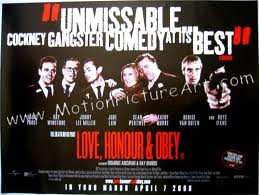
Dee Dee’s big swinging shotgun dick contradicts the analysis of gangster movies offered in Love, Honour, and Obey, a cross between a gangster film and Four Weddings And A Funeral which marks, arguably, the nadir (to date) of this British cycle. Ray Winstone in this one found himself among an absurd cast of would-be tough guys like Jude Law and Rhys Ifans, and luvvie molls Sadie Frost and Denise Van Outen. As one so-called hardman explains: “Women fuck it up in the end,” no double entendres intended, but all of them understood. L,H, & O also featured Kathy Burke dragging Ray Durdis’ impotent gangster to sex therapy. You couldn't make it up, except they did!

Back in Sexy Beast Spain, despite DeeDee’s taking care of business, Gal still must return to London. The big caper has been organised by crime lord Teddy Bass (Ian McShane, who's the most convincing thing in the film), in elaborate revenge for being buggered by bank chairman Harry at some Cliveden-style society orgy. Harry is played by James Fox, who’s wandered in from a remake of Performance, and we all know what that signifies. And did you happen to notice that the working class crime lord so offended by the upper class’ polymorphous perversion is named Teddy Bass, or Teddy Be Ass. I warned you.

How do Teddy Be Ass’ villains revenge themselves on gay Harry? They assemble, naked in a Turkish bath. Do I need to draw you a picture? In case I do, they penetrate the backside of the bank with a giant dildo of a power drill, shades of Thunderbolt and Lightfoot, an American buddy picture which wore its sexual role reversals on the sleeves of the dress Jeff Bridges had to wear. When Teddy B. Ass's boys break through into the vault, it releases a huge spurt of water. The naked gangsters swim up the tube and grab Harry’s jewels. Gal stuffs some earrings for DeeDee into his bikini, thus providing himself with the set of the family jewels he lacks. Teddy, having raped Harry’s vault, then shoots Harry in a needless bit of literal overkill. He drops Gal at a bus stop, paying him a tenner like a used hooker, knowing the secret of his shame is safe with a Gal. It’s a buddy movie gone haywire. Having, like Teddy, proved he’s NOT homosexual, Gal can now return to Spain, give DeeDee the family jewels, and enjoy a eunuch's retirement, accepting his femininity, frolicking on top of Don’s body in his pool.

Far-fetched? Director Jonathan Glazer claimed the eponymous Sexy Beast was money, but I think he was having us on. The Guardian’s critic Jonathan Romney, without a hint of irony, described Sexy Beast avoiding “the usual gangster geezerisms”. He noted that “above one hard man there is another, then another, then another….”, then pointed out Ian McShane as Teddy Bass played the ultimate man on top, “with a curiously prissy walk”. He thought Glazer might be “trying to cram too much in”. Some of us might suggest that’s the whole point. As I said before: DO I HAVE TO DRAW YOU A PICTURE?