 It was as if Annette
had died, at least in part, to provide spiritual relief from the media psychodrama and political point-scoring gush around Margaret Thatcher's passing. That was what
Annette did for us, when we were kids, provided a sort of marker
toward a different sort of life. Of course, I was about five when I
was keen on the Mickey Mouse club—so keen I can recall begging Miss
Molloy, our kindergarten teacher, not to keep me after school because
it was Mickey Mouse night and my mother wouldn't let me watch the TV
if I'd stayed after. It wasn't to watch Annette, and in retrospect I
wonder if the Spin and Marty stories were really
that intriguing. My memory tells me I liked Gunga and Rama on Andy's
Gang more.
It was as if Annette
had died, at least in part, to provide spiritual relief from the media psychodrama and political point-scoring gush around Margaret Thatcher's passing. That was what
Annette did for us, when we were kids, provided a sort of marker
toward a different sort of life. Of course, I was about five when I
was keen on the Mickey Mouse club—so keen I can recall begging Miss
Molloy, our kindergarten teacher, not to keep me after school because
it was Mickey Mouse night and my mother wouldn't let me watch the TV
if I'd stayed after. It wasn't to watch Annette, and in retrospect I
wonder if the Spin and Marty stories were really
that intriguing. My memory tells me I liked Gunga and Rama on Andy's
Gang more.
But Annette, even then,
was a step or two ahead—the older sister (or her friend), the
baby-sitter just discovering older boys, the only one of the
Mouseketeer girls who actually looked like the girls we knew. She was
a Funicello, just like the Bonessis, Montaltos, Volpes, or Aquilinos
we grew up with. She came from Utica, not California, though I didn't find
that out until I read it in an obituary.
Which was ironic,
because it was Annette who became the ultimate beach-bunny in those Disney
movies. Uncle Walt had spotted her dancing, and in retrospect we can
see both Graham Greene's appraisal of Shirley Temple and a touch of
the Humbert Humbert in his appreciation of her. She was remarkably
adult in her appeal, even before she astounded us younger males by
hitting puberty full-force while we were just becoming aware of the
difference in the sexes. Again, I say this recalling that the MMC
went off TV when I was seven, so I may be applying some
retro-analysis to my emotions when I say forget Darlene and Cubby and
all the other goodie-goodies with their names written across their
white T-shirts. And don't get me started on the adults. Jimmie? He was the kind of guy our parents should've been warning us about.
even before she astounded us younger males by
hitting puberty full-force while we were just becoming aware of the
difference in the sexes. Again, I say this recalling that the MMC
went off TV when I was seven, so I may be applying some
retro-analysis to my emotions when I say forget Darlene and Cubby and
all the other goodie-goodies with their names written across their
white T-shirts. And don't get me started on the adults. Jimmie? He was the kind of guy our parents should've been warning us about.
The explosion of breasts beneath the 'Annette' was like someone throwing a great switch on the libidos of millions of American baby boom boys. It was probably also the signal that the Mickey Mouse club was about to exceed its sell-by date. How big was the impact? A full decade after their last show, at a Yale football game, the marching band did a tribute to Annette, and in honour of her most lovable attributes formed two circles around two upturned tubas, signifying, as the stadium announcer intoned, 'her big brown eyes'.
 even before she astounded us younger males by
hitting puberty full-force while we were just becoming aware of the
difference in the sexes. Again, I say this recalling that the MMC
went off TV when I was seven, so I may be applying some
retro-analysis to my emotions when I say forget Darlene and Cubby and
all the other goodie-goodies with their names written across their
white T-shirts. And don't get me started on the adults. Jimmie? He was the kind of guy our parents should've been warning us about.
even before she astounded us younger males by
hitting puberty full-force while we were just becoming aware of the
difference in the sexes. Again, I say this recalling that the MMC
went off TV when I was seven, so I may be applying some
retro-analysis to my emotions when I say forget Darlene and Cubby and
all the other goodie-goodies with their names written across their
white T-shirts. And don't get me started on the adults. Jimmie? He was the kind of guy our parents should've been warning us about.The explosion of breasts beneath the 'Annette' was like someone throwing a great switch on the libidos of millions of American baby boom boys. It was probably also the signal that the Mickey Mouse club was about to exceed its sell-by date. How big was the impact? A full decade after their last show, at a Yale football game, the marching band did a tribute to Annette, and in honour of her most lovable attributes formed two circles around two upturned tubas, signifying, as the stadium announcer intoned, 'her big brown eyes'.
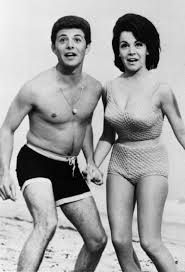
By that time, she was
another generation's sexpot. Her modest bikinis, and the equally
modest Frankie Avalon, were soppy compared to what was happening, and
Walt Disney's world-view was getting overtaken by times—it would
come back when Annette's generation and the ones that watched her
started looking for those comfortable childhood fantasies again.
were soppy compared to what was happening, and
Walt Disney's world-view was getting overtaken by times—it would
come back when Annette's generation and the ones that watched her
started looking for those comfortable childhood fantasies again.
 were soppy compared to what was happening, and
Walt Disney's world-view was getting overtaken by times—it would
come back when Annette's generation and the ones that watched her
started looking for those comfortable childhood fantasies again.
were soppy compared to what was happening, and
Walt Disney's world-view was getting overtaken by times—it would
come back when Annette's generation and the ones that watched her
started looking for those comfortable childhood fantasies again.
Annette gave up the
industry. Of course she did so to marry her agent—which must've
made 'Uncle Walt' jealous. She took being the all-American mom very
seriously indeed, and when she came back into the public eye it
wasn't as a faux-moralist, like Anita Bryant, but as a spokeswoman
and fund-raiser for the disease that afflicted her, muscular
dystrophy. In the end, Annette wasn't our pre-pubescent fantasy; she
became the kind of mother we watched in the Fifties—not so much on
the Mickey Mouse Club, but on Donna Reed, or Beaver, or Father Knows
Best. But it's hard not to look at those pictures, with the mouse
ears and the bespoke T-shirt, and think about the kind of innocence
we like to pretend the world had then.


