HALLOWEEN’S POLITICS: Donald Trump’s Three Rs
A few days ago, while intending to write about the link between Donald Trump, reality television and professional wrestling, I happened to read an article by Alan Moore. It was ostensibly about changes in comics’ fandom, since the time his younger self emerged from it to become one of the genre’s greatest creators. He bemoaned the loss of youngsters who read affordable comics as enthusiasts, and the move to older readers who can afford the more expensive modern versions, and “carp and cavil” at a sub-culture they believe they own. A decade earlier, (before, Moore pointed out, Brexit, Trump and “fascist populism”) he had written a piece wondering if the adult popularity of of superhero movies was “potentially an indicator of emotional arrest” with “worrying political and social implications.” Given that Moore’s work includes Watchmen, From Hell, and V for Vendetta, his concern needed to be taken seriously.
A decade later, we find ourselves with “elections that decide the fate of millions…conducted in an atmosphere more suited to evictions on I’m A Celebrity.” And by inference, being decided by those same people queuing to see the latest Spider Man or Superman sequel or spinoff. The people who buy images Donald Trump transformed into muscle-laden superhero on collectors cards or non-fungible crypto. “I alone can fix it,” exclaims our electoral superman, and as election day looms and the twin spectres of conflict over an unrecognised decision, or a Trump win foretelling a fascist future, raise their monstrous heads, the clarity with which we can see the fruits of this emotional arrest are clear.
They are amplified in every moment of a political campaign stoked by Trump’s three Rs: Reality TV, political Rallies and professional Rasslin’. All three are entertainments which require the audience to surrender emotional belief in what they’re seeing, even when logic or experience argue against it. In one sense, this is the essence of art; reality television is a drama presented without the need for actors or elevated scripts: a debased version of soap opera, which itself is opera without the music and with the conflicts reduced to game boards of conflict. Much like pro wrestling, itself a bowling alley version of sporting opera; the joy of victory, the agony of defeat, as Wide World of Sports used to tell us. The emotions are big, the challenges seem massive, the victory over them cathartic, the defeat, usually at the hands of villainous perfidy, tragic. It’s a Trump election.
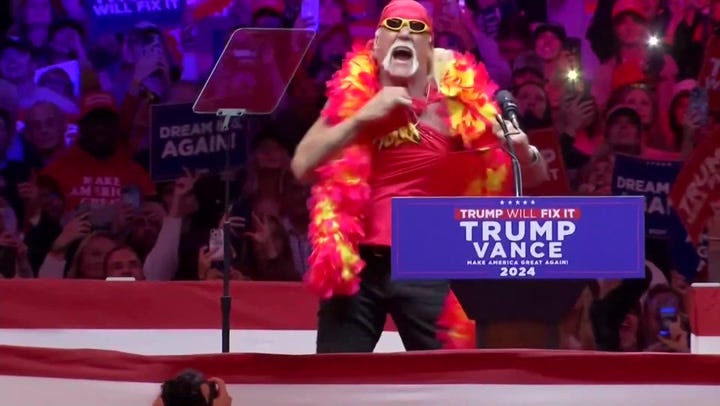
Donald Trump was our first professional wrestling president. The link reached apotheosis when Hulk Hogan appeared on stage last weekend at Trump’s Madison Square Garden MAGA version of the 1939 German Bund Rally. The 71 year old Hulkster struggled with his own signature move, failing to rip apart his tank top, struggling like Frankenstein’s monster’s grandad with battery running low. Hogan had been slightly more effective invoking the past last summer at the Republican convention. It was an appeal begging us to recall Wrestlemania 23, when, in the “Battle of the Billionaires,” Trump decked WWF (now called WWE after losing a lawsuit by the World Wildlife Fund) owner Vince McMahon and pounded him with his tiny hands, while each “billionaire’s” champion battled in the ring. After a cheating intervention by Trump’s own “referee”, Stone Cold Steve Austin, his champion, Bobby Lashley, pinned McMahon’s Umaga, and the Hair vs Hair match ended with Trump, Austin and Lashley shaving bald the shrieking McMahon. All it needed was a final aria from the hairless WWF boss.
That match appeared in a Netflix series, Mr. McMahon, which debuted in September, as the election season picked up pace. Although Trump’s role is minor, the comparison it suggests between the two “billionaires” is fascinating, not least because, when McMahon’s WWF was briefly losing the Monday Night War to his main television competition WCW, McMahon actually used a character called “Billionaire Ted”, whose Turner Broadcasting included WCW. This portrayed WWF as a small, family business trying to fight the big corporate bully.
Which was both technically true and ironically false. False, because McMahon had driven out of business most of the family-run regional promotions which had once made up the wrestling world, and had a hugely profitable near-monoply on the business. True, because McMahon’s WWF was originally his father’s World Wide Wrestling Federation, whose territory ran up the east coast from Washington to Boston. Vince had been raised by his mother and a step-father who abused him; the show portrays the young Vince as a bad boy bully and rebel. But eventually his real father took him in, and into the business. He worked his way up, but eventually Vince saw the opportunity to take down most of the regional promoters by stealing their stars and out-promoting them in their own areas, and on TV. McMahon Sr ostensibly disliked betraying what were, in effect, his business partners, and eventually sold the company to his son. The rest was history.
The parallels with Trump are superficially attractive — going into the father’s business, and although he claims his father gave him very little of it, the truth was young Donald received a fortune from his dad, as well as many contacts within the politics of New York, contacts Trump was quick to betray. An interesting sidelight into McMahon’s career is that every one of his ventures outside wrestling ultimately failed: a professional body-building federation; a film company; WWF hotels and restaurants, and even a pro football league, the XFL.
This is a mirror of Trump’s career outside real estate: he dreamed of having an American football franchise in the NFL: he joined the upstart spring-league, the USFL with a team in New York, then persuaded his fellow owners to move to the fall, hoping to force a merger. The USFL sued the NFL and won one dollar in damages; NFL commissioner Pete Rozelle swore Trump would never be allowed to own an NFL team. Sadly, he didn’t make that announcement on tape. The litany of Trump’s other failures is well known: steaks, water, a college, the Eastern Airlines shuttle, even casinos (one of which was hit with the largest money-laundering fine in FINCEN history). Trump’s major business was really talking bankers into loans, using the businesses he bought as collateral, and selling them back to his investors in repayment of his loans. As the adage goes, when you owe the banks billions, you’ve got them by the balls.
Part of the secret of McMahon’s ultimate win over WCW in the Monday Night wars was his re-creation of himself as a heel (ie, villain in wrestling parlance) character, Mr McMahon. With his steroid-inflated muscle-bound body, which made his head look tiny, McMahon borrowed a wrestling strut and brought his own self into the character. As he is interviewed for the documentary, and especially after he grows a pencil moustache in his final days as chairman of the company after scandal had forced him to sell to a bigger entertainment conglomerate, McMahon resembles a Twilight Zone evil ventriloquist’s dummy who comes to control the ventriloquist.
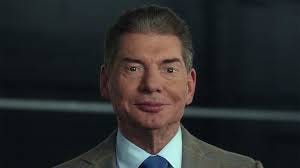
Wrestling is full of performers who come to believe they are the character they are playing, and the same was true of Vince: “I was a character, but the character is me,” he says. “It’s what I do best; I lie and I cheat and I win,” he tells his son Shane, whose efforts to please his father and win his approval are the most touching part of the documentary.
“Nothing that anyone involved in wrestling says should be regarded as fact,” explains wrestling journalist Dave Shoemaker. Does that sound familiar? Think of Trump in his uniform blue suit and red tie, with the heavy makeup and the George George style-hairpiece blown in the wind. Read the books on business Trump’s ghostwriters produced, “creative exaggeration” became his keyword for lying, and the stuff of his campaign speeches seemed borrowed from the ringside interviews of wrestling heels like Jerry Graham, “Classy” Freddie Blassie, or Dick the Bruiser. If Trump’s businesses did not make him an actyal billionaire, as journalists critics like Wayne Barrett, Tim O’Brien or David Cay Johnston kept saying, though no one in the political media paid any attention, he played a billionaire on TV, in The Apprentice, which turned the world of business into a WWE-style rumble, with Trump as Mr. Mahon.
He is, as many have noted, the poor man’s idea of what a rich man is, and the combination of the supposed dog-eat-dog competition and his faux cruelty to the contestants desperate to succeed gave him lots of opportunity to promote his own acumen while cutting them down to size, in a voice that increasingly would adopt the harsh growl of a wrestling heel. Of course the lines were written for him, the challenges choreographed in the same way wrestling matches are, and the aim was to make Trump the kind of figure who could, love him or hate him, “draw heat” as they say in wrestling: bringing followers in to see what happened next.
By the time Trump announced a presidential run in 2015, a large portion of the nation watching reality TV believed him to be a millionaire who could master any would-be business star and make tough decisions, such as, in Barack Obama’s famous White House Correspondents’ Club put down, “whether or not to fire Gary Busey”. Many in Trump’s circle have claimed that was the moment Trump decided to run for president.
As if the promise of more Hulk Hogan fuelling Trump’s third try at the White House were not enough, a few days before the MSG rally, he went on the Six Feet Deep podcast hosted by Mark Callaway, better known as The Undertaker in his own days in WWE. During the interview, Trump diverted from election talk by playing the quintessential wrestling “mark”, in effect asking the Undertaker whether or not pro wrestling was real. “That ring takes great absorption,” he marvelled. When Trump asked “what stops somebody from going nuts & starting a real fight,” Callaway desperately tried to steer the conversation back to the election, explaining, “It’s like the way I wish politics would get back to,” the Undertaker said, “I may not agree with you…but we can share a dressing room, we can shake hands.” I met Callaway once, in a Sky television make-up room, where I was broadcasting an NFL match and he was being interviewed to promote a WWF event in London. He’s an intelligent guy, very well spoken, but as most wrestlers are, wary of giving too much away. He came off the same way in Mr McMahon; protecting the business and the man who created the character that made him a true superstar. It was as if Trump were expecting the same treatment.
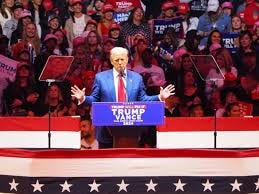
Which he received just a few days later with the rally at Madison Square Garden. It began with a comedian trashing Puerto Rico and characterising sex-crazed Latinos along Trumpian lines. It didn’t get much better, even though Trump’s son Eric, the Fredo of the Trump crime family, described the event as “a movement of total love.” The love extended to Kamala Harris, described variously as the “anti-Christ,” a “Samoan-Malayasian low-IQ” candidate, or a “fake” with “pimp handlers”. Hilary Clinton was described as a “sick son of a bitch” and the Democratic party as a “bunch of degenerates, low lifes, Jew haters and low lifes”. Trump’s two legal eagles appeared: Alina Habba, who started representing Trump’s Bedminster New Jersey golf club, seemed rehearsing her next music videos while Rudy Giuliani, once “America’s Mayor” and now chasing Trump for the $2 million he’s owed in legal fees, warned the crowd about “Palestinian two-year olds” who were waiting to kill Americans.
Then Elon Musk, dressed as “dark Gothic MAGA” as if he were Trump’s wrestling manager, introduced Melania, playing Trump’s wrestling valet, to present the main eventer himself. She asking the crowd to “size (sic) the moment and create a country for tomorrow, a future we deserve.” Imagine if Jill Biden had done that.
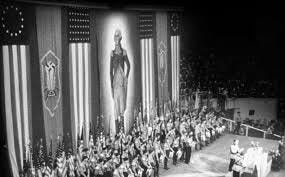
The staging wasn’t as impressive as the 1939 pro-Nazi rally at MSG, but that one wasn’t televised. Not that many of the speakers weren’t trying: Trump’s ambassador to the undead, Stephen Miller, chanelling his inner Fritz Kuhn to declare “America is for Americans and Americans only”. The levels of vitriol were higher, the crowd more raucous, and the coverage far more normalising, as you would expect for Trump. CNN commentator Van Jones nailed the difference in coverage of Trump and Harris in one line: “He gets to be lawless; she has to be flawless.” For months and months, campaign coverage centered on the question of whether 80 year old Joe Biden was physically and mentally fit to be President. He had a disastrous showing at his debate with Trump, and soon withdrew from the race. Did the coverage then shift to ask questions about the 78 year old Trump’s fitness, even as the summer wore on and more and more evidence of cognitive decline appeared? Of course not.
In the past few weeks, the Harris campaign has instead tried to highlight Trump’s fascist tendencies. After all, he had claimed on day one of his second presidency he would “be a dictator”. Nothing in his first term would contradict that, not even his failed coup of January 6 2021. Nothing in statements from generals who served under him, most notably his former White House chief of staff John Kelly, who read the dictionary definition of a fascist and pointed out how Trump checked all the boxes. Nothing from his former VP, 44 members of his cabinets, and Republicans across the country who’ve announced they would not support him (if not, in many cases, vote for Harris). Nothing that Trump has done has shaken his core supporters, not sexual assault, not criminal conviction, not support for dictators world wide.
The Washington Post and Los Angeles Times took their both-siding to the extreme, refusing to endorse either candidate — in both cases at the behest of their billionaire owners over-ruling the plans of both papers’ editorial boards to endorse Harris. Whether this was an owner’s fears of alienating part of his audience or, more likely, especially for the Post’s Jeff Bezos, out of a deeper fear that angering a Trump who won would cost him hundreds of millions of profit via government regulation of Amazon or loss of government contracts. Journalists at both paper resigned, even as the Post in particular published coverage that made it seem a Harris endorsement was the only legitimate course it could take.
Nothing Trump said during the New York rally contradicted his critics’ claims. Nothing would indicate any intention of relaxing the insults, dialling down the false claims, tamping the fires of resentment aimed at the faceless “they” against whom Trump rails. In the Mr. McMahon doc, another wrestling journalist, Dave Meltzer, explained “people will support an entertainment product and not care about the moral character of the guy running the product”. The same is true when the guy running the product is the product. The product is created to draw the audience. Wrestler Tony Atlas said “we cater to what’s in front of us”. Look round Madison Square Garden, America, because what you see in Donald Trump on the dictator’s pulpit is a reflection of the angry faces whooping with entertained joy. As a much quoted, though probably not ancient, Circassian proverb says, “When a clown moves into a palace, he doesn’t become a king. The palace becomes a circus.” In just a few days, will American send in the clowns?


