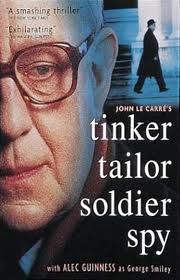
In 1938, E.M. Forster wrote that, if asked to choose between 'betraying my country and betraying my friend, I hope I should have the guts to betray my country'. You might look at John LeCarre's work, particularly the books now known as the 'Smiley novels' as a profound examination of that point of view, and
Tinker, Tailor, Soldier, Spy as its apotheosis. The novel was published in 1975, and the justifiably renowned television adaptation was shown in 1979. It may strike some as foolhardy to make a film of
Tinker Tailor now, but in three decades our world has changed. The wars fought by our spies are no longer symmetrical and our perception of the home team in that battle, that nebulous entity called Britain/England, depending on who's speaking and in what context, has taken a battering from years of Thatcher/Blairism. Most importantly, our feelings about the nature of loyalty and betrayal have altered, and that change of our perspective may be the most notable thing in the new version.
The film is a fine adaptation, too, so good it drove me to re-read the book, and then to watch the TV series, which, oddly enough, I had never seen (in my early years in London I eschewed television, in part because I was working at ITN and got enough of it there). The screenplay (by Bridget O'Connor and Peter Staughan) sacrifices, as it must, character for plot, but the way it re-structures that plot, leading with the shooting of Jim Prideaux, not only makes the story flow more like a thriller, and less like a parlour mystery, but also foregrounds the novel's central concern with betrayal. It jettisons some of the supporting cast to simplify things. Where it differs most from the previous versions is in its attitude toward what drives that betrayal, and in its nostalgia for something very different than the things LeCarre wrote about.
It's too facile to say that being directed by a Swede (Tomas Alfredson) means the film falls onto the side of neutrality, but when Bill Haydon justifies his treason on the grounds of aesthetics, the film seems to accept the statement as if he were offering a critique of design, and makes you wonder if Haydon had ever been to the USSR. But in the book and on

TV it is clearer that Haydon's aesthetic is his self-view; after all he is an artist, even if not a very original one, and rather than submit to the failed aesthetics of the world in which he grew up, which his paintings represent, he found it more aesthetically pleasing to create his own world, no matter how unreal, which in secret mocked that one. I've always found it odd that Ian Richardson played Bill; he's hardly a charmer, especially to the opposite sex; in my mind he was playing Anthony Blunt (whose own treason was revealed just before the TV series came out). But Blunt's own betrayal was indeed for aesthetic reasons, like those I've just described, and LeCarre was either prescient or imbued with deeper knowledge when he wrote his book.
The other big difference is that the film seems nostalgic for the era in which the book was set, but only to a point. It misses an important nuance there; the book itself was nostalgic for an earlier time—either the pre-war innocence of England or the years of the war itself, when these men were heroes and not so much bureaucrats. Haydon's art speaks to the thirties, and the suits worn by the Circus' leaders speak of that era: chunky tweeds and garish pinstripes, whereas the film's version of the 70s boast thinner materials, thinner ties, thinner lapels. Everything is more sleek, including the Circus itself. Critics praised its grainy reconstruction of its era, but a few moments with the TV series renders that praise hollow. Theirs is a far more shoddy world, one that still speaks of rationing and second-class status.

In the film version, gone is the ramshackle HQ of a small British overseas business, stuck into tiny rooms in old buildings—its Circus is a cross between the many warehouse sets of
Spooks and the control room of
Get Smart.
There are other odd changes too: Smiley is moved from Pimlico to Hampstead (though the address on his letters, strangely, is a building in Kings Cross used for Spooks); he even swims in the pond on the Heath every morning. Gary Oldman's Smiley is a stronger and silenter character than Alec Guiness'; his performance reminded me most of Toni Servillo as Andreotti in
Il Divo; Smiley as determined bureaucrat. The Circus' bureaucratic in-fighting is presented along those more European, less English lines as well. This is highlighted by some of the mis-casting, which you see around the Circus 'board room': Toby Jones is too young to be Alleline, and though he catches the ambition he doesn't get the clubbable fatuousness, nor the hint of incipient fascism, both of which were captured perfectly in Michael Alridge's TV performance. David Dencik's Toby is too weak; Bernard Hepton's was a more mysterious character.

And although Terrence Rigby's Bland looks the part more than Cieran Hands, both are wasted; Hands' role reduced to a few sinister closeups and threats to maintain your suspicions. Which is the real problem: in the novel and the TV series, the identity of the mole is still a mystery—even though, like Smiley and Prideaux, we intuit it must be Haydon. But in the film, Colin Firth is really the only possibility; none of the others, bar Dencik, are given a chance to establish themselves, but Dencik plays the character too weak to be the traitor. That the film manages to be far more a thriller than the TV series is a tribute to the structure of its script and the pacing of the direction.
The novel is clear about the nature of betrayal, as an outgrowth of secrecy, and sexuality is part of that secrecy; its clarity recalls the Forster quote. Its deeply understated sense of friendship grows from the world of schoolboys to which LeCarre traces the English proclivity for both loyalty and betrayal.

For LeCarre, sex is a side issue, a motivator, not a determining factor, and the TV series reflected that. For example, in the novel the relationship between Haydon and Prideaux is explained, if you can call it that, by innuendo—small comments about being close, reports from their university days, all of which require you to read between the lines, and much of which might have been missed by, say, a young American like myself with no grounding in British society. In the TV series, you are almost shocked to see the slight reaction from Ian Richardson when Ian Bannen (an excellent Prideaux) shows up. It should be noted that in LeCarre the only sexual relationship that is actually out in the open, discussed and mentioned freely, is Smiley's, or more specifically, Anne's serial adultery. In other words, only betrayal makes sex an open subject. In that context, Smiley's loyalty to Anne becomes a mirror, if not an explanation, of his loyalty to Britain, and the Circus.
And of course Smiley's own deepest relationship (apart perhaps from Control—and consider the meaning of his service being run by 'control', English self-control, self-restraint, stiff upper lip and all that) is with Karla, whose woman's name is no coincidence. Smiley 'gives' Karla the lighter Anne has given him, inscribed with the ironic-in-context 'all my love', and that becomes a key to identifying Karla's machinations behind the Circus' problems.
All this is grounded in hidden sexuality, but our world today, at least on film, requires that we give sex a more straightforward approach. In the movie, Colin Firth and Mark Strong exchange smouldering glances that leave little in doubt. This is the reason they are there, although they are,strictly speaking, too young; it would be a stretch, in the time of the story's setting, to see them as veterans of World War II. In this light, it is odd that they chose to give Peter Guillam (Benedict Cumerbatch) a gay back-story; there is no hint of that in the earlier versions, and there seems no point to it, unless they were worried they needed to balance off the image of gays as traitors. The film's sexuality does work much better on one level, however, and that is in the relationship between Ricki Tarr

and Irina, who is far more beautiful in the film than she was on TV, and whose fate is shown in a moment that helps condense the plot. Moving Prideaux's betrayal from rural Czechoslovakia to a Budapest cafe is fine for its time-saving, but moving the Tarr scenes to Istanbul is a fine change that allows fewer religious overtones to Irina's conversion, and more standard spy intrigue. Interestingly, Tom Hardy's Tarr is probably the single role in the film that comes closest to the interpretation in the TV series (by Hwyel Bennett) while Svetlana Khodchenkova's Irina is very much a figure of sexy glamour, where Susan Kodicek's had been partly religious and partly non-glamorous in exactly the same way the service is presented throughout.
This ties in with the decision not to show Mrs. Smiley, which is pretty much true to the book, although it ends with Smiley anticipating her return to gather him up. The TV film added a postscript of sorts—with Sian Phillips perfect as Anne—which uses her to sum things up: Bill 'loved being a traitor', and she misses one opportunity when Smiley asks if she loved Bill, where she could have echoed ironically Smiley's earlier answer 'not really', but she also sums him up. 'Poor George,' she says, after telling him she didn't love Haydon. 'Life's such a puzzle to you isn't it?' Meanwhile Smiley fiddles with his glasses, and resets them over his eyes, perhaps seeing straight again.

Anne is very much a presence in the film, but in a very clever way, seen only from behind, and with a flower in her hair to symbolise some sort of exotic and old-fashioned glamour, perhaps someone trying to retain their youth.
The film adds a few other inventions which are improvements, not all simply because they're needed in the restructuring which turns it into a literal thriller. John Hurt is particularly over the top as Control, and that works. The Christmas party scene is the one contrivance which actually harkens back to the LeCarre point of view, the one time you get that sense of the Circus as a second-rate British overseas corporation. And the moment Santa enters as Lenin and everyone sings the Soviet anthem in full voice is brilliant. The modern ethos seems reflected too in Connie's new status: from a dump of a flat she has moved up the property ladder to a lovely detached house in Oxford, and though Kathy Bates needs to be more crucial in this condensed plot, it is hard to top Beryl Reid's Connie for pathos.
And although Haydon's artistic career doesn't play the part in the film it did before—hence the problem with the 'aesthetic' argument; Haydon is not, after all, a very good artist—it is a signal that he is off-kilter.

Colin Firth's performance is exceptional, particularly in catching what LeCarre described as the 'pewter' tone of Haydon's eyes after his interrogations. His louche pose, slipping on chukka boots, would be something Richardson would not do. He wouldn't
wear chukka boots! But of course much of the rest, including the looks exchanged with Mark Strong's Prideaux, is stuff we've seen before from both actors; for that Firth could have wandered in from the set of
A Single Man.
But the most telling re-doing is Prideaux's relationship with the schoolboys. Prideaux, after all, is the key character, the one who is personally betrayed by the man he idolises and loves, the man with whom he has the exact sort of schoolboy relationship envisaged by EM Forster. In the novel and TV series his car is something old fashioned, 'best of British,' an icon which represents the illusions of a lost past which he is conveying to the boys he teaches. LeCarre is pretty clear about this: in the novel we again intuit that Jim has killed Bill because the manner of death has been foreshadowed a couple of times, most notably when he kills a bird in front of the schoolboys. On TV we see it, but it's a face to face killing, a small discussion of betrayal followed by anger. And although there is no discussion between Jim and Bill in the film, the face to face is reduced to Jim's seeing him through a sniper scope,

the look on Colin Firth's face is one of what, resignation? Perhaps invitation? And we sense Jim may even be doing him a favour.
We know the myopic Jumbo could well be the schoolboy Smiley—the kind of boy who could grow into Alec Guiness' huge spectacles. But he can't really become Gary Oldman's Smiley, and that is probably why there is such a significant change in Strong's Prideaux, whose car is a junker and who, after killing Bill, reacts to Jumbo with fury. In LeCarre, traditions carry on, and public schools will continue to produce men increasingly unsuited for the non-imperial world—Camerons and Osbornes and even non-men like Stella Rimington. For Alfredson, it's different. You might read Strong's rejection of Jumbo as a rejection of the weak or you might read it as a rejection of the system. In the latter reading, Prideaux becomes a sort of disillusioned hero, the only one in the game willing to give it up because it's at heart corrupt, or at least disfunctional. But I prefer to see it as Alfredsson's way of suggesting the circle has been broken here, and Prideaux will no long participate in grooming boys for the system that feeds the Circus. I love the ambiguity here, but it bothers me because of what follows.
Which is the triumphalist ending, undercut by the ironic use of 60s pop song 'La Mer' as Oldman's Smiley

sits in the control seat in the Get Smart set. It doesn't really work. Smiley is in charge, but as we know from LeCarre, this is not really a triumph: it is only the first step in his becoming what he is closest to. For me, coming back to the 1970s versions, artefacts of the time I arrived in this country, but with the knowledge I have learned over all this time, the depths of its predecessors seem something the film cannot match. But I am also acutely aware that there is a generation of film-goers now as ignorant of that Britain as I was when I arrived here, and this is a film pitched for them, and, as I have said, an excellent one, for me too. I am not criticising the film for not recognising what is after all outside its purview; but I wonder if, even within its own terms, that was way it ought to end.
 NOTE: This review contains some small spoilers
 I paid particular attention to the story at the time because I had just returned to America from my first visit to Europe, much of which time had been spent meeting my relatives in Sweden. I noted at the time that Olofsson was kept in Kalmar Prison, which is just across the Olandsbron from where many of my family lived and I remember wondering then and wondered now exactly how they got him up to Stockholm so quickly.
 In The Captor, it's less a collective feeling born of a long stay in a confined place under horrible conditions, and more of two individual love stories. The obvious one is between Olsson, here called Lars Nystrom (all the names were changed as many of the people involved are still alive) and played by Ethan Hawke and one of the hostages, here called Bianca and played by Noomi Rapace. The story puts Lars in contrast to Bianca's boring husband, and it's not too subtly shown that Lars' plan to shoot her, while she wears a bullet-proof vest, is a sort of climax, as it were, of their growing attraction. But there is also the relationship of Lars and his partner, here called Gunnar and played by Mark Strong. It's a strong enough bond that the police chief accuses Lars of being 'queer' and Bianca later asks him if he 'loves' Gunnar.
 This focus renders the other two hostages almost superfluous, which is a shame because Bea Santos as Klara in particular tries to convey feelings about what is going on, without much scope for that. We wind up seeing the bonding between the five (the number of captives has been reduced from the actual four captives) which comes about primarily because they come to believe that the kidnappers care more about their safety than either the police or the politicians, who have bigger points to make with them as the pawns. The key scene is a phone call between Bianca and Swedish Prime Minister Olof Palme, who chilly detachment contrasts sharply with Lars' undirected passion.
 What saves this conflict of themes, between a love story and a syndrome story, from sinking the film is the quality of the acting. Once you realise Hawke is playing a Swede playing an American playing a Swede, it all makes sense, and he does a tremendous job of bringing out Lars child-like energy and lack of judgement. Rapace is brilliant, able to convey building emotion and internal conflict with small looks behind the oversized glasses which were the fashion in Sweden in those days. Strong has to be the straight man for Hawke, but he carries off an ambiguous position well (he had been offered his freedom if he 'mediated' a solution--eventually Swedish courts found Olofsson not guilty and he was released from prison). There is also a star turn by Canadian actor Christopher Heyerdahl (cousin of the Norwegian explorer) as police chief Mattsson. He plays a role which is sometimes even farcical and sometimes brutal with a precise control that reminded me constantly of Max Von Sydow, who would have been cast in that role had a Swedish version been made at the time, a la Dog Day Afternoon.
  His performance is the real anchor against which the chaos of the hostage situation plays.