
Showing posts with label Peter Boyle. Show all posts
Showing posts with label Peter Boyle. Show all posts
Tuesday, 12 May 2020
GEORGE V HIGGINS' FRIENDS OF EDDIE COYLE AT FIFTY: GIVING JACKIE BROWN HIS DUE: THE ISOLATION ROW REVIEWS IV


Monday, 7 November 2011
LONDON FILM FESTIVAL: IDES OF MARCH
So metimes it seems as if George Clooney wants to single-handedly re-interpret America's last great Golden Age in terms of the paranoid politics of today, as if to make the world safe for an heroic sort of Kennedy liberalism. Although he reached back to the Fifties to recast TV newsman Edward R Murrow as the forefront of the campaign against McCarthy-ism in Good Night And Good Luck, it's more instructive to see the CIA reduced to a Chuck Barris gong show, or Fail Safe's Col. Jack Grady given a conscience but still carrying a full payload of paranoia strong enough to conclude both the President and his own son are Soviet dupes.
His latest film, Ides of March, which received its world premiere at the London Film Festival is really a reimagining of The Candidate, which highlight the differences between Clooney the director/star and the approaches of both Michael Ritchie, a sharp social critic, as the Candidate's director and Robert Redford as its star. Ides transfers the focus from the candidate, Governor Mike Morris, played by Clooney, to his number two campaign chief, played by Ryan Gosling. In a neat transfer from The Candidate, here it is the political pro who is the idealist, who believes in the candidate, and the candidate himself is, at best, already a seasoned pol. But just as crucially, we can imagine Ides Of March's storyline beginning exactly at the point The Candidate ends, with Redford as Bill McKay, exchanging glances with the young campaign worker slipping into a hotel room. That moment symbolised McKay's corruption in the way American political films—and I extend this to documentary as well as fiction-- see their politics: in personal terms.
The difference between the two films is primarily that Clooney starts from an assumption that we all know our institutions are corrupt; he is building on the revelations which spawned films like The Candidate. That the professionals are running the show, that ideals are sacrificed on the altar of vote-getting expediency, a revelation in The Candidate, here is taken for granted. The play on which the film is based was called Farragut North, after a Washington DC street off K Street where lobbyists and consultants make their lairs. Therefore the crucial change of focus is from the candidate himself as idealist to the campaign manager as idealist—the somewhat contradictory idea that Ryan Gosling's Stephen Meyers is a ruthless professional who could be in this sleazy business for idealistic reasons. That he is out-smarted by Morris' opponent's campaign chief, Tom Duffy, played by Paul Giamatti reprising Allen Garfield/Goorwitz's brilliant performance from The Candidate, is not a surprise; that the weakness on which Giamatti preys is Meyers' boss Paul Zara's (Phillip Seymour Hoffman) sense of loyalty—Hoffman in a sense is playing the Peter Boyle character from The Candidate, but he is playing it as PSH in standard mode. Although the term 'anorak' doesn't really exist in America, he wears one, and plays it as one; the most predictable scene in the film is the one where he gets the push from Morris. It's a shot of the car in which the dagger is being used, and when Hoffman gets out, and the car drives away, you can predict the slump of the body within the anorak.
Because this is America, the crucial betrayals are not political but personal—and it's hard to figure out whether Meyers is more incensed because Morris is shown to have sexual feet of clay, or because Molly, the campaign intern he's sleeping with (Evan Rachel Hunter) has 'cheated' on him. Intern sex reflects the post-Clintonian reality of political morality, which is specifically referenced twice: first when we learn the Republicans are more ruthless, better organised than the democrats-better at the process of politics, the perennial lament of the headed-for-extinction liberal. And second when we learn that the one unforgivable political mistake is 'fucking an intern'--all else, including starting wars, pales into insignificance.
That Meyers first lets Molly down and then appears to threaten her with exposure causes her suicide, and puts him in the position to be able to blackmail Morris indicates the key thrust of the film. Although Clooney the actor handles Morris' 'reveal' brilliantly. It's always fascinating to me how powerful Clooney can be playing against type. He's our Clark Gable, but he has darker depths. And like Gable, he's not very good at comedy, though unlike Gable he keeps trying. Clooney the director isn't so subtle about the reveal: both Morris and Gosling's Steven are cast in half-shadow, to emphasize the duality of their positions, the choices they make. It's shot wonderfully by Phedon Papamichael, who alternates the styles of campaign documentary and neo-noir with aplomb. The film reveals its origins as a play – it is opened up but everything of importance takes place in small encounters, and the mobile phone plays an important role in delivering outside news. But the real point of the film is never politics, but love.
This is born out by Marisa Tomei's turn as Ida Horowitz, the obnoxious (and Jewish—pointedly so) reporter for the New York Times, who keeps telling people she loves them and reminding them that love means nothing. In that sense, we see Giamatti's seduction of Gosling as more telling than Molly's seduction of him, and we realise that Molly's weakness may well be believing in love more than politics. It is interesting that the scene in which Gosling rings least true in his role comes in the bedroom, where he's revealed to be far more buff male beefcake than you'd expect from a campaign manager— more American Psycho than American Politico. But again, that may be the point. And the reversion of Molly to helpless girl, female victim of morality (her family is Catholic) may well be more a comment on the false morality of American politics than an attempt to send the women's movement back to the Sixties.
There are a few practical problems. That Molly is the daughter of the Democratic Party's chairman means that Mike Morris would know her as well as Paul Zara says he does, and Stephen would likely be at least aware of who she was. Would Morris thus choose her to sleep with? After her death would no one do an autopsy that would reveal her recent abortion, and then check local clinics? Did no one ask Stephen why he happened to go to her room where she was found dead? Did no one try to trace her phone? But those are the kinds of question you'd ask in a crime film, not a political drama.
The revelation that politics are corrupt, or hypocritical, is hardly earth-shaking. It's easy to see Ides Of March as longing for some more innocent reality, but such innocence may never have really existed, we George Clooneys just believed it did because the media (and movies like The Candidate) hadn't revealed all to us. This film is earnest in its liberal way, well-played and well-made, but it really reveals very little.
Ides Of March directed by George Clooney
screenplay by Clooney & Grant Heslov and Beau Willimon,
based on Willimon's play, is on general release
 metimes it seems as if George Clooney wants to single-handedly re-interpret America's last great Golden Age in terms of the paranoid politics of today, as if to make the world safe for an heroic sort of Kennedy liberalism. Although he reached back to the Fifties to recast TV newsman Edward R Murrow as the forefront of the campaign against McCarthy-ism in Good Night And Good Luck, it's more instructive to see the CIA reduced to a Chuck Barris gong show, or Fail Safe's Col. Jack Grady given a conscience but still carrying a full payload of paranoia strong enough to conclude both the President and his own son are Soviet dupes.
His latest film, Ides of March, which received its world premiere at the London Film Festival is really a reimagining of The Candidate, which highlight the differences between Clooney the director/star and the approaches of both Michael Ritchie, a sharp social critic, as the Candidate's director and Robert Redford as its star. Ides transfers the focus from the candidate, Governor Mike Morris, played by Clooney, to his number two campaign chief, played by Ryan Gosling. In a neat transfer from The Candidate, here it is the political pro who is the idealist, who believes in the candidate, and the candidate himself is, at best, already a seasoned pol. But just as crucially, we can imagine Ides Of March's storyline beginning exactly at the point The Candidate ends, with Redford as Bill McKay, exchanging glances with the young campaign worker slipping into a hotel room. That moment symbolised McKay's corruption in the way American political films—and I extend this to documentary as well as fiction-- see their politics: in personal terms.
The difference between the two films is primarily that Clooney starts from an assumption that we all know our institutions are corrupt; he is building on the revelations which spawned films like The Candidate. That the professionals are running the show, that ideals are sacrificed on the altar of vote-getting expediency, a revelation in The Candidate, here is taken for granted. The play on which the film is based was called Farragut North, after a Washington DC street off K Street where lobbyists and consultants make their lairs. Therefore the crucial change of focus is from the candidate himself as idealist to the campaign manager as idealist—the somewhat contradictory idea that Ryan Gosling's Stephen Meyers is a ruthless professional who could be in this sleazy business for idealistic reasons. That he is out-smarted by Morris' opponent's campaign chief, Tom Duffy, played by Paul Giamatti reprising Allen Garfield/Goorwitz's brilliant performance from The Candidate, is not a surprise; that the weakness on which Giamatti preys is Meyers' boss
 Paul Zara's (Phillip Seymour Hoffman) sense of loyalty—Hoffman in a sense is playing the Peter Boyle character from The Candidate, but he is playing it as PSH in standard mode. Although the term 'anorak' doesn't really exist in America, he wears one, and plays it as one; the most predictable scene in the film is the one where he gets the push from Morris. It's a shot of the car in which the dagger is being used, and when Hoffman gets out, and the car drives away, you can predict the slump of the body within the anorak.
Because this is America, the crucial betrayals are not political but personal—and it's hard to figure out whether Meyers is more incensed because Morris is shown to have sexual feet of clay, or because Molly, the campaign intern he's sleeping with (Evan Rachel Hunter) has 'cheated' on him. Intern sex reflects the post-Clintonian reality of political morality, which is specifically referenced twice: first when we learn the Republicans are more ruthless, better organised than the democrats-better at the process of politics, the perennial lament of the headed-for-extinction liberal. And second when we learn that the one
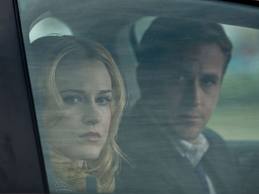 unforgivable political mistake is 'fucking an intern'--all else, including starting wars, pales into insignificance.
That Meyers first lets Molly down and then appears to threaten her with exposure causes her suicide, and puts him in the position to be able to blackmail Morris indicates the key thrust of the film. Although Clooney the actor handles Morris' 'reveal' brilliantly. It's always fascinating to me how powerful Clooney can be playing against type. He's our Clark Gable, but he has darker depths. And like Gable, he's not very good at comedy, though unlike Gable he keeps trying. Clooney the director isn't so subtle about the reveal: both Morris and Gosling's Steven are cast in half-shadow, to emphasize the duality of their positions, the choices they make. It's shot wonderfully by Phedon Papamichael, who alternates the styles of campaign documentary and neo-noir with aplomb. The film reveals its origins as a play – it is opened up but everything of importance takes place in small encounters, and the mobile phone plays an important role in delivering outside news. But the real point of the film is never politics, but love.
This is born out by Marisa Tomei's turn as Ida Horowitz, the obnoxious (and Jewish—pointedly so) reporter for the New York Times, who keeps telling people she loves them and reminding them that love means nothing. In that sense, we see Giamatti's seduction of Gosling as more telling than Molly's seduction of him, and we realise that Molly's weakness may well be believing in love more than politics. It is interesting that the scene in which Gosling rings least true in his role comes in the bedroom, where he's revealed to be far more buff male beefcake than you'd expect from a campaign manager—
 more American Psycho than American Politico. But again, that may be the point. And the reversion of Molly to helpless girl, female victim of morality (her family is Catholic) may well be more a comment on the false morality of American politics than an attempt to send the women's movement back to the Sixties.
There are a few practical problems. That Molly is the daughter of the Democratic Party's chairman means that Mike Morris would know her as well as Paul Zara says he does, and Stephen would likely be at least aware of who she was. Would Morris thus choose her to sleep with? After her death would no one do an autopsy that would reveal her recent abortion, and then check local clinics? Did no one ask Stephen why he happened to go to her room where she was found dead? Did no one try to trace her phone? But those are the kinds of question you'd ask in a crime film, not a political drama.
The revelation that politics are corrupt, or hypocritical, is hardly earth-shaking. It's easy to see Ides Of March as longing for some more innocent reality, but such innocence may never have really existed, we George Clooneys just believed it did because the media (and movies like The Candidate) hadn't revealed all to us. This film is earnest in its liberal way, well-played and well-made, but it really reveals very little.
Ides Of March directed by George Clooney
screenplay by Clooney & Grant Heslov and Beau Willimon,
based on Willimon's play, is on general release
Tuesday, 11 January 2011
PETER YATES AND EDDIE COYLE: A DIRECTOR'S LEGACY
 It's sad that with the obituaries following Peter Yates' death, his career as a film director already appears to be becoming defined primarily by the car chase in Bullitt (though that is probably preferable to the mainstream's second-choice, Jacqueline Bisset's wet-T shirt in The Deep, which won't stop my using a photo of it below). It's not that Bullitt isn't an interesting film without the car chase; in many ways Yates and Steve McQueen
 showed the way for Don Siegel and Clint Eastwood in Dirty Harry. And it is a great car chase, which inspired William Friedkin's (with the same stunt driver) New York version in The French Connection, and was probably topped by the auto-decapitation in Philip D'Antoni's Seven-Ups. But Bullitt was by no means Yates' best crime movie, and the McQueen's Mustang is not probably not even Yates' best chase scene.
That would be Dennis Christopher, on his bicycle in Breaking Away, chasing the visiting Italian cycle team he idolises, and having that idealism shattered along with his bicycle's wheel. Or if not that one, Christopher's race with his friends in the Little 500; the climax of that excellent film about growing up, friendship and, incidentally, sports. To me, Yates was a director primarily interested in ch
 aracter, who got miscast by Bullitt into being thought of as an action man. His problem was that his 'serious' movies where he tried to examine 'adult' issues, never quite clicked, whereas he does an awful lot with Bullitt's character by letting Steve McQueen simply be, and letting Bisset (again) and others react to him. It makes sense if you think of Robbery, his first feature, which, for all its moving-train action, and the London car-chase that got him hired for Bullitt, is really about Stanley Baker's relationships with his gang members and pursuers. It's noticeable how much Baker is very much a silent-type like Bullitt, and Joanna Pettet a very effective Jacqueline Bisset. It's interesting, because for a while on You Tube, before they disappeared for the inevitable copyright and intellectual 'property' issues, I was watching early episodes of The Saint and Danger Man, the two TV shows where Yates first made his mark, and you can often see how the economies of scale in television result in some very subtle exercising in character. And in Patrick McGoohan's John Drake, you see the same sort of detached cool that McQueen would show as Bullitt.
When taken out of the genre context, Yates' 'serious' work seems just slightly off-the-mark, though some of the knock-off stuff, like The Deep, tries to be better than it is. I think of films as varied as John & Mary; Mother, Jugs, and Speed, Murphy's War, or Eleni, none of which really convinces, and some of which miss by a lot.
 The exception is The Dresser, but again I think it is the structure of Ronald Harwood's play which helps Yates get to the characters, and get to them he does, with Finney and Courtney delivering epic performances. Yet even at his peak, between Breaking Away, and The Dresser, Eyewitess (written, as was Breaking Away, by Steve Tesich) fell flat, despite a good premise and strong cast. Another promising crime film, House On Carroll Street was perhaps too derivative of its period, and ended flatly, but it was an interesting attempt by Walter Bernstein to put that period into some sort of context, and remains an overlooked but interesting film.
Yates real legacy should lie in two very different crime films based on classic books by pantheon writers. The Hot Rock was scripted by
 William Goldman from Donald Westlake's first novel featuring the Dortmunder gang, comic caper crime played for laughs but always with Westlake's real crime sensibility not far from the surface. Yates caught it almost perfectly, with a seemingly mis-cast Robert Redford eschewing glamour to portray the permanently-jinxed Dortmunder, George Segal and Ron Liebman perfect as gang-members Karp and Murch, and Zero Mostel an unforgettable foil. Compare it to the sequel, Bank Shot, with George C Scott, to see just how sure a hand Yates had.
His masterpiece, of course, was The Friends Of Eddie Coyle, adapted beautifully by Paul Monash from the understated, dialogue-driven prose of George V Higgins' first novel. There's a bit of noirish inevitability in Eddie Coyle's fate (again, foreshadowed somewhat by Baker in Robbery), from which
 Robert Mitchum draws out all the emotions, and like The Hot Rock, his supporting cast is wonderful: Peter Boyle as his 'friend', the bartender Dillon, a young Richard Jordan as the Fed, Foley, Steven Keats as the gun-dealer Jackie Brown, and Alex Rocco as the bank-robbing Jimmy Scalise, providing the sort of energy Liebman did in The Hot Rock. Eddie Coyle is one of those magnificent adaptations of a small but perfect novel; like Huston's version of The Maltese Falcon the dialogue simply jumps off the page onto the screen. But as with all his best work, Yates was fascinated by Higgins' concern with the relationships (signalled by the title), the levels of trust and lying, friendship and business, that delineate Coyle's world. The actors get it; they don't play for sympathy from the audience, they play their parts in a world of give-and-take, a world where you make your choices and take responsibility, and what you don't know is your own fault. It's one of the greatest of all crime movies, it's Yates' best, and it's that, not a Steve McQueen car chase, that constitutes his true legacy.
Subscribe to:
Posts
(
Atom
)
