Showing posts with label Quentin Tarantino. Show all posts

Monday, 9 October 2017

TAKASHI MIIKE'S BLADE OF THE IMMORTAL: LONDON FILM FESTIVAL 2017: 1

This is apparently Takashi Miike's 100th feature film, and as such made its London debut as the Gala show  of the 'Thrill' Strand of the London Film Festival yesterday. It's an epic swordsman movie, with supernatural overtones, and like most of Miike's work, based on other sources, in this case a manga series by Hiroaki Samura. It's very different from Miike's last LFF entry, Yakuza Apocalypse, in 2015. Like that film, which I discussed on our late, lamented Americarnage podcast, but about which I didn't write, there's a serious theme behind the over the top treatment of violence. Apocalypse was somewhat derivative of blaxploitation and early vampire tropes, everything from Solomon Kane to Kolchak. 

But the basic theme, equating the Yakuza with vampires, was a thread that tried to hold the whole thing together, at least until the face of the ultimate apocalypse, a giant soft frog, appeared. To music that sounded like Ennio Morricone scoring the Teletubbies. I found my screening notes, and I'd actually scrawled 'some weird shit coming out of nowhere', which is a good description of Miike's work.

For someone who works so quickly, Miike can make some incredibly artful cinema. Blade Of The Immortal opens in black and white, a homage of sorts to the 50s. Manji (the name echoes Clint Eastwood's 'Joe Manco', The Man With No Name') is a samurai who is tracking down his sister, who's lost her senses after seeing her husband killed by Manji, under orders from his master. The kidnappers kill her, in a scene echoing The Wild Bunch, before Manji literally disposes of the entire bunch, somewhere between 70-100 (I lost count). He is dying, but a witch feeds him 'bloodworms' which heal his wounds, rejoin his severed hand to his body, and basically render him immortal.

Fifty years later, and in a fine, cold-toned colour, he meets a young girl (Hana Sugasaki, shown right with Miike)  whose parents (her father is a samurai sensei) have been murdered by a group of swordsmen, the Itto-ryu, who eschew the honourable tactics of samurai, insisting on winning at all costs. He eventually agrees to avenge them on her behalf.

What follows is interesting, but to be honest it's a bit boring. I wrote that after yet another one man against dozens fight. Despite the set-up, which would augur some internal, as well as external battling, Blade Of The Immortal really becomes a kind of Kill Bill, or Kill Lots More Bill. The presence of Kazuki Kitamura here does little to avoid one making that connection. But seriously, there doesn't seem to be any substantial difference between the Itto-ryu and other fighters, particularly those from the government, and there is no real examination of the samurai code. Nor, despite the strains of facing an immortal life thanks to witchy worms, does Manji appear to try to figure much out. It's superficial compared to some of the work of Beat Takeshi, where existential questions of samurai loyalty and life's meaning often haunt the story, or even to Miike's own 13 Assassins, a film which draws quite heavily on westerns (my review is here) or Yakuza Apocalypse.

Takuya Kimura is fine as Manji, but the show is mostly stolen by Sugisaka as the young girl he eventually equates with his long-gone sister. The villains are all impressive, especially Sota Fukushi as the androgynous head of the Itto-ryu, particularly when he gets the tables turned on him by sneaky Imperial bureaucrats. Miike presents the Tarantino-like anachronistic costumes, and there is a good bit of his trademark dark humour. But one wishes Miike would have done more to condense the story into its main lines: graphic novels are told quickly, although series do meander. But I get the feeling that for number 100, Miike was looking to go full Tarantino.

NOTE: This review will also appear at Crime Time (www.crimetime.co.uk)

Wednesday, 3 July 2013

JIM KELLY: THE INDEPENDENT OBITUARY

My obituary of Jim Kelly, best-known for Enter The Dragon, but for me at his best as one-third of Three The Hard Way, is in today's Independent; you can link to it here. The track of Kelly's brief career as a blaxploitation star might be said to reflect his relative lack of acting ability--he had a certain presence (which his combat pout, combined with tufts of chest hair that appeared to be glued on, and loud exhales during karate fights all did much to dissipate; see below left) but there is self-restrained cool and there is the inability to emote. Fred 'the Hammer' Williamson had more of a career, but little of it was worthwhile so perhaps Kelly was better off pursuing other avenues which gave him more satisfaction. You could say that was what Jim Brown did, first when he gave up football, and later when he withdrew from full-time acting.

What is odd is the way Bruce Lee's star rose, fuelled by his death, no doubt. Lee is closer to Kelly in acting terms than he was to, say, John Saxon--for all that Enter The Dragon is a cult film, none of the three actors had great careers afterwards. I wonder how much camp is involved in the whole blaxploitation revival --certainly we could look at almost all of Quentin Tarantino's later career as an excercise in camp, if not an effort to become a high-priced Larry Cohen. That Kelly didn't join the Original Gangstas cast, or thht Kung Fu Joe is a figure of some fun in I'm Gonna Git You Sucka says something about the continuing value of Kelly's role.

Still, he seemed to appreicate his late renaissance in fandom, and take it with good humour. Speaking of which, you really should go to you tube and watch that 2004 Nike Chamber of Fears commercial, in which LeBron James goes head to head with Kelly--it is absurdly weird.

Tuesday, 11 June 2013

EAT YOUR HEART OUT QUENTIN TARANTINO: MY MICKEY SPILLANE INTERVIEW

 
NOTE: In the summer of 1999, Mickey Spillane arrived in London to be honoured by the late lamented Crime Scene festival at the NFT. He had just flown in from South Carolina, via Charlotte, that morning, and his BBC handler wanted to make sure I understood I had 45 minutes with Mickey, who was, after all, in his 80s. Then he would rest before taking a taxi to Broadcasting House for another interview. After 45 minutes, Mickey shooed the handler away, and I ran out of tape as we continued talking until, literally, he was being pushed into the taxi cab.Caspar Llewellyn-Smith ran what follows, my short version of the interview, in the Daily Telegraph that Saturday--I later transcribed the whole thing for Crime Time, and maybe I'll post that here sometime too; it's worth it!

I, THE JURY, Mickey Spillane’s 1947 best seller, boasts the most infamous ending in hard-boiled fiction. Mike Hammer knows the woman he loves has murdered his best friend. She is seducing him with a strip tease. She’s also reaching for a gun behind her back. Hammer plugs her in her naked belly with a slug from his .45.


How c-could you?" she gasped
I had only a moment before talking to a corpse, but I got it in.
"It was easy," I said.

Eat your heart out, Quentin Tarantino. More than 50 years after writing those words, the king of pulp fictions is in London. Spillane's 81 years old, but his handshake could still crush a hoodlum’s trigger finger. He will deliver a Guardian Lecture tonight to keynote a season of crime films at the National Film Theatre, which includes the debut of a Spillane documentary directed by award-winning crime writer Max Allan Collins. "He was savaged by the critics," says Collins, "so Mickey developed this persona, entertainer and pitchman." 

And how. Interviewing Mickey is like saddling a bronco who refuses to be broken, and knows all the cowpunchers’ tricks. Ask about critics and he’ll tell you about interpreting between Salvador Dali and Jimmy Durante, who were both speaking English, more or less. Ask about politics and he’ll tell you about being shot from a circus cannon. There's no slowing down. And he’s still answering the inevitable questions about Mike Hammer’s violence with laughter.

"I tell them, you know why Mike shot that woman in the belly? He missed!"

Nowadays the violence of so-called neo-noir is high fashion, while Spillane’s has become somehow declasse. On its 50th anniversary, I THE JURY went out of print in America for the first time. Mickey’s surprised to learn he’s coming back into print in the UK with Robinson Publishing’s HARDBOILED: A MIKE HAMMER OMNIBUS, released to coincide with his visit. (Note: You can find my essay on the two Hammer omnibuses here).

"Corporate turnovers," he shrugs. "They thought I’m old and passe. I tell them I’m not an author, I’m a writer. I’m a merchandiser. I did Miller Lite commercials for 19 years on TV. The Mike Hammer TV series has been brought back for the fourth time. People know me, they stop me on the street."

In the adverts, Spillane, in trench coat and fedora, played himself as Mike Hammer with enough ironic humour to launch a thousand Tarantinos. "Hey, Mickey, got a Lite?" "Sure thing doll." The series featured many of America’s most famous sportsmen, but he was the star, the one they all looked up to. Spillane, like John Wayne (who gave him a treasured vintage Jaguar as a reward for some script doctoring) was what American men aspired to be. "Things change," he sighs. Well, almost sighs. "The Blue Ribbon’s gone in New York. We have no leaders to admire, all we’ve got is that cocksman in the White House" 

Spillane isn’t crazy about any of the Mike Hammer films either. The first, I THE JURY, was made by Victor Saville in 1953. Its NFT showing will be its first British showing in its original 3D format, and with the 20 minutes of cuts by the censors restored. But Spillane has never seen it all the way through.

"I went once in Brooklyn. Biff Elliott walks on screen and says "I’m Mike Hammer," and a voice in the audience howled ‘DAT’S Mike Hammuh?’ I walked out." He laughs again. "Victor wanted to make an epic, THE SILVER CHALICE, which fell on its face with a deathly thud. So to save money he gets this slob writer, and he rooned it! They have Mike getting knocked out with a wooden coat hanger!"

Ten years later, Spillane was cast as his own hero. Can you imagine Raymond Chandler playing Philip Marlowe? Mickey looks at stills from THE GIRL HUNTERS. "Good grief, did I ever look like that? There’s Shirley Eaton. What a pro; no ego, she just played the character and made me look good." The filming was done in Britain, where he palled around with gangsters like Billy Hills and Jack Spot. "When we needed a .45 for Mike, Billy brought a sack full of guns to the set, with live ammo."

The best-regarded Hammer adaptation is Robert Aldrich’s KISS ME DEADLY, which ends in nuclear holocaust. Mickey hates it. "They never even READ my book!" Aldrich saw an apocalyptic strain in Hammer, and critics have recently tried to connect that to Spillane’s faith. He’s a Jehovah’s Witness, but the critics got it wrong. "It’s not the end of the world we witness," he says, "but parousia, the coming of the peace of God, the end of the system of things as they are. It’s taking in knowledge."

But confounding the critics is his favourite pastime. "It tears them up. I had seven books at once in the top ten best seller list. I said ‘you’re lucky I don’t write three more!'"

He’s written two children’s books. The first, THE DAY THE SEA ROLLED BACK, won the Junior Literary Guild Award. "I keep winning these crazy prizes," he shrugs. "It meant the book sells to libraries." And he’s still writing.

"I’m halfway through a new Mike Hammer novel," he says. "But I used to write fast…now my rear end gets tired. I’m not full of piss and vinegar any more. The vinegar’s all gone." He wrote I, THE JURY in nine days, originally plotting it as a comic book starring "Mike Danger". The book revolutionised the publishing industry.
"I knew it would be a hit. Paperback reprints were huge during the war, and I saw a market for originals. All those soldiers coming back. A little sex wouldn’t hurt, and they’d seen violence. I got a comic distributor to guarantee a paperback reprint, got a $1,000 advance from Dutton for the hardcover." Soon the only books outselling Spillane were the Bible and Dr. Spock. "I’ve gone downhill ever since," he laughs. 

Spillane has a radio interview next. He’s been talking for two hours; I’ve long since run out of tape. Across the room in the Savoy, a business meeting has ground to a halt, eavesdropping on Mickey’s spiel. After he leaves, they ask, "who was that?"
"Mickey Spillane," I tell them.
"Mickey Spillane! How do you interview Mickey Spillane?"
"It was easy," I said.

Friday, 22 July 2011

STEPHEN HUNTER'S 47TH SAMURAI: A Forgotten Friday Entry

The 47th Samurai is not the first time Stephen Hunter has paid homage to movies; the Earl Swagger novel Pale Horse Coming referred explicitly to The Magnificent Seven (and to Aeschylus' Seven Against Thebes). This should not be surprising, since Hunter is also a film critic who has championed the action/adventure movie, but unfortunately this tale of a sixty-year old Bob Lee Swagger embarking on a quest for revenge in Japan has to be taken with a huge amount of tongue in cheek. Hunter signals this when he's listing samurai movies – it's as if he's giving you Quentin Tarantino's young adulthood to follow, and though he isn't into the wholesale exaggeration that QT built his Kill Bill films on, Hunter still has a few problems to overcome.

The main ones concern Bob Lee, first because part of the story requires him to remain relatively anonymous in Tokyo, which is not an easy thing for any gaijin, and the other because Bob Lee's samurai training is of necessity too short, a fact about which everyone in the story reminds us, but being aware is not the same as being convinced.

The real problem is that Hunter attempts to encourage the suspension of disbelief by using facts—constantly giving the Japanese terms for weapons, fighting moves, techniques and parts. I noted in my review of I Sniper (2009--you can link to that here) that Hunter's writing was becoming more 'device-centric', and that as a result Swagger himself was turning into a plot device, rather than a character. This book was published the year before that one, but you can see it moving in that direction. In truth, however, when you look at Hunter's pre-Swagger work, you can see that it is the action thriller that interests him, and perhaps the historical emphasis was a detour.

That's dangerous because the strong points of the Swagger series (both father and son) have been personal as well as historical. Point Of Impact, which introduced Bob the Nailer, was conspiracy-based and began filling in Bob's personality; Black Light, the second novel, in which Bob investigates his father's death and White Springs, the first Earl novel, are perhaps his best books, and their core is character crossing corruption. There's some of that here; the sequences on Iwo Jima are particularly strong, if a bit reminiscent of Clint Eastwood's films, and of course the parallels of the Swagger men as American samurai is not subtle, but it is effective. So too is the relationship between Earl and his Japanese adversary during the war, and between Bob Lee and that man's son afterwards.

So, in the end, the question is whether you smile when Bob Lee assembles his own 47 samurai (the tale of the 47 ronin being the classic Japanese samurai story) or whether you feel it's all too contrived. As usual, Hunter's combat scenes always convince, and when he brings a twist or two into the plot it's never telegraphed, even if Bob Lee always saw it coming. It's got more meat than, say, I Sniper, and it flows along—the only question is how much you want to surrender to the ride.

The 47th Samurai by Stephen Hunter
Arrow Books 2008, £6.99 ISBN 9780099519232

Monday, 27 June 2011

WHAT MAKES THE BRITISH HARDMAN HARD?

NOTE: This essay originally appeared in 2001, in Crime Time 24, linked somewhat belatedly to the release of Sexy Beast and the non-release of Two Days, Nine Lives. That was because it had originally been sold to The Independent, who liked the idea of mocking pseudo-tough guys, but then said 'wait a minute!, you're taking the piss out of BRITISH films, British directors, British actors, and British men! And Guy Ritchie too! This editor was also a fan of Bros and Spandau Ballet. I was oddly prescient too: this was four years before Daniel Craig played James Bond; Craig's Bond is a Texas Hold 'Em playing David Beckham clone. I went back and looked at this essay again after the death of John McKenzie; I remember seeing him present The Long Good Friday when it had its English debut at the London Film Festival, and marvelling at how good it was. I thought most of you would have missed this in CT, or forgotten it by now, and that you might like to read it now, and consider how times have changed.

WHAT MAKES THE BRITISH HARDMAN HARD?

Only a few generations ago the cinema’s epitome of British masculinity wore a dinner jacket, played chemin der fer, and drank martinis ‘shaken not stirred’. Today Bond would be hard put to reclaim his place as a role model for British manhood from his contemporaries, the Krays. If this switch from Sean Connery or Roger Moore to the likes of Ross or Gary Kemp, or a steady stream of middle class actors playing untough toughs in a series of ever more preposterous crime films, British masculinity is being stirred, if not shaken, by gangster chic.

Beneath all the geezer bluster lurks a deep-seated macho unease at what exactly stirs the swizzle stick. Recall that US distributors famously told Harry Salzman they didn’t want the first Bond film because they didn’t think audiences would believe in a British hero as a womaniser. Four decades later it seems that for once the Yanks got it right.

On the surface, gangland would appear to be a perfect metaphor for a generation raised on show-me-the-money Thatcherism. But Thatcher-era gangsters, like Bob Hoskins playing Harold Shand in The Long Good Friday, were hardly role models; indeed, Arthur and Terry were figures of fun in Minder. Was it really only twenty years ago that close-cropped hairdos and glottal cursing were the mark of football hooligans and neo-nazi yobbos, embarrassing rather than aspirational?

The current stampede of luvvies, footballers, pop stars, and stand-up comics into gangster roles resembles a giant casting call for a remake of Bugsy Malone. That film was Alan Parker’s way of saying all this American gangster bluster and violence was, well, childish. Two decades on, men WANT to be called lads and girlie has replaced Greer-y in what British wanabees wanna be.

This might be acceptable were it sui generis. Sadly, it‘s actually nothing more than an endless remake of Quentin Tarantino. If Tarantino hadn’t shown that a mix of the stylish language and imagery from decades of gangster movies could transform such unlikely figures as John Travolta, Steve Buscemi, or even himself into action heroes, it’s unlikely Britain would have ever spawned any of these Reservoir Lads films. After all, it was all Nick Hornby could do to reclaim football for upper middle-class boys a full decade after American baby-boomers had indulged their retro fantasies with fantasy baseball (a craze which spawned such films as Eight Men Out, Major League, and Bull Durham).

Peter Medak’s The Krays began the British movie equivalent, fantasy gangland. In Lock Stock and Two Smoking Barrels, public-school old boy Guy Ritchie established his own street cred by letting Vinnie Jones do his mugging on camera. The hooligans’ football idol became a minor movie star, a real hard man made good. Only Vinnie's hardman rep was made in a sport where tugging shirts is considered tough-guy behaviour, and his own signature act involved caressing Gazza's goolies during a match. But the resurgence in football's popularity, off the back of upper-middle class boys like Hornby rediscovering their childhood fields of dreams, is exactly the same as the more recent surge in gangster films. Jones was the perfect bridge between the two, making it easy for Vinnie to become everyone’s favourite diamond geezer made good. Then, following Vinnie down the tunnel came all sorts of close-cropped singers parading their Oxbridge idea of East-End toughness.

This repositioning of middle-class pop stars as working class tough guys reached its apotheosis in Simon Monjack’s Two Days, Nine Lives, which I saw in a preview and which, months or years later, was flushed down the drain of straight-to-video release. Ostensibly a sensitive tale of nine people experiencing Another 48 Hours of therapy in a posh drug clinic, it couldn't resist larding itself with gangster baggage. In fact, in scenes later cut from the film, Clive the therapist was shown in his previous career, committing shotgun robberies of bingo halls (!) and shooting a cashier whom he crippled. As played by Ralph Arliss, this left him so traumatised he still dressed in a 70s timewarp, like Kevin Keegan guesting in The Sweeney.

Luke Goss starred as Saul, pop music producer with a drug problem. Hair cropped, designer needle tracks covered with a designer scarf, and spitting lines between clenched teeth, Goss is all head-butting aggression, which in the context of psychotherapy gives ‘nutter’ a whole new meaning. He expresses rage by quivering like Daffy Duck trying to pronounce ‘preposterous’. Aggression means a posturing head extended to form a human question-mark, like Frank Gorshin playing the Riddler in the Batman TV show. When he plays scenes with the adoring Danny (Jonathan Bruun, whose name seems to come from the same imaginary country as Haagen-Daaz) they’re like Beavis and Headbutt. If all this seems out of place in a would-be sensitive film, Two Days is at least right in suggesting these geezers need therapy. A better title might have been Barrels, Docs, and Crack Smoking Luvvies.

So why does lad culture need so desperately to appear tough? What do they fear might shatter their fragile macho facade? Why does Luke Goss pronounce Bros “bras”? What is it that really makes British hardmen hard?

For the answer, we turn to Sexy Beast, the most stylish of this current gangster cycle. Because beneath its glossy surface, the kind of style Gore Vidal called “forty commercials looking for a product”, Sexy Beast is really about a gangster’s wish to escape the relentless rage of repressed homosexuality, and be left alone to indulge his feminine nature.

For British hardmen, the all-purpose endearment and ultimate insult of choice is ‘cunt’, equating a man with the passive sexuality of the female organ. Contrast this to any episode of The Sopranos, where the equivalent term is ‘you fuck’ or affectionately, ‘you fat fuck’. The American gangster looks at his colleague as a fellow predator in the sexual jungle, not as an obscure object of desire. After all, where Americans call their male friends ‘buddy’, ‘pal’, or ‘home-boy’ the British Lad’s term is ‘mate’, which to everyone else in the world (except Aussies) connotes two creatures of opposite genders getting it on. “This is my mate” should mean Tarzan has found Jane, not Michael Portillo. It's not so much James Bond as male bond.

Again, a generation of Brits plays craven homage to Tarantino. This time, it’s the Tarantino who, in the otherwise forgettable Sleep With Me, delivered a memorable deconstruction of Top Gun, read as an allegory in which the pilots led by Ice Man try to pull Maverick over to ‘the gay side’, where he can learn exactly what those heat seeking sidewinder missiles finding your flaming red exhaust chute actually symbolise. In Sexy Beast, Ray Winstone has already gone over to the gay side, and his former mates are trying to pull him back to the straight side, while revealing their own repressed desires.

The film opens with a suntan-oiled body glistening in the Spanish sun, like a Christmas turkey basting in a roasting pan. In his bikini, bedecked in gold jewellery (gangsters quickly adopt female rules of display), we can’t tell at first whether Ray Winstone is male or female. We see he’s male when he applies ice cubes to his balls, a symbolic scrotum-shrivelling de-manning. His name is Gary Dove. He’s a retired gangster, growing, as his name suggests, peaceful and soft. His friends call him “Gal”. I didn’t say this was going to be subtle.

As the camera eyes lasciviously the young Spanish pool boy, Gal contemplates his good life, like Joe Orton and Kenneth Williams on a Moroccan vacation checking out young Arabs. A giant testicle of a boulder flies over his head, landing in the pool, drenching him in an explosion of liquid, enough to unfreeze anyone’s cojones. It’s an Omen, because big balls Don Logan (Ben Kingsley) soon arrives, intending to pull Gal back to London for a big job. Logan has a permanent hard on for the world (Logan equals “log on”, geddit?). The epitome of designer tough, after literally marking his territory (he deliberately misses the loo while pissing), he actually practices tough guy faces in the mirror, method actor given a scene stolen from Travis Bickle. We soon learn that Logan and Jackie, the wife of Gal’s mate H, were once an item, until Jackie put a finger up his bum during sex. This is wrong, Don tells Gal, and worse, he liked it.

Dumped by Don, Jackie then married H, who’s presumably unflustered by digital probes (Preparation H is, after all, a popular haemorrhoid remedy). Don’t laugh. Remember, the guys who wrote Sexy Beast also wrote Gangster No. 1, an exercise in models playing gangsters, and if we think about what children sometimes call their bodily functions we can only be glad they don’t make a sequel called Gangster No. 2, which is basically what reviewers should have called Gangster No 1.

Don also reveals that Gal’s wife Dee Dee used to be a porn actress. This makes sense, since it gives her extensive experience of pretend sex with disinterested men. Married to a porn star, with (Prep) H for a mate, and far from Britain, Gal is presumably free to indulge in anal stimulation and eye pool boys to his fat heart’s content.

But this won’t do for Don, who is so upset at revealing his inner, so to speak, self, that he breaks his tough guy routine, and flees to the airport. Finally regaining his composure, he gets himself removed from the flight and blackmails the airline into letting him go by claiming a steward touched him up, doing a very convincing impersonation of a homophobe. Returning to Gal, he gets killed by Dee Dee, the woman forced to brandish the inevitable lock stock and phallic smoking barrel. Adding insult to fatal injury, Don gets buried in the hole left in the swimming pool by the giant testicle.

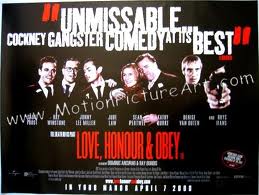
Dee Dee’s big swinging shotgun dick contradicts the analysis of gangster movies offered in Love, Honour, and Obey, a cross between a gangster film and Four Weddings And A Funeral which marks, arguably, the nadir (to date) of this British cycle. Ray Winstone in this one found himself among an absurd cast of would-be tough guys like Jude Law and Rhys Ifans, and luvvie molls Sadie Frost and Denise Van Outen. As one so-called hardman explains: “Women fuck it up in the end,” no double entendres intended, but all of them understood. L,H, & O also featured Kathy Burke dragging Ray Durdis’ impotent gangster to sex therapy. You couldn't make it up, except they did!

Back in Sexy Beast Spain, despite DeeDee’s taking care of business, Gal still must return to London. The big caper has been organised by crime lord Teddy Bass (Ian McShane, who's the most convincing thing in the film), in elaborate revenge for being buggered by bank chairman Harry at some Cliveden-style society orgy. Harry is played by James Fox, who’s wandered in from a remake of Performance, and we all know what that signifies. And did you happen to notice that the working class crime lord so offended by the upper class’ polymorphous perversion is named Teddy Bass, or Teddy Be Ass. I warned you.

How do Teddy Be Ass’ villains revenge themselves on gay Harry? They assemble, naked in a Turkish bath. Do I need to draw you a picture? In case I do, they penetrate the backside of the bank with a giant dildo of a power drill, shades of Thunderbolt and Lightfoot, an American buddy picture which wore its sexual role reversals on the sleeves of the dress Jeff Bridges had to wear. When Teddy B. Ass's boys break through into the vault, it releases a huge spurt of water. The naked gangsters swim up the tube and grab Harry’s jewels. Gal stuffs some earrings for DeeDee into his bikini, thus providing himself with the set of the family jewels he lacks. Teddy, having raped Harry’s vault, then shoots Harry in a needless bit of literal overkill. He drops Gal at a bus stop, paying him a tenner like a used hooker, knowing the secret of his shame is safe with a Gal. It’s a buddy movie gone haywire. Having, like Teddy, proved he’s NOT homosexual, Gal can now return to Spain, give DeeDee the family jewels, and enjoy a eunuch's retirement, accepting his femininity, frolicking on top of Don’s body in his pool.

Far-fetched? Director Jonathan Glazer claimed the eponymous Sexy Beast was money, but I think he was having us on. The Guardian’s critic Jonathan Romney, without a hint of irony, described Sexy Beast avoiding “the usual gangster geezerisms”. He noted that “above one hard man there is another, then another, then another….”, then pointed out Ian McShane as Teddy Bass played the ultimate man on top, “with a curiously prissy walk”. He thought Glazer might be “trying to cram too much in”. Some of us might suggest that’s the whole point. As I said before: DO I HAVE TO DRAW YOU A PICTURE?

Tuesday, 1 February 2011

MACHETE: CUTTING EDGE EXPLOITATION

Quentin Tarantino has a lot to answer for. Machete, of course, began as a trailer as part of Grindhouse, the parody exploitation film(s), he co-directed with his low-budget emanuensis Robert Rodriquez. It follows almost slavishly the same formula, and with both its knowing pseudo-cheapness and its often referential humour, it's basically very enjoyable. But it's a shallow kind of enjoyment, one tempered by the cloak of irony, of self-awareness, that hangs over the film, like a semiotic critic about to go semi-idiotic on it.

Otherwise, though, what you see is what you see, lots of action, lots of soft-core sex, and some real humour, leavened by some performances by big name actors playing off or with their image, or sometimes hamming it up—and of course Lindsay Lohan as more or less herself.

Machete (the iconic Danny Trejo) is a Mexican cop, lured to a trap by drug kingpin Steven Seagal, who sees his wife murdered and is left for dead in a burning house. When we see him next, he is in Texas, looking for day labour like all the other illegals. He's hired to assassinate a right-wing state senator (Robert DeNiro) but is actually shot himself, while DeNiro is wounded by the same shooter. Aided by his brother (Cheech Marin), a priest, and by local activist Luz (Michelle Rodriquez), and avoiding immigration agent Jessica Alba, Trejo basically uncovers a plot by business man Jeff Fahey, the brains behind DeNiro, to enflame the immigration issue to allow for total border control, which somehow will allow Seagal to dominate the drug trade. And did I mention Don Johnson leads the border vigilantes, and shoots Michelle Rodriquez through the head, a wound whose only consequence is that she gets to wear a cool eye patch?

Along the way Machete gets his vengeance, which includes a mother-daughter threesome on camera with Fahey's wife and drug-addled internet celeb daughter (Lohan, as I said, playing herself). The ultimate shootout is the over-the-top confrontation you'd expect, although Lohan in a nun's suit shooting on the side of the good guys may be too much for the suspension of disbelief to take hold! Rodriquez and co-director, his longtime editor Ethan Maniquis keep the action moving, though characters do morph at will from capable to not. Cheech gets to have fun with his priest wielding two shotguns, and though Alba at times seems to be expecting a more serious role, Michelle Rodriquez really steals the chick side of the film. It's true in spirit to the era of Grindhouse, and it's fun on its own terms. And it's certainly worthwhile to see Danny Trejo get not just the girl, but all the girls. And the best line: 'Machete don't text.' If only we weren't supposed to take it so seriously!

Wednesday, 30 December 2009

TARANTINO'S INGLOURIOUS BASTERDS ON DVD AT CHRISTMAS

British tradition used to reserve Christmas TV for films like The Guns Of Navarone, so it felt somehow appropriate to settle in Christmas night with Nate's two uncles to watch Inglourious Basterds (hence, IB to avoid terminal irritation by spellcheck), which has just be released on DVD (Universal, Dec 2009). The film was hailed as a return to form for Quentin Tarantino (henceforth QT), but it seems to me more of a transitional work, as there are two separate movies pulling at each other here, and when QT finally brings them together, he needs a good twist to make it work. But the set-piece portion of the film works brilliantly, more than enough to carry you through to the end of Christmas evening.

The first and less interesting strand of the film is the story of the IBs themselves, and oddly it is the bit which received the most attention. This is partly because it features the star, Brad Pitt, and partly because of the politics of having Jews massacring Nazis. Those considerations aside, it is also the bit which is very much in the vein of QT's last few films, all of which have been big budget star vehicles which transmute the low-budget shlock he admired in his video-counter days. This one is a hommage to an Italian rip-off of The Dirty Dozen; the IBs are eight Jews and one German led by a red-neck officer from Tennessee played by Pitt as if trying to channel Clark Gable before George Clooney can claim him permanently. Like Clooney, Pitt's approach to comedy is mugging and over-egging, and in this context that almost works. But the whole conceit of this Jewish version of Sgt. Fury going round France scalping Nazis pales after a short while, though one can see why it might appeal to the Weinsteins, who produced it. In the end, the Basterds wind up being primarily a plot device, as their plot to assassinate Hitler is far less interesting than the other one, initiated by cinema-owner Shosanna Dreyfuss, who has escaped massacre herself, at the hands of SS office Hans Landa.

The more interesting story revolves around Landa, played with great relish (and really as a Gestapo officer) by Christophe Waltz. It is, as I said, a series of set-pieces, all of which involve interrogations by Landa in which he twists his interrogees in a kind of verbal torture. These are, at first, the highlights of the film, and by the time they have paled QT realises it and lets the last one dissolve to violence. Interestingly, there is one parallel interrogation by an 'actual' gestapo officer involving the IBs, which recalls the 1940s film OSS, where one character was exposed to the Gestapo when he switched his fork from left to right hand. This scene's shootout foreshadows the massacre in the cinema that is the climax of the film.

As usual, one can see scenes from movie history played with, everything from To Be Or Not To Be to The Eagle Has Landed, and one hears music which is taken from other films, most obviously Ennio Morricone, whose presence also echoes the hommage to Sergio Leone in the title of the film's first 'chapter' 'Once Upon A Time In Nazi-Occupied France'. This is less of a problem than it might seem, because the scenes themselves are brilliantly written and almost as well played.

But it's also because the film is not about war as much as it is about the cinema of war, most specifically the pleasure audiences get from watching large numbers of Nazi bad guys mowed down by their heroes. Its most interesting conceit is a German version of Audie Murphy, a baby-faced sniper whose heroic killing of scores of Americans in Italy is being turned into Goebbels' greatest success as a propaganda film, A Nation's Pride. The soldier, played by Daniel Bruehl, falls in love with the cinema-owner, and gets the Paris debut of the film scheduled for her theatre. And there in a nutshell is the plot. The British (Rod Taylor as Churchill and Mike Myers as the inevitable plan-ridden general) bring British, devise a plan to send a German film scholar, Archie Hicox (Archie Leech, Alfred Hitchcock) to meet up with the German actress who's a British agent, Bridget von Hammersmark, and you can guess where it all goes from there.

The irrelevance of the Basterds themselves to all this is obvious in the way four of them simply disappear from the film, and another pops up again only when Brad Pitt is arrested, with no explanation of where he was or when he was arrested himself. One assumes there was much footage left on the cutting room floor (or intended for a more complex DVD reissue later on—in fact, I saw that Maggie Cheung had a role as the original theatre owner, who leaves the cinema to Dreyfuss, her 'niece'). The only extra in this DVD is a bit from the German propaganda film itself, powerfully effective and every bit as modern as anything in QT's work propre.

In the end, it's only Pitt's Aldo Raine who is willing to settle for less than ultimate revenge, an odd sort of compromise that merely points out the bloodthirsty-ness of all that has gone before. In the Kill Bill films, QT looked at over-the-top violence and cartoonish body counts, and we smiled until we got bored. Here he's looking at the context in which such things are acceptable, and the seriousness of that point is reinforced by the seriousness of the set-pieces, which remind us of the awful reality which underscores all World War II memories.

Tarantino gives Waltz a showcase, though the moment he pulls out the Meerschaum pipe to show he's really not a Jew-Hunter but a 'detective' is more out of Airplane than anything else. Bruehl is excellent also, and Diane Kruger (as Bridget) and Melanie Laurent (as Dreyfuss) are equally good. But the real star is cinematographer Robert Richardson, Oliver Stone's one-time cameraman, who gives the whole production a look which encompasses the history of war movies, as well as casting a lush, dream-like feeling over the whole thing. It gives the film a lustre which helps carry you along, but in the end, like so much else of QT, it's unsatisfying, not stretching you beyond the narrow boundaries of its own exploitation. At least in parts. I await its revival at countless Christmases to come.