Showing posts with label Robert Creeley. Show all posts

Saturday, 29 August 2020

WISHFUL THINKING: A SONNET

It's hard to explain exactly why I seem to be writing more in traditional verse forms. I think it had something to do with writing the obituary, and re-reading while I did, my college professor Richard Wilbur, though I can't claim what I do is anything like his work. It seems I sometimes try to stick to the formal structures, and play with rhymes, while trying to keep the verse within the breath and rhythms of speech, rather than strict meter, something of the continuing influence of Charles Olson and his Projective Verse theories which have influenced me since the late Sixties. Or, as Robert Creeley put it, 'form is never more than an extension of content' which I took to mean the poem takes its own form, and you just try to keep up with what it is doing. I could be very self-analytical and point out how the rhyme scheme changes after the first verse, just as the position of the two people in the poem does, but that might ruin someone else's MA thesis.

Anyway, this poem (and another, currently lurking as Wishful Thinking II, but searching for its own title) was structured from pages of notes I found in a notebook from 2001. I gathered a number of putative stanzas, unfinished quatrains, couplets, and even some single lines, and then put them together into two sonnets. This one came from notes all done at the same time and place, and seems to have more structure as a result, but it fell together when I found a couple of lines from 2013 which
fit eerily into those that were heard 12 years earlier.

The song by Ralph Towner is what I was listening to as I wrote the current poem, but I am sure I was playing it in 2001 as well....


WISHFUL THINKING
                                         (after a tune by Ralph Towner)


As you or I might try to say,
This empty night does not require
That we express even slight desire.
A breeze might blow us either way,

Together, apart, it's all the same,
Though you proceed as if they were
Distinct, thus called by different names.
And we still linked, not sliding further

Away. Confusion's just a slight delay
Til things are meant to work out well.
You pay no notice to what I say.
What you say, well, I’ve no way to tell

What a single word means; your eyes are blanks.
You insist someday I'll tell you thanks.

July 2001, St Jean de Luz/2013 Haslemere

Tuesday, 26 March 2019

W.S. MERWIN: THE GUARDIAN OBITUARY

My obituary of the poet W.S. Merwin went up on The Guardian online yesterday; it should appear in the paper paper soon. You can link to it here, it is mostly as written with just a few cuts for simplicity's sake, which is instructive because Merwin's was a complicated life to unravel. I actually wrote the piece a week earlier, just before I flew to Florida, and did some changes (mostly to clarify publication details) in the airport after I arrived but before I picked up my car and headed for the Everglades.

It was trying to sort the chronology of his relationships and his early work that was the most difficult, especially because things like wedding and divorce dates, maiden names and the like are important for the paper's sense of record. Before I filed I dropped a few things I found interesting, two in particular: his secondary education at Wyoming Seminary, a Methodist-founded school between Scranton and Wilkes-Barre and his relationship with Moira Hodgson. I'd know people who went to Wyoming, which tended to produce high achievers--but it was also interesting because Merwin claimed he applied originally to Princeton thinking it was an actual seminary. I found that somewhat fanciful. Hodgson seemed to be a steadying influence on him; the British-born writer was working at the UN in New York when she met Merwin; they lived together for ten years, mostly in Mexico, and he was still technically married to Dido for at least part of that time. Anyone who's read her food writing would be interested.

I also included a longer list of the fellowships which kept Merwin going through the Fifties and beyond. This ability to win them was the segue point to mentioning his charm, and I thought the idea that he was a successful 'establishment' poet was one that was necessary to make. I also mentioned that when he received the Academy of America Poets prize there was a minor controversy in that he was a Chancellor of the Academy, and the judges, inevitably were all friends.

This was interesting in light of the Great Naropa Poetry Wars. Ed Sanders had his students in 'investigative poetry' do a long report about it, and I think I read something by Tom Clark, who's the poetry equivalent of a tabloid journalist, about it at the time. But what I found fascinating was the way the poetic community divided as I describe, with Merwin representing the establishment, and some Naropans, representing the other side, the underground, whatever. I recall asking Anne Waldman about that at a reading, because it seemed to me the dispute, beyond the defense of students toward Trungpa their master, was one of 'business' of poetry, not poetry itself. She didn't like that question.

But I drifted back to it as I wrote the obit and tried to analyse Merwin's work in terms a general audience might understand. I was trying to draw connections, but apart from the obvious one to Auden (who stylistically, placing words to accentuate their ambiguities, is not as far removed from later Merwin) and the less obvious (but for proximity) one to Lowell, I felt I'd be getting into a kaleidoscope that would mean little to my audience. Merrill and Kinnell I mentioned, and would have liked to elaborate on in terms of their work.

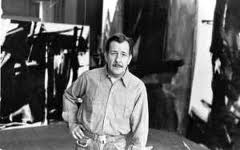
I see links to a lot of the people who might be thought by casual observers to be on the other side of the Naropa wars. Given the obvious influence of Ezra Pound, some of the names seemed obvious. The most telling to me was Robert Creeley, who also worked as a tutor for Robert Graves, and whose work, albeit punctuated, is very similar to Merwin's in style, if someone more grounded in the personal, maybe even the romantic. I thought of Paul Blackburn, not immediately similar in the elegance of the language, but with a sense of rhythms and music that also draws from the Provencal. Merwin at his most elegant reminds me sometimes of Robert Duncan too--again not too close, too exact, but it is easy for me to think that as his own work was changing, Merwin was aware of these people already working in open (and projective) verse, and he is never looked at as someone related to that. The final comparison I longed to make was to Gary Snyder, like Merwin a Buddhist and an early champion of ecology. That's Merwin (above left) with Carolyn Kizer and Snyder, in Oregon in 1966

I was also thinking about Robert Bly, who on the face of it would look like an unlikely comparison, but whose sense of nature, if not the surreal, seemed like a fit. And John Ashberry, close than Duncan but also for the austere sense behind the words. It also occurred to me, after a comment by Helen Vendler, how many American poets were born in 1926-27: she mentioned a couple but the 1926  list includes Creeley, Blackburn, Ginsberg, Merril, Bly and W.D. Snodgrass (whose obit I also had the privilege of writing), A.R. Ammons and Frank O'Hara; while 1927 boasts Kinnell, Ashberry and James Wright. I wondered if this might have something to do with the Depression or the War, or maybe the burgeoning of poetry and new movements in the Fifties, or the growth of creative writing programmes in colleges which provided a living for many of these poets.

The Merwins' work with his Conservancy was also a step decades ahead of its time, and this might in some ways wind up being his most enduring legacy. I wondered, as I filed my copy, if perhaps he would have had a tougher road to success had he been born a couple of decades later, but if perhaps his poetry might have found a wider, more ecologically aware audience. I'm not sure the work would have been as good, but the thought that it will continue to find a new audience from that direction as well as the literary one is a heartening one.

Friday, 15 December 2017

WILLIAM GASS: THE GUARDIAN OBITUARY

My obituary of the writer William Gass is online at the Guardian; you can link to it here. It should appear in the paper paper soon.

Gass' was an unusual one to write, mostly because I felt I had to explain what it was that defined his writing, and why a writer of such immense reputation was so little known among the wider public. I could not escape the sense that much of his writing was in a sense academic; written by a professor, though I really should have mentioned that he taught philosophy, not English or creative writing (he did offer seminars at various points), and it's important to note also how crucial his essays were considered.

Perhaps the fact that his major novel, The Tunnel, one of those big Great American Novels, was so difficult is part of the reason why he is so cherished among some critics, and some writers in the post-modern, meta-fictional spheres, while being dismissed by other critics (I really would have liked to include extracts of some reviews, but space did not allow) and passed-over by much of the general public.

He's often linked with John Barth, whom I both studied and read for pleasure in my college days. I have to confess I liked the 'post-modern' Barth, of The Sot Weed Factor and Giles Goat-Boy more than the increasingly dense 'metafictions' that followed them. Perhaps the deconstruction of language and the demands of narration are more exclusive than theorists suggest, perhaps the novel wants to extend beyond itself. Gass' special talent was in being able to do that while bringing his story out, so that the work became a metaphor of the story. "Form is never more than an extension of content", Robert Creeley said. Where many would reverse the aphorism for Gass, I think it rings true as it is.

Monday, 23 January 2017

CY TWOMBLY: CYCLES & SEASONS (TATE MODERN, 2008)

Note: I originally posted this at my irregular art blog, Untitled: Perspectives (On Art 
back in August 2008. I should have migrated it here before now, but as I am headed to Houston soon and hoping to visit the Twombly Gallery at the Menil Collection, I thought it would be nice to reacquaint myself (and you) with the artist now. I will also be writing about him at some point soon in connection with the recently finished Abstract Expressionist exhibition at the Royal Academy.... 

The best art exhibitions are those which open your eyes to something you haven't seen before, and Cy Twombly: Cycles and Seasons, at the Tate Modern through 14 September is one of those. It forced me to re-think and come to a whole new appreciation of Twombly's art, which was never as strong for me as, with hindsight, I can see it probably should have been, given his background at Black Mountain College, and his close association with so many people whose work I have found centrally important.

Part of this is context. The single Twombly encountered in a gallery may seem pleasant, but often gives off an unfinished, almost fragile, quality. A single Franz Kline can overwhelm you. But seeing Twombly's works in groups, in rough chronological order, and watching what he does with the elements of squiggles and words, with colour and with the physicality of brush and pen strokes, reveals the powerful emotion which becomes more explicit in some of his later works, particularly the two Four Seasons sets on display.

It's easy to see in Twombly's work the theoretical foundation of Black Mountain poetry, as articulated by Charles Olson and Robert Creeley, that 'form is never more than an extension of content' (which I've always taken to mean 'should never be more'), and that 'one perception should lead immediately to another'. Although his pencil stokes are often seen as subverting Pollack's calligraphic gestures, some of the paintings in the exhibition's first room, notably 'Tiznit' (1953) suggest something halfway between Creeley and Kline, with whom Twombly studied at with Black Mountain. The heavy whites and blacks give way to seeming doodles, as if Creeley had stopped by to write a short poem on a Kline canvas. By 1955's 'Criticism' the marks actually do seem like writing. 'Poems To The Sea' (1959) carries this even further, and I found myself again thinking of Kline, this time crossing his work with Olson's more epic writing.Kline worked in black and white for most of his career, and there's sense here in which Twombly seems wary of colour, as if not trusting, at this stage, its intense, uncontrollable emotionalism.

By the start of the 1960s 'Crimes Of Passion' and 'Murder Of Passion' move in a different direction, discarding the pencil-strokes for smears of paint which suggest both passion and anxiety, and not a little eroticism, expressed in hints in representational painting, reminding me of DeKooning. Perhaps it was a reflection of Twombly's move to Italy, set free of American context, and confronted with the heat of Italian summer in Rome. Within this, references to classical works, like 'School Of Athens' homage to Rafael, suggest an elegance that somehow doesn't seem to fit. When 'Ferragosto' (1961) adds a rusty red to his palette, it seems more than thousands of miles removed from the effects of pencil lines around strong blacks and whites. All these elements begin to merge in his 1969 paintings, made in Italy, whose calculations reflect his experience as a cryptographer in the 1950s, while celebrating the moon landings. It's a mix of American pragmatism and European classicism, and it works brilliantly. There are graphs, diagrams, geometric forms, but there is still an overarching asceticism which suggests someone learning from the past while being overcome with the future.

There is an element of challenge involved here too. Twombly's was the generation immediately following the abstract expressionists. Their emotionalism was replaced by the cool stylings of pop art, and have evolved into the heavily ironic commentaries of the modern world. Twombly, in sense, reminds me of Richard Diebenkorn, convinced the concerns of the artists he grew up with were valid, and looking for new means of executing them.

But the real fulcrum of the show comes with the next two series, starting with 1970's 'Treatise On The Veil'. It is minimalist, a grid structure of repeating rectangles, adorned with measurements; one in black and the other, opposite, in gray. It suggests the music of Philip Glass, and apparently were influenced by Muybridge's photos of a bride in motion. But looking at the shades of gray and black, and the strong brushstrokes, I was reminded of late Rothko, and it struck me that these slabs on their ends were like drawings for a Rothko mural, and that they may have been inspired, or influenced, by Rothko's suicide. Certainly they carry the same kind of quiet impact of the Tate's Rothko room, which at the moment is closed while the major Rothko retrospective is being prepared.

My feeling of elegy continued and was amplified in the next room, which contains 'Nini's Paintings', a response to the death of his Roman dealer's wife. Their mood takes the melancholy of the 'Treatise On The Veil' and transforms it to a sense of frustrated rage, like someone scribbling lines that make no sense because there is nothing useful to say. There is nothing minimalist or repetetive about them, there are no sombre grays or blacks. The brush strokes that were backgrounded in the Treatise, creating a deep atmosphere, are now in the foreground, like chaos released.

If I find those works a peak in Twombly's career, it's also evident that his work progressed on both the intellectual and emotional levels, and his white sculptures of found material seem almost like a relief. 'Two Squares' recalls Joseph Albers, another leading light of Black Mountain, and when the exhibition returns to painting, there is a greater exuberance, a more daring sense of control. By now living on the Tyrrhenian sea at Gaeta,his work begins to engage heavily with the sea, both in 'Hero and Leandro' where the waves become ever-increasingly harsh strokes of the paintbrush, and 'The Wilder Shores Of Love', whose sea effects in gray Turner might even admire.

Although the nine paintings of 'Untitled' were done for the Italian pavilion at the 1988 Biennale, and reflect 18th century Venice, they mark a progression from light to dark, in which again I find echoes of the Treatise, almost an allegory of life. Something that makes sense in light of the two versions of 'The Four Seasons' which move from the energy of Spring to the gathering darkness and pale light of Winter. Oddly, all the reproductions at the Tate are of the later version (1993-95), but I found the earlier one (1993) more powerful, particularly in the dying bursts of yellow that drop through the blacks on one side of 'Inverno' (Winter). (It's the later version of 'Inverno' which is pictured at the header of this essay).

The exhibition's end, Bacchus (2005) with its estatic vermillion ooze, came as a sort of winking coda to this, confirmation that the viewer had completed the kind of emotional journey those late paintings describe. It's a journey that reflects the progress of Twombly's art; an art concerned with perception and expression. Twombly's work, seen as a progression, takes on a modest, intellectual sort of power, unmistakably a searching for the right way to give emotional power to his apprehension of the world around him. It's a brilliant show, from a painter who's now the last,and maybe just being recognised as one of the greatest, of a crucial American generation.

Footnote: A couple of days after seeing this exhibition, I sat in as the analyst on Channel Five's Major League Baseball show. I mention this because Cy Twombly's father, also named Cy, was a pitcher in the major leagues, probably the second-best ever named Cy. The best, Cy Young, lends his name to the award for baseball's best pitcher. Baseball was surprisingly important to the people at Black Mountain, see Fielding Dawson's writing, particularly 'A Great Day For A Ballgame' (he also wrote 'An Emotional Memoir Of Franz Kline'). The abstract expressionists were always trying to prove they were red-blooded Americans, not longhaired eggheads or effete artistes. Moving to Italy was certainly a way for Twombly to get away from that need, perhaps from his own legacy. My own expat experience has been the opposite, as I always keep getting drawn back to sport as a profession, or part of it. As it is, moving from Cy Twombly to Cy Young doesn't seem unusual, their coexistence doesn't strike me as unnatural, though lots of people out there still think it should be!

Tuesday, 26 July 2011

KLINE AND DEKOONING: A 1995 RE-EVALUATION

I've just posted an unpublished essay I wrote in 1995 about the Abstract Expressionist painters Franz Kline and Willem DeKooning over at Untitled: Perspectives; you can link to it here. Kline, of course, has been one of my favourites ever since I discovered art--the poster for that 1994 Whitechapel show is sitting over my shoulder as I write this. Part of that was the Black Mountain connection: I read Fielding Dawson's Emotional Memoir of Franz Kline, and it was easy to see the way Kline's work reflected or was reflected in, the poetry of Charles Olson and Robert Creeley, just as those influences were reflected in the work of Cy Twombly. So pop over to the other blog and see what I was talking about then...

Friday, 20 November 2009

JACK O'CONNELL'S BOX NINE: A Forgotten Friday Entry

I'm revisiting Box Nine specifically because O'Connell is in Britain to promote his latest novel, The Resurrectionist, but more generally because it is hard to believe that a novel which won the then prestigious $50,000 Mysterious Press First Crime Novel Prize, and which has been followed by four books full of both invention and erudition, should even spring to mind as being overlooked today. But Box Nine appears to be out of print in America, and although The Resurrectionist may be his best book yet, it has not received anything like the attention it deserves.

Box Nine, like all O’Connell’s novels, is set in Quinsigamond, which is based geographically on Worcester, Massachusetts (where O'Connell lives) but is a futuristic fantasy of a mill town crossed with the Blade Runner LA of cyberpunk novels. In Box Nine there’s a new drug around town, called Lingo, which gets you speaking in tongues but also drives you to fiercer rage than the worst crank you ever saw. The high is great, but the price is high.

Connections to Vonnegut’s Ice-Nine are obvious, and also to Naked Lunch, which first posited language as a viral infection, and addiction. Language, in one way or another, has been at the heart of all O'Connell's work. When Box Nine first appeared, I noted O’Connell’s most relevant influences appeared to be the early Thomas Pynchon, concerned with issues of entropy, the early Don DeLillo, apparently concerned with early Pynchon, Julio Cortazar’s Hopscotch (and the Borges who inspired Cortazar) and of course Blade Runner, and its source material, Philip Dick's Do Androids Dream Of Electric Sheep?

This may have seemed a strange mix to apply to a small city in central Massachusetts, however fantastically it is imagined, but it does work, particularly because O’Connell’s alternately manic and dreamy prose echoes not only the effects of Lingo, but his concerns with the uses and abuses of language itself. I am amazed this guy is not being taught in post-modernist English Departments all around the world.

Leonore Thomas is the drug cop investigating Lingo. Problem is, she’s a thrill-seeking speed freak gun fetishist who might be more at home on the other side of the fence. In a city torn apart by ethnic gangs, the big drug lord is Cortez (Cortex? Neil Young's Cortez the Killer? Keats' 'stout Cortez'?) and the microcosm of society O'Connell presents is more like a slide full of bacteria wiggling under a microscope. It works as a crime novel, it works as a 'mainstream' novel, it works as a cult 'slipstream' novel. The bottom line is, it works.

O’Connell is one of those writers who can bend his prose to what he’s doing. There aren’t many of them around. It's form as an extension of content—and it wasn't a surprise I discovered Robert Creeley as one of his earlier influences. I, and other reviewers, keep comparing O'Connell to so many great writers not because he's derivative, but because he's unique, the kind of writer who makes you want to compare him to those other great writers who've blown you socks off with your first hit. Sort of like Lingo. And now I try to compare his career path, and I find no one close to the same, perhaps Joseph McElroy or someone else you probably haven't heard of either, or maybe Donald Harington, most of whose books were set in his own fictional Arkansas (see my obit of him here). But he's the real deal, and Box Nine is the place to get that first hit. No Exit Press have kept him in print in the UK, and their cover for The Resurrectionist should be one that attracts the kind of 'sophisticated' general readership who perhaps might pass by the book were it billed as crime. Their cover for Box Nine was a beauty too: Dick would have loved it. At least one publisher gets it.

Box Nine No Exit Press 1998 (second edition)
ISBN 9781901982275

The Resurrectionist No Exit Press 2009
ISBN 9781842433065