Showing posts with label Ron Rosenbaum. Show all posts

Monday, 20 March 2017

JIMMY BRESLIN: THE GUARDIAN OBITUARY

My obit of the newsman Jimmy Breslin is up at the Guardian online, you can link to it here. It should be in the paper paper soon. It is pretty much as I wrote it, and what has been left out is what I needed to omit for space, and in consideration of an audience who were not familiar with his work. Luckily, I was writing for an audience of journalists, who understood it well.

One trim was the best quote I'd found about Breslin, from the Village Voice's ace muckrakers Jack Newfield and Wayne Barrett. It would have preceded the story that led up to his 2002 book about Eduardo Gutierrez. They had called Breslin "an intellectual disguised as a bar room primitive" and that was in many ways true. Damon Runyon was certainly his model, but his writing drew on a lot of literary sources, not the least of them Dickens, as well as endless hours on the phones and in the bars, and endless days with people.

The other I missed was the story of his jumping into a cab to cover the race riots in Crown Heights in 1991. When he cab got there, rioters pulled him out and beat him seriously, leaving him with, as he wrote, only his underwear and press card. He wrote that from the scene, calling in his copy before being patched up, as cops stood by. "How do you like your friends now?" they asked.

I probably should have stressed the hard reporting he did as well. I did mentioned he'd won a Polk award in 1985 for metro reporting. His 1986 Puzliter cited his AIDS story, but in 1986 he had also brought down Queens borough president Donald Manes in a payoff scandal; Manes would commit suicide a few months later.

I had also given his wives a bit more prominence. When he married his second wife he moved from Queens to Central Park West, began swimming every day, and as I mentioned stopped serious boozing after that bender with Moynihan. I couldn't get into much detail after the cast of Runyon characters he was often accused of gilding, if not inventing, in his stories. And I would have liked to have examined the nature of the Irish-American reporter: Breslin and Pete Hamill and so many others in their trench coats and tweed hats. But that's another essay. As might be his campaign with Norman Mailer, but Breslin wrote that one himself in Running Against The Machine (1969).

I had mentioned his nomination for a Golden Turkey award for his role in the 1978 movie If I Ever See You Again. He had a brief late night TV interview show on ABC, but he was no Studs Terkel; his skill at drawing the stories out of people in print didn't translate to the screen. When he got fed up with the network he bought an ad in the New York Times announcing that when his contract was up he would quit. I had also discussed the argument he had with a woman in the Newsday newsroom who accused one of his columns of being sexist, and for which (the argument) he was suspended. He took his case onto the Howard Stern radio show, not a bastion of feminist sensibility.

He was direct. I didn't speculate about his childhood, but his father literally walked away from the family: went to the store one night and never came back. In a different context I might have used the story the New York Times used, but it didn't fit my piece, and besides, they'd used it. But I'll repeat it here, verbatim from Dan Barry's obit:

after Mr. Breslin had become famous, his father, destitute in Miami, came back into his life “like heavy snow through a broken window,” he wrote. He paid for his father’s medical bills and sent him a telegram that said, “NEXT TIME KILL YOURSELF.” 

And I wanted to use this quote from Ron Rosenbaum, who called him "one of the great prose writers in America. Period." Asked for his favourite Breslin line, he quoted this one: "somebody always hangs out at a collision shop." Think about it.  RIP.

Saturday, 8 October 2011

THOSE HILARIOUS GUYS ON THE SUPREME COURT

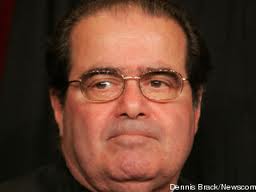
There was a fatuous piece on Slate (you can find it here) which I just happened to spot while reading Ron Rosenbaum on Long Island serial killers (don't ask) by one Dahlia Lithwick, which said that Supreme Court justices Stephen Breyer and Antonin Scalia ought to take their double-act on 'Living Constitutionalism' (something of an oxymoron itself) on the road, and put TV cameras into the Court, after their boffo show before the US Congress. According to our solons, and Lithwick, the guys are funny! Here's how she explained it:

The bear joke is a Scalia classic. (Patrick Leahy, chairman of the committee, confirms that he’s been telling it for years.) “The story is about the two hunters who are out in the woods in their tent and there's growling in the brush near them,” Scalia told the committee. “And they open the tent flap and there is a huge grizzly bear and they start running. … And—and the guy who's a little heavier and he's running behind, he says, ‘It's no use. We're never going to outrun that bear.’ And the guy who's running in front says, ‘I don't have to outrun the bear. I just have to outrun you!’ ”

As the Senate chamber dissolved in laughter, Scalia sharpened his point, just in case no one got it. “It’s the same with originalism,” he said, referring to his preferred theory of constitutional interpretation. He doesn’t have to prove that it’s the best theory. Gesturing toward Breyer, Scalia said, “I just have to show it’s better than his.”

Nobody expected any less. But the two justices killed before the Judiciary Committee, raising the question anew: Why don’t they do this every week? Why are they hiding this great light under a marble bushel?

Great light? Lithwick wrote Scalia 'sharpened his point in case no one got it', but never realised he'd ALREADY done just that. The punchline of the joke is 'I don't have to outrun the bear!'. Period, full stop, end of joke. 'I just to have to outrun you' is EXPLAINING the joke, and this also explains in a nutshell what is wrong with Washington--that someone who twists the consitution into tantric pretzels for his own ideological gain can tell an old joke, so old it's been used in television commercials, and tell it badly, and thus can be presented by the chatterati within the Beltway as the 'great light' who will get people to 'believe' in the Supreme Court again! Like cameras would reveal some hidden sympathy in the judges, or indeed, reveal Clarence Thomas actually saying anything during the Mudville Nine's deliberations.

Maybe if the Roberts/Scalia Supreme Court occasionally ruled in favour of 'the people' then those people might start to believe in it? And they could leave the jokes to Henny Youngman.

Saturday, 4 June 2011

'DR. DEATH': JACK KEVORKIAN'S GUARDIAN OBITUARY

My obit of Dr Jack Kevorkian is up on the Guardian's website, you can link to it here. It's hard to know exactly what to make of Dr Death, and perhaps one can make too much of his defense of Nazi doctors in concentration camps, but it is hard to escape the feeling that he was, at heart, a badly-adjusted obsessive, and it is easy to see that like many obsessives, he was capable to great compassion to individuals but had great trouble extending it in theory. I called him the 'Ralph Nader of Death' in my copy, but that was cut from the piece as used.

I also wanted to try to compare him to William Burroughs, not just for their asceticism but for their attitude to death--but that was the stuff of a literary essay, not an obituary. It was telling that Kevorkian became a popular talk-show guest even as he was disavowed by most of the assisted-suicide community.

The Barry Levinson HBO film with Al Pacino sounds interesting, but on the face of it I get the feeling that Pacino's hot emotionalism might not be right. If he did 'crack' Dr Death, it would indeed deserve an Emmy.

And it was also fun to revisit Ron Rosenbaum's essay, Travels With Dr Death, which became the title-piece of his first, and probably best, collection of journalism. It was when he was really at his peak as an essayist, and Kevorkian provided him with the perfect fodder for one of his exegeses, almost a religious interpretation while being both perceptove and entertaining.

I also found myself wondering if a wrestling match between Kevorkian and Dr Sam Sheppard might have had any legs?

Saturday, 26 June 2010

HITLER AND GELI: KRIS RUSCH AND HITLER'S ANGEL

Adolf Hitler was unlucky in love. But not half as unlucky as his women. Maria Reiter, just 16 when Hitler first approached her, tried to hang herself, but was saved by her brother. The actress Renate Mueller jumped (or was thrown) from the window of a sanitarium. Eva Braun tried to kill herself in 1932, before she and Adolph celebrated their 1945 marriage with a joint suicide the next day. And, in 1931, Hitler's niece, Angelika 'Geli' Raubal, daughter of his half-sister, was found dead from a gunshot wound in his Munich apartment. That death too was ruled a suicide.

The question of whether it was suicide or murder, and if the latter who committed the crime, is at the core of Kris Rusch's Hitler's Angel, originally published in the US in 1998, and now reprinted here by Max Crime, part of that list's adventurous mix of new work and reprints of lesser-known titles. This may be the best so far, a serious novel structured around the reminiscence of a long-since retired Munich detective, Fritz Stecher, famed for solving one notorious murder, but trapped in the politics surrounding Geli's death.

This was the time when the Nazi party was starting to make its impact on German politics, when the country was polarising between left and right, and brown shirts fought street battles with communists, and left a trail of enemies dead. Rusch does a good job of catching the chaotic and uncertain political atmosphere, if only second hand, as the novel is structured as Stecher's telling his tale to a young American student, researching his earlier success as a detective, and set against the 1972 Munich Olympic games. That setting ought to serve to remind us only 36 years had passed since the Berlin games, only 27 since the end of the war, yet it was a whole new world opening up. To be honest, Rusch doesn't make enough of this, mostly because the character of Annie, the student, is allowed to develop only in reaction to Fritz, and serve as his springboard.

Part of that relates to her resemblance to Fritz's wife, lost to the depravations of Germany in the years immediately after World War I, and here, subtly, is the strongest contrast of all in the book, between Fritz's controlled grief and the furious bitterness of the NSDAP, a bitterness which was shared widely enough in Germany to help vault them into power. This is Fritz's internal story: Rusch might have wrung more atmosphere out of Munich in both 1931 and 1972, but basically this is a book set in two places; Fritz's dingy apartment in the latter year, and Hitler's luxurious flat in 1931.

Geli's death was ruled a suicide without an autopsy being performed. Hitler was well alibied, but rumours abounded. His relationship with Geli had already been the object of salacious speculation in the anti-Nazi press, and there was no shortage of enemies, even within the party itself, who would have an interest in framing Hitler, or simple creating a scandal around him. Again, one might have liked to see more made of some of the potential suspects, Otto Strasser and the like, but the book's focus, via Fritz, is obviously on Herr Hitler himself.

Ron Rosenbaum once called this moment 'Hitler's Chappaquidick', while reviewing Norman Mailer's The Castle In The Forest. Rusch credits Rosenbaum's Vanity Fair article with triggering her interest in the case; given the timeline it's not unreasonable to think it had a similar effect on Ron Hansen, whose novel Hitler's Niece appeared the year after Rusch's. He also may be the man to blame for Mailer's never getting around to the promised continuation of his massive CIA novel, Harlot's Ghost; Mailer apparently got distracted while reading Rosenbaum's exceptional book Explaining Hitler, from which the Vanity Fair article was extracted. The book is an exegesis of studies of the 20th century's icon of evil. Rosenbaum, a natural skeptic, found most of them reductionist, that is, attempting to somehow get to the root of Hitler's evil, while leaving out the wider political, cultural, or social factors behind the Nazis. So it was with the Geli case. Attesting that he wanted to find Hitler guilty of the crime, he found himself unable to prove any such thing. In fact, although alibis are alibis, he performed a ruthless dissection of Ronald Heyman, who had previously made the strongest case for Hitler as Geli's killer. But the story goes deeper than that, because the nature of Hitler's alleged perversions, mainly coprophiliac, provides us with a motive, not only for him as killer, but for his supposed lovers as potential suicides, and, of course, for the deaths of millions in Europe.

This would appeal to Mailer, of course, who believed firmly in the power of male sexuality. In Oswald's Tale he had theorized that, had Marina Oswald actually put out for Lee on the night of October 21, 1963, JFK might not have been shot. Rosenbaum dismisses the idea that such ideas might be meaningful, but Rusch has Fritz merely drop them in to suggest why Geli might have been dissatisfied, why she and Hitler might have fought, and why she might have died. But again, this sexual and psychological deep focus underestimates Hitler, as surely as Hindenburg and Von Papen and so many others did on his rise to power and to domination of Europe.

The real suspense in Rusch's book comes as she builds up to two revelations, the big one as Fritz gets closer and closer to Hitler himself, and the other as we learn about Fritz's own life. In this sense we are like Anna, forced to move at Fritz's pace and accept his version, but perhaps not conclude that, even were Hitler the killer, and even had he been found guilty, that Germany would have moved in a different direction. That is an even more interesting piece of speculation.

Rusch has written novels under six different names, some just variations of her own name, but as far as I can see this is the only one published as Kris Rusch. It's a good enough book to deserve that special status, and it's a boon that Max Crime have brought it back into print.

NOTE: This review will appear also at Crime Time, www.crimetime.co.uk

Tuesday, 14 April 2009

AMERICAN EYE LOOKS AT LA OUTLAWS and CHINATOWN BEAT

My latest American Eye column has been posted at Shots, you can find it here. It's discussing two novels with no UK publishers: one by an old favourite of mine, T. Jefferson Parker's L.A. Outlaws,and the other, Henry Chang's Chinatown Beat, which was touted in a column by Ron Rosenbaum. It doesn't quite live up to Rosenbaum's hype, but it's not bad, as you'll see.