Wednesday, 25 July 2012

THE UNBEARABLE SADE-NESS OF BEING


Note: I recently found the draft of this article, as faxed (remember that?) to the Financial Times, attached to a clipping of the piece as it appeared, in somewhat different form and with a different title, in January 2001 in the FT's Saturday arts section. It was a rewrite of a piece I'd originally written after the London Film Festival in October 2000, expanded to take into account the re-release of Salo and the various books mentioned. Although looking at it now it seems to suffer from a bit of Millennial Overload, it still seems relevant, especially because in the past decade I don't see any big changes, either in interpretations of Sade or in the world that interprets him. On the other hand, I will confess to a certain Marquis OD a decade ago, and re-reading this essay hasn't changed that!

THE UNBEARABLE SADE-NESS OF BEING

The idea of the Marquis de Sade as a spiritual poster-boy for the fin of our siecle may take some beating, but here we are in Stanley Kubrick's 2001 and after two centuries of demonisation as a pornographer, and after reinventions as both revolutionary and counter-revolutionary, we are suddenly confronted with yet another deconstruction of Citizen Sade. This time it's as Celebrity Sade, a posh bad boy born to epater, a sort of Jacobin cross between Damien Hirst and Will Self.

Sade has been reimagined more times than Frankenstein's monster, but presenting his life as a Hammer horror film is one of the more striking features of Quills, the film by Philip Kaufman (The Right Stuff, Invasion Of The Body Snatchers, The Unbearable Lightness Of Being) starring Geoffrey Rush as the Marquis, which received its world premiere at the London Film Festival in October 2000, and which opened in London in January 2001. Set during Sade's famous stay at the asylum of Charenton, it climaxes with a burning castle scene whose parallels with Frankenstein's mindless peasants destroying that which they cannot understand is hardly lost for subtlety.

At the same time, Sade the monster is also presented as Sade the artist, persecuted for his avant-garde vision in Sade, by the French director Benoit Jacquet, which also premiered at the LFF last autumn. In Jacquet's film, Sade, played by Daniel Auteuil, is shocked to discover his philosophy of excess translates badly into the political arena. Of course this was a point rammed home, so to speak, a full quarter-century ago by Piers Paolo Pasolini in his Salo: 120 Days Of Sodom, which fortuitously enough was also re-released in January 2001.

Yet positioned between the traditional poles of literary pioneer and misguided sexual madman, something about Sade obviously resonates within our own obsessions with media-hyped art and spin-doctored politics. 'He's such a useful millennial figure,' says Doug Wright, who adapted the screenplay of Quills from his own play. 'His extremes provide a way of examining culture in a time of chaos, millennial chaos. It's no coincidence there were five new biographies of Sade published in the 1990s, and each presented a radically different portrait.'

Wright's Sade suffers persecution at the hands of philistines. Indeed, our first view inside Charenton reveals that Sade's fellow inmates are busy inventing both abstract art and atonal music, more than a century ahead of schedule. When Wright wrote his play, which won a 1995 Obie Award for off-Broadway success, he was originally addressing funding controversies within America's National Endowment for the Arts. 'I wrote it to join the debate over artistic freedom,' he says. 'The NEA issue faded but last year (New York) Mayor Giuliani's attempts to ban the Saachi collection from the Brooklyn Museum kept it timely'.

Also timely were the persecutions of America's own Presidential libertine, which convinced Michael Caine to take the role of Sade's inquisitor and tormentor. 'Kenneth Starr's pursuit of Bill Clinton gave us a little more relevance,' says producer Peter Kaufman. 'Michael was sold after he watched Starr facing the press with his inappropriate little sadistic smile. “'I hate Starr—I'll do it!'”, he said. Thus the French Marquis becomes a metaphor for American politics being reduced to sexual burlesque.

Sade proceeds down a similar path but in a more philosophical French way. Set in 1794, during the Reign Of Terror, it has Sade imprisoned at the wonderfully named (for English-speaking audiences) Convent Pricpus, which eventually becomes the site of mass graves for victims of the guillotine. The film opens with Auteuil shrinking away from the sight of the guillotine in action, disillusioned to the point of despair by the excesses of Robespierre, who's played as a somewhat harsher version of Foucalt, bending the world to his own political post-modernism. Saved from the chop himself only by his mistress's whoring herself to Robespierre's assistant, Sade's libertine reputation assumes the mien of an existential response to hopeless absurdity. Unlike theatre of the absurd, however, in this case the absurdity is political.

Interestingly, in neither Quills nor Sade does the Marquis get up to much in the way of the high-jinks for which he is celebrated, apart from Auteuil receiving a few lashes from the gardener. Auteuil's Sade resists nobly the advances of an aristocratic adolescent who wishes to be deflowered before she faces the guillotine; Sade grants her wish but arranges for the busy gardener to act in his stead. Quills seems to hold feminine sexuality in even less regard than Sade did; the film opens with a guillotine scene similar to Sade's, but here presents a woman's seeming pleasure as pain only when the blade actually descends. Meanwhile, Rush's Sade seduces only through his words, and, in contrast to Caine, is remarkably non-sadistic. It's as if he wants to be able to tesitfy to the Directorate: 'I did not have sex with that woman, Mlle. X'!

It's hard to see the last generation's Sade so neutered. In Peter Weiss' play Marat/Sade (filmed by Peter Brook in 1966) Sade the revolutionary threw his revolution back into the faces of the aristocracy who came to see his plays performed by his fellow inmates at Charenton. For Pasolini, Sade was the original blackshirt, drawing the parallel between class domination and individual domination in both sadism and fascism.

As Doug Wright noted, the rebirth of our new Marquis has been underway throughout the past decade. Donald Thomas, in his 1997 biography, saw Sade as a revolutionary of sorts, torn between aristocratic boredom and lechery, as if he were breaking down the barriers of society merely to more freely abuse the lower classes in his quest for libertine fraternity, if not equality. More tellingly, Francine du Plessix Gray in At Home With The Marquis de Sade (1999) drew on Sade's letters to show his being shaped uniquely, and controlled throughout his life, by women, transforming him into an early sort of whipping boy for feminism. For Gray, Sade's writings were responses to the constraints imposed by his wife, his mother, indeed, by society itself—in the classic metaphor of women standing for societal bounds. This is reflected in Sade's prison letters, collected and translated in 2000 by Richard Seaver. There one senses little more than a naughty boy being alternatively spoiled and punished by protective mother figures. For Gray, this translates into Sade stepping forward as a sort of prophet of life-style as politics.

Which makes the 'Carry On Marquis' humour of Rush's performance in Quills all the more apt. In a scene Philip Kaufman asked Wright to add to the film, DeSade welcomes his tormentor to Charenton with a play poking fun at the man and his young bride, whom Caine has literally purchased from the nuns who raised her. While it echoes the play-within-a-play confrontations of Marat/Sade, this is a personal confrontation: if not Kenneth Starr, Sade has become Jerry Springer: Next On Marquis!: Church Sells Child Brides To Powerful Men!

Wright points out that the plays Sade wrote at Charenton were actually 'toothless romantic comedies...he always hoped for mainstream acceptance as a popular playwright.' And he might well have finally achieved that goal. Sade reborn as popular mainstream entertainer? In a sexually obsessed society that sees Anne Robinson or Chris Tarrant as personifications of sadism, we may well get exactly the Marquis De Sade we deserve.

Saturday, 14 July 2012

HOW BLACK WERE MY HAWKS


I didn't pay much attention to DC Comics 'New 52' promotion last year, in which they relaunched and reinvented 52 of their titles. It seemed too much like an exercise in forced marketing, like a soccer team creating a new jersey for its supporters to have to buy. But Barry Forshaw remembered that I had once written fondly of Blackhawk, so he forwarded the first two issues of its reincarnation—I read them and didn't like them very much, so I didn't bother to write about them then. But I was reminded of the new Blackhawk when I recently read Howard Chaykin's Avengers 1959, which seems to be a new concept design from Marvel, called The Heroic Avengers, very much like the DC idea of reinvention. In a nutshell, it seems more a marketing tactic, designed to use existing 'brand names' to sell new stories, rather than create new characters for their own stories.

The connection, of course, is that Chaykin was responsible for a remake of Blackhawk as a mini-series in the mid 1980s (which itself followed a similar sort of revival by Mark Evanier) which succeeded in the sense of establishing a slightly different background for Blackhawk himself and a more up-to-date approach to the ethnic melting pot that was his squadron, with the 1940s stereotyping disappearing--Chop Chop in particular had to be recast as something more than a comedy figure.

The New 52 Blackhawk has literally nothing to do with its namesake, apart from the idea of a muilti-national group. Oddly enough, although we are supposed to have moved on from those days of ethnic stereotyping, the group features The Irishman, who seems to be a red-headed, cloth-capped cross between Wolverine, a leprechaun, and Colin Farrell. Their eyrie seems to be sponsored by the UN, more Tracy Island than Blackhawk Island, and the group includes Canada, Ukraine, Japanese, Hungarian (or at least Hun) and so on. There isn't a lot of character-building done in the first two issues; it's primarily action-oriented, as you'd expect, and Graham Nolan and Ken Lashley's art, reminiscent of Gil Kane, is perfectly suited for that. Oddly enough, Lashley's cover for issue 1 has a Chaykin-esque Lady Blackhawk, complete with eyepatch. The original Blackhawk, from its Will Eisner-Bob Powell days and through Reed Crandall, benefited from great art which helped make up for its lack of super-heroes.

It made me long for the old days. Realistically, the Blackhawks make more sense as a World War II outfit, and indeed Chaykin's speciality seemed to be period pieces (his Shadow, of course, being the best example, and note the pose with the twin .45s, in the Chaykin cover pictured on the right) and proof they could work. But it would not be impossible to revive the storyline in a modern context; it's just that this high-tech Mission Impossible version is lacking in the character development, even in caricature, which made Blackhawk work.

Here is what I would have suggested, had not this remake been killed almost immediately. The group should be fighting, primarily on the ground, but with some air (or helicopter) element, as an anti-terrorist outfit. It should be made up of soldiers who are refugees themselves from the ethnic and religious conflicts of the past two decades: Russian, Chechnian, Bosnian, Serb, Kurd, Yemeni, Sudanese, South African, Sri Lankan, whatever, which would open the opportunity for plenty of internal conflict, and they should be engaged in missions which raise ethical as well as tactical questions on the ground. They could battle pirates and kidnappers as well as terrorists, drug barons and corrupt oil companies as well as fundamentalist tribesmen. The stories would need to have some edge, and with any luck the Army would not want to advertise in them. It's a thought.


As I said, I went back to the New 52 Blackhawk because I came across Chaykin's Avengers 1959, which is supposedly a period piece itself, though it doesn't really create much of a Fifties feel. The choice of time-frame is interesting in comic book terms, because the new-style Marvel superheroes come along only a couple of years later, and I was really surprised we didn't get a more mundane sort of 50s setting, rather than one that could just as easily be today.

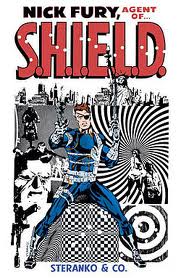
Nick Fury is head of the group, which might reflect his presence in the Avengers' movie, which obviously is the springboard for all this brand-recognition business. The group of heroes first appeared, apparently, in the New Avengers, battling The Red Skull, and in this collection they seem to be fighting against the remnants of the Skull's Nazi crowd, but also against the nascent Hydra, which was Fury's nemesis in the old Agent of Shield series. This group of heroes isn't particularly interesting; it's hard to tell what their skills or powers might be, and Chaykin's storyline, which is an interesting one involving former-Nazis harnessing mystical powers, gets lost within its own confines, while trying to both delineate his characters and two separate groups of villains, who are each time given their introductions and then promptly disposed of. It all begs for more time, and perhaps it might have been condensed, and characters drawn more fully. This applies especially to the lead henchman, General Dieter Skul. While he's not the Red Skull, and there's no Captain America breaking out of the ice ahead of skulledule for another epic confrontation, more could have been made of him. There's also the sense that the most interesting story-line, of treacherous elements within the US government, has been left for a sequel which may never appear..

There's the core of a fascinating graphic novel in Chaykin's idea, but it begs for more development and a more continuous battle between Fury's new Avengers and the Nazis. Since this group seems more like a prototype for Fury's SHIELD, and indeed, since that is what the new DC Blackhawks actually amount to,  SHIELD with a nicer logo, I might be missing the point of both. But what I feel I'm missing is the depth of the originals (and in the case of Blackhawk, that may seem strange, but re-read the Chaykin series), the Steranko SHIELD (even though it was obviously a rip-off of The Man From UNCLE), the early Avengers, even when Don Heck took over drawing. The difference lay in the sense of taking their own storylines seriously and not relying on pyrotechnics. Perhaps the video game generation has different needs. Perhaps the marketing guys who came up the concepts insist.

Blackhawks, issue 1-2 (the New 52!) DC Comics Nov, Dec 2011
written by Mike Costa, art by Graham Nolan and Ken Lashley
Avengers 1959 written and drawn by Howard Chaykin
Marvel 2012 $16.99 ISBN 9780785160724
collects issues 1-5, published 2011

NOTE: This review will also appear at Crime Time www.crimetime.co.uk

Monday, 9 July 2012

ERNEST BORGNINE: AN APPRECIATION


Like most kids of my generation, my first exposure to Ernest Borgnine came on the TV show McHale's Navy, one of those comedies in a genre which quickly, during the Vietnam War, lost its appeal (though offbeat variations on the war-is-fun theme survived, like Hogan's Heroes, or F Troop, which could be read as a fantasy of the Vietnam experience, with friendly Indians replacing Viet Cong). But my memory of McHale's is positive, with the interchange between Borgnine's frustrated McHale and Tim Conway's bumbling ensign the key to the comedy. They would reprise their collaboration thirty years later in a Sponge Bob movie.

It wasn't much later, however, that I discovered Marty, one of my mother's favourite movies (I dunno, whadda you wanna do Marty? was one of her catchphrases), and one of Borgnine's best performances. Many years later, living in Belsize Park, I became friendly with Betsy Blair (see this appreciation of her here) and she told me about what a wonderful man Borgnine has been to work with—their chemistry still jumps off the screen in a non-glamorous way that's almost totally gone from movies today.


Then came what I'd call Borgnine's renaissance, the high points being The Dirty Dozen (1967) and The Wild Bunch (1969). In the former he more or less set the template for the rest of his career—playing the good-natured sidekick or foil in a big-name, big-budget cast or film. He did it in Ice Station Zebra, in disaster movies like The Poseidon Adventure, in Sam Peckinpah's Convoy and many others—often he was the most watchable thing about an otherwise bloated movie. But as Dutch in The Wild Bunch he embues the sidekick with great depth. He provides the moral conscience of the film, seems to relish the nihilism of the Bunch's finish, and also plays subtly with the romantic nature of his partnership with Pike Bishop. It's probably my favourite of all his roles. His embrace of nihilism reflects the quality which made him so memorable: under the surface of affability there lurked an explosion of violence or humour--in his best films you never know which is going to appear, and in Marty the brilliance is that under the surface lurks a great sensitive vulnerability

Although you might also say he defined his screen persona in his first creative golden age, with a series of films around Marty. He was Fatso in From Here To Eternity (1952), in Johnny Guitar and Vera Cruz (the prototype Wild Bunch) both in 1954, along with a brilliant piece of cowardly bullying in Bad Day At Black Rock (1955) which made that year a pretty good one for his performances.

I also liked Borgnine because he was a local hero: born in Hamden, Connecticut and went to Hillhouse High in New Haven, he not only spent ten years in the Navy after high school, but then went to drama school in Hartford! And after a spell in stock in Virginia, landed a role as a nurse in Harvey on Broadway: from Harvey to From Here To Eternity!

He did lots of TV, TV movies, voice-overs: he's a better J Edgar Hoover than Leonardo (though maybe not as good as Broderick Crawford) in the very obscure Hoover. He also played Italians in a couple of sports movies, Vince Lombardi in a 1973 TV movie called Legend In Granite and Angelo Dundee in the 1977 film The Greatest.He was a good actor who could do serious, but never seemed to take himself seriously. And he lived to 95 and seemed to have a great deal of fun—his book tour at age 90-something was a hoot, you can see the you tube clip on Fox if you like hearing naughty words in the morning! And he was married five times, including, back to back, to Katy Jurado and Ethel Merman, which is some sort of Daily Double! The marriage to Merman lasted only 32 days—Borgnine claimed that was due to his being more popular than her, due to McHale's Navy; Merman's chapter on the marriage in her autobiography was a blank page.

There is something about the final shootout of The Wild Bunch which resonates in terms of American myth as well as Peckinpah's violent cinema. And it's Borgnine's presence that stops it from going over the top--he provides both the comic relief and the tragic undertones: Oates does the nihilism, and Holden is doing what Joel McCrea did at the end of Ride The High Country. 'C'mon you lazy bastard' says Pike Bishop, and Dutch does come on, to die.

Friday, 6 July 2012

HUNTING IN PIANO TERRITORY: WILLEM DAFOE IS THE HUNTER


Willem Dafoe is the eponymous hunter, sent to Tasmania to follow up on reported sightings of the last Tasmanian Tiger—a species of wolf believed to be extinct since the last known tiger died in captivity in 1936. Dafoe has been sent by a biotech company that wants extracts from the tiger's glands, and then wants it eliminated. When he arrives in Tasmanian he's met by a local guide (Sam Neill) and set up in lodging with Lucy (Frances O'Connor) living in a drug-addled haze since her husband, a zoologist, disappeared in the wilderness searching for that same tiger. She's got two kids, adept at looking after themselves—the younger of whom, a boy called Bike, doesn't speak. Dafoe of course keeps the nature of his hunt secret, but he's also landed in the middle of a dispute over protecting the forests from lexploitation, and is assumed to be another ecologist by the local loggers.

There is a lot to like in this quiet drama, not least the way director Daniel Nettheim and DP Robert Humphreys use the landscape to reflect the story—not only the struggles against the harsh territory, but also the isolation of the characters (particularly Dafoe's Hunter) and the mysteries of the tiger itself. As Dafoe gets drawn closer and closer to the family, he becomes suspicious of the husband's disappearance, and of his own mission, and eventually he too will become hunted, the metaphor of a 'last of his species' kind of extinction never far from our minds.

It's a slow burning film, which apparently reflects the pace and mood of its source novel, by Australian Julia Leigh, which won the Betty Trask award. It was originally adapted by Nettheim and Wain Fimeri before Alice Addison wrote the screenplay. Apparently the result is somewhat different from the book, which I haven't read, so I can't say whether the film is more tragic or less so. But sometimes the film gets trapped in a sort of nether-zone between wilderness family drama and international conspiracy thriller, with the former generally winning out, but only nudging along.

There's a lot of suspense, some ambiguity, and the opportunity for double-cross; though Neill's presence is virtually a give-away from the start. It's odd the way internet coverage can be good and phone coverage bad at the same time, and whole sub-plot with unfriendly locals doesn't go very far. But it's biggest flaw is that when the suspense is finally broken, it happens off-stage, and that dilutes its impact. It does build to another climax, and then a touching coda that seems completely impractical, but I can't an audience by that point worrying about the details. O'Connor's performance is first rate, holding in emotions almost as strongly as Dafoe. She reminds me of a young Barbara Hershey (and in this film, the Barbara Seagull version might be closer), but her part, if anything is understated; her character is never able to fully engage with Dafoe's, which is part of the point, but which ought to be, in contrast with her husband, driving the film. The young actors, . Finn Woodlock as Bike and Morgana Davies as his sister Cass are both very good.


 Dafoe and the landscape are the real stars, however, and both are excellent. But in the end I kept feeling like I was watching a less-prententious but almost as self-consciously arty revisiting of The Piano, with the mother in a daze and the child not speaking, and the man who's gone native replaced with the man who learns to go native. And whether this was simply an instinctive reaction by the adapters, or something lodging in the novel. Either way, this element of familiarity, this suggestion that muteness may be the only way to avoid adapting to the landscape, this sense that maybe the it's trying too hard to be sensitive, is the only thing that stopped my liking this likeable film even more.

The Hunter opens in London today

Wednesday, 4 July 2012

BRITAIN'S VIETNAM? A FOURTH OF JULY SPECIAL: The FT review of A Few Bloody Noses


NOTE: I wrote this review for the Financial Times eight years ago; it must be one of the last book reviews I did for them, and I'd hate to think this take was the cause. As you'll see, I thought the book did best things it didn't necessarily set out, or even want, to do, so as I say, it sometimes seems to be arguing against itself. But Harvey provided a new perspective to think about the Revolution, & the concept of Britain's Vietnam is one that makes more and more sense to me. So because I came across it in my files again just before the Fourth of July (or as the Brits call it, Thanksgiving) I thought I'd share it with you now...

History is not always written by the victors; imperial powers often get to rewrite defeats in their favour. This should be kept in mind when Robert Harvey points out Britons have been unusually silent on the subject of the American Revolution. Although Harvey sets out to debunk what he says are myths cherished by most Americans, and, as he says, ‘creation myths are the strongest’, he also concedes that some pretty comprehensive debunking has already been done by the Americans themselves. And in fact, A Few Bloody Noses is most fascinating when it delves into British, not American, perceptions of the war.
 
Harvey calls America ‘Britain’s Vietnam’, an apt and telling comparison. It's a comparison he reinforces with his own emphasis on the actual tactical conduct of the Revolution’s few major battles, which reminds one of revisionist histories of Southeast Asia. For example, Saratoga may not have been the overwhelming victory Americans claim it was, but arguing against its symbolic importance is like arguing the US really ‘won’ the Tet offensive. Saratoga gave the revolution momentum at home, credibility abroad, bringing the French into the war and the Dutch to help finance it. Most importantly from a British point of view, it forced Parliament, already divided on how to deal with the colonists, to reconsider how winnable the war might be.

In fairness, Harvey makes such points himself, even though his making them is self-contradictory; that's true of any number of issues. For example, he asserts the colonists already possessed more freedom than the average Briton, thus dismissing revolutionaries as frauds, but at the same time he concedes that the greater freedom they did enjoy is by nature self-perpetuating, something the British could not dare acknowledge. He castigates the Americans for their skill at ‘spinning’ their side of the war, yet recognises such spin arose because, unlike in Britain, the revolutionaries needed public support merely to fight, much less win, the war. Harvey emphasises a low level of popular support for revolution, while admitting that, like the South Vietnamese, many colonials sat on the fence, waiting to join the winning side, while others merely capitulated to ruling power. Harvey will also accept some American myths when they suit him, but that can prove dangerous. For example, the myth of the heavily armed yeoman farmer springing to the American cause had been debunked comprehensively not long before this book appeared, by Michael Bellesiles’ Arming America.

Harvey’s first major triumph is the outlining the many successes but ultimate failure of British military strategy. Here, the story of Saratoga (that's the British surrender pictured above left) suggests he might also have drawn a striking parallel to the Second World War. ‘Gentleman Johnny’ Burgoyne’s campaign was the Revolution’s equivalent of Operation Market Garden, a daring but flawed plan conceived primarily to allow its creator to outshine his rivals. Harvey corrects the American attribution of victory at Saratoga to British incompetence, asserting ‘professional jealousy’ was the real cause. But surely allowing such jealousy to overcome strategic common-sense is the very essence of incompetence! In case it isn't, Harvey also details enough incompetence in other areas to nullify his original point. Interestingly, Burgoyne’s reputation, unlike Clive’s or Byng’s, but very much like Montgomery’s, was sullied not a whit by the failure of what was supposed to be his masterstroke.

Harvey also demonstrates convincingly George Washington’s importance as a leader, as well as a myth. Washington won few major battles, but his crossing of the Delaware and wintering at Valley Forge are America’s equivalents of Dunkirk. Indeed, America has not always wrapped itself in the cloth of invincibility; its two most crucial battle myths of the 19th century, the Alamo and Custer’s Last Stand, are both defeats, as is the "Lost Cause" myth of Pickett's Charge for the Confederacy.
  
Washington was patient, until, when necessary, he moved quickly and with focus. His decisive action in marching to reinforce Nathanael Greene at Yorktown contrasted directly with Sir William Clinton’s inaction, and was the single stroke which won the war. He also understood politics, surviving numerous plots against his command. Continuing the World War II analogy, I was struck by how closely Washington resembles Eisenhower. “His greatest virtue appeared to be his dullness,” says Harvey, but like Ike, he possessed the perfect temperament for unifying disparate and often unfriendly factions for a long haul.

Harvey’s other great success is bringing to light episodes American history prefers to neglect. Although Massachusetts recruited black soldiers, the colonials soon banned them from their armies, fearful of encouraging slaves to leave their masters. The British quickly did exactly that. Nearly a century before Lincoln’s Emancipation Proclamation, the Earl of Dunmore, then royal governor of Virginia, offered freedom for any slave who fought for the crown; ‘Lord Dunmore’s Ethiopian Regiment’ joined and fought on the British side; tens of thousands of former slaves joined the British forces, though only 4,000 or so black veterans and refugees from slavery found their way eventually to the promised freedom, in Nova Scotia. The Revolution also provided an excuse for colonists to ignore Britain’s Proclamation Line, beyond which land was reserved for Indians. The colonists waged war ruthlessly against those Indians, most of whom, particularly four of the five Iroquois tribes, sided with the Crown, providing a grim foreshadowing America’s relentless expansion west.

About other atrocities, however, Harvey becomes much more circumspect. The Paoli and Waxhaw massacres, perpetrated by British regulars, lead him to conclude only that 'occasional excesses occurred on both sides’. Although conceding General Alexander Leslie ‘distributed’ some 700 Negroes infected with smallpox to plantations in Virginia, he allows that this primitive biological warfare ‘would have been a crime indeed’ only if Leslie actually had infected the slaves himself! He seems unaware Lord Amherst had pioneered such tactics two decades earlier, by 'donating' blankets taken from smallpox victims to unsuspecting Indian villages in Massachusetts. The British army saw to it that whole tribes were ethnically cleansed by disease.

His book also contains some strange errors. Far from 'disappearing from American myth', John Hancock’s name remains a synonym for signature. Marching west from Lake Ontario would hardly bring one to the Hudson River, which lies well to its east. Numbers are used oddly; Cornwallis’s rearguard at Monmouth shrinks from 6,000 to 2,000 men in the space of two paragraphs. Characters are frequently reintroduced redundantly. Ethan Allan is described as the ‘thuggish’ leader of ‘a band of hillbillies’; on the very next page he is introduced again as ‘hillbillyish’. He was indeed more of a thug than American history cares to admit, but a hillbilly? And, in a book loaded with assertions, the lack of footnotes is frustrating.

It may not have been his intent, but Harvey actually succeeds  better than he intended in embellishing the reputations of Washington and such neglected rebel leaders as Greene (pictured left), Daniel Morgan,and Henry Knox, rather than debunking any major American myths. In the end, however, as a direct descendant of leaders on both sides of the Parliamentary argument, Harvey succeeds best in giving us a kind of Pentagon Papers view of the British war effort, something that is more than two centuries overdue.

A FEW BLOODY NOSES: The American War Of Independence
by Robert Harvey
John Murray 2004, 480pp, £25.00

ANDY GRIFFITH: THE GUARDIAN OBITUARY

My obituary of Andy Griffith is up at the Guardian website, you can link to it here, and with any luck it will be in the paper paper tomorrow (Thursday). The most interesting thing I discovered was that the great character actor R.G. Armstrong was originally a student of his, though other sources that say he was a classmate, which seems more likely. They remained friends all their lives, but I didn't see anything they did together on the screen.

I have to say that in my youth I never warmed to The Andy Griffith Show, and I still feel suspicious of Ron Howard because of Opie. While writing the obit, it occured to me that Griffith first made his name playing a hick, but found his role as the shrewdly wise folksy good ol'boy, and he was smart enough to leave the pure hick stuff to Jim Nabors (and the broad comedy to Don Knotts). One of the great anomalies of TAGS was Knotts, who was so obviously not southern at all, and didn't really try to be (the same was true of Judy Norton on The Waltons, her nasal California voice belieing everyone else trying to sound southern--in fact thinking about it wasn't Richard Thomas kind of the thinking goober's Opie?).

But from the first time I saw A Face In The Crowd I had the greatest respect for Griffith's talents--the pity is they were stretched so little. Hearts Of The West is a much under-appreciated movie, and he is excellent in it--he virtually reprised the role ten years later opposite Tom Berenger in Rustler's Rhapsody. Think of the kind of roles James Garner played in Twilight, or Slim Pickens in Rancho Deluxe and they would have been perfect for Griffith as well.

I liked the way he returned to Roanoke Island, where he had played Sir Walter Raleigh every summer with his first wife, and lived his life there and got engaged in North Carolina (and national) politics in what seems to be a good way. He even moved Matlock to Wilmington, NC, probably to be closer to home, but also in a sign of loyalty to his home state.

Friday, 29 June 2012

ALAN FURST'S MISSION TO PARIS


Mission To Paris, like most of Alan Furst's work, is set in the period just before the Second World War, when Europe is about to come apart at the seams. It's also set in Paris, which makes it a little different, as Furst has actually dealt with Paris during the War itself. Which leads me to think about where this stands in his oeuvre, especially since it follows Spies Of The Balkans, which was a Richard & Judy choice and in this country his most successful novel yet (you can read my review of that book here).

Like Balkans, Mission has a pared down plot—and oddly, considering it's set mostly in Paris, somewhat less atmosphere than his early books. Perhaps he, or we, know Paris too well? Its main character, unusually for Furst, is an American of sorts, Hollywood star Frederic Stahl (to me his name recalls Frederic March and John Stahl, both Americans who might well have been Europeans) born in Vienna, with a Slovene father, now loaned out by Warner Bros. to make a movie in 1938 Paris. But the Germans are waging a deep and complicated propaganda battle within France, trying to keep public opinion away from the idea of preparing for war, and Stahl soon finds himself the object of the affectionate Nazi eye, to his growing discomfort.

From there the story proceeds along familiar lines—through a series of vignettes, set in Paris, Berlin, Morocco, and finally Rumainia, and each ends with an unexpected and sudden death. This is Furst's world, where even the most commonplace of human activities can be fraught with danger, and his stock in trade is recreating that atmosphere of unsettled paranoia and fear.

But this book moves onto a slightly different track in a couple of ways. It's far less ambiguous than many of his previous novels. Furst actually sets up any number of questions for the reader—can we trust so-and-so at Warner Bros, him at the film company, her at the German hostess' party-- and in every case it turns out that we can, or that we were wrong simply to worry. This goes against the great strength of his work, which is that we can never know what positions the people on whom we are forced to depend have taken, and we can never know if that means they can or can't be trusted. So in that sense, this story is more straightforward.

It's also, as I said, less atmospheric. The most interesting parts of Paris don't rise up from the page, they seem to fade in the background of the story. Indeed, the best description is saved for the workings of the film industry (there's even a sly nod to Jean Casson, a hero of previous Furst novels). Even when he visits the wardrobe woman's modest digs, we don't get the deeper sense of what the surroundings mean to her that we've come to expect. Similarly, his Berlin, on Kristallnacht no less, remains something heard off-stage, and he really seems to move through the more exotic settings with even more dispatch.

In a more important way it is more straightforward as well—because Stahl falls in love, and in that sense his 'mission' to Paris has been to do what people have done, have gone to Paris to do, forever. I said in my review of Spies Of The Balkans that there seems to be less 'action' in each successive Furst novel, but that appears to have allowed his love stories to become more involved, more detailed, and I would guess more satisfying for a wider audience. I suspect Mission To Paris will be optioned quickly for a film which, paradoxically, might render what I have taken to be a relatively less well-drawn atmosphere, and convert it into a film whose atmosphere will steal the screen. Furst's work deserves no less.

Mission To Paris by Alan Furst
Weidenfeld & Nicholson £18.99 ISBN 9780863922

NOTE: This review will also appear at Crime Time (www.crimetime.co.uk)

Thursday, 28 June 2012

WHY DOES ANGELINA HAVE TO DIE: THE LINK

I've written (with Portland Green) a piece called 'Why Does Angelina Have To Die', about gender roles in feature films about dance, which will be published in Dance Theatre Journal in August. You can get a sneak preview (actually the whole thing!) courtesy of Film London and Artists Long Format Film...follow this link and use the password ALFF2012 if it asks for one... 
 I will be posting the piece here after publication....but read it now!

Saturday, 23 June 2012

WHEN THE FIGHT WAS FIXED AND IRON MIKE WAS THERE


I was struck by the way Grantland's Rafe Bartolomew expressed his disbelief at the recent split decision that gave Timothy Bradley Jr. the WBO welterweight title belt over Manny Pacquiao. He called it 'boxing's worst robbery at a major fight' since the Pernell Whittaker-Julio Cesar Chavez 'draw' in 1993. That unusual 'majority draw' (two judges called it even, the third gave the fight to Sweet Pea, who doesn't then get a 1-0-2 split decision) was indeed unusual, but it wasn't even the worse decision of Whittaker's career. That one came on another split decision five years earlier. I remember it well because it happened on my birthday, and I was there in the ring.

It was March 1988, in a dingy arena named for the great Marcel Cerdan, in the Paris suburb of Levallois-Perret.Whitaker, whose pro record stood at 15-0, was fighting Jose Luis Ramirez, like Chavez a Mexican, for the World Boxing Council lightweight title which Ramirez had won after Hector 'Macho' Camacho had vacated it. I was there working for ABC Sports and we were broadcasting the fight back to America. It wasn't the most relaxing birthday—dealing with boxing promoters was never easy and the French brothers who were promoting this fight were particularly slippery whenever I had issues to iron out. Simply getting the crew out to the arena from the hotel in central Paris was a task: traffic on the Periphrique tied them up, while I used the metro to make sure I was there early. But in those days you didn't suggest to ABC Sports producers that they travel by subway.

The fight was totally one-sided. Whitaker dominated early, then appeared to settle into counter-punching, because, as we learned later, he had broken his hand in round four. But although Ramirez continued to come forward throughout the 12 rounds, he rarely landed any punches of consequences, while Whitaker picked his shots and connected. I had Pea up 8 rounds to 4 when the bell sounded.

What happened next was different. After the bell, I got into the ring; my job would be to get the interview for our announcer Don Chevrier. I went over to the ropes, above where the judges' scorecards were being totalled, and began reading them upside down. I looked up with an expression of disbelief as I realised Whitaker was behind on two cards, and caught the eye of Jose Sulaiman, the Mexican boss of the WBC, who looked at me impassively.

Then I turned to Whitaker's corner and looked at Lou Duva, his manager, from whose Main Events company ABC had acquired the fight. Lou was built like a white-haired fire hydrant with a face that looked like it had battered all the other fire hydrants into submission. Lou was a former boxer who'd used the profits from a trucking business to open his own gym, which grew into Main Events when they started managing Leon Spinks. Lou didn't waste much time with bullshit, and when I shook my head at him he knew what was going on. He climbed into the ring, and even before the announcement was made, he was yelling over the ropes at Sulemain. Then the split decision came, with English judge Harry Gibbs (a referee back in London) scoring it 117-113 for Whitaker, judge Newton Campos 118-113 for Ramirez, and judge Louis Michel 116-115, also for Ramirez.

I'd seen bad decisions before. Some I assumed had been foregone conclusions. Part of my job as Director of Programming in Europe for ABC involved sometimes going to matches in London, to watch fighters whom British promoters might be touting. Sometimes I went just out of my own curiosity. Many times these young fighters would be facing some older tomato-can, flown in from a great distance, usually Latin America, for the express purpose of getting beaten. And if the can were to outbox the hometown hero, well, he would inevitably lose a decision, rendered by the referee alone (who was sometimes that same Harry Gibbs), by a scant half-point, and have his arm raised afterwards for applause as a 'gallant loser'. In Ireland I had a promoter offer to 'speed up' the two remaining fights on the card before the one we were doing live back to the States; there aren't too many legit ways you can speed up a six-round fight. The nature of the business, however, means you shrug it off, and wait for the moments of courage and high drama the fighters themselves provide.

Lou Duva wasn't shrugging anything off. His face turned bright red and he exploded, leaning over the ropes to direct a chain of profane accusations in Sulaiman's direction. He invited him to perform anatomical impossibilities, suggested embarrassing things about his geneology, and, more to the point, threatened to sue the WBC. Meanwhile Don was setting up inside the ring, and our producers were telling me they wanted Lou for the interview. I reached around him, telling him we were ready to talk to him,and half-dragged, half escorted him over to Don, with him leaning backwards as he continued to hurl invective at Sulaiman. Then he turned and faced Don, who suggested he might be upset by the decision. Lou turned to the camera and proceeded to give a calm, reasoned evaluation of where he thought the decision was lacking, and what redress might be open to him and Whitaker, and what avenues they might explore when they got back to America. Don thanked him and Lou immediately spun around, picking up his verbal assault on Sulaiman as if from mid-sentence.


I spent the rest of my birthday commiserating in a hotel bar with various people from Main Event, ABC, and some press. The famed Irish scribe Harry Mullan, from London's Boxing News, would later write that the decision 'was generally considered to be a disgrace'. Our opinions that night were more Lou Duvaesque. I would have my real birthday party the next day, a Sunday lunch with friends at La Ferme Ste. Genevieve, where in those days they did old-fashioned escargots and confit du canard. When I told them about the robbery I'd witnessed the night before they just laughed, surprised I could take it so seriously. 'You haven't been at ringside and seen what goes through those guys' eyes,' I replied. 'They deserve better'.

Pernell Whitaker went on immediately to win the IBF lightweight title from Greg Haugen, and then avenge himself over Ramirez with a unanimous decision in Norfolk, Virginia that gave him the WBC belt as well. He won seventeen fights in a row between that loss to Ramirez and the excruciating draw with Chavez, and won titles at Welter and Light-Middle before finally suffering his first 'real' loss to Oscar DeLaHoya. How seriously should we take it? The Book Of Boxing Lists has the Chavez fight as the tenth most controversial of all-time, and the Ramirez as the ninth. That's pretty tough for just one fighter. Take away those two bent decisions, and Whitaker gets recognised more widely as one of the greatest fighters of his era, maybe of all time.Which is what he deserves.

Friday, 22 June 2012

JACK TWYMAN: THE INDEPENDENT OBITUARY

The friendship between Jack Twyman and Maurice Stokes, which prompted Twyman to look after his paralysed teammate, is one of the greatest stories in sports. My obit of Jack Twyman is in today's Indy, you can link to it here.

All that was cut from it was some of the basketball detail. Stokes scored 32 points in his very first NBA game, and averaged 16.8 points and 16.3 rebounds in his rookie season, winning the Rookie of the Year award, and making second-team all-NBA, which he would do for each of his three seasons. Twyman averaged 14 points as a rookie, and that would improve to 17ppg in his third year. I pointed out that while Twyman was part of a long continuum of 'white small forwards'--include Cliff Hagan, Jack Marin, Billy Cunningham, Larry Bird, and Dirk Nowitski in that, among others--Stokes was unique in his time. His game was more complete even than someone like Charles Barkley, and he was taller than Barkley as well.

The key bit cut had to do with Stokes' membership on the all-time NBA 'what-if' team. As I wrote, without Stokes, Twyman's scoring 'average went from 17 to 26 points per game the next year, along with 9 rebounds, and in 1959-60 he and Chamberlain became the first players to average over 30 points per game (31.2, along with 8.9 rebounds). After the 1960 Olympics, another Cincinnati University star, Oscar Robertson, joined the Royals; one of the great what-ifs of NBA history is imagining how Stokes,Twyman, and Oscar would have played together. Those Royals also had Wayne Embry, and might have been contenders for years. The rest of the all-time what if team is Bill Walton, Connie Hawkins, David Thompson, and Pete Maravich. That's injury, scandal, drugs, and drugs n all kinds of other shit.

I've never seen the film Maurie, but like Bang The Drum Slowly, it suffered from coming after Brian's Song, and unlike Bang The Drum, a film starring Bo Swenson and Bernie Casey was not aimed at being an A feature. But I think the true story of Twyman and Stokes rivals the fictional one of Bruce Pearson and Henry Wiggin in that baseball novel and film. As I said, it's one of the great sports stories of all time, and because of it, I have always admired Jack Twyman.

Wednesday, 20 June 2012

LEIF G.W. PERSSON'S ANOTHER TIME, ANOTHER LIFE


Note: This review does contain a spoiler of sorts. You can leave the final paragraph until after you've read the novel...

When I reviewed Leif G.W. Persson's Between Summer's Longing And Winter's End earlier this year (you can link to that here), I likened it to a cross between Sjowall & Wahloo and Stieg Larsson (particularly The Girl Who Kicked The Hornet's Nest). There the subject was the murder of Olaf Palme, and it was ironic that policeman Lars Martin Johansson, investigating a different murder, is not only unable to 'solve' the most important crime in Swedish history, but that the man most responsible not only gets away with it, but gets the girl Johansson fancies.


In Another Time, Another Life it's years later, 1999, iand Johansson, is now married to that woman, though the circumstances of their re-connection are not as innocent as he knows. Thought of as a safe pair of hands, has just joined the Security Police, Sepo, one of the many layers of secret police set up to protect themselves from public scrutiny each time the public is given scrutiny to the previous layer. But the story begins in 1975, when the Red Army Faction took over the West German embassy in Stockholm, leaving four dead, two of them the terrorists. Johansson discovers that files on two Swedes who allegedly helped the Germans, have disappeared and reappeared in his files, and want to find out why. One of them was the victim of a murder in 1989, and the statute of limitations is about to run out—but Johansson's friend Bo Jarnebring, who also appeared in the previous book, and the competent, attractive Anna Holt, were the detectives on that killing. Their investigation got nowhere, primarily because it was headed by the pig-headed, corrupt, alcoholic Backstrom (think NYPD Blue's Bunz without the conscience).

Now, reopening that investigation takes Johansson deep within the workings of the Swedish state—not only in terms of solving the crime, but also in terms of figuring out just who wanted the whole thing reinvestigated, and why. And why it was covered up in the first place.

If Summer's Longing crossed Martin Beck with Mikke Blomkvist, Another Time, Another Life is like Beck crossed with Joseph Wambaugh, and Backstrom, convinced this is a simple homosexual killing barely worth solving, is a character worthy of Wambaugh at his best. Johansson, who in the previous book showed signs of being bound for the lonely life of a Beck, here seems much more in command. The subtleties required by his new job are still a strain, but not beyond him, and in the end he achieves a result that satisfies his sense of justice, and probably pleases those above him as well. My one criticism of Summer's Longing was for its being somewhat prolix, but not only is this book written much more tightly, the result for Johansson means the story is resolved in a way the Palme killing never could be. In that sense, despite the fact that you almost need to know the characters' backstory from the previous book, and you can see where some of their personal lives are headed, this might be a better place for newcomers to Persson to begin.

The brilliance of the story, however, lies in its coda, where Backstrom gets the last laugh, in the end 'solving' the 1989 murder, pinning it on a gay serial killer. That he uses liquor he stole from the murder victim's cupboard ten years earlier, and that the bottle is a banana liqueur which even the thirsty Backstrom presumably found unapproachable, is a bit of subtle irony which Swedes would recognise, and I assume find even more amusing than I did. Underneath the humour, Persson does shine a light on Swedes and their society, and in that broader sense may be the most interesting of the novelists in the current Swedish crime boom.

Another Time, Another Life by Leif G.W. Persson
Doubleday £16.99 ISBN 9780385614191

NOTE: This review will also appear at Crime Time (www.crimetime.co.uk)


ARNALDUR INDRIDASON'S BLACK SKIES


It's been a busy couple of weeks for the Reykjavik police, while Arnaldur Indridason's detective Erlendur has been completely out of touch while on holiday in the lonely eastern part of island where he grew up. The compression of time in published fiction means that while readers wait and wonder what has happened to the moody Erlendur, Indiridason has now written two novels, each starring one of Erlendur's supporting cast. In the previous one, Outrage, Elinborg took centre stage, and as I wrote at the time (you can link to that here), her dilemmas, and the case, encapsulated Indridason's recurring theme of conflict between the older traditional Icelandic life, and the new.

Black Skies, which features Sigurdur Oli, is very much rooted in the new Iceland, the boom country which famously went bust in a perfect foreshadowing of the global economic crisis. Oli himself is very much entrenched in a new Icelandic identity: he spends most of his time aping all things American, especially sport. In my own identity as an American sportscaster I began wondering if Oli's TV in Iceland, or his computer, actually could pick up my commentary on Channel 4, or Five, or Eurosport. Although Oli has disdain for most things Icelandic, in another sense, in his aloof loneliness, he seems a much more traditional figure: substitute hamburgers for horses' heads and he's as shut-off as Erlendur.

But he's dragged into a very modern-seeming case when a friend asks him to do a favour for his sister's wife and her husband, who are being blackmailed with photos taken while experimenting with wife-swapping. When Oli goes to visit the woman blackmailer, he finds she has literally just been murdered, and though he can't chase the baseball-bat killer, his dogged pursuit winds up uncovering other crimes, a possible second murder, and a number of small betrayals of his trust. Meanwhile, one of Erlendur's informants has supplied him with a small bit of film depicting his own abuse as a child, and he is in the process of extracting revenge on his abuser.

As the first case expands, Oli finds himself in almost over his head with the world of fast-moving high-finance, looking on with disdain at the conspicuous consumption which seems to be fuelling it. He's also forced to face the breakdown of his own relationship, and re-examine the way he saw the divorce of his own parents. That story acts as a parallel of sorts to the story of Andres, the abused child, and yet again provides the contrast with the old: Andres' only happy times was when he was taken from his mother and raised briefly on a farm, away from the 'modern' Iceland.

Oli's doggedness finally solves the murder, which turns out to be unconnected with the larger issues of money-laundering and speculating, and the possible second murder, another out in the old Icelandic wilderness, which may have done the killing itself. And Anndres' story resolves itself too, with a touching ending that acts as a coda to both stories, reminding us that beneath the trappings of our lives, how basic the needs of human existence really are.

Oli makes the perfect protagonist, in a sense, because he doesn't mull through these issues himself, as Erlendur would (Erlendur actually strikes me as being perhaps closer to John Harvey's Resnick, or Graham Hurley's Faraday than his Swedish forebears). This means the reader is free to make the connections and draw the conclusions for himself. This is why I think Black Skies is one of, if not the best, of Indridason's books. And, of course, we still don't know what's happened to Erlendur.

Black Skies by Arnaldur Indridason
Harvill Secker £12.99 ISBN 9781846555817


NOTE: This review will also appear at Crime Time: www.crimetime.co.uk