So first Ginger
Sov arrives from France with a stand-up do and wicked piercings. And
she's all like Scotland's my country and accent and everything and
you gotta make me queen. And she tells Posh Sov she wants to be BFFs. But Posh Sov's like fuck MQS! That ginger bitch is
more in line for my throne than I am, so she tries to hook her up
with the super-fit squeeze she fancies, but Ginger's too woke for
that and she hooks up with Darnley, who's like next in line to Posh's
throne after Ginger, but he's like anyone's, an-ny-ones! after a
couple of red bull and meads. Ginger's also pretty sporty, ridin'
horses and winnin' battles and stuff, but then Posh goes all Scary
with these poxy bumps and scars and she uses a ton of goth makeup to
cover them up and hide her real face. Then she watches horses giving
birth cause she's jealous of Ginger's now Darnley's Baby Momma and
the baby's another one who could steal her throne. But the Ian
Paisley preacher guy with the huge false beard is all like she's a
whore and a papist so they kill her gay singer song writer guy who
also slept with Darnley and her best-bud kidnaps and rapes her and
like this goes on for two hours....like an extended episode of Neighbours
So first Ginger
Sov arrives from France with a stand-up do and wicked piercings. And
she's all like Scotland's my country and accent and everything and
you gotta make me queen. And she tells Posh Sov she wants to be BFFs. But Posh Sov's like fuck MQS! That ginger bitch is
more in line for my throne than I am, so she tries to hook her up
with the super-fit squeeze she fancies, but Ginger's too woke for
that and she hooks up with Darnley, who's like next in line to Posh's
throne after Ginger, but he's like anyone's, an-ny-ones! after a
couple of red bull and meads. Ginger's also pretty sporty, ridin'
horses and winnin' battles and stuff, but then Posh goes all Scary
with these poxy bumps and scars and she uses a ton of goth makeup to
cover them up and hide her real face. Then she watches horses giving
birth cause she's jealous of Ginger's now Darnley's Baby Momma and
the baby's another one who could steal her throne. But the Ian
Paisley preacher guy with the huge false beard is all like she's a
whore and a papist so they kill her gay singer song writer guy who
also slept with Darnley and her best-bud kidnaps and rapes her and
like this goes on for two hours....like an extended episode of Neighbours
I exaggerate. Sure
there isn't much new in Mary Queen Of Scots; in fact it is a lot like
the 1971 film, which itself seemed based, uncredited and with
liberties taken, on Antonia Fraser's wonderful biography, There are
two major themes to Mary's life: Mary vs Elizabeth, which is in part
England vs Scotland, but more the English Virgin Queen versus the
younger, prettier, French version. The other is Mary versus the Scots
establishment, particularly the church, John Knox versus the Pope,
intertwined with the usual Scottish betrayals and in-fighting over
their crown and the big one in modern eyes, men over the 'mostrous
regimen of women' or as Mary should have called it, 'We Too'.
 But to put it
simply, the major question in any story about Mary is her own agency:
how much she acts and how much she is acted upon, and the biggest
problem with this film's approach to that is how it ultimately
reverts to cliché whenever it needs to make the dilemma of agency
personal. When Mary decides she loves Darnley they ride off on their
horses, away from the following lords, to the accompaniment of the
inevitable helicopter shot. Later when Elizabeth watches a mare
weaning her colt, she is mesmerised to the point of giving herself a
shadow-puppet pregnancy. This horse metaphor is so good the movie
will come back to it again.
But to put it
simply, the major question in any story about Mary is her own agency:
how much she acts and how much she is acted upon, and the biggest
problem with this film's approach to that is how it ultimately
reverts to cliché whenever it needs to make the dilemma of agency
personal. When Mary decides she loves Darnley they ride off on their
horses, away from the following lords, to the accompaniment of the
inevitable helicopter shot. Later when Elizabeth watches a mare
weaning her colt, she is mesmerised to the point of giving herself a
shadow-puppet pregnancy. This horse metaphor is so good the movie
will come back to it again.
They are serious
about the centrality of the distinction between Mary and Elizabeth.
The Virgin Queen suppresses her desire to the point of sending the
man she loves to woo Mary. Mary, on the other hand, gets married
three times, and, if the movie is to be believed, has sex one time
with each husband. This is an extreme point of view, based partly on
the 1971 film's reading of Darnley's gayness and partly on the
filmmakers decision to make Mary the victim of Bothwell, which
requires them to ignore a large chunk of her life after her
kidnapping and rape, which is probably the most contentious of all
the readings of Mary's life. They get around the alternate reading,
that Mary might have been part of Darnley's removal, that she went
willingly with Bothwell, got pregnant by him (a miscarriage was the
result) and stayed with him until they lost the battle of Carberry
Hill.
But the film's
variations with history are not something that serious, at least if
you can justify them in character, and that is the hard part.
Bothwell is sympathetic to the point he turns on Mary: the
possibility he is actually acting with her or to protect her is
unraised. I don't have problems with most of the other deviations,
apart perhaps Mary's having a Scots accent. Her English was likely
better than, say, Bonny Prince Charlie's, but he had been raised in
the French court.
 Of course Mary and
Elizabeth never actually met, but arranging a secret meeting between
them is not a dramatic absurdity. The problem with this meeting is
that the arresting shot of the laundry drying and the two queens
manoeuvring around the hanging sheets (or whatever they are), each
keeping out of sight of the other, loses its visual impact quickly.
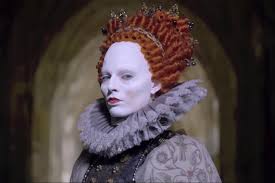
It's also larding-on the presentation of Elizabeth: after being
struck with the pox, she relies on heavier and heavier doses of
make-up, creating thicker and thicker white masks, until she looks almost like an sf movie villain.. In case you don't
realise that the real woman is hiding behind the mask, the visual
metaphor will be flung in your face until you do. Given too that Mary
does not age from the time she first sets foot in Scotland until she
is executed (oh, did I just spoil the film for you?) while Elizabeth
ages rapidly is more of a dramatic license than actually having them
meet.
Of course Mary and
Elizabeth never actually met, but arranging a secret meeting between
them is not a dramatic absurdity. The problem with this meeting is
that the arresting shot of the laundry drying and the two queens
manoeuvring around the hanging sheets (or whatever they are), each
keeping out of sight of the other, loses its visual impact quickly.
It's also larding-on the presentation of Elizabeth: after being
struck with the pox, she relies on heavier and heavier doses of
make-up, creating thicker and thicker white masks, until she looks almost like an sf movie villain.. In case you don't
realise that the real woman is hiding behind the mask, the visual
metaphor will be flung in your face until you do. Given too that Mary
does not age from the time she first sets foot in Scotland until she
is executed (oh, did I just spoil the film for you?) while Elizabeth
ages rapidly is more of a dramatic license than actually having them
meet.
The other major
problem I had was the birth of Mary's son. By making Rizzio,
generally referred to as her secretary, obviously gay, the movie
registers its view on the accusations of her having an affair with
him. When Mary's actual birthing is shown in detail as gory as
Rizzio's murder, it is like RoseMary Queen Of Scots' Baby: the child is outsized
and almost misshapen, which probably reflects the general opinion of the Presbyterians of the time.  And when we see the young boy, he looks
decidedly like Rizzio—and nothing like the picture we see of the
young James I of England, which indicates that Mary won the long game
over Elizabeth; dying but leaving her heir to take the crown.
And when we see the young boy, he looks
decidedly like Rizzio—and nothing like the picture we see of the
young James I of England, which indicates that Mary won the long game
over Elizabeth; dying but leaving her heir to take the crown.
 And when we see the young boy, he looks
decidedly like Rizzio—and nothing like the picture we see of the
young James I of England, which indicates that Mary won the long game
over Elizabeth; dying but leaving her heir to take the crown.
And when we see the young boy, he looks
decidedly like Rizzio—and nothing like the picture we see of the
young James I of England, which indicates that Mary won the long game
over Elizabeth; dying but leaving her heir to take the crown.
There are things to
like here, particularly in the interior scenes, which are dark and
claustrophobic, and even occasionally lighted to reflect contemporary
paintings. But overall it is directed and shot like a series of music
videos (Elizabeth would be a natural) or commercials, a sort of
short-span story-telling. I think of the visuals of John Ford's Mary
Of Scotland, which makes Mary (Katharine Hepburn) into a Holy
Catholic martyr, after its love-story with Bothwell (Frederic March)
– which are consistent and build toward its climax, one which
reflects Ford's obsession with Hepburn as much as anything else.
Saoirse Ronan is
excellent as MQS—despite being limited by never aging—and I like her better than Vanessa Redgrave, who seemed too dominant, even while Glenda Jackson was more harsh. Ronan's finest moments come as she realises her position as Queen is nowhere near enough to triumph over being both a Catholic and, most fatally, a woman. Whereas, for Elizabeth, that problem is overcome by, in effect, denying her womanhood.  Here
Margot Robbie is more limited by the reading of Elizabeth's
increasing one dimension of frustration, but there is something to be said for her starting out on more of an even footing. Guy Pearce as William Cecil
is perfect, almost stealing scenes from Elizabeth. Brendan Coyle
(Lennox), James McArdle (as a weak Moray) and Martin Compston as
Bothwell all fill their costume drama roles well, while David Tennant
as John Knox is appropriately intense, all Ian Paisley burning eyes hiding underneath a fake
beard worse than the ones worn by Tom Berenger, Richard Jordan and
Joseph Fuqua in Gettysburg, the greatest fake-beard movie of all time.
And a special shout-out to Ian Hart as Maitland, who somehow manages
to look (though not sound, thankfully) exactly like Harvey Keitel.
Here
Margot Robbie is more limited by the reading of Elizabeth's
increasing one dimension of frustration, but there is something to be said for her starting out on more of an even footing. Guy Pearce as William Cecil
is perfect, almost stealing scenes from Elizabeth. Brendan Coyle
(Lennox), James McArdle (as a weak Moray) and Martin Compston as
Bothwell all fill their costume drama roles well, while David Tennant
as John Knox is appropriately intense, all Ian Paisley burning eyes hiding underneath a fake
beard worse than the ones worn by Tom Berenger, Richard Jordan and
Joseph Fuqua in Gettysburg, the greatest fake-beard movie of all time.
And a special shout-out to Ian Hart as Maitland, who somehow manages
to look (though not sound, thankfully) exactly like Harvey Keitel.
 Here
Margot Robbie is more limited by the reading of Elizabeth's
increasing one dimension of frustration, but there is something to be said for her starting out on more of an even footing. Guy Pearce as William Cecil
is perfect, almost stealing scenes from Elizabeth. Brendan Coyle
(Lennox), James McArdle (as a weak Moray) and Martin Compston as
Bothwell all fill their costume drama roles well, while David Tennant
as John Knox is appropriately intense, all Ian Paisley burning eyes hiding underneath a fake
beard worse than the ones worn by Tom Berenger, Richard Jordan and
Joseph Fuqua in Gettysburg, the greatest fake-beard movie of all time.
And a special shout-out to Ian Hart as Maitland, who somehow manages
to look (though not sound, thankfully) exactly like Harvey Keitel.
Here
Margot Robbie is more limited by the reading of Elizabeth's
increasing one dimension of frustration, but there is something to be said for her starting out on more of an even footing. Guy Pearce as William Cecil
is perfect, almost stealing scenes from Elizabeth. Brendan Coyle
(Lennox), James McArdle (as a weak Moray) and Martin Compston as
Bothwell all fill their costume drama roles well, while David Tennant
as John Knox is appropriately intense, all Ian Paisley burning eyes hiding underneath a fake
beard worse than the ones worn by Tom Berenger, Richard Jordan and
Joseph Fuqua in Gettysburg, the greatest fake-beard movie of all time.
And a special shout-out to Ian Hart as Maitland, who somehow manages
to look (though not sound, thankfully) exactly like Harvey Keitel. In the end, Mary
Queen Of Scots is perhaps too much costume and not enough drama, and the various tensions between countries, relgions and queens are all subsumed into the crucial question of womanhood. Unfortunately, that seems resolved primarily in fashion terms, the movie becomes all costume no drama. Although the execution scene is
visually stunning, especially when Mary is stripped of her cloak, a note from
history might have been brought it more final drama. Because it took the
executioner three strokes of the axe to severe her head completely.
Even in dying, Mary was denied her agency.
In the end, Mary
Queen Of Scots is perhaps too much costume and not enough drama, and the various tensions between countries, relgions and queens are all subsumed into the crucial question of womanhood. Unfortunately, that seems resolved primarily in fashion terms, the movie becomes all costume no drama. Although the execution scene is
visually stunning, especially when Mary is stripped of her cloak, a note from
history might have been brought it more final drama. Because it took the
executioner three strokes of the axe to severe her head completely.
Even in dying, Mary was denied her agency.
Mary Queen Of Scots, directed by Josie Rourke
screenplay by Beau Willimon based on the book by John Gay