Showing posts with label True Grit. Show all posts

Monday, 9 March 2020

CHARLES PORTIS: THE TELEGRAPH OBITUARY

My obituary of Charles Portis is in today's Daily Telegraph; it's also up online, and you can link to it here, though it is behind a paywall. There is no byline on Telegraph obits, and though what appears is pretty much what I wrote, for reasons of space a lot of detail was cut. And there was at least one reference that was not mine: when it calls the first movie of True Grit "corny". It may feature John Wayne having fun with himself, and some overly severe acting, but even in state it is too dark to be called corny. So here is what I originally filed, and I am grateful to the paper for sticking with Portis and eventually finding him some space....

 CHARLES PORTIS, novelist


Charles Portis, who has died aged 86, was, in the oft-repeated words of critic Ron Rosenbaum, America's 'least-known great novelist'. At least he was before his cult following of the good and the great got his five novels back into print, appropriately enough from former Penguin editor Peter Mayer's Overlook Press. Portis' literary low-profile was partly due to his low output and his reluctance to self-promote (though he was hardly a recluse, as he was often described), but mostly because his claim to fame happened to be a western, and worse, one made into a movie starring John Wayne.

Yet when True Grit appeared, Roald Dahl, in a rare book review, called it 'the best novel to come my way for a very long time...he hasn't put a foot wrong anywhere. What a writer.'
True Grit is the story of 14 year old Mattie Ross who, seeking to avenge the murder of her rancher father, hires hard-drinking deputy US Marshal Rooster Cogburn to track him down. Like all Portis' novels, it is a journey, peppered with eccentric characters, and stands its frequent comparison with one of the greatest American novels, Huckleberry Finn. Like Twain, Portis' eye for America's ingrained absurdities is presented almost as reportage. But like Thomas Berger's Little Big Man, True Grit is a recollection, with a now-elderly Mattie providing prickly, unreliable narration. Her aged Arkansas voice is pitch-perfect, which Portis once attributed to his time working on a paper in his college days, editing local reports by the Arkansas town ladies who filed in longhand.

Charles McColl Portis was born, appropriately enough for someone whose fiction was a series of quests, in El Dorado, Arkansas, 28 December 1933. His father Samuel came to El Dorado during an oil boom, where he met and married Alice Waddle. He began teaching, and his mother wrote for local papers. Portis grew up in a series of southern Arkansas towns, and after finishing high school, enlisted in the Marines and fought in the Korean War. Discharged a sergeant, he took a journalism degree from the University of Arkansas, working on the college paper, the Traveler, and the Northwest Arkansas Times. His first job was at the Memphis Commerical-Appeal, followed by two years with the Arkansas Gazette, where his work got him hired by the New York Herald-Tribune. At the Tribune his coverage of the civil rights movement across the South was so impressive that in 1963 he became their bureau chief in London.

Although he was considered one of the stars among a group of reporters at the Trib who went on to define 'new journalism', after a year in London he quit to return to a lake-side cabin in Arkansas and write fiction. Two years later, in 1966, his first novel, Norwood, was published after being serialised in The Saturday Evening Post. In it, Arkansas-born ex-Marine Norwood Pratt returns from Vietnam determined to become a famous singer, and is conned by Grady Fring the Kredit King into moving cars to New York, encountering a cast of eccentrics along the way, including Joann The Wonder Hen, a college-educated chicken.

True Grit was published two years later, its episodic journey again perfect for the Post's serialisation. After the film's success, Kim Darby (who played Mattie) and Glen Campbell were reunited alongside gridiron star Joe Namath in a friendly but flat movie version of Norwood, which was stolen by actresses Tish Sterling and Carol Lynley in smaller parts. Portis briefly tried script-doctoring in Los Angeles, but returned to Arkansas and his writing career, best summed up by his famous new journalism colleague Tom Wolfe in his usual flamboyant style: 'He made a fortune...A fishing shack! In Arkansas!...It was too goddamned perfect to be true”

It took 11 years before Portis' third novel, many people's cult favourite, The Dog Of The South appeared. Dreamy innocent Ray Midge heads south from Arkansas to track down his runaway wife, her lover Dupree, himself is being sought for writing letters threatening the president, and, most crucially, his Ford Torino car. His con-man is Dr Reo Symes, literally a snake-oil salesman, who himself is searching for the mysterious John Selmer Dix, author of inspirational self-help books for salesmen. Portis was hugely well-read, and it is not unreasonable to draw comparisons with another of America's greatest neglected novels, Herman Melville's The Confidence Man, with its panoply of hopeful, deluded Americans being taken for rides. The trick was the way Portis reported their sometimes surreal stories with straight-faced seriousness, in voices that resonated authenticity. As Portis scholar Carlos Rotella put it, 'when my 9-year-old daughter turned over a straight that beat my two pair and said “Shot by a child!” I knew that reading True Grit to my kids had been a good idea.'

Portis' next novel followed only six years later. Masters Of Atlantis (1985) begins in 1917, when an American doughboy, Lamar Jimmerman, is handed a manuscript by a London beggar. The Codex Pappus leads him to the secret Gnomon Society and an Englishman called Sir Sydney Hen with whom he creates a religion, which attracts an American con-man preacher, Austin Popper. It reads like a slapstick combination of Thomas Pynchon's V and Flannery O'Connor's Wise Blood. Six years after that came Gringos (1991), in which another ex-Marine, Jimmy Burns, sells illegal antiquities in a dangerous Mexico almost as strange as Portis' America.

In 2010 the Coen Brothers remade True Grit, which propelled Portis back into the public eye, and in 2012 a miscellany of his shorter writing, Escape Velocity, was published. That year also saw Portis diagnosed with Alzheimer's disease. In 2014, he was honoured at a Gala at the governor's mansion in Little Rock, but he was unable to attend. In a moment of pure Portis fiction, the keynote speaker, journalist Ray Reed, sent his last-minute regrets, because the headlights of his car weren't working. Portis died 17 February 2020, in a Little Rock hospice, survived by his brother Jonathan. In Gringos, Jimmy Burns muses that 'none of us, not even the high-jumper slithering over his crossbar, ever gets very far off the earth. And yet we come down hard.' He never married and leaves no survivors.

Tuesday, 9 July 2013

JANUARY JONES' SWEET VENGEANCE

I'm always interested in new westerns, films that belie the ongoing belief that the genre is dead, so I was intrigued by Sweet Vengeance, which offers a strong female lead role, and colourful performances from Ed Harris and Jason Issacs. Sadly, the film (originally released as Sweetwater, which may have played more on Harris' western past) is less than the sum of its parts.

Jones plays a newlywed wife on a dusty farm in New Mexico. She was, we learn, a whore, who has settled with a Mexican (played well by Eduardo Noriega) who lacks the edge of violence necessary for this frontier. Their land is surrounded by land owned by the self-proclaimed Prophet Josiah (Issacs), whom we watch, early in the movie, murdering trespassers on his land, and seems to control a good portion of the town as well. We learn he is a refugee from Utah, and we see him engaged in sex with his wife and, it seems, his daughter as well.

The build-up is classic, until Harris, as Sheriff Corneilius Jackson, enters the scene, trying to track down the two murdered trespasses, whose unlikely tale of being related to the governor turns out to be true. It's as if he's Virgil Cole reappearing after being out in the desert too long--but the suggestion of a saviour who's spent 40 days in the desert comes to mind, for reasons that I'll soon discuss. Meanwhile, Josiah and the bank are putting pressure on Miguel and Sarah for the land he covets, and that soon turns violent too.

This is, apart perhaps from the Mormon sex theme, pretty standard stuff, but this is not a Katharine Ross and Sam Elliott movie. The opening, which involves Issacs preaching in extreme closeup direct to the camera, sets a tone which the film finds hard to maintain, in part because it undercuts its own themes with attempts at offbeat humour that mostly fall flat. These involve Harris' dancing and Issacs' own slippage into a very modern kind of self-aware irony. The latter is particularly jarring since the film begins with its supporting characters hewing very closely to the kind of formal declamation that works so well in films like True Grit. But they, or the writers (Logan and Noah Miller, story by Andrew McKenzie; Logan also directed) can't keep it up. It's as if they're determined to make a Tarantino movie, but couldn't get Uma Thurman.

In fact its the relgious theme which is the strongest part of the movie, not least visually, as Josiah has erected a series of whitewashed crosses on the approach to his ranch, looking like a cleaner version of the road in Spartacus. There is a parallel to modern America, and the self-serving hypocrisy of the fundamentalist right, which might have been played on more strongly--just as the incest theme needed to be set out more clearly by identifying the women in Josiah's household beforehand. They also hint at the bigotry behind Josiah's religion, particularly important as Miguel is Mexican. There's something potentially powerful and contemprary lurking below the surface here. But as with Josiah himself constantly getting tired of keeping up the pretence, what we get on the surface is a temptation to fall back on hamming it up--something Harris does with more tongue in cheek than Issacs.

The other big problem is that Jones is simply not strong enough for them to play off. Her success in Mad Men was based on her conveying repression, and on the small screen she often appeared to be about to boil over. On the bigger screen, however, she's merely simmering, and when she delivers her lines, there's little of the power required to make them work. One or twice she seems so ananchronistic, it makes you wonder if the 1950s isn't really her default setting. On the other hand, there is at least one gratuitous nude scene. And there is another problem, which is the closeness, which doesn't become apparrent until the end of the film, of Sarah's previous employment, at her mother's whorehouse. This fills out the character of Miguel, because not only is he demeaned in the eyes of the townspeople because he's Mexican, but also because he married a whore. And as we see when he and Sarah are introduced, he can't shoot; but she can. Usually, you'd expect Sarah and Miguel to have moved on to begin her new life, but the revelation (in a great scene with Amy Madigan in a powerful cameo--Madigan is also married to Ed Harris) then is followed up when she seeks her revenge, starting with the local banker.

When Jones does begin to enact her vengeance, we get disappointed on a number of counts. Yes the local banker is a worthy victim (and played with great relish by Stephen Root) but death for a peeping Tom? He's peeking on a schoolgirl, so I suppose there's a modern analogy in there too. The final shootout ends in something of an anti-climax, although the Christian symbolism of Sarah's hiding among the lambs is a good one. And the ending is rather a cop out, as we have seen her dig her own grave, next to her husband's, but instead we see her burning her fancy dress, and standing naked again, before the fire of rebirth.

There are moments when this film charms, and a few where it seems to be working toward new approaches on old themes. In the end, though, it lacks the courage of its own convictions, much like Josiah himself, and settles for new gags and old tropes, and it's too much for January Jones to overcome on her own.

Sweet Vengeance (2013) aka Sweetwater, is out on DVD

Sunday, 17 March 2013

MODERN WESTERNS: MARIELLA, ACE & ME ON OPEN BOOK

I was on the BBC Radio 4 programme Open Book today, with host Mariella Frostrup and the writer Ace Atkins, to talk about westerns. The hook was two radio adaptations of western novels which will air on R4: Elmore Leonard's Hombre (you can see my take on the book, which I read recently, here), at 2:30 next Saturday 23rd, and Jack Schaefer's Shane the following Saturday. You can find programme on IPlayer here, for at least the next week, and it will be repeated on Thursday 21/3 at 3:30pm --it's a good listen, with Kate Atkinson preceding us, and an interesting discussion of betting on the Womens Prize for Fiction. Which, had I heard it, might have prompted me to note that westerns serve, for America, much the same function as costume drama does for Britain; it's way of reassuring the present by showing its roots in the past.

This was a discussion that was immense fun when we recorded it in the studio, and it's also one that could have go off in any number of directions--I could easily have traced the western through Fenimore Cooper's Deerslayer through Melville's Confidence Man to Nick Carter--the dime novel western hero who becomes Nick Carter the detective later on--but Ace drew the comparison, of 'gunslingers moved to town', which made it unnecessary.

We might also have delved a little further into the connection between movies and novels, in reverse perhaps, because as Ace made clear, movies influence writers' own concepts of the west as much as books used to fertilise Hollywood's west. I probably ought to have made clear another distinction: westerns were a major part of the pulpy and slick magazine fictions just as film was coming into being--The Great Train Robbery, after all, was the first narrative film--but the movies' immense appetite for westerns was expressed primarily in B features, serials, and the like--John Wayne made many forgettable westerns in between Raoul Walsh's The Big Trail and John Ford's Stagecoach. Then television did the same thing in its early days--wringing the genre dry to the point that from the middle Sixties onward, we get western films that are in many ways commentaries on the genre and its conventions.


One thing that was cut was the question of what our favourite western novel actually is: Ace chose True Grit (our discussion of which also fell by the wayside) and I was torn between True Grit, Warlock by Oakley Hall and Little Big Man by Thomas Berger. Have a listen to the programme as it stands; you'll like it.

Tuesday, 1 January 2013

ELMORE LEONARD'S HOMBRE

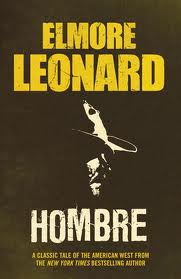
I'd never read Hombre, probably because I knew the movie so well that it never occured to me to go back and seek it out after I'd exhausted all Elmore Leonard's other westerns, and the magnificent collection of his western stories. But I came a across a copy recently, and read it as a little Christmas treat for myself. It turned out to be more of a Christmas treat, it's a superb novel, whose strong points typify what makes Leonard so good.

The biggest difference from the film version is that Leonard's story is told from the point of view of a young man, whose job with the stagecoach company that's closing down of the local office provides the starting mechanism for the plot. Carl is extremely naive, and not very courageous, and he's the one who has the rifle in the book's climactic scenes, and his version of events that is the only one being told. He's a more dependable narrator than, say, Charles Portis' Mattie in True Grit, which came a bit after Hombre and might well have been influenced slightly by it. The obvious influence on Leonard is Stagecoach, which similarly puts the passengers together on the stage, and includes one figure of authority who's fleeing with an agenda of his own.

John Russell, raised by Apaches, is the hero, and he's a quieter character in Leonard's version, remembering that it's Carl's perception that is passed down to us. In the film, Carl turns into a young man who's leaving with his wife, along with the woman (Diane Cliento) who ran the boarding house Russell inherited and which he's closed down. You can see how the movie involves Russell more in white society even before he gets on the stage--in Leonard's book it's not a decision he's fully embraced yet--and the Cilento character becomes a woman who was kidnapped by Apaches and lived with them for two months. This serves to heighten both the racial tension and debate, and also to emphasise Russell's ultimate decision when it comes to the codes each race lives by. Leonard's Russell is less knowable (again, remember, we are at the mercy of our narrator), and his actions more matter-of-fact than the film's star; Newman plays him far more Christ-like at film's end. But then he is Paul Newman; when you read the description of Russell's blue eyes you realise Newman was almost perfect for the role, and he plays with almost the restraint it requires, although in the end it always seems improbable that Paul Newman would be turned away from anything, even if he were an Indian.

Where the movie is superior in in the villains. Frederic March and Richard Boone are each, in their own ways, hams at heart; March draws out every drop of venal hypocrisy from his portrayal of the corrupt Indian agent Favor. His slickness contrasts perfectly with Boone's sandpaper roughness; just as Boone's bombast and earthiness contrasts with Newman's restraint. Boone's best roles were as likeable villains (see The Tall T), and he injects Grimes (called Braden in the book; the name is shifted to Cameron Mitchell's outlaw in the film), with a perfect mix of cruelty, charm, and slyness. Between them Favor and Grimes define the bit of white civilisation not defined by women. Barbara Rush, as Audra Favor, makes the most of what is a rather thankless role, but the better she plays it, the more difficult and telling Russell's final decision becomes.

Unlike the original film version of 3:10 To Yuma, where an entire backstory was tacked onto Leonard's movie, filling it out brilliantly (what the remake did is another story!), the film follows the book pretty faithfully, and is all the better for that. But it inevitably has to show things Leonard lets you intuit for yourself; he builds his characters by letting them say and do, and letting you compare those things. That you are placed behind the eyes of a naive young man probably tells us more about ourselves, as readers of, or perhaps believers in, the myths of the West than we need to know, and that's what makes Hombre so brilliantly discomforting.

Hombre by Elmore Leonard
originally published by Ballantine in 1961
Orion Phoenix Books, £8.99 ISBN 9780753819111