Saturday, 7 January 2012

BORGEN: BBC4'S SARAH LUND REDUX

The BBC have announced they bought the rights to another Danish TV series, Borgen: you can link to the announcement here. The series will air tonight, as The Killing did on Saturday nights, on BBC4. I'll try to catch it on Iplayer, that wonderful tool which for some reason the BBC cant make compatible with the latest version of Firefox (you can watch, but you can't store, suggest, or favourite).

Without pre-judging Borgen, the premise is interesting in a number of ways--the most obvious being that the most compelling part of the second series of The Killing, and almost the most compelling part of the first, was the political drama. In fact, in series two, it was as if the battle within the cabinet were part of a separate show, and though Nicholas Bro may have occasionally over-egged the pudding, his befuddled battle with the 'establishment' and the fights within the ruling coalition, were both extremely well done.

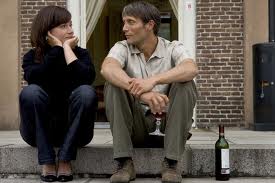
The Danes may be producing the best cinema in Europe right now, and their television seems equally strong. Not that it matters, because Borgen will be something the BBC can market to Sarah Lund fans because it's about a female political leader whose party takes power in a coalition which she heads as Prime Minister. When you consider, despite the strength of Sofie Grabol's performance, how the British response inevitably concentrated on her sweater, you can almost predict that whatever Sidse Babette Knudsen (another fine actress, as anyone who saw the Oscar-nominated After The Wedding can attest) wears is likely to do the same.

But there is far more to Danish film than sweaters and actresses--the country has such talent that even the Swedish Girl With The Dragon Tattoo was directed and written by Danes (and if you're looking for a fine political thriller to prepare for Borgen try The King's Game, written by the same pair of writers, Nikolaj Arcel and Rasmus Heisterberg, and directed by Arcel). So check it out tonight, or on IPlayer, or, if you don't have either, you can buy the Danish DVD with English subtitles on Amazon.

Thursday, 5 January 2012

D.D. GUTTENPLAN'S I.F. STONE: AMERICAN RADICAL

In 1958 IF Stone wrote:
 'For almost two decades we have lived in a stale atmosphere of Fifth Amendment radicalism; no one is a Communist, few admit themselves Socialists, nobody owns up to reading Marx, and practically everybody on the Left claims only to be a Liberal, nothing more; the word 'radical' is avoided as a bad word.'

Reading that passage, it struck me as some measure of how far backwards we have moved in the past fifty years; today virtually no one on the left dares claim 'only to be a Liberal', devalued as that word has become. The real beauty of DD Guttenplan's monumental biography of the man best-remembered for IF Stone's Weekly is the way it tells a story whose themes seem to reverberate constantly with echoes of today.

American Radical is really the tale of two rises to journalistic success, accomplished in two very different atmospheres. Thus it is almost two different books. As someone who grew up during the era of (if not 'with') IF Stone's Weekly (my parents being mainstream Democrats who got their news from Time, Life, and the right-wing New Haven papers, 'balanced' by the Sunday New York Times), to me the story of Stone's early rise was the more surprising. I had never realised just how successful he had been in the mainstream—to the point of wielding (or thinking he wielded) a little bit of influence in FDR's Washington. It was still possible to do that from the Left in those days, and Stone's rise is the more remarkable because he managed to do it while avoiding the in-fighting and back-stabbing which seem to always categorise left-wing politics, and which seem to grow more vicious the more politically irrelevant the groups or issues involved. Stone somehow managed to avoid being caught up between factions, while writing for both mainstream papers and leftish magazines. There was some cross-over; as interesting as Stone's story might be, that of J. David Stern, the crusading Philadelphia newspaper owner who wound up buying the New York Post and turning it into a left-wing daily of some courage, may be more fascinating. Of course the peak of mainstream left wing news in America might well have been New York's afternoon paper PM, for whom Stone also worked, and as it died so too died the progressive dream. But it's chilling to read that in August 1943 PM was already charting the murder of 1.7 million Jews in Europe, while officially Allied governments were refusing to take steps to try to save those who remained.

In the case of the factionalism of the left, it might be easy for Guttenplan's detailing of the many-faceted progress of progressives through the Thirties to lose readers along the way, but I found it fascinating, if in a sometimes anoraky way. The minutiae of esoteric debate and distinction may itself be part of the reason the left found, and still finds itself, so vulnerable to the right in the bigger picture. The right has always been quicker to understand that it's about power, not principle. But it's typically revealing to learn that a group of Republican backers offered Earl Browder, head of the US Communist party, $250,000 to either nominate or endorse FDR in 1936. That gives somewhat more credence to General Smedley Butler's 1934 testimony that he'd been offered, by a similar group of shadowy financiers, command of a fascist army to overthrow FDR. Indeed, Guttenplan's view is so complete that some of the most fascinating stories are often tossed away in footnotes, as when he details Philip Johnson's career as a 'fascist intellectual'. The Johnson & Johnson heir was a huge supporter of Father Coughlin's radio hate-mongering, and started his own band of 'grey shirts' – yet in post-war New York he rose to architectural prominence with no one commenting on his past, much less the wistful totalitarian nature of his design. I was similarly intrigued to discover Corliss Lamont, the Marxist scion of an investment banking family, whose great-nephew Ned tried to rid the political world of Joe Lieberman a few years back.

The better-known story of Stone's blacklisting stands in sharp and touching contrast to this early story of success, and the fact that he built his second career on a self-published weekly newsletter has huge relevance in today's world of internet 'journalism'. It's facile, and largely wrong, to say that Stone would be blogging today—his work was better suited to the weekly, which allowed him to collate research—but he was in a sense a small-scale aggregator, like a number of present-day sites at the sub-Huff level, which mix good journalism with aggregation (eg: Truthdig. Tom Paine). Perhaps the heirs to IF Stone's Weekly are Tom Englehardt's Tom Dispatch or Robert Parry's Consortium News. But it reminds us exactly what a journalist is, or should be. Stone was so successful as a newsletter maverick precisely because he had been successful in the mainstream (and, to a lesser extent, on the left-wing). He had contacts, and more important he knew both how power worked, in Washington and in city halls, and how to find information in the public domain. He had built his sources through hard work, through go-getting of the sort that used to be a journalist's stock in trade. This is the most interesting part of his progression from Isidor Feinstein to IF Stone. He wasn't Studs Terkel or Jimmy Breslin, haunting the working-class bars, but he knew how to work rooms in high places, how to argue policies and principles, and he kept his talent working on behalf of his ideals—he wasn't likely to be Judith Miller'd, even in the service of policies or ideologies he supported.

Guttenplan is very good on such dilemmas—in the protean world of the Depression Thirties, no less than the McCarthyite Fifties, people often tailored their opinions to suit their ideologies. They always have and still do, of course. But more than most, Stone needed to see for himself, and it shows. He was an early and unofficial visitor to Israel, as detailed in his classic book Underground To Palestine, and an equally early proponent of treating the Arab population fairly. He warned of the 'moral imbecility that marks all ethnocentric movements'. When he added a new introduction to the book in the Seventies, the pre-mature neo-Con Martin Peretz denounced him as a PLO stooge. Even in his years of success, nothing had changed.

What's sometimes missing is a sense of the contradictions inside Stone. A devoted husband, he seems to have been simultaneously a devoted but very difficult father. He had some talented people as assistants on the Weekly, but tended to drive them hard and treat them harshly. There's little information and less speculation about his relationships, except when they turn into politicised feuds. The radical lawyer Leonard Boudin was his in-law and friend; Boudin's daughter Kathy was a key figure in the Weather Underground—I wonder what Izzy's reaction was to having an outlaw of the left in the family. I've always wondered why Stone was so adamant about supporting the Warren Commission's whitewash of the JFK assassination: he was perfectly willing to believe in a conspiracy (even involving J.Edgar Hoover and his FBI) in the killing of Martin Luther King. But these are my curiosities.

If the book seems to pick up pace and slide through the years of Stone's return to the mainstream (although interestingly, his sort of political reporting was already being marginalised by television) it may be because we know those political debates too well: Vietnam, the Middle East, the late Cold War, the civil rights movement. It may also be that Stone as a success, as an icon, is less interesting to a biographer than Stone as fallen angel, or maverick outsider. If anything, however, his decision to study Greek and write The Trial Of Socrates deserves even more attention; a remarkable late change of pace. Years ago I went back and read up on Stone, often missing much because the context wasn't fully there. But the over-arching theme was this: that governments could not be trusted to act in the best interests of the majority of their citizens; that official versions were suspect for that reason, and for other, more practical reasons as well; and that the pursuit of profit and power was no respecter of human life or morality. In that sort of context, an analysis of Socrates seems perfectly fitting.

In our own trying times, this book stands as both a blessing and a warning. Guttenplan (whose own claim to fame now may be as the father of a remarkably Brainiac champion on University Challenge) is aware of this, and makes such connections subtly, but unmissably. The greatest danger to the left in the United States has always been the fear that FDR warned us about, the fear that it is somehow 'un-American'. One of Stone's warnings in particular stood out to me. 'Never turn your back on a liberal in a tight corner'. In this tale of one man's stand against the right-wing's force-marching Americans into tight corners, it seems salutary to remember now.

American Radical: The Life And Times of IF Stone
by DD Guttenplan
Farrar, Straus & Giroux 2009, ISBN 9780374183936
also published in the UK by Quartet/Charles Glass Books, £25

Saturday, 31 December 2011

PER WAHLOO'S STEEL SPRING

After discovering Maj Sjowall and Per Wahloo's Martin Beck in the early Seventies in Sweden, I remember searching around for Per Wahloo's early novels, and finding all of them except The Steel Spring (1968). In fact, I had forgotten about the book, until Vintage's reissue of it along with the other Chief Inspector Jensen novel, Murder On The 31st Floor, in new translations by Sarah Death, whose work here seems to catch the bleakness perfectly.

It's fascinating to read Wahloo in retrospect. The Steel Spring is a dystopian sf novel, in which Jensen, having gone abroad for a liver transplant, receives a message from his government telling him to return home. He soon discovers that his country is closed off to the outside world, but his doggedness gets him back home, where he finds an epidemic has struck, and his familiar surroundings are almost deserted.

Wahloo's concerns are the failure of social democracy, with a specific eye toward the way social improvement leads to social control, and democracy edges into totalitarianism. The urge to control is what has led to the epidemic, a case of society destroying itself from within. That the government under which this tragedy has happened is a nominal coalition makes the story shiveringly relevant to today's Britain, if not as much Sweden. The nameless country in which Jensen works seems to be a mix of Sweden with some proto-Iron Curtain eastern European state, sort of Albania or Romania thrown in.

Jensen is the perfect protagonist for such a setting, and in him it's easy to discern the prototype Beck. He has no personal life, appears to have no opinions or preferences, very little individual feeling, apart from doing his job to the best of his ability, which implies a sort of blind faith in the laws, the social contract, he enforces.

That was always the main conflict in the Beck books: the contrast between the world the policeman is protecting, and the laws he is enforcing—the way they are applied selectively, or not at all, depending on circumstances beyond his control. If The Steel Spring has a flaw, it's that most of the realisations seem to come from Wahloo, because although they are presented via Jensen, Jensen doesn't seem to share the criticisms which are obviously implied. Or maybe it's because he can't see them as criticisms, whereas we can. Which is the mark of good dystopian fiction. Wahloo's solo work deserves to be considered in the same context as Zamyatin, Capek, Orwell, or Durrenmatt...high praise indeed. I will probably revisit Murder On The 31st Floor soon, and if you haven't got to the Martin Beck books, please start now—and be aware I wrote the introduction to the sixth volume in the Harper Perennial reissues, Murder At The Savoy.

The Steel Spring by Per Wahloo
Vintage £7.99 ISBN 9780099554752

This review will also appear at Crime Time (www.crimetime.co.uk)

Wednesday, 28 December 2011

JERRY ROBINSON: THE INDEPENDENT OBITUARY

My obit of the comic-book artist Jerry Robinson, who created The Joker, Robin, Two-Face, and Alfred the Butler for Bob Kane's Batman, is in today's Independent; you can link to it here. The paper has a wonderful layout of Robinson and his Batman art. And I ought to point out my own mistake, as the first Superman movie appeared in 1978, not 1975.

I was fascinated to learn that Robinson had taught Steve Ditko, because you really can see the link between their thick, expressionistic inking, and the way they exaggerate to create realistic characters out of somewhat unrealistic drawings. And also because their political world-views couldn't be more diametrically opposed!

It's also rare to write an obit of someone so universally admired. He helped artists in myriad ways, guys like Siegel and Shuster in particular, in the fight for the rights to Superman, but many others in general, by helping them win the fight to retain copyright to their work (and here Neal Adams stands as the other beacon), syndicate their material, and fight for the human rights of political cartoonists. He also deserves for credit for his early history of comic art, one of the first books to take it seriously and do it well.

I wanted to include this quote from Stan Lee, for whom he worked at Atlas in the 1950s, but cut it for space. In retrospect, I wish I had. 'Jerry Robinson was not only one of the finest artists ever to illustrate comic books, but he was also the head of an editorial syndicate which made cartoons available worldwide, as well as being an inspiration to young artists whom he always found time to help and advise. A genuine talent and a genuine gentleman, he was truly a credit to the arts.'

Tuesday, 27 December 2011

JOHN HARVEY'S GOOD BAIT

John Harvey's police novels have always been built on the characters of his cops, and there is no one better at revealing those characters through the day-to-day concerns that real people have. In that sense, you might place Harvey firmly in the path forged by, say, Ed McBain's 87th Precinct novels, and Sjowall & Wahloo's Martin Beck books. Harvey is a master at very subtly using the cases his detectives pursue to reflect the conflicts they face in their 'real' live, and this is what is most impressive about Good Bait, which follows two separate investigations.

In London, DCI Karen Shields is lumbered with the corpse of a teenaged Moldovan boy found on Hampstead Heath, and despite a number of leads, finds herself running into walls. Not only from potential witnesses who won't talk, but from higher-ups in the department who want certain aspects of the case left alone. Meanwhile, in Cornwall, DI Trevor Cordon, playing out his string in the sticks, is asked by Maxine Carlin, a long-time problem for social services and the police, to find her daughter Rose, who never showed up for a planned visit with her father. Years before, Cordon had tried to help Rose, now calling herself Letitia, and found himself getting more involved emotionally than was safe for a cop. But when Maxine herself is killed just a few days later, underneath a train in London, Cordon decides he will get involved.

Involvement is the real danger in Harvey's work: his characters find it dangerous, and often withdraw rather than take the risk. Although the two cases will be brought very close together, the real parallel between them is the sense of danger emotional attachment can bring, how committing yourself to a person, for whatever reason, always brings risk. The dead boy was involved with a girl whose parents disapproved; Letitia/Rose has a child, by very dangerous man who believes the boy belongs to him. At the heart of each subplot is also a father's desire to protect or possess his child, and a mother's to protect it. The personal is never far from the criminal in Harvey's writing.

Meanwhile, Shields winds up facing an unexpected relationship on the job, and Cordon (a name full of resonance in this context) finds those old feelings for Rose are indeed real, though just as dangerous and unlikely to be fulfilled as ever, and his efforts on behalf of her and her son show him just what his own withdrawal from life has meant. This is where he is vulnerable, and he has to face and shrug off that vulnerability if he is going to get a 'result'. Meanwhile, since in Harvey's books the bureaucracy of the police is often more threatening (and sometimes more criminal) than the villains, Shields finds herself having to walk a fine line, which her new relationship may make more dangerous. It seems likely this is a potential conflict to which Harvey may turn in the future.

Drawing all these stories together, in a way, is 'Good Bait' the Tadd Dameron tune which has become a jazz standard. Harvey name-checks quite a few versions throughout the book (as well as the Swedish Wallander TV series, Eric Dolphy, and his own early western novels!) to the point it becomes a motif, and we remember that we are the bait for each other, and the hooks we take are often barbed. My favourite version might be John Coltrane's on Blue Train, where it's a tune that tries to escape itself, be free and happy, but can't quite shake its way out of the blues. That's what this quiet and affecting novel, whose layers draw out feelings in a masterful way, is all about. It's a very early entry for the best crime novel of 2012.

Good Bait by John Harvey
William Heineman £12.99 ISBN9780434021628

This review will also appear at Crime Time (www.crimetime.co.uk)

Saturday, 24 December 2011

KILLING THE BLUES: MICHAEL BRANDMAN DOES ROBERT B PARKER

Michael Brandman's Killing The Blues is the first of the posthumous continuations of Robert B Parker's characters, being the tenth Jesse Stone novel (Ace Atkins will pick up the Spenser franchise) and it's interesting in the way in strives to match Parker's concerns, and tone. It's more successful in the former, especially once it gets going, because action is character and once Jesse begins trying to help out kids with problems we enter familiar Parker territory.

Brandman produced, and co-scripted with Parker a couple of Spenser TV movies starring Joe Mantegna, which attracted little attention around the turn of the century. He and Parker then did a remake of Monte Walsh, which starred Tom Selleck, which led to a quite good series of Jesse Stone TV movies, starring Selleck as Stone (I reviewed Stone Cold favourably years ago for Crime Time, and might revisit the series later here). In that sense, for Brandman it's a continuation, but when it comes to tone, there is a bit more of the Selleck Stone, and a lot more of the TV movie. Brandman's Stone is somewhat darker, a bit more confrontational, and much more aggressive, than Parker's. He's made his task a little easier by writing out Sunny Randall, and bringing a new girlfriend on the scene. She seems more like Jesse's long-lost Jen than a perfect mate for him, but as always in these series, one assumes things will evolve.

The biggest change is in Spenser's supporting cast: Molly, who's a mothering sort of figure with Parker, becomes an even sassier version of the TV movie character, and Suitcase Simpson's role seems diminished. It's as if this Stone is more of a TV series police chief, and needs an action sequence every now and again; the kidnapping and holding of a small-time gangster seems quite out of character for the old Jesse, but the new one is a man of action. Which also changes the nature of his sessions with Dix, the shrink (played wonderfully by William Devane in the TV movies) because Jesse seems far more in control and far less revealing.

The story itself is very much in the Parker vein, it moves well, and the scenes are delineated clearly. But what it most lacks is Parker's ability to draw a character quickly and concisely, to establish with just a small description and a couple of lines of dialogue, a person you could see and understand. It was his greatest talent as a writer, and it would be asking a lot of Brandman to match it. But while the story is constructed cleverly and delivers at the end, its most powerful scenes are not, as they would be with Parker, the one-on-one confrontations with mobster Gino Fish, because Fish's character just doesn't explode. But the single best scene may be when Fish sends his hitman, Vinnie Morris, off on a job, and when's he's done it he delivers Fish's message: 'always look on the bright side of life'. It isn't really Fish, or Morris, but it many ways it's pure Parker.

Killing The Blues by Michael Brandman
Quercus £18.99 ISBN 9781780872896

Tuesday, 20 December 2011

3D SEX AND YEN: YOUR CHRISTMAS MOVIE?

The new 3D version of Sex & Zen quickly became Hong Kong's all-time biggest grossing (and I choose the word carefully) film, but I wonder if its makers ever happened to watch either of the Paul Morrisey 3D sex 'n horror films. If they had, they might have realised that 3D merely accentuates the unreal nature of soft-core porn, while adding nothing at all, and the western market has moved beyond Category III in Hong Kong. I wonder also if there is a real cultural divide in terms of sex and comedy, and I don't necessarily mean between China and Britain, but within Britain itself, because releasing this film on DVD just in time for Christmas week seems a very strange idea indeed. It is being billed as the first 3D erotic film, which ignores the 3D Stewardesses, a big hit when I was a boy, and the Warhol/Morrisey films, but had they watched any of those films they might have realised the extra dimension, so to speak, isn't necessary or sufficient. But as a stocking stuffer (and again, I choose the word carefully) I'm not so sure!

It was only 20 years ago that Sex and Zen (both films are adapted, extremely loosely, from the 17th century story The Carnal Prayer Mat) was made in 2D, starring Lawrence Ng and more famously Amy Yip (see poster below), but again, western viewers drawn by the allure of 'Category III', the Hong Kong version of 'adult' discovered a very soft core at the heart of a very strange sort of eroticism, one that didn't translate easily into our mores. Be warned as well, if you're a seeker of prurient interest: the version I saw in preview a few months ago suffered three minutes of cuts, which may improve it, or not, depending on your point of view.

There are a few funny moments in Sex and Zen, mostly revolving around the sexual naivete of our 'hero' Wei Yangshang, but otherwise the film is all too often nasty and violent, its sex primitive male fantasy, its attitude curiously prissy about what it shows and doesn't show, and, its mood, in the end, boring. In fact, the single most interesting thing about it is the way the sub-titles, in 3D, appear to be running in another dimension from the film itself, as if they were being projected onto a clear screen in front of each scene, an effect I began to find fascinating, like watching a child's toy theatre.

Wei is a conceited, not to say boring, scholar, who reacts to a recent outrage by the Prince of Ning by telling his master, the Monk Budai, that Ning will not be happy in the long run. Then Wei discovers love. But after marrying his true love, Tie Yuxiang, he fails to excite her. Given his boring lovelife when he goes to Ning's Pavilion of Ultimate Bliss, intending to make Ning pay for his blasphemy, he soon finds himself lost to carnal delights. The sexual-expert Ruizhu entices him but seems oddly unfulfilling, while the sadistic Dongmei frightens him, but seems to symbolise the dangers of the basic insecurity Wei is trying to assuage. But he still has problems, and eventually realises his tool is inordinately tiny. Since he has abandoned Tie, his true love eventually bows to family pressure and divorces him. Meanwhile, however, the Elder of Ultimate Bliss, a transsexual who has attained a sort of immortality by sucking the Zen ying yang out of his/her victims, has a solution for Wei, but the price will be high. He can get a new, larger penis, but in return he has to perform a service for the Prince...confused?

Hiro Hayami is a suitably dazed bozo of a hero, while Tony Ho sometimes seems like a Hong Kong version of Brian Blessed as the villain. The female roles are basically a dead-end street, but Leni Lan is appealling as the true love, and Saori Hara and Suou Yukiko compelling as Ruizhu and Dongmei, as far as the moaning allows. What might work for Suou, and for Vonnie Lui, is the contrast between their relatively innocent appearance, and their 'true' characters, but they don't get a huge chance to display it. Lui, from a girl band, is apparently known as 'Hong Kong's Sex Bomb' in Taiwan, which must be worth something at the Golden Globes (the very idea of a general release in the US is hilarious to entertain, especially as it has attracted virtually no attention in the UK).

The slapstick comedy is crude but effective, especially when Wei gets a donkey dick attached, literally, and a couple of times the intrigue around the Prince threatens to make the story compelling. There is even some well-done action (of the non-sexual variety) which is really the only time the 3D effects seem to add anything at all.

But those moments are all too few-- there are even a couple when the characters' pursuit of pleasure reveals its extreme cost, a sort of Sadian insight which seems strangely out of place. In the end, however, true happiness is revealed with an O. Henry twist, marital bliss is achieved only after the husband has been castrated and wife placed in an impregnable chastity belt. Oh the irony. Of course the young won't believe it, so you probably should not bother taking the kids to this one for Christmas in lieu of your local panto. But it does make a certain amount of sense, especially seeing as the 3D Sex and Zen is likely to put them off Sex and leave them praying for Zen.

3D SEX AND ZEN: EXTREME ECSTASY is on DVD (cinema release was in September)
directed by Christopher Sun screenplay by Mark Wu, Stephen Shiu, Stephen Shiu, Jr. photography: Jimmy Wong Hiro Hayama (Wei), Leni Lan (Tie), Tony Ho (Prince of Ning), Vonnie Lui (Elder of Ultimate Bliss), Saori Hara (Reizhu), Suou Yukiko (Dongmei)

Monday, 12 December 2011

MONEYBALL: THE MOVIE

Moneyball the film is just as interesting for what it isn't as for what it is. It isn't a traditional misfits get together and start to win baseball movie, like Bad News Bears or Major League, though it threatens to become one at a number of times. And it isn't a particularly good explanation of what it is that Billy Beane bought into, and why it was so different to the rest of baseball. What it is, however, is a very good attempt at getting to the core of what Michael Lewis was writing about, which is Billy Beane and his character.

You probably thought it was about the economics, which is the point that people – especially baseball people-- always missed. Lewis was not saying that Billy Beane was the smartest guy in baseball, or that he'd found the best way to build a baseball team. Lewis was saying that Beane had realised something about the economics of baseball, and that if he were going to survive in Oakland, and produce a winning team, he would have to invest in those commodities that other teams undervalued. The film does a pretty good job of explaining that, though they basically boil it down to on base percentage and don't really show what that means.

But that's not the core of what Lewis wrote about. Lewis' theme, his persistent theme, is the maverick, the man who goes against the book, bucks the trends, follows his own drummer. He especially enjoys it when his maverick is obsessive, as Billy Beane is, and eccentric, which he also is, and the film is literally at its most successful when Brad Pitt's Beane gets to play off the stolidity of Philip Seymour Hoffman's Art Howe. That is the core of Moneyball, Pitt burning off energy on the stationary cycle in the bowels of the stadium while Howe sits impassively with his arms folded watching the season first collapse and then explode in front of him.

Moneyball might have been a more interesting film had Steven Soderbergh hung around to direct. The original adaptation was by Stan Chervin, the first screenplay by Steve Zaillian, and Soderberg's concept apparently would have included interviews, like Reds, and probably explained the baseball concepts behind Moneyball better. You can see the urge to make the film more accessible to folks who aren't baseball geeks, more like what everyone expects a sports movie to be, which is why the film as directed by Bennett Miller keeps edging toward those traditional tropes (and it's not just baseball, think of Hoosiers, or Miracle on Ice, or Bang The Drum Slowly, or The Longest Yard—all films about disparate characters learning there's no I in team--and that's why North Dallas 40 is such a good sports movie, because it subverts that entire message, and why it was so important in the original Rocky that Rocky NOT win) of the team that learns to play together turning into winners. But you can also see why Aaron Sorkin, who seems to specialise in making drama out of mundane non-fiction, would be find this story interesting, because his films are full of obsessives, misfits, and geeks, and also because Billy Beane is literally a Sorkin character come to life, full of fast-talking repartee, and every bit as driven, if not by the same drivers, as Sorkin is reputed to be.

Where the film lets down is in failing to make some of the obvious parallels stronger. Scott Hatteberg is a Billy Beane character: Beane's own career as a player stands as a monument to the ability of scouts to misjudge talent, or predict a player's ability to harness his own talent—Hatteberg's own doubts reflect Beane's and more might be made of that. Similarly, the film gets mawkish with Beane's daughter, but skips the potential for real conflict and literally ends with her offstage, speaking through a cheesy song she's recorded for him. They really need to explain Bill James more clearly, explain the Red Sox' John Henry and his attempted hiring of Beane better (Henry is given the film's 'hammer' (a phrase I coined in my book about Oliver Stone) speech, which hits you over the head with the movie's theme, in case you've been asleep for the past 80 minutes and missed it) and it would have been good to have answered the question of how, if Bill James was actually working for the Red Sox, Billy Beane was responsible for everything. It also would have useful to have credited Joe Morgan's gloating explanation of why Moneyball couldn't work, just so we could blame him for fatuousness.

It's also interesting that Jonah Hill is so obviously unathletic (until you see the film of A's extreme Moneyball propsect Jeremy Brown, a pudgy catcher who never really made it in the bigs, and he looks just like Hill) because Paul DePodesta, the executive on whom he's based, was actually a college baseball player at Harvard, so yes he was somewhat socially inept, quiet and self-effacing (which is why he didn't want his name used in the film, which otherwise uses real names throughout).

In fact, if Aaron Sorkin had got involved earlier, we might have been able to combine The Social Network and Moneyball into one movie, with DePodesta and Mark Zuckerberg duelling with their computers trying to impress Radcliffe girls. It's like Beane's the Rob Lowe character from West Wing, or maybe Josh, and Brandt is Toby. In Beane Sorkin gets to combine the handsome jock with the smart geek, and create an unclubbable god! In that sense Moneyball and TSN are the same movie, and end on the same note, with Zuckerberg and Beane both viewing or hearing the voice of their love, ex-girlfriend or daughter, who can't be with them. Sob.

Wednesday, 7 December 2011

CRIME TIME'S BEST NOVEL OF 2011

I wrote the following for Crime Time (crimetime.co.uk) who are doing a survey via tweet, and then posting the full text on their website.

I agreed with the Dagger judges for once: Crooked Letter Crooked Letter is beautifully written & says much about America, not just the South. I thought Robert Crais' The Sentry defined Joe Pike & Elvis Cole. I admire Michael Connelly's 2011 two-fer: The Drop, a fine Harry Bosch, and The Fifth Witness, the best Mickey Haller yet.

I should also mention that I was going to put Graham Hurley's Borrowed Light on my list, but went back and discovered it was published last year. But it deserved the mention.

MORE EQUAL THAN OTHERS: GODFREY HODGSON

NOTE: Speaking this morning about my obit of Tom Wicker, which appeared in today's Guardian and which is discussed in my preceding post, my friend Michael Goldfarb and I talked briefly about Godfrey Hodgson, the Guardian's man in Washington during much of the time Wicker was the Times' bureau chief. It reminded me of this review I wrote for the Spectator seven years ago, and it seems appropriate to post it now, because Hodgson's analysis seems so precient given our precipitous decline in the years since then, years during which most of the inequalities Hodgson warned about were increased, with little thought to the effects that might have on society. I've reprinted it as it appeared, with just a few cosmetic changes...
A SECOND, DARKER, ANALYSIS (Spectator, 15 May 2004)
In 1976 Godfrey Hodgson published In Our Time, a portrait of America in the years from ‘World War II to Watergate’. To this American, reading it newly arrived in Britain in 1977, it seemed remarkable that the best social history of my country during my then-brief lifetime should have been written by an Englishman. Hodgson's sharp eye captured both a society in turmoil and one imbued with immense postwar promise. He combined critical distance with an innate, almost American optimism.
Nearly three decades later this sequel, as its title implies, is far less optimistic. Hodgson would certainly agree with Richard Nixon’s campaign manager and Attorney-General, John Mitchell, who said, on his way to jail, ‘This country is going so far to the right you won’t recognise it.’ Certainly there’s little of In Our Time recognisable in Hodgson’s analysis of the nation today.
He now sees a country in which the postwar liberal consensus has indeed moved right, turning free-market capitalism from an economic theory into a cultural template. The result is an America in which financial segregation increasingly preserves opportunity for a wealthy elite. Quoting Mark Twain’s aphorism, ‘We Americans worship the almighty dollar! Well, it is a worthier god than hereditary privilege’, Hodgson argues convincingly that American society has come to resemble old-fashioned Europe, and its strictly class-structured elites, enchanted as much if not more by the latter than the former.
Hodgson’s analyses in cross-section, topic by topic, dividing the country into its constituent interests and ultimately bringing those sectors together. By digging beneath the surface of cause and effect, he shows clearly where political policy and social change intertwine. Nowhere is this more evident than in the central issue of race.
The Right’s current hegemony is not due to policy, but in fact a by-product of racial politics. On signing 1965’s Voting Rights Act, Lyndon Johnson said, ‘There goes the South!’ The Democratic party’s control of Congress came from its uneasy alliance of northern liberals and southern conservatives. The combination of legalised equality for blacks and the left's protest against the President’s conduct of the Vietnam war drove southern whites first to George Wallace and then to the Republicans, changing the political balance for the rest of the century.
Once in power, the overriding aim of this Republican ascendancy has been to undo Franklin Roosevelt’s New Deal. Buttressed by the postwar economic boom, the New Deal created a burgeoning middle class, expanded its educational system, provided a state-guaranteed safety net, and gave the baby-boom generation the most privileged upbringing the world had ever seen. Those baby-boomers have piece by piece dismantled the hand that fed them, until only Social Security remains from the New Deal, and it too is now under fire.
The moneyed elite in northern cities have abandoned state education, while the growth of ‘Christian Academies’ in the south has, in effect, resegregated education there. University costs have escalated while financial aid shrinks, reinforcing an eduational upper-class. Is it any coincidence that both candidates for president in this year’s election were members of the same secret society at Yale?
This paradigm repeats in Hodgson’s examination of American life. One major change from 1976, as befits a scholar rather than a journalist, is that he now draws on mounds of statistical analysis. This is not always an advantage; sometimes the numbers threaten to overpower the reportorial instincts which make his work so telling. Strangely, the most obvious factual error he makes is British, saying that the 1970s saw Arthur Ashe become Wimbledon’s first black champion. In fact, Althea Gibson had won the woman’s title two decades earlier, but her death in relative obscurity last year showed, without needing Ron Atkinson to drive the point home, that we sometimes overrate the impact of sport on the advancement of minorities.
Yet sport helps demonstrate Hodgson’s acuity. He rightly draws on Robert Putnam’s excellent study, Bowling Alone. Putnam extrapolated from the decline of recreational bowling leagues that television had destroyed the sense of community activity in America. Hodgson takes his analysis further, tracing the massive changes in the telecommunications industry, arguing convincingly that the free market has created a less responsive and less responsible media just when Americans are most crucially dependent on it.
Hodgson concludes, with typical understatement, that his book paints ‘not an altogether happy picture’. He asks if America will ‘turn back’ to ‘older and wiser’ instincts. Rarely has a call for liberalism been made in such a convincingly conservative fashion.
More Equal Than Others by Godfrey Hodgson, Princeton Univ. Press, £29.95


TOM WICKER: THE GUARDIAN OBITUARY

My obituary of the New York Times columnist Tom Wicker is in today's Guardian, though online it's dated last Friday (2 December); you can link to it here. Wicker was a fine writer; I've enjoyed a number of his novels very much, and my praise of A Time To Die is honest and if anything understated; I've never understood why it didn't win a Pulitzer that year. But the point I was trying to make was that he was by no means the outsider some of his writing (and his presence on Nixon's enemies list) would make him out to be. But unlike many columnists, he was in most cases a writer who refused to bend reality to fit preconcieved ideology--he was hugely critical of Jimmy Carter, and was one of the few important opinion writers who refused to let Ronald Reagan skate on Iran Contra. If his fiction had a flaw, it was a tendency toward worthiness, an echo perhaps of the strong morality in his columns. Thus it was a surprise to discover his three Gold Medal paperbacks written as Paul Connelly--pulpy fiction was a good way of working out some of the kinks in those moral positions.

Although his career might be said to have been made by the JFK assassination, his position on the killing was one instance where he avoided his own dictum (in On Press) against over-reliance and trust in official sources. Wicker supported the Warren Report without equivocation immediately upon publication; and when the Times published its version of the House Assassination Committee's report, Wicker's introduction contradicted the report's own findings, that JFK's assassination was likely a conspiracy. I had written about a confrontation at a 1980 New York literary cocktail party at Jean Stein's apartment, where Anthony Summers and Norman Mailer took pot shots at Wicker, with Robert Blakely, chief counsel to the Committe in the crowd (Blakely would write a book concluding the Mafia, and no one else, killed JFK). Summers accused Wicker of having written his critical introduction before studying fully the evidence; Wicker, by then having read Summer's own excellent book, acknowledged that there were questions but opined a conspiracy had not yet been fully proven. It was an odd position for a journalist as critical and probing as Wicker to take, but I suspect it had more to do with the leaning against the Manichean world-view the establishment ascribes to conspiracy theories of any sort, than the actual evidenciary trail.

Finally, in my obit I did mention his step-children as survivers; I worked with one of his step-daughters at ABC in London for a number of years, and I'm sorry Kayce didn't get mentioned in the piece as published.

Tuesday, 6 December 2011

GEORGE PELECANOS' CUT

When I reviewed The Way Home in 2009 (you can link to it here), I suggested that, since so much of his work falls into the series framework, it might be grouped with George Pelecanos' previous two novels, The Night Gardener and The Turnaround, into a trilogy I dubbed 'Fathers and Sons'. His new novel, The Cut, in one sense might be considered the fourth book in what would then become a quartet, but it also marks a departure in style from the trilogy which precedes it, and also introduces a character who seems poised to begin a series of novels all his own. Spero Lucas does the investigating that gets a major drug dealer's nephew off a stolen car/traffic accident beef, and winds up working for the dealer to trace a leak in his marijuana supply chain. Things get complicated from there, and there's an interesting twist in the end, which helps confirm Spero's lone-wolf status.

In one sense, Spero's story continues the concerns of the 'Fathers and Sons' trilogy, with family values, in the old-fashioned, core sense of that phrase, being at their centre. Lucas is one of four children, two natural, two adopted, raised by hard-working Greek parents. He and his brother Leo are the adopted ones, and Leo is black. Of the two older children, one is a successful lawyer and the other is a ne'er do well; neither has much to do with their widowed mother. Leo is a teacher, Spero a war-hero home from Iraq, working as a casual investigator for a criminal defense attorney. The Cut features sub-plots; one of Leo's students is a witness to one of the central crimes, and is a bright boy in need of a father figure; a crooked cop turns out to have a criminal father of the worst sort—the contrasts between nature and nurture are never sharper than when Pelecanos approaches them through the prism of crime.

But looked at from another angle, The Cut does a couple of things differently from most of his previous fiction. There is a feeling in the way the book is structured around Spero that reminded me of Robert B Parker's fiction, how quickly he constructs a scene and the characters within it, and then moves on. Like so many of Parker's novels, this one also moves very quickly toward one big action scene, a structure not unlike the westerns which Pelecanos admires and which have been reflected before in his work.

The other new thing is Spero himself, who, unlikely as it seems, reminds me of John D MacDonald's Travis McGee, the 'salvage consultant'. That's the nature of Spero's work for the defense attorney. Like McGee, he possesses superior and well-honed skills that make him more formidable than he might seem (and like McGee's, those skills were acquired in the military). But most striking is Spero's attitude toward the opposite sex: though firmly on the side of families and raising children properly, he is, like McGee, a confirmed bachelor and unwilling (or unable) to commit to a relationship—though he is a lot of fun even without that. Being the 21st century, this attitude runs afoul of one of the women in the story, but being McGee-like that is, in effect, her problem. Admittedly, it has been a long time since I read a Travis McGee, but I was hearing definite echoes of his pop psychology in the narrative.

This is not meant to deflate the impact of this book. There is no one writing crime fiction who deals more realistically or more tellingly with the situation of working class people in American cities, and the degradation of life within those cities caused by the disappearance of jobs and the downscaling of education as a government priority for those people. He makes the problem personal, and that works. In The Cut, he has adapted those concerns to a faster-paced, more hero-centered story. If it's Parker and MacDonald with a conscience and a soul, that is not a bad thing to be.

The Cut by George Pelecanos
Orion Books, £12.99 ISBN 9781409114567