Showing posts with label Bernie Sanders. Show all posts

Monday, 2 March 2020

JOW BURROW, THE DRAFT, THE PRIMARIES & NINE INCH HANDS

I wrote this last week before the NFL combine started, and Joe Burrow came to terms with his tiny Trump-like hands and the possibly of being drafted by the Cincinnati Bengals. I published it at Medium, where I tend to do long form, and at my subscription football column, Friday Morning Tight End, at Patreon. You can visit either of those sites to investigate and ideally subscribe....

 
JOE BURROW, THE DRAFT, THE PRIMARIES & NINE INCH HANDS
 
The NFL Draft is a lot like an election, albeit with a limited voter base, especially if you think of quarterbacks as the top-of-the-ticket presidential candidates. Those quarterbacks spend four months building up their resumes and turning themselves into stars. Then, after the Super Bowl, the tables get turned. Only those who've crossed a certain threshold in the polls get to enter the Combine, not even if, like Michael Bloomberg, you were to offer $60 billion as collateral.  The Combine is the equivalent of the campaign 'debates'.

Like presidential 'debaters', the players at the combine will face examination and grilling from Gms,coaches and scouts who, like a gaggle of Beltway Chuck Todds, mostly follow the same mainstream script they've followed at every combine. The script is designed to somehow squeeze square-peg quarterbacks with individual characteristics, who have succeeded within systems often unique and sometimes antithetical to the mainstream paradigm for NFL offenses, into the round holes of the classic NFL dropback passer, possessed of size to see over the pass rush, arm-strength to throw over a cross bar from the knees at 60 yards, leap over tall buildings in a single bound and with hands big enough to squeeze hogs by the neck until dead. One of those may be an exaggeration. Having been built up through the college season as potential saviours to the worst NFL teams, having been allocated top spaces in the draftnik's premature orgasms of early mock drafts, they now turn into chopped liver. And no one gets picked apart harder than the so-called recently-proclaimed front-runner.

That, of course, is LSU's Joe Burrow, and if the combine were like the Democratic primary, the other QBs would form a circle and test their arm strength by playing dodgeball with Burrow, like Bernie Sanders' long lost grandson, in the middle. Burrow, like Sanders,  made his front-runner status even more interesting by suggesting a little bit of socialist revolution. The guy who at season's end was a slam-dunk to be chosen first overall by the Cincinnati Bengals expressed the belief that he still held some 'leverage' over the process.

This was seen as a shot across the bows of the notoriously tightly run SS Bengal, whose quarterdeck includes owner Mike Brown, executive VP Katie Brown Blackburn, VP Player Personnel Paul Brown and VP Troy Blackburn. They are a family business, so ever dollar is personal, and anyone who remembers when Carson Palmer tried to get out of Cincinnati will member how Paul Brown showed the flexibility of a candy cane until he got what he wanted from the Raiders from Palmer. Coincidentally, Joe Burrow's personal QB coach for the combine is Carson Palmer's brother Jordan.
Last week I went on ESPN UK's Nat Coombs Show (@thencshow) and discussed Burrow's leverage with former NFL GM Mike Tannenbaum. Mike pointed out right away that things are different now, with the rookie salary cap and the fact the drafting team keeps the player's rights for the length of his (unsigned) rookie contract: which for a first-rounder is five years. If I were an agent I'd be looking to frighten the socialist monopoly of the NFL with an anti-trust suit, but that's just me.
It was a non-quarterback, Bo Jackson, who actually sat out 1986 and played baseball rather than disappear into Tampa Bay. But Bo was a major league player; the two more relevant uses of leverage were from quarterbacks who forced trades. John Elway in 1983 also threatened to play baseball, but his time in the Yankees' farm system had already showed he had about as much chance of being a major league regular as, say, Tim Tebow. Elway's  coming out of Stanford's west-coast offense, did not want to play for the Colts and Frank Kush, a fiery coach whose success in college had been based on fierce defense and a somewhat paleolithic view of the forward pass. The Colts caved in and traded him to Denver for the fourth pick overall (tackle Chris Hinton), veteran QB Mark Herrmann and Denver's first rounder in 1984 (Ron Solt, who became a journeyman at guard).
You hear various stories about who engineered Eli Manning's refusal to go to San Diego with the first pick overall. His father Archie, or his agent Tom Condon, are usually blamed, with the reason being either a Kush-like aversion to Chargers' coach Marty Schottenheimer (who had messed up his Doug Flutie/Drew Brees duo) or a recognition that San Diego was a media deadzone. In any event, Chargers' GM AJ Smith had an advantage: the 2004 draft featured three quarterbacks all worthy going in the draft's top 10 (indeed, had he not landed Manning, Giants' GM Ernie Accorsi was supposed favouring Ben Rothliesberger (henceforth Ben) over Philip Rivers. Smith liked Rivers, so after he took Manning, the Giants took Rivers with the fourth pick. When they flipped choices, the Chargers also got a third round pick in 04 (kicker Nate Kaeding), a first in 2005 (Shawn Merriman) and an 05 fifth, which eventually became starting tackle Roman Oben. Two Super Bowl wins apart, you'd call it win/win.

As the combine opens there are two questions. The first is whether the Bengals can convince Burrow to play for them. This is not up to Mike Brown as much as it is up to coach Zac Taylor, who's a young supposed offensive guru whose job it will be to persuade Burrow that he can blossom and star in his offense, and that the team will build around him. Burrow, of course, is from Ohio: but Athens is only 40-50 miles closer to Cincinnati that it is to Cleveland or Pittsburgh (it's 75 miles from Columbus, though, where Burrow went to Ohio State.

The second, more telling question, is whether Burrow will remain the consensus top pick. After all, that undefeated national championship is now a long time in the past. And, on the first day of the combine Burrow was measured with NINE INCH HANDS!!! Not the name of a heavy metal band, nine inch hands might as well be puppy paws in NFL scouting. According to ESPN, in the past decade only three NFL starters have ever been measured with hands that small: Ryan Tannehill, Jared Goff and Chad Henne. Interestingly, Zac Taylor's hands measured nine inches at the 2007 Combine.
A passer with small hands, the theory goes, can't control the ball as well in bad conditions, is more likely to lose it on sack contact, and has questions about his overall maturity and mannish construction. By the way, Iron Mike's span (the measurement from thumb to pinkie) is a full 10 inches, though that in itself wasn't enough to get me to the combine. Also by the way, Patrick Mahomes' mitts measured out at 9 ¼ inches when he went through the combine.

It's funny when measurements begin to trump tape. I remember sitting with scouts watching an NFL Europe scrimmage. Barcelona's QB was Robert Daugherty, at 5-10 Boston University's answer to Doug Flutie. When Daugherty had a pass batted down at the line of scrimmage, the scouts started nodding and saying to each other 'that''s what happens when you're too short'. On the next possession Scotland's QB, Matt Blundin, a 6-6 guy from Virginia who was a second-round draft pick of the Chiefs, had a pass batted down. 'That's what happens when you're 6-6', I announced loudly. It got one or two smiles.
But now everyone will be considering Burrow's arm—strength, rated only average based on his college season. But why couldn't be beat out JT Barrett or Dwayne Haskins at Ohio State. What about his 2018 season? Is he a one-year wonder? And in 2019 he played on a powerhouse team with great offensive weapons. Did they make him look better than he was?

Funnily enough, the one thing that gave Burrow some leverage was being the unquestioned first choice. If that status drops at the combine, things get interesting, because as I said to Mike Tannenbaum, I see this year's draft class as something like 2004's, with Justin Herbert of Oregon and Tua Tagovailoa (henceforth 'Tua') of Alabama as the Rivers and Ben of the group.

Herbert is a big but mobile pocket passer who like Rivers played on a team which wasn't that good around him. He can look deliberate, and his decision-making was questioned, but that's what being over-manned can do to you. His arm will measure out strong, and his taking the decision to play at the Senior Bowl and showcase himself paid off: he was clearly the game's MVP and his leadership skills stood out. Tua, of course, is coming off a dislocated hip injury, and other problems with ankles, which raises some red-flags, but his is a rare talent in terms of mobility and arm strength. He was generally considered the number one prospect before his injury, and no one was downgrading him because his Bama teams were powerhouses. As a footnote, it wouldn't surprise me to see Jordan Love from Utah State move into this group with a top Combine; like Ben he comes from a second tier programme, but like Ben he has a rare combination of arm strength and pocket mobility; though he is less likely to step in quickly with the team that takes him.

So if Herbert or Tua step in front of Burrow in some team's expectations it could be a bonus for teams sitting with top five picks. If the Bengals decide a plan B would be fine with them, and other teams still covet Burrow, they could then feel free to do business.

At the very least you'd expect the swap of first round picks to cost the swapping team a another first, a second (those might be futures) and something else: and the Bengals are a team that needs a lot of something elses.

And here's where the Combine, and the post-combine draft process resembles a presidential race. Almost everybody lies. If the Bengals talk up other prospects, they may be trying to get the price up for Burrow. If they talk Burrow up, they may be trying to get the price up for Burrow. Or they may want Burrow, before during and after the Draft. Agents will float rumours, which the Hot Takz mouth clowns will be quick to spread round the twitosphere. In the end, Joe or No Joe, this soap opera will have exactly as long to run as the Bengals decide, and if Burrow does nothing to lessen his stock apart from NINE INCH HANDS, they would do well to play the game from now until April 23, two full months of reality TV. Just like a presidential race.

Saturday, 30 June 2018

ALEXANDRIA OCASIO-CORTEZ: IT'S NOT TRUMP'S QUEENS ANYMORE

Two stories dominated political news this week in the United States, which I was able to watch from the inside as I made a family visit, and from the inside their effects seemed to be interpreted in a curiously backward logic, which speaks to way politics is played in America.

On Tuesday, not far from where I was staying, a 28 year old woman, Alexandria Ocasio-Cortez, scored an amazing upset in the Democratic party primary for New York’s 14th Congressional district, defeating Joe Crowley, a 20-year incumbent who was considered the front-runner to replace Nancy Pelosi as minority leader in the House, and who, at 56, was at least 20 years younger than the three Dems higher than him in the party hierarchy.

The next day, 81-year old Justice Anthony Kennedy announced his retirement from the Supreme Court, effective at the end of July. Though he seemed to be tacking well to the conservative side in recent years, Kennedy was still considered the ‘swing vote’ between right and left on the nine-member court. His resignation gives President Donald Trump the chance to appoint another young die-hard rightist, in the mould of Neil Gorsuch, whose impact after being nominated last year has already been great.

The Kennedy resignation seems timed to allow Trump to make an appointment before the upcoming mid-term elections in November. Senate majority leader Mitch McConnell, who when President Barack Obama tried to fill the seat opened by the death of Justice Antonin Scalia, flat-out refused to provide the Senate’s ‘advice and consent’ as prescribed by the Constitution, thus holding the seat open until Trump could select Gorsuch, immediately announced he would this time fast-track the process. Commentators opined that the rush would be to avoid Republicans losing their majorities in an anti-Trump landslide in the mid-terms. Many of the them pointed to the Ocasio win as a sign the country was turning left.

That analysis missed the biggest point about Ocasio's win, the difference between national and local politics, particularly in today’s America. Because on the national level, Democrats would need a massive swing away from Republicans, estimated by pollsters at between eight and ten per cent nationally, to merely eke out a slight majority in the House of Representatives. This is due to the dual effects of systematic gerrymandering and intense voter repression, whose roots can be traced to the Republican focus on local politics in the 2010 midterm elections. By making huge gains in state legislatures, the party was able to dominate the redrawing of Congressional districts in the wake of the 2010 US census. By drawing districts that lumped likely Democrat voters together, they ensured their majority in the House, even when they polled fewer votes nationwide in Congressional elections.

Meanwhile, those same state legislatures were busy passing laws requiring government-issue photo ID in order to vote, and concocting schemes to defeat non-existent voter fraud by setting up registration checks designed to fail people who rented, moved, or simply wouldn’t check what looked like junk mail. With Justice Kennedy voting with the other four right-wing judges to allow virtually unlimited political spending, those who could vote were increasingly influenced by local advertising closely coordinated with national aims.
After ignoring the Ocasio campaign (the New York Times, which after al is her local paper, never ran a single article about her, though she did get mentions in election round ups), the national media jumped onto her victory to illustrate their own narratives, tied to national politics.

Ocasio had worked for Bernie Sanders in the 2016 Presidential primaries, so pundits either characterised her win as the beginning of a revolution for the Democrats, proving a rleativelt radical agenda could energise their voters or else as another futile gesture which would fail on the national stage because moderation is what they see as the only means of defeating Trump. Neither view was accurate, because it overlooked the local story.

Joe Crowley was a powerful man in Congress, a successful fund-raiser (he had outspent Ocasio by a 10-1 factor even before the final two weeks of campaigning) for the Democratic national committee, and for himself and his lobbyist brother. He came up through local politics in his New York City borough, Queens, which also produced Donald Trump. He was known locally as ‘The King Of Queens, but his congressional district aslso included parts of another New York borough, The Bronx, and after 20 years in Congress, he was perceived as not representing the interests of that part of his constituency.

Ocasio capitalised on that perception. She produced a virtually homemade campaign video (you can link to it here) which went viral with over 300,000 hits in its first day. It emphasied her own roots in the community and Crowley’s distance from the voters in his home near Washington. She articulated policies which may have seemed Sandersesque to the national media, but resonated with a community of working class people, many of them immigrants. Arguing for free university education in the city may seem radical today, but it was the reality in New York for decades before Reaganomics changed our perspective of the world. Beneficiaries of the city colleges included former Supreme Court justice Felix Frankfurter, author Frank McCourt, designer Ralph Lauren, polio vaccine pioneer Jonas Salk, General Colin Powell, novelist Mario Puzo, artist Barnett Newman and many more, often themselves the children of immigrants. What was seen as necessary then is seen as radical now.

The circumstances of Ocasio’s victory cannot be replicated across America. She won a primary where fewer than 30,000 voters turned out against a complacent candidate who, for all his power was very much vulnerable. She herself will likely be more vulnerable than Crowley in a heavily-Democratic district where she may not be able to enthuse Crowley supporters. Her campaign was based on providing a strongly articulated platform that was a real alternative to big-spending politics as much as to Republican policies or indeed Trumpism.

Nationally, the Democratic party has been content to present itself as a kinder, gentler alternative to the Republicans. This is a significant difference, and it can appeal to a wider audience when articulated effectively. But underneath its appeal is the famous dictum attributed to Bill Clinton when asked where the left would go if his ‘third way’ was not enough of an alternative. ‘Where else are they going to go?’ There will not be a horde of Alexandria Ocasio-Cortezes arguing with passion and courage a progressive programme and attracting those voters in the centre besieged with heavy media spending portraying them as radicals, nor will there be minority and immigrant voters battling simply to get registered and be allowed to vote. 

Following Crowley's defeat, Trump tweeted that he lost because he hadn't been respectful enough to his president. Missing the point is endemic in the American Beltway establishment, reinterepting every hiccup in their punditry's estimation in a way that will reinforce their previous convictions. Their picture of the centre fails to recognise how far to the right it has been shifted in the past four decades. The lesson of Ocasio-Cortez is not that a determined, energetic and attractive young self-proclaimed socialist is necessary to shift that paradigm within which 'liberal' is perceived as a smear. But it requires what Ocasio called the courage to stand up for the values which even a hesitant electorate can see are necessary to combat not just Trump but the modern, Koch Brothers Tea Party Christian Fundamentalist Republican Party, should it survive Trump, rather than empower him to some Erdogan-like President for Life status. Even though a look through history shows that most Supreme Court justices are Republicans when appointed, in the past many of them became bastions of liberal democratic values. Earl Warren had been Republican governor of California when Japanese were intered in concentration camps. Hugo Black had once belong to the KKK. And so on. The odds of Trump appointing anyone who might be considered a 'swing vote' by even the most accomodating mainstream pundit, or who had any human proclivity to slide that way, are very small indeed.

The mid-term elections in November will be above all a test of the nation’s acceptance of Trumpism. But it will also take place in the shadow of the nation’s quiet acquiescence to a sea-change in the political landscape. Alexandria Ocasio-Cortez was a ripple in the waters. But the appointment of another Gorsuch, or worse, to the Supreme Court, could be the start of a right-wing tidal wave.

Sunday, 10 September 2017

NOTES ON THE EFFECTS OF BIASED DEBATE ON THE JET-LAGGED

I've been quiet on IT the past two weeks, mostly because I returned to the UK and went right into a job voicing highlights of the US Open tennis, which involved working in the middle of night. Hence I have remained effectively jet-lagged for the past two weeks, and formulating coherent thoughts about things (other than the NFL, where I continue to pick all the games for nfluk.com, and am now doing a twice a week --Friday and Monday--betting and general column for Betfair) has proven difficult.

Except when I am provoked, especially on the political side. Hence I've produced a couple of longish moans on facebook, which might be considered curmudgeonly by the cruel-minded, but which I will share here just to let you know I am still engaged....

HILLARY'S BOOK & THE 'BERNIE BOYS'
The most popular hook for media coverage of Hillary Clinton's book about the 2016 election has been her blaming the loss on Bernie Sanders.Well toast that on the log fire. I posted a link to a November New Yorker article which detailed how actively Bernie campaigned for Clinton; only Bubba and Chelsea were out there more for her. So here was my reaction:

On behalf of Bernie Bros of all genders (and Barack Boys, or don't you remember when she tried that one briefly in 2008, until someone pointed out the ambiguity of using 'boy' in the Bog O context?) can we all now please woMAN up and accept that Hillary deserves at least some of the blame for losing to the most unelectable candidate since Barry Goldwater? Or George Wallace?

Blame Russians, blame a Republican Party whose success relies on disenfranchizing voters, blame Comey, blame Comey again, but it is time to STFU about Sanders. He was out there campaigning while the Perezes and Wasserman Schultzes were hiding from voters they drive away because it's so obvious who they don't give a shit about. And yes, it's true, Bernie walked the walk for Clinton...

TOUGH ON BREXIT AND THE CAUSES OF BREXIT

Then I unluckily caught a few moments of Any Questions on Radio 4, and heard a Brexit 'debate' where the central issues were issues that are non-issues, but no one, on any side mentioned it.  I had suffered through a few minutes of another edition of it, or Question Time, or Ask Dimbelby or whatever they call it, the previous week, as I mentioned in my last post, about the self-parodying Jacob Rees-Mogg and the nepotistic BBC and its Dimbelbies. Of course Rees-Mogg, son of the editor of the Times, qualifies just as much as a legacy. But this week the real affront was the fraudulent Brexit con job....

How many times do I have to repeat this? There should be no debate about EU migration. Under Schengen, UK controls EU migration. Any EU citizen unable to show means of support after 3 months can be sent home. BUT the UK is too lazy, like its work force, to enforce a policy which isn't abused on large scale AND the politicians, particularly on the right, don't want to sacrifice their wrapped in union jack Little England xenophobia and appeals to bigotry.

As to the economic advantage for low-paid hard-working British families (TM).  Do you really think British companies will rush to hire British workers at high wages? Is there any single point in history, including the massive need for wage slaves during Industrial revolution at its peak, when this has EVER happened in GB? Name one. Right, I knew you couldn't. Listening to Dumbelby and panel 'debate' immigration is a painful joke. Are they ignorant? Or do they prefer an ignorant electorate?

Friday, 11 November 2016

WHY TRUMP WILL WIN: A Guest Post by Julia Carter

Forget electoral math, demographics and polls. Julia Carter laid out the reasons why Trump would win both the Republican nomination and the election, back on 29 February this year. She was spot on, and reading this in conjunction with my piece about the tactics of his campaign, I wish I'd kept this post as a template for that. In the interests of full disclosure, Julia Carter is my niece, and ever since she was a kid we have rarely agreed on politics. But she was right this time, and it's the best piece of analysis I've seen--especially given how long before the election she saw what would happen.

WHY TRUMP WILL WIN
by Julia Carter

It is really incredible how Donald Trump is completely outsmarting and manipulating the mainstream media with its nonstop coverage and dissection of every intentionally ridiculous comment he makes. His strategy is totally winning and he is most certainly a more dangerous threat to Hillary Clinton than Rubio or Cruz. How anyone does not understand this is beyond me. 

1. Rubio would do no better than Romney did on an electoral level. There is no state he could win that Romney didn't.

2. The Latino vote will ultimately not affect Trump. California and Texas will vote blue and red respectively regardless, and his turnout affect in Florida among whites will offset any uptick in Latino voting, which is always low. Only the Cubans vote in high numbers and they don't associate themselves with Trump's wall comments. And even blacks like Trump more than Romney...ouch!

3. Trump galvanizes a base and appeals to independents. He can win swing states. He can win northern states. The votes of the Republicans who say they'll refuse to vote for him will ultimately not matter in die-hard red states. Again, it's all about the swing states.

4. And Trump's biggest advantage is that just as many people who will refuse to vote for him will also refuse to vote for Hillary. She is totally divisive for Independents and non-inspirational for Democrats. You cannot count on people voting for her just to vote against Trump.

Conclusion? Bernie Sanders would be a much more formidable opponent. But he won't be and that gives Trump very favorable chances in November. And guess what? Sadly enough, Trump is more qualified than the other two Republican front runners. He is the least full of shit and the best player in the game of thrones. He has outsmarted the system. Nations get the governments they deserve.

-Miami, 29 February 2016

Tuesday, 7 June 2016

BRUCE SPRINGSTEEN AT WEMBLEY: BORN TO RUN

Sunday night I went to see The Boss at Wembley. It was about as nice a night as London allows, beautiful weather, easy access, and with 80 some odd thousand like-minded people (actually, many far more single-mindedly Bossy than I was) it was an excellent time. It helped I was with three of the Americarnage Gang of Four, Gnat Coombs and Hollywood Dan Louw (literally just in from the Stockholm marathon and proudly exposing his blisters to the crowd) and muchas gracias Senor Gnat for the tickets.

It was the third time I've seen Springsteen. The first was still the best, at Tanglewood in the Berkshires in August 1975, just before Born To Run broke, just before I moved to Montreal, and just before Annie's and my brief romance was over. I wrote about it last year (you can find that here) when I dug out an old poem to mark the 40th anniversary of Born To Run. It was the best not just because I thought I was madly in love, and we'd gone spur of the moment, and it was outdoors in the mountains; there was an intimacy among the 1,200 or so people there, who shared a knowledge of something great that most of the country didn't really know about. It's still special, and The Wild The Innocent and the E Street Shuffle may still be my favourite Springsteen album.

The second time I saw him was at Wembley in 1985, on July 3rd. I flew to America on the Fourth of July that year, and I suspect the Fourth would have been a bigger thing and better show, but it was still pretty good. Again, I felt it was far more intimate than a stadium show had the right to be, even though my company was nowhere near as compelling as Annie and Bryan, and the seats, high and to the side, meant you couldn't really see the stage, saw only one and a half screens, and heard everything echoing back as if on tape delay. I pretty much resolved then not to go to any more stadium shows, and for 30 years I didn't.

But this one was much better than 1985. The technology is, I suppose, better, and once you got used to the sound it was fine. We were on the field; lined up on our own 10 yard line with the stage in the opposite end zone, meaning you could see the little figures on stage, but you needed the three screens, like watching a TV in a showroom window from across the street.

What's different is the Boss, at 67, is more frenetic, and in better pumped-up shape (& perhaps a little bit scapel'd), than 30 years ago, and the band is, if anything tighter and more versatile. It's great to have Soozie Tyrell fiddling, though every time she got a closeup I thought of Beverly Sills! Violin has always added a lot of texture to the band; I recall Suki Lahav from the 1975 WMMR/Main Point concert which is one of my all-time favourite records, bootleg and all. And it was funny to see Nils and Steve each going for second place in a Keith Richards look alike contest! And I kept watching Max Weinberg, looking at lyrics on a IPad teleprompter as he pounds the skins, and thinking he doesn't need amplification. Interestingly, I read an interviw with Suki Lahav, who returned to Israel soon after leaving the band, and she said Max didn't like being behind Bruce while drumming, in the drummer's usual position, because he couldn't see/hear the words of the song, and he wanted to see what Bruce was singing because the words influenced the way he drums. So that was a problem  solved by technology.

They sounded great, they interacted with the audience with a spontaneous quality, and they played through a huge catalogue of songs, all of which have a Springsteen similarity but which cover a lot of different textures. And changing contexts: 'Tougher Than The Rest' was played as a tribute to Muhammad Ali, and you can't do much better than that, great one to greatest.

Which is the interesting thing, because this crowd was not just people like me out to see a figure from their past. It was not like watching Duran Duran because you loved them when you were a teen and now you're old and they're old and you're both going through the paces. This crowd was made up of people from their teens to, I dunno, older than me, and they all had their favourites from different eras, and many of them could not have come to the Boss long before the previous decade. When I was 20, there weren't many recording stars from 40 years before we were listening to--people who were hot in 1931. But it's different, and has been since the Sixties, maybe even since the Fifties. Again, technology is part of that, but there is a sort of Golden Age of rock which seems to attract and open new ears in every new generation.

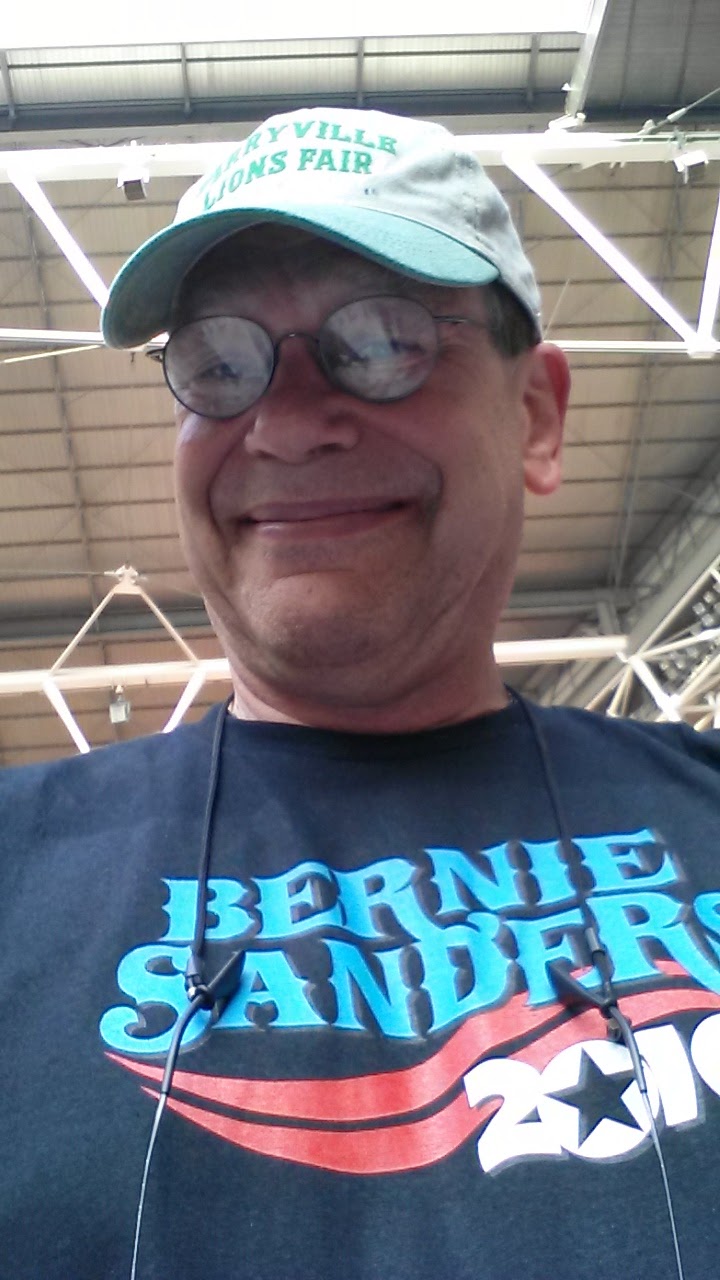
As well as turn the original old generation into kids again. Check out the S.E.G. on Iron Mike in the photo on the right.  Do I look Born In The USA or what?

Of course, we have aged. I started to leave after the first encore ('Jungleland') because I had to get a train home, and it was Sunday in Britain, and the last train leaves earlier, and there was a replacement bus service one of whose drivers had nearly taken his bus into a low railway bridge was I was coming back from the BBC that morning. So I played safe and managed to get home before midnight and walk the dog. But the sax solo in 'Jungleland' started to take me back, maybe because I was out of the crowd, and there is a sense where I find the collective experience overkill, and Jake Clemons wasn't playing his uncle's stuff note for note, but the sense of continuity being the thing that mitigates against time passing struck me strongly.

Then people started coming up to me and shaking my hand, or congratulating me, and I thought they might be NFL fans, but they were saying things like 'Feel The Bern' and I realised it was because of my  T-shirt (not my Terryville, Connecticut Lions Fair hat). Thanks folks.

I walked alongside the stadium as they played 'Born To Run', and again the sax solo launched me into reverie, and I stopped and listened. I went back 40 years and 2,600 miles and one old love and one best friend and I don't know how many scratched LPs and awkward record players and Lord knows what else. They started playing Dancing In The Dark and I walked away listening to that, which pushed me back to the 80s again. I missed some more encores, including Tenth Avenue Freeze Out, which I would have pleased Gnat by singing along to. When the changes came uptown, indeed.

Monday, 6 June 2016

THE CALIFORNIA PRIMARY: BACK TO THE FUTURE

It's the California primary! The Democratic party's nominee for President seems all but decided, with the votes of party insiders making the crucial difference. The insurgent faction of the party is being told to stand-down, to allow a candidate they see as part of the very problems they are protesting get down to battling a Republican candidate seen by many as a figure of revulsion. Yet the insurgents battle on, hoping that a big win in California might open up the party's convention, and their candidate might win were it contested. Ah, you think, Bernie Sanders' position is hopeless and he ought to quit before Tuesday's vote? But it's not Bernie Sanders I'm talking about, it's Bobby Kennedy. And today, of course, is the anniversary of his assassination in Los Angeles.


The analogy is not perfect, because it was not only Kennedy competing against the party's anointed candidate, he was competing also against fellow insurgent Senator Gene McCarthy. In those days primaries were few in number and not crucially important; even in some states that held them, the primary vote did not even bind the convention delegates who were chosen in the traditional manner, by each state's party 'machine'. Party delegates got to travel to the convention, carry signs, wear red and white and blue clothing, sing and cheer, and do what they were told by their state party chairmen. It was democracy in action.
Hillary Clinton, the party's presumptive choice now, is a good match for Vice-President Hubert H. Humphrey, the eventual Democratic candidate, while Richard Nixon was many things, but not many of them resembled the snake-oil hucksterism of Donald Trump. And it's highly unlikely that the eventual choice of a Democratic candidate this year will involve assassination or riot.

The 1968 Presidential race, like everything else in America then, was chaotic. Protests against the Vietnam war were reaching massive scale; the black inner cities were erupting in a series of riots, and the progress of de-segregation in the South, despite President Lyndon B. Johnson's steering the 1964 Civil Rights Act and the 1965 Voting Rights Act through Congress, was desperately slow. American politics itself was in a period of profound change, which Johnson recognised as he signed the Voting Rights Act into law: 'there goes the South.' he said. The Democratic Party had been maintained by an uneasy alliance of big city Northern machines and labor unions with so-called Dixiecrats, Southern segregationists whose states had, for a century, continued to fight the Civil War and ignored the Republicans, the party of Abraham Lincoln.

Johnson's landslide win over Barry Goldwater in 1964 had been based on his continuation of the legacy of John Kennedy, and the portrayal of Goldwater as a right-wing fanatic whose finger was not to be trusted on the nuclear button. The famous TV ad of the little girl picking flowers before a nuclear explosion ran only once, and didn't mention Goldwater by name, but it didn't have to. But Johnson's refusal to 'lose' the war in Vietnam saw him escalate the conflict and the American presence in it. In February 1968, Johnson watched TV news anchor Walter Cronkite report on Vietnam, highly critical of our involvement. 'If I've lost Cronkite I've lost Middle America,' Johnson told his aides. On March 12, in the New Hampshire primary, McCarthy's army of college students and anti-war activists emerged with 42 per cent of the vote. Johnson 'won' the state with 49 per cent, but the McCarthy faction had also lured 20 of the 24 delegates available. For a sitting President, this was a disaster.

Sensing LBJ's vulnerability, four days later Bobby Kennedy entered the race. Many McCarthy supporters never forgave RFK his opportunism; they pointed to Kennedy's similar behaviour in appropriating a Senate seat in New York, when everyone knew the Kennedys came from Massachusetts. Years later, Hilary Clinton faced similar accusations when she traded in her Chicago Cubs baseball cap for a New York Yankees one while winning a Senate seat in her newly-adopted state.

On 31 March in a speech suspending American bombing in Vietnam, LBJ shocked the country by announcing 'I shall not seek and I will not accept the nomination of my party to run for President.' I was in my last year of high school; just turned 17. I leaped from my seat in excitement: it was as if we had driven Johnson from office.

Vice President Hubert H Humphrey now became the presumptive nominee, with the backing of party bosses. Known as 'the Happy Warrior,' Humphrey, a textbook 'liberal' and party loyalist, was trapped in his support of the Vietnam war. He did not contest any primaries: in some states 'favourite son' candidates stood on behalf of delegations controlled by the party machines. And the battle between the insurgents became fierce. Kennedy's civil rights record helped him with minority voters, especially after the assassination of Martin Luther King on 4 April; he had the charisma and the Kennedy name to give black voters hope. Plus McCarthy was no tireless Bernie Sanders; lacking the drive to take his campaign on the road, his appeal was more to reason. Even so, going into the California vote McCarthy had won four primaries (Wisconsin, Pennsylvania, Massachusetts and Oregon) while Kennedy had taken two (Indiana and Nebraska), though McCarthy would take New Jersey and Kennedy South Dakota on the same day as California. Only in Oregon, Indiana and Nebraska had the two gone head to head.

But California on 5 June was the big prize and when the vote was counted Kennedy won with 46%, to McCarthy's 42. Despite having taken far fewer popular votes around the country, he now led McCarthy in committed delegates (393-258) though Humphrey and his surrogates still had a comfortable lead. Then in the early hours of 6 June, after a victory speech and a cry of 'on to Illinois' Kennedy was shot dead at the Ambassador hotel.

McCarthy would win Illinois, but the Democrats were now split into four pieces, and the insurgents' delegates won in primaries would never have been enough to out-vote Humphrey's, even had they been united. Perhaps Kennedy, riding a wave of primary support, might have convinced the convention that he had a better chance of defeating Nixon. But by the time the convention opened in Chicago on 26 August, Kennedy's support was split, only some of it sticking after Senator George McGovern picked up his standard. The Dixiecrats, who could back LBJ but were more suspicious of HHH, were facing challenges on the floor to their own delegations, many of which were still segregated. Meanwhile, outside the convention, the Youth International Party (Yippies) and Mobilization Against The War were organising a festival which soon turned into a riot, triggered when Chicago police beat a man who'd lowered the American flag in Grant Park.

The ensuing scenes of violence shocked America, as Chicago police seemed to run amok, even assaulting press on the convention floor. When Abraham Ribicoff, Senator from my state, Connecticut, rose to nominate McGovern, he said that with a man like him as president 'we wouldn't need Gestapo tactics in the streets of Chicago'. The television cameras caught Chicago mayor Richard Daley, hand cupped like a megaphone around his mouth, shouting at Ribicoff, and lip readers claimed he yelled 'sit down you Jew bastard'. In the end, Humphrey won the nomination by a wide margin, and went on to lose the election to Nixon, by a narrow margin in the popular vote but a wide one in the electoral college. This was thanks to Alabama governor George Wallace, running as an Independent, winning five states in the South away from Humphrey. Nixon's 'southern strategy' had been born, and soon the so-called 'solid south' would switch from being solidly Democrat to solidly Republican. Humphrey's only chance would have been a success in the Paris peace talks being held with the Vietnamese. But in what became known as the first 'October surprise,' Nixon's team, with help from Henry Kissinger, sabotaged the negotiations, promising the South Vietnamese they would get a better deal once Nixon was President. The Vietnamese were surprised when it turned out they were lying.

I still recall some former McCarthy supporters refusing to support Humphrey, arguing a Nixon win would bring the country to its senses. Instead, four years later, McGovern won the nomination as a result of a more democratic primary-driven process which he had been chosen by the party to develop. Even so, despite the deepening of the Vietnam quagmire, and the Watergate burglary, Nixon beat McGovern in a landslide even bigger than Johnson's over Goldwater just 8 years earlier. The country had turned full circle, but many would say the worst was yet to come.

Almost 50 years later, the process has been democratized even further, to the point where independent voters who don't identify as Democrats have a say in the choice of candidate. This may be unfair to the party faithful, or it may be a better gauge of how a candidate will fare in November with the independent voters who decide national elections. This is why the party bosses still hold the so-called 'super delegates' in the hole, to ensure an insurgent like a McGovern, whom they believe will lose, or worse, believe might win without their support, cannot get the nomination. The system, deeply entrenched, is designed to work, and after California Hillary Clinton seems likely to be declared the nominee. A Sanders shock in California, however, might persuade some super-delegates to question Hillary's electability, and consider whether the Democratic convention should actually be an open affair.

There has not been a seriously contested party convention since the Republicans in 1976, when Ronald Reagan narrowly lost a challenge to incumbent (but unelected) President Gerald Ford. Ford would go on to lose the election to Jimmy Carter, but much as I searched for parallels between them and Clinton/Sanders, I defy anyone else to find them either.