Showing posts with label Bill Clinton. Show all posts

Saturday, 20 June 2020

JEAN KENNEDY SMITH: THE GUARDIAN OBITUARY

My obit of Jean Kennedy Smith, the last of the Kennedy siblings, went online yesterday at the Guardian, you can link to it here. It should appear in the paper paper soon.

I had written it a few years ago for stock, and there was little to change. I added some details and clarified the Northern Irish peace process a bit, but basically it was as written. I would have liked to have spent more time on her childhood, and the aura of privilege which she enjoyed, but with the space I had, the issues more important to our British audience were paramount. I'm not sure her bit part in Michael Collins was as important as it seems to be the way I wrote it, but it was a nice bit of trivia to include.I did think the Barack O'Bama endorsement was a great way to conclude, especially with the references to John Hume.

Saturday, 30 June 2018

ALEXANDRIA OCASIO-CORTEZ: IT'S NOT TRUMP'S QUEENS ANYMORE

Two stories dominated political news this week in the United States, which I was able to watch from the inside as I made a family visit, and from the inside their effects seemed to be interpreted in a curiously backward logic, which speaks to way politics is played in America.

On Tuesday, not far from where I was staying, a 28 year old woman, Alexandria Ocasio-Cortez, scored an amazing upset in the Democratic party primary for New York’s 14th Congressional district, defeating Joe Crowley, a 20-year incumbent who was considered the front-runner to replace Nancy Pelosi as minority leader in the House, and who, at 56, was at least 20 years younger than the three Dems higher than him in the party hierarchy.

The next day, 81-year old Justice Anthony Kennedy announced his retirement from the Supreme Court, effective at the end of July. Though he seemed to be tacking well to the conservative side in recent years, Kennedy was still considered the ‘swing vote’ between right and left on the nine-member court. His resignation gives President Donald Trump the chance to appoint another young die-hard rightist, in the mould of Neil Gorsuch, whose impact after being nominated last year has already been great.

The Kennedy resignation seems timed to allow Trump to make an appointment before the upcoming mid-term elections in November. Senate majority leader Mitch McConnell, who when President Barack Obama tried to fill the seat opened by the death of Justice Antonin Scalia, flat-out refused to provide the Senate’s ‘advice and consent’ as prescribed by the Constitution, thus holding the seat open until Trump could select Gorsuch, immediately announced he would this time fast-track the process. Commentators opined that the rush would be to avoid Republicans losing their majorities in an anti-Trump landslide in the mid-terms. Many of the them pointed to the Ocasio win as a sign the country was turning left.

That analysis missed the biggest point about Ocasio's win, the difference between national and local politics, particularly in today’s America. Because on the national level, Democrats would need a massive swing away from Republicans, estimated by pollsters at between eight and ten per cent nationally, to merely eke out a slight majority in the House of Representatives. This is due to the dual effects of systematic gerrymandering and intense voter repression, whose roots can be traced to the Republican focus on local politics in the 2010 midterm elections. By making huge gains in state legislatures, the party was able to dominate the redrawing of Congressional districts in the wake of the 2010 US census. By drawing districts that lumped likely Democrat voters together, they ensured their majority in the House, even when they polled fewer votes nationwide in Congressional elections.

Meanwhile, those same state legislatures were busy passing laws requiring government-issue photo ID in order to vote, and concocting schemes to defeat non-existent voter fraud by setting up registration checks designed to fail people who rented, moved, or simply wouldn’t check what looked like junk mail. With Justice Kennedy voting with the other four right-wing judges to allow virtually unlimited political spending, those who could vote were increasingly influenced by local advertising closely coordinated with national aims.
After ignoring the Ocasio campaign (the New York Times, which after al is her local paper, never ran a single article about her, though she did get mentions in election round ups), the national media jumped onto her victory to illustrate their own narratives, tied to national politics.

Ocasio had worked for Bernie Sanders in the 2016 Presidential primaries, so pundits either characterised her win as the beginning of a revolution for the Democrats, proving a rleativelt radical agenda could energise their voters or else as another futile gesture which would fail on the national stage because moderation is what they see as the only means of defeating Trump. Neither view was accurate, because it overlooked the local story.

Joe Crowley was a powerful man in Congress, a successful fund-raiser (he had outspent Ocasio by a 10-1 factor even before the final two weeks of campaigning) for the Democratic national committee, and for himself and his lobbyist brother. He came up through local politics in his New York City borough, Queens, which also produced Donald Trump. He was known locally as ‘The King Of Queens, but his congressional district aslso included parts of another New York borough, The Bronx, and after 20 years in Congress, he was perceived as not representing the interests of that part of his constituency.

Ocasio capitalised on that perception. She produced a virtually homemade campaign video (you can link to it here) which went viral with over 300,000 hits in its first day. It emphasied her own roots in the community and Crowley’s distance from the voters in his home near Washington. She articulated policies which may have seemed Sandersesque to the national media, but resonated with a community of working class people, many of them immigrants. Arguing for free university education in the city may seem radical today, but it was the reality in New York for decades before Reaganomics changed our perspective of the world. Beneficiaries of the city colleges included former Supreme Court justice Felix Frankfurter, author Frank McCourt, designer Ralph Lauren, polio vaccine pioneer Jonas Salk, General Colin Powell, novelist Mario Puzo, artist Barnett Newman and many more, often themselves the children of immigrants. What was seen as necessary then is seen as radical now.

The circumstances of Ocasio’s victory cannot be replicated across America. She won a primary where fewer than 30,000 voters turned out against a complacent candidate who, for all his power was very much vulnerable. She herself will likely be more vulnerable than Crowley in a heavily-Democratic district where she may not be able to enthuse Crowley supporters. Her campaign was based on providing a strongly articulated platform that was a real alternative to big-spending politics as much as to Republican policies or indeed Trumpism.

Nationally, the Democratic party has been content to present itself as a kinder, gentler alternative to the Republicans. This is a significant difference, and it can appeal to a wider audience when articulated effectively. But underneath its appeal is the famous dictum attributed to Bill Clinton when asked where the left would go if his ‘third way’ was not enough of an alternative. ‘Where else are they going to go?’ There will not be a horde of Alexandria Ocasio-Cortezes arguing with passion and courage a progressive programme and attracting those voters in the centre besieged with heavy media spending portraying them as radicals, nor will there be minority and immigrant voters battling simply to get registered and be allowed to vote. 

Following Crowley's defeat, Trump tweeted that he lost because he hadn't been respectful enough to his president. Missing the point is endemic in the American Beltway establishment, reinterepting every hiccup in their punditry's estimation in a way that will reinforce their previous convictions. Their picture of the centre fails to recognise how far to the right it has been shifted in the past four decades. The lesson of Ocasio-Cortez is not that a determined, energetic and attractive young self-proclaimed socialist is necessary to shift that paradigm within which 'liberal' is perceived as a smear. But it requires what Ocasio called the courage to stand up for the values which even a hesitant electorate can see are necessary to combat not just Trump but the modern, Koch Brothers Tea Party Christian Fundamentalist Republican Party, should it survive Trump, rather than empower him to some Erdogan-like President for Life status. Even though a look through history shows that most Supreme Court justices are Republicans when appointed, in the past many of them became bastions of liberal democratic values. Earl Warren had been Republican governor of California when Japanese were intered in concentration camps. Hugo Black had once belong to the KKK. And so on. The odds of Trump appointing anyone who might be considered a 'swing vote' by even the most accomodating mainstream pundit, or who had any human proclivity to slide that way, are very small indeed.

The mid-term elections in November will be above all a test of the nation’s acceptance of Trumpism. But it will also take place in the shadow of the nation’s quiet acquiescence to a sea-change in the political landscape. Alexandria Ocasio-Cortez was a ripple in the waters. But the appointment of another Gorsuch, or worse, to the Supreme Court, could be the start of a right-wing tidal wave.

Friday, 12 January 2018

TRUMP AND THE EMBASSY ACROSS THE RIVER

Former US Secretary of State of John Kerry once complained that the United States was 'building some of the ugliest embassies in the world...we're building fortresses'. It was a telling metaphor. If form follows function, these buildings were designed to provide a modicum of safety for Americans often unappreciative, if not hostile, countries. In fact, much the same function as the State Department and its colleagues in intelligence perform on behalf of US 'interests' in those countries.

It is thus odd that Donald Trump should cancel his appearance to dedicate the new US Embassy in Nine Elms, given the 'special relationship' between the US and the UK, a relationship so special Trump failed to include the UK in his catalogue of 'shithole' countries from which he'd like to bar immigration. But since arrangements for the official state visit that Theresa May rushed to offer him after his election have not yet manifested themselves, any visit by Trump now ran the risk of being seen by the world as a sort of consolation prize. Especially because Britain cannot guarantee a protest-free Vauxhall, not as much to protect the President physically as to protect his fragile self-esteem, but in essence denying both the form and function of the new building.

Trump's own objections to the embassy, as voiced on twitter, are as easy to decipher as his fear of being met with demonstrations of mass disapproval. He called the Grosvenor Square embassy 'the best located and finest embassy in London', and said the new one was in 'an off location'. Donald Trump is a child of Queens, the New York City outer borough located on Long Island. He is one of the 'bridge and tunnel' people who see Manhattan as the centre of earthly delight. When he took over the family business from his father, his first moves were to rename it the Trump Organization and move it into Manhattan. To Trump, being on the 'wrong side' of the river is literally slumming, especially when the new embassy lies in a bleak development area south of the Thames River, reminiscent of the New Jersey marshlands across the Hudson from Manhattan.

Trump was also quick to blame Barack Obama for the move, saying he'd sold the Grosvenor Square location 'for peanuts' and spent the money on the new one in a 'bad deal'. Trump remains at heart a real estate hustler, and he could not pass up the opportunity to remind his followers of his own business acumen. Never mind that the move of the embassy was a product of the Bush administration, including the sale of the lease that runs until 2953 to the Qatar Sovereign Wealth Fund. The symbolic figurehead, the golden eagle, will remain on the building overlooking the square, to people that once this was the seat of the American presence in Britain, and was back to the days of Johan Adams, but it will also confirm a shrinking specialness for that special relationship.

The old embassy, opened in 1960, was designed by Eero Sarinen. Its fortress appearance is more the result of recent renovation than original design; it never really fit Grosvenor Square, but it did squeeze itself in without claiming domination. The structure was low and sweeping, and many years ago, quite pleasant and relaxed to use, more like a modern town hall than a fortress.

Of course it's probably best remembered for the 1968 demonstrations against the Vietnam War, which infamously featured a young Bill Clinton. This year is the 50th anniversary of those demos, as well as the ones in France, Mexico, America and elsewhere that will provide acres of fodder for ageing pundits.

But the threat posed by those demonstrations seems placid compared to the fears that fueled the Bush administration's flight from Mayfair. In the wake of the President's 'Global War On Terror', the US government was selling fear, and the Grosvenor Square building was a vulnerable branch of the store. It wasn't large enough to house the extra bureaucracy needed to 'protect' America by making the visa process more of a trial, nor could it house the huge increase in intelligence personnel, nor could it be protected adequately from the busy traffic that still passed nearby everyday.

To its credit, the new building manages to avoid the look of a fortress, though the Kieran Timberlake design has met with criticism in British architectural circles. It certainly doesn't do anything to spoil the landscape in Nine Elms, blending in with the graceless luxury flats with river views springing up in the emptiness of the neighbourhood. Its security is guaranteed by the large open spaces and moat that surround it, as well as invisible high tech equipment. Given the penchant for nicknaming London buildings, in the spirit of the Gherkin, it most resembles an artichoke. Or perhaps an armadillo. Or indeed a kind of Star Wars death-star: one expects those glass windows to open like gun portals, and laser weaponry to emerge. And while it lacks the Stalinist-modern menace of the MI6 headquarters, also in Vauxhall, but in the 'on location' side of the Thames, it also falls short of the state department' idea that it 'gives form to core democratic values of transparency, openness and equality. Just you try to get in, and try to open one of those windows.

The Michael Wolff book Fire and Fury would suggest quite strongly that the primary concern of the Trump White House is protecting the image and self-regard of its occupant. In such a situation, the idea that he would travel to Vauxhall, which he'd probably describe as a 'shithole', to cut a ribbon on a modernist fortress in disguise rather than accept a lift round Knightsbridge in a golden carriage with Her Majesty the Queen should surprise absolutely no one. The Trump team are probably drawing up architectural plans for the new 'special relationship' as we speak.

Tuesday, 8 November 2016

JANET RENO: THE GUARDIAN OBITUARY

I've written an obituary of Janet Reno for the Guardian, you can link to it here; it will be in the paper paper soon. I wrote it quickly under deadline pressure (1,200 words in two hours) so it was trimmed considerably, for the most part additional details about the cases I discuss, or background information.
For example, her loss in the 1972 state house election was largely the result of Richard Nixon's landslide win at the top of the Republican ticket. Occasionally there are conclusions I drew that were left out: she might not have fallen victim to a 'glass ceiling' for women when she was turned down by Miami' top law firm, but I find it hard to believe that wasn't the case.

Obviously Whitewater or the Siege of Waco require a lot of explaining. I had already cut references to current events: Whitewater and the origins of the 'crooked Hillary' myth; Waco and the Cliven Bundy affair, in which heavily armed rebels become right wing heroes as they stand down the government.

Her loss in the 2002 gubernatorial primrary to Bill McBride I had explained in more detail as well. McBride was seen as a more liberal alternative, but the primary was marred by contested results that I thought provided an eerie echo of Jeb Bush's attempts to deliver Florida to his brother two years earlier.

In the end Reno is a fascinating character, and her parents are a big part of that: one gets the sense that she is an amalgam of both, with her mother's more practical down to earth nature winning out. Janet Reno seems to be someone with both compassion and a strong moral compass, but with a degree of inflexibility which oddly helped her survive the Clinton years, where many more malleable politicians failed.

I didn't use a quote which Reno often repeated, advice from a mentor in Florida politics, John Orr: "don't equivocate, don't pussyfoot, don't talk out of both sides of your mouth, and you'll wake up the next morning feeling pretty good about yourself."


Monday, 19 September 2016

GREIL MARCUS: THE HEADPRESS/DAILY TELEGRAPH INTERVIEW

I did this interview in the autumn of 2000, in the bar of London's My Hotel, just before the US presidential elections. One version of it appeared in the Daily Telegraph. The editor there, Casper Lewellyn Smith, was most interested in Marcus' thoughts about punk rock, but Marcus' Dadist take was far too academic for the music he (Casper) loved for different rebellious reasons. Unfortunately I'd found Lipstick Traces enigmatic to the point of incomprehension; punk rock not only couldn't take the weight of Dada which Marcus wanted to load onto it, but the bridge he wanted to build between Punk and surrealism never seemed complete. I wrote the piece anyway for Casper, who cut it severly, and then I wrote this, the more complete version, for Headpress, where it ran in 2001. I also reviewed the re-issue of Mystery Train for the Spectator, which is another story, and met my future ex-wife at My Hotel soon afterwards, which is another another story....


GREIL MARCUS: DYLAN, THE BAND, PUNK, ELVIS, & BILL CLINTON
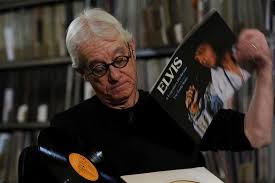
 
Greil Marcus’ Mystery Train is a landmark of rock criticism, a look at America myth seen through the magic lens of rock and roll, from Robert Johnson through Elvis to The Band. Its publication turned Marcus, at age 30, into an instant eminence grise for an entire generation. There had been writers, like Ralph J Gleason, who had discussed rock music in terms of the wider world, but no one had attempted so wide a sweep, nor accomplished it so gracefully. With one book, Marcus changed rock writing forever, becoming, in effect, the music’s creative conscience.

Indeed, behind Bertold Brecht spectacles, Marcus resembles a cultural commissar. He’s never considered himself a rock critic. “I ignore the industry, don’t go to the parties,” he says. His essays now appear in such rocking outlets as Artforum, Suddeutsche Zeitung, and Salon. But you can still see the excitement behind his eyes each time an idea clicks into place. A sense of risk-taking danger gives Mystery Train its edge. It’s criticism as creative art.
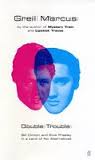
Marcus was in London to promote the 25th anniversary edition of the book (“presented finally the way I always envisioned it”) alongside simultaneous publication of Double Trouble, a collection of essays dealing with a very different American myth. Double Trouble is subtitled “Bill Clinton and Elvis Presley in a Land of No Alternatives.” When we meet at his London hotel, Marcus is worried about the upcoming presidential alternatives to America's First Bubba. He’s living temporarily in New York while he teaches at Princeton University, and although he’s registered to vote there, his wife isn’t.
We registered on the subway. New York sends people to wander the cars, signing up voters; they pay them a commission,” he says. “But only my registration went through. So if an absentee ballot hasn’t arrived by the time we get back, Jenny’s going to fly home to San Francisco, just to vote.” Marcus was born in Palo Alto, outside San Francisco, and educated at Berkeley. His lifelong addiction to rock began with a different sort of poll. I was 11 years old, my favourite song was “All Shook Up.” Chuck Berry’s “School Days” was everyone else’s favourite, and threatening to knock “All Shook Up” out of number one in the local charts. So I went and bought the record, in an unsuccessful attempt to keep Chuck Berry from number one.
 
He became a “self-conscious” fan in the summer of ’64. “I was interning in Washington, and I’d brought the Beatles’ album with “Money” on it with me. One of my flatmates said ‘what’s the big deal?’ and I said, ‘just listen to the instrumental break, the way you hear the whole machinery of industrial society grinding the man down, and he refuses to go under.’ A light bulb went ‘click’ in my head. I knew it was all bullshit, but I also believed it.”

When Rolling Stone magazine appeared, Marcus submitted a review to editor Jann Wenner, a college buddy. “A week or so later it was printed and I got a check for $12. That was it. I’d spent all my time studying at Berkeley, undergrad and grad school, and my professors seemed to have stopped trying to inspire students, and instead were training them for jobs. It was time to leave.” 
 
Marcus eventually became Rolling Stone’s book critic, and in Mystery Train he brought the devices of literary criticism to bear on rock music. I ask about what I feel is the particular influence of Leslie Fiedler, author of Love And Death In The American Novel, obvious in the way Marcus uses his personal sensibility to interpret wider issues of myth.

That sums it up pretty well. I thought a book might work if I could combine the instinctive reaction of a fan with the bigger ideas that attracted me. I felt that the whole of America was somehow captured in songs like “Mystery Train”, Robert Johnson’s “Stones In My Passway”, The Band’s “Cripple Creek”, Sly Stone’s “Thank You For Talkin To Me Africa”, Randy Newman’s “Sail Away”. If you’re presuming that, the theoretical ideas wouldn’t work without the visceral reaction.
But that book was really motivated by Watergate, by the idea that the country was up for grabs, being fought over daily. It was tremendously thrilling, but also scary, the sense of a battle taken away before it was finished.” 
 
Mystery Train was published in 1975, by which time many of the artists profiled had already slipped from the creative peaks Marcus chronicled. Soon Bob Dylan would retreat into born-again Christianity, Sly Stone would begin his odyssey through jail and rehab, Elvis would be beyond comebacks. Almost immediately after Mystery Train appeared, The Band would play their “Last Waltz”. 
 
Coincidentally, on this trip to London, Marcus read an article in Mojo chronicling the bitterness among the Band’s surviving members over song-writing credits. In Invisible Republic, his study of The Band and Dylan’s Basement Tapes (note: now retitled The Old Weird America), Marcus wrote that he still found himself framing questions for Richard Manuel, who hanged himself in 1986, knowing Manuel could not answer them. Marcus won’t go into some of the aspects of the Mojo article, but remembers when Manuel once told him he hadn’t been able to finish a song in two years. “Why not?” asked Marcus. “I haven’t been able to finish a song in two years,” said Manuel. 
 
I was most interesting in seeing Rick (Danko) say he got a $200,000 cheque for his share of “Wheels on Fire”. This was 25 years ago. There are various stories out there about what went on with song writing credits. For example, there’s one that Garth wrote the early version of “Daniel and the Sacred Harp”, and sold it away, but I won’t say any more about that.”

As America turned to mellow rock and disco in the late 70s, Marcus embraced punk, which led to Lipstick Traces, a study of punk and dada which attempts to deconstruct the entire 20th century. The book left many Marcus fans cold, perhaps because it was more intellectual?

It didn’t feel different to me, but it is more intellectual in the sense that I started with a question I wanted to answer, ‘why is “Anarchy in the UK” so powerful?’ which is a different approach than Mystery Train, where I started with an instinctive understanding. But I found the lack of understanding no less thrilling. Lipstick Traces was very much a Reagan book; in the same sense that Mystery Train sprang from Watergate. It was written at a time when I literally couldn’t bear to think about America. So intellectually, I left for Europe.
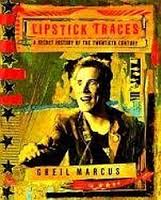
It was a burning desire to get to the heart of something I knew I wasn’t going to get to the heart of. I do think I got close to figuring out what made Dada a thorn in the side of the 20th Century. After I’d finished my research and before I wrote the book, I actually wrote a play combining all its characters in a night club. I spent a month writing footnotes to the play, but it never got into the book itself.
Recently a theatre company in Austin, Texas adapted Lipstick Traces as a play. My only involvement was to see the finished product, which they did as a comedy. I said, ‘you’ve staged the book I wanted to write!'

A quarter of a century after Mystery Train, Marcus says America is once again up for grabs. Again, he’s following instinct, because the parallels between Bill Clinton and Elvis go further than their white-trash upbringings in the hinterlands of Memphis. Clinton auditioned for his job by playing America’s First Elvis on the Arsenio Hall show, donning shades and blowing the sax. 
 
When President Bubba’s activities below the waist began exciting America’s right-wing would-be moralists, he literally forced Elvis off the front pages of the scandal sheets. What was Kenneth Starr, after all, but another Ed Sullivan telling Clinton to keep his hips out of camera shot? In Double Trouble, Marcus quotes Jonathan Alter saying “(Clinton) may be a hound dog, but he’s our hound dog”.

From the moment Clinton was elected, the right has tried to deprive him of his legitimacy,” he explains. “His temerity was believing in himself, just like Elvis. Elvis could’ve been accepted, if he’d dropped his Memphis buddies, took the right drugs, slept with the right celebrities. Instead he stayed in Memphis, where local society treated him with contempt. Clinton went to Washington and met similar contempt from a similar high society. He didn’t do what Reagan did, invite them all to the White House, where they’d say, ‘what class!”. Clinton didn’t schmooze them. He and Elvis are fundamentally outsiders, hicks who see no reason to become sophisticated. 
 
And if he had invited them, they’d feel this deep sexual terror, a nightmare of waking up in the White House hungover with Clinton snoring next to them. Elvis communicated a sense that life is easier than you’ve been told it is. The people who hated him, who hate Clinton, are the ones telling you it’s not."

During the London Film Festival I watched Elvis: The Way It Is, Rick Schmidlin’s magnificent re-edit of Dennis Sanders’ 1970 Las Vegas documentary. The new film captures Elvis’ ability to draw something from an audience. It struck me I hadn’t seen a performance like that since Bill Clinton’s speech at the Democratic Convention in August.
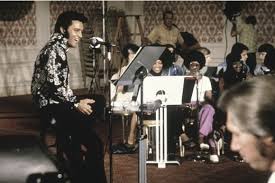
Exactly,” Marcus smiles. His eyes light up again and I feel like a student being given a A. “Think about it, from the time Elvis was 19 or 20, he was a citizen of a nation divided. Half the country wanted to BE him, and the other half wanted him removed! Clinton divided the country in the same sort of way. People thought: ‘if they can do that to the President, what can they do to me if I step out line? And they keep redrawing the line!’ They look at Clinton and they’d simply like to feel as good as he does in his element.”

We also agree on the film’s defining moment, when Elvis flirts with one of his backup singers. “Yes, here’s the woman who is black, she could feel ‘oh, he’s stolen our music’, but then he spins around to her and turns it on, and she’s jelly.” 

Marcus misses that sense of joy in music today. Does he believe, as he writes in Double Trouble, that rock music “no longer seems to speak in unknown tongues“? 

Well, so much is subject to commodification. John Langford, of the Mekons, plays in the Waco Brothers, and he began one show I saw by saying ‘we do not play no alt country.' Someone wrote that Britney Spears is 18, and she looks like a 35 year old 1950s housewife at the same time she’s an ingenue. Like she’s used up her capacity to have new experience.” 
 
In an essay “The Summer of Love Generation Reaches the White House, and So Do Their Kids”, Marcus quoted Margaret Drabble’s 1977 observation that people are “more ironic, more cynical, more amused by more things, and less touched by anything.” 
 
It’s more true than ever now,” he says. “But people are still moved by what they hear. Polly Harvey and Coren Tucker of Slater Kinney are infinitely more alive—it isn’t age—they will be touchstones in the next 20 years. They’re younger than other people and of course now they’re younger than I am. The last music to come out of nowhere and change my expectations was the last three Dylan albums, the two acoustic and “Time Out Of Mind”. They tell a single story, it’s a great detective story, as good as The Big Sleep
 
Most music today is a different story, but it’s a continuing one. The groups I revile, like Rage Against the Machine, Limp Biskit, Christina Aguilera, well they were created so I wouldn’t like them. Dock Boggs, the banjo-playing white bluesman said it best when he was older, “I don’t really like rock and roll, but then, I’m not supposed to like it.”

Friday, 15 July 2016

THE SELF DESTRUCTION OF THE LABOUR PARTY

I don't care whether youre a Corbynista, Blairite, Millibandito, Blue Labour or whatever. The UK has just gone through the most turbulent three weeks in 70 years. 52% of the country has voted to leave the European Union; the leaders who lied and played the fear card to engineer that triumph have jumped ship; the prime minister who gave the country a referendum as the price of placating his own MPs and holding off a UKIP who gained at Labour's expense, not his, is gone.

There is a new Tory prime minister, chosen by a handful of grandees; there is the most frighteningly ideological and inept cabinet I have seen in my 40 years in Britain. In the face of all this, the Labour party has been silent, not even a squeaking opposition, being more concerned with ousting their own leader and marginalising their members who elected him. This is a godsend to the largely Tory media, who play Labour's internal division up above all the other problems, but don't blame the media for their biases, they are something you have to live with.

Labour achieved power under Tony Blair with a Bill Clintonesque third-way strategy based on Clinton's core precept: where else do they have to go? Thus you focus your appeal on the undecideds, swing voters, independents, marginal seats, and you treat your core voters with a kinder gentler version of the abandonment of a conservative government. Which worked until Labour's tepid response to six years of austerity under the Liberal Democrat/Tory coalition allowed the SNP and UKIP to give those ignored voters alternatives. Tory scare mongering on immigration worked a treat in pushing Labour votes to UKIP in England and letting Tories win parliamentary majority with barely more than 1/3 of vote, but it invited the no vote that won the Brexit referendum.

Labour has been waiting for someone to stand up and marshal the opposition to what was going on--offer the country a viable alternative, help the country make sense of the disaster that is going on. Jeremy Corbyn was elected leader by party members who saw that traditional Labour values and policies were an answer, but, villfied in the press as a nutter and abandoned by many in his party as a, uh, socialist, he was not the leader to marshal the sane part of the country, not the person who could gather opposition and perhaps force a vote of no-confidence once the public schoolboys (and girls) have finished ruining the country they see by right as their playground.

My guess is a figure who was able to do that with any level of articulation and energy might have been chosen Labour leader by acclimation once the dust had settled. If a majority of the parliamentary party and their big donors wanted Corbyn out, the sensible way to do it would be for someone to step up and lead opposition to Tories, not opposition to Corbyn. Filling the gulf of leadership for the country outside Westminster, and indeed outside the party, would make the point self-evident. But who stepped forward? Who presented a vision of anything for the country, anything except a party not led by Corbyn? 

By abrogating their responsibility to the country in a cheap effort to re-establish their control, they have moved Labour closer to a split, and nullified themselves not only as an opposition but as a potential government. The lesson of the Gang Of Four in 1982 was two more election wins for Thatcher, and political wilderness until Nick Clegg's craven deal with Offshore Dave Cameron. Putting self before party, putting party before country, and ignoring the best opportunity to present a united face of sanity in the wake of the past three weeks of chaos was the only sane thing to do, and the opportunity has been pissed away. Like a pack of rabid hyenas they turned on themselves, while a lame sheep strolled past uneaten. Shame on you, Labour.

NOTE: I don't often use this platform for political party broadcasts, but this morning I wrote a quick angry rant on Facebook, & it stayed with me through the day. So I've filled out the thoughts a little, trying hard not to let my despair poke through too far. 

Thursday, 24 March 2016

BASEBALL DIPLOMACY IN HAVANA HAPPENED BEFORE: THE LOST 1999 FT ARTICLE

President Obama's trip to Havana to watch the Tampa Bay Rays take on the Cuban national team was a huge news story, with the predictable condemnation from the right. Cuba remains a contentious issue in the USA, just as the US remains contentious in Cuba. But the visit reminded me that this baseball diplomacy had actually begun March 28, 1999, when the Baltimore Orioles went to Havana and played the Cubans, and another Democratic President was being vilified for allowing it to happen. Note it did not happen again for 17 years. 

Of course the real story this time was Obama, not the baseball team, going to Cuba. In retrospect it's an interesting study in role reversal: right-wing presidents can indulge in rapprochement with enemies that they would condemn were it done by a Democrat; Democrats like Clinton can indulge in financial or welfare 'reform' that would draw weak howls from the center were a Republican to try them. Certainly Obama looked a lot more relaxed doing the wave at the stadium with Raul Castro, than either then-baseball commissioner Bud Selig or Oriole owner Peter Angelos had looked with Fidel in 1999. Note too, there aren't any luxury boxes in Havana's biggest stadium.

In March, 1999 I was in Melbourne, Florida, where the story was big news, with the invective often being the lead. The piece I wrote was commissioned by the Financial Times' sports page, meant to appear on Friday 26th, two days before the game. But it was killed when their news pages decided to send a staff reporter to Havana for the Saturday paper. The perspective was somewhat different, and the history somewhat absent. 

The Orioles won that game 3-2, but the game's star was Jose Contreras, who came in to pitch in the second inning, after Jose Ibar allowed a two-run homer by Charles Johnson. Contreras pitched eight innings of two-hit ball and struck out ten; scouts noticed. He would also start the return match in Baltimore; he got shelled but Cuba won that 12-6. In 2002 Contreras left the Cuban national team at a tournament in Mexico; he was signed immediately by the New York Yanquis. 


BASEBALL DIPLOMACY: CAN THE US AND CUBA STOP PLAYING HARDBALL?

Last season Mark McGwire and Sammy Sosa both smashed the Major League Baseball home run record of 61 set by Roger Maris in 1961. This Sunday, a different sort of mark, two years older than Maris’, will fall, when the Baltimore Orioles take the field in Havana’s Estadio Latinoamericano against a Cuban national selection. It will be the first time in forty years that a major league team has visited Cuba, the first time since the Los Angeles Dodgers and Cincinnati Reds played an exhibition game there in 1959, only weeks after Fidel Castro's revoilution had ousted the dictator Fulgencio Batista, the American-backed man in charge of keeping the island safe for sugar companies and mafia casinos. 
 
The game will mark the first major break in the embargo the United States has maintained against Cuba since 1962. Set up under pressure from Cuban exiles in the wake of the failed Bay of Pigs invasion, it prohibits trade and even travel between the two countries, less than 90 miles apart. This series (the Cubans will play a return match in Baltimore in May) has already been compared with Nixon’s “ping pong diplomacy” which launched the normalizing of US relations with China. But Bill Clinton’s “baseball diplomacy” has met with fierce opposition in South Florida, where Cubans exert considerable political clout in an electorally crucial state.

Protestors picketed two of the Orioles’ spring training games in Fort Lauderdale, both against Miami’s team, the Marlins. Fewer than 200 people demonstrated against the games, but they generated a hugely disproportionate media barrage. Miami Republican Congressman Lincoln Diaz-Balart likened the Orioles trip to travelling to Berlin to take part in the 1936 Olympics, or going to play in apartheid South Africa. “It would be rightfully seen by history as shameful.”

Since the agreement was announced in early March, relations between the countries have done anything but improve. Cuba cut telephone links to the US in retaliation for bills unpaid by US phone companies, and the US protested the harsh sentences meted out to four Cuban dissidents under recently enacted sedition laws. But to the baseball organisers, this has nothing to do with politics. 
 
This is really about the common ground that the two peoples have, apart from any positions taken by government entities,” said Orioles Executive Vice-President John Angelos. Angelos’ father Peter, owner of the team, spent three years laying the groundwork for the series. It’s been a priority for Peter Angelos for years,” says Orioles press director John Maroon. “These are two countries that share a passion for baseball.”

Baseball is America’s national pastime, but it may be Cuba’s national obsession. Fidel Castro himself was a pitcher for the law faculty at the University of Havana; legend has it he was scouted by the Washington Senators, which prompted the story about the two old baseball scouts discussing how different history might have been had Castro become a baseball player. One cogitates, then says, 'no, it wouldn't have made a difference. Washington were terrible then, and he wasn't good enough to change that.' Baseball's world view can be rather narrow.
 
When America’s National League began play in the 1870s, the Troy (New York) Haymakers boasted two Cuban players. In the apartheid years when MLB was segregated, light skinned Cubans escaped the colour bar, while others played their way into baseball’s Hall of Fame in America’s Negro Leagues. More recently, Boston’s Luis Tiant and Cincinnati’s Tony Perez became heroes in their adopted communities.
Although the flow of Cuban stars dried up following the embargo, current sluggers like Jose Canseco and Rafael Palmiero were among the generation brought to the US as infants fleeing Castro. Keeping their best players at home, Cuba's own teams, meanwhile, dominated amateur play, including the Olympics. 

International play allowed some defectors to prove the current crop of Cubans were as good as ever.
Livan Hernandez, who fled the national team during a tournament in Mexico, became the most valuable player in the Marlins’ World Series championship in 1997. His brother Orlando, confined to Cuba after Livan’s defection, nearly died escaping the island in a home-made boat. Two years later, he was winning World Series games for the New York Yankees.

Though their journeys are held up as examples of those seeking 'freedom' in America, ironically neither of the Hernandez brothers actually established residency in the United States, preferring other Caribbean islands whose players remain outside the major league baseball's amateur draft. Avoiding the US meant they were free to sign with the highest bidding team.

The Cuban team that plays the Orioles reportedly will not include players from the island’s top four teams, who are still involved in the National Series playoffs. But it will boast third-baseman Omar Linares, who has been considered the best baseball player outside the major leagues for the last decade, and is still only 28. Scouts will get their first chance to see Linares play with a wooden bat, rather than the lighter and stronger aluminium generally used in amateur play. In a major concession, Cuba agreed to the visitors’ choice of weapons. Their National Sports Institute (INDER) was quick to point out this gave the Orioles a decided advantage.

But the big story, of course, is outside the ballpark. The prospect of seeing Havana from the inside has attracted over 500 accredited media. The game will be televised nationwide in the US by the cable sports giant ESPN. “We’ve organised seven charter planes, and expedited visas with the cooperation of both governments,” explains MLB Vice-President Tim Brosnan, who points out the series is just another step in baseball’s expanding international expanding activity. For the innately conservative lords of the game, this is a commercial opportuinity, not a political statement.  “We have exhibition games in Mexico and the Dominican Republic,” he says, “and for the first time two teams will open their official season outside the US or Canada, in Monterrey Mexico. We’re also close to finalizing a season opener next year in Japan.”

Cuba has played, and usually beaten, American amateur teams for decades. But their success in Olympic and World Championship events would be threatened if MLB’s plans to allow its players to represent their home countries in international play come to fruition. “At very least, the top players from the minor leagues will play in the Sydney Olympics,” says Brosnan. 
 
In the days before the revolution, Havana had a top minor league team in the International League. In 1959, the Sugar Kings won the Junior World Series. Felo Ramirez broadcast that series then, and now does Spanish radio broadcasts for the Marlins.  Like many who left Cuba in the early days, he's against the series.  “I don’t like it that the Orioles play in Cuba,” he says. “If not for Castro, Havana would have a team in the major leagues right now. We wouldn’t need exhibitions.”

In Miami the spectrum of opinion extends only as far as others, like Miami Herald writer Robert Steinbank, who favour the series only  because they sees the temptations of capitalism as the ultimate threat to Castro. But even Steinbank points out the game “reveals the limits of Miami’s Cubans to steer US policy.”Even so, on Sunday as 50,000 Cuban fans fill the stadium in Havana, in Miami many will echo the frustration of Tony Perez, now Vice President of Community Relations for the Marlins. “It’s done,” he says, “there’s nothing we can do about it.”

Monday, 9 February 2009

ON THE CHEEK: WALTER MOSLEY'S CINNAMON KISS

Another seeming relic from the Crime Time vault (we could have a show called Crime Time Team, uncovering lost reviews!), but this review of Walter Mosely's Cinnamon Kiss actually appeared first in CT48! Anyway, it has just been posted on the CT site, here. Bill Clinton made Mosely a household name (and pimped Dennis Lehane and Stephen Hunter too), but Bubba Bills' mojo didn't carry over through the eight years of the Bush regime. Maybe Barack can bring him back, though I wonder if a great Chicago writer like Eugene Izzi might be due for an Obama-boost too?