I've done an essay on Steve Ditko, creator of Spider Man, Dr Strange, The Question, and Mr A, for BBC Radio 4's Last Word. You can listen to it here; the introduction comes just before the 17 minute mark. But as is so often the case with Last Word, the programme itself is worth the listen, especially the lead item on Oliver Knussen, about whom I wrote right here last week. I knew of Sam Chisholm from my days working at Sky, and then there are two fascinating obits for people I didn't know, Barbara Harrell-Bond and Anna Sandor de Kenos. It's this mix that helps explain why I love being part of the show. Thanks to producer Neil George.
Ditko called out for more length. Some of what was cut out of my script as recorded was in my Guardian obit of Ditko, which like the Knussen you will find just before this post. I probably should have spent a little more time on his weirdest super-hero, The Creeper. But look at that (very early) Mr A panel, and think that decades later, Ditko was writing far more argument into far more static panels. It was outsider art indeed. And I am writing a deeper dive into Ditko and Ayn Rand, which I will let you know about....
Showing posts with label Jack Kirby. Show all posts
Saturday, 21 July 2018
Sunday, 8 July 2018
STEVE DITKO: THE GUARDIAN OBITUARY
I've had the sad pleasure of writing Steve Ditko's obituary for the Guardian; it's online now here and should be in the paper paper soon. It is pretty much as I wrote it, but there is so much else to say about Ditko that I could not get into the word limit, and that would probably be considered too esoteric for the Guardian readership.
Ditko's work in those 50s Atlas/Marvel comics and elsewhere was a great honing ground for his later super-hero work. See the illustration left; he would have made a fine illustrator for Edgar Allen Poe or HP Lovecraft. The expressiveness of his faces, no matter how stylised, was the key to his success with the early Spider Man, as I wrote, but it was not just Peter Parker's hesitant teen--it was Aunt May's worry and Jonah Jameson's bullying bluster. His villains registered enjoyment of their evil--it's how one as absurd as the Green Goblin could work (see also The Creeper).Ditko also drew other Marvel heroes: his Bruce Banner emphasizes the Peter Parkerish nature of his wimp personality--this was not Superman combing back his spit curl and putting on a pair of smart-guy glasses. I would have liked to discuss the difference in Spider Man after Ditko left and John Romita took over: Romita's faces are more perfect; his women actually beautiful. His Peter Parker was more of a heroic figure before he becomes Spider Man. Romita, who came to Spidey from Daredevil, was adept enough with action, but something more primal was lost. Of course the books immediately increased in popularity. It reminded me of when the underrated Don Heck took over from Jack Kirby on The Avengers; Heck's work reminded me of John Prentice on Rip Kirby, in the Alex Raymond school: his faces were cleaner, and his action more subdued.
And of course there was nothing like Dr Strange, which quickly became my favourite Marvel. I made the point that youngsters thought Ditko must be tripping when he drew the comic, and nothing was further from the truth. By the way, the Guardian using 'hippy' for 'hippie' is one of their bizarre 'style guide' decisions: the guide appears to have been written by someone who spent the Sixtys (sic) locked in a teletype room trying desperately to save received English from American encroachments. Correcting a neologism? What next, yuppy as the singular of yuppies? Charlton Comics ran out of Derby, Connecticut, not far from where I grew up. They were one of the town's big industries in the dying Housatonic Valley (Wham-O, makers of Frisbees and Whiffle Balls, were another, in Shelton) and they were in the comics business mostly to keep their printing presses busy. But they were a great proving ground for talent--the story is that Ditko introduced Dick Giordano to DC, where he eventually became the editor. Some was local talent, like the great Batman artist Jim Aparo, who came from nearby Hartford, and the amazing Joe Gill, who wrote twice as much as Stan lee twice as fast. Charlton was also the place where my college buddy Wayne Howard, who had been an assistant to Wally Wood, worked and became the first artist to get a name credit in the title.
The Question remains one of my favourite comics characters, especially before he went over the top: he predated the Pauline Kael/Dirty Harry 'fascist' controversy. I remember Mr. A from Wood's Witzend, to which I subscribed, and I found it funny in a strange way--thinking perhaps Ditko had gone off the rails. This was before I realised there were actually people who took Ayn Rand seriously, which was just before those people starting trying to control the world. The Question has appeared in DC's animated Justice League TV series; a movie is frequently rumoured. Dennis O'Neil did a nice job with an update of Ditko's series; I think it's time I wrote a Question novel. The Jonathan Ross BBC4 documentary is a good one, even if Ross' smugness at not revealing anything Ditko said to him irritated me at the time and still does. You can find it on You Tube here. Alan Moore and Neil Gaiman's contributions make it work, but there's also nice stuff from Jerry Robinson and Stan Lee, as well as a couple of later Marvel staffers.
Trying to divide the kudos for Marvel's success is pointless, though we might have wished the financial rewards to fall to Kirby and Ditko as they deserved. John Romita, in the Ross doc, makes the point that Ditko wasn't really interested in money; like a ranch hand he wanted an honest day's pay for his work.For all that Kirby and Ditko and others may have shouldered the lion's share of the creative burden at Marvel, it was Lee's ability to sense out the market that drove the company forward, that attracted and kept casual fans as well as those entranced by the remarkable work of great artists. Ditko in many ways is the greatest of them, certainly the most mysterious, and most enigmatic. RIP
Labels:
Alan Moore
,
Charlton Comics
,
Dennis O'Neal
,
Jack Kirby
,
Jim Aparo
,
Joe Gill
,
Neil Gaiman
,
Stan Lee
,
Steve Ditko
,
Wally Wood
,
Wayne Howard
Wednesday, 8 January 2014
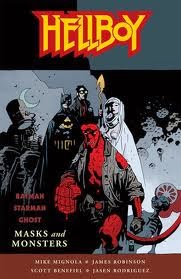
MIKE MIGNOLA'S HELLBOY: MASKS AND MONSTERS
Masks and Monsters consists of two team-up stories. In the first, written by James Robinson and drawn by Mignola, Hellboy meets Batman, but actually teams up with the modern Starman, in a tale which involves modern day Nazis and a plan for world conquest set in the rainforest jungles of the Amazon. The original Starman has been kidnapped, because his research is crucial to the Nazi plan, and it is a tale of rescue, both of a father and the planet. It also reminds us who our real monsters are.The second story, written and laid-out by Mignola, but drawn by Scott Benefiel and inked by Jasen Rodriguez, teams Hellboy up with Ghost, a spirit avenger armed with two non-spectral .45s, to fight another plan for world domination. This one comes from a resurrected spirit of an ancient Babylonian god, but derives from some brutal murders back in 1939. Since Hellboy is the world's greatest paranormal investigator, this is paranormal worthy of his talents.
Both stories are entertaining, showing different sides of the Hellboy character, which is a facinating one: The Thing combined with a hard-boiled detective perhaps. But I couldn't escape the idea that they would have been better had the drawing assignments been switched. Benefiel's art works best with highlighting the combination of spectral qualities and pin-up looks of Ghost, but might have been even better suited to the rumble in the jungle, although I accept the early part of the story set in Gotham City is perfect for Mignola's own art. Mignola's darkness, the hard-angles shadows and hard-edged almost abstract figures, is in a line that goes from Kirby through Steranko, and Chaykin, and I couldn't help but feel it might have adapted itself to the almost Dr Strange quality of the Ghost tale.
But the other thought which I couldn't escape was that the better team-up of these characters might have been Batman and Ghost. They are both driven by the urge for venegeance, to an almost sociopathic level (of course Ghost is a ghost). The Ghost's costume aims more at the flesh than the ectoplasm, but you see the point. It's a natural team-up, and a woman already dead is perfect for The Batman, if not Bruce Wayne. But when I looked at her twin .45s I could not help but thinking of The Shadow, the most obvious stylistic precursor of The Batman. And I discovered quickly that Dark Horse had indeed done a team-up with them: that's something I now will have to check out.
Hellboy: Masks and Monsters by Mike Mignola et al
Dark Horse Books 2010, $17.99, ISBN 978595825674
Labels:
Batman
,
Ghost
,
Hellboy
,
Howard Chaykin
,
Jack Kirby
,
James Robinson
,
Jim Steranko
,
Mike Mignola
,
Scott Benefiel
,
The Shadow
Sunday, 24 February 2013
AVENGERS ASSEMBLE: THE STATE OF THE OSCARS
Avengers Assemble was
nominated for only one Oscar, for its visual effects, which would not
be unjust for it to win, though frankly most of CGI stuff isn't
particularly new or exciting. But if you're a comics fan, you'll
recognise something of the detailed drawings Jim Steranko did for the
Nick Fury, Agent of Shield comic way back when, full of geometric
detail and improbable scale. And, after you think about it, you may
realise that although this is by no means a 'great' movie, it is a
pretty good bit of writing and directing, and that the so-called
adult audience's tastes for what is superior work in films is
informed pretty much by the same aesthetic impulse that turns the
Stan Lee-Jack Kirby-Steve Ditko world of our Sixties adolescence into
mainstream adult entertainment, which then turns middlebrow worthy
drama, middle of the road grand scale musicals, or tales of offbeat
people having troubled paths to boy gets girl into Oscar contenders.
Which is pretty much the same situation as films were in when Marvel
became popular in the first place!
What proves this point,
and what is amazing, is exactly how closely the filmmakers have
stayed to the original 60s comics characters and storylines. In Avengers Joss Wheddon, of course, was the director and screenwriter
(the story credit shared with Zak Penn), and the way he's managed to
bring a galactic war involving Norse gods down to a human level is
impressive, but it's much the same way Lee and Kirby did nearly 50
years ago. It's something he's meshed with his direction
—the
screenplay's arc is the moving of the individuals into a group, and the
direction basically teases this idea throughout. Wheddon uses his
actors well: at one end Mark Ruffalo (worthy of a supporting actor
nomination as Bruce Banner/Hulk) dark and depressive and at the other
Robert Downey, playing flippant as he seems to do effortlessly well. In
between them are the beef- and cheesecake, Chris Evans, Chris
Hemsworth and Scarlet Johannson, the most interesting of the lot, who's given the chance to deepen her character alongside Jeremy Renner. Renner's Hawkeye
is potentially the most interesting of the lot, not really
in the beefcake bunch, but he never says or denotes enough to turn himself into
something more interesting. Perhaps he needed the Hawkeye headgear
after all.
—the
screenplay's arc is the moving of the individuals into a group, and the
direction basically teases this idea throughout. Wheddon uses his
actors well: at one end Mark Ruffalo (worthy of a supporting actor
nomination as Bruce Banner/Hulk) dark and depressive and at the other
Robert Downey, playing flippant as he seems to do effortlessly well. In
between them are the beef- and cheesecake, Chris Evans, Chris
Hemsworth and Scarlet Johannson, the most interesting of the lot, who's given the chance to deepen her character alongside Jeremy Renner. Renner's Hawkeye
is potentially the most interesting of the lot, not really
in the beefcake bunch, but he never says or denotes enough to turn himself into
something more interesting. Perhaps he needed the Hawkeye headgear
after all.
The set-up of this
movie, which was begun in the individual characters' films the stars made, was
presumably something that Penn brought to the table, and you have to
admire the marketing nous of Marvel to have conceived of tying those
films together in the first place. Samuel Jackson's Nick Fury is the
linchpin of all that. Jackson gets a good part, though the
fascinating and epically named
Colby Smulders, who does smulder away
as she says things like 'Yes, sir', works hard to upstage him. The show is nearly stolen
completely by Clark Gregg, as Agent Coulston (why do I keep thinking
of Charles Colson?), who's playing his usual kind of role but gets it invested
with a certain amount of dignity because Wheddon realises he is
the stand-in for the audience of geeky kids of all ages.
Colby Smulders, who does smulder away
as she says things like 'Yes, sir', works hard to upstage him. The show is nearly stolen
completely by Clark Gregg, as Agent Coulston (why do I keep thinking
of Charles Colson?), who's playing his usual kind of role but gets it invested
with a certain amount of dignity because Wheddon realises he is
the stand-in for the audience of geeky kids of all ages.
Tim Hiddleston's Loki
is what we expect British actors to bring to villainy in big budget
action flicks, while Gwyneth Paltrow appears to be finding her level
in Hollywood, here, as Pepper Potts, in a brief role as arm candy to Downey.
But the audience, as more or less adult as it must be, doesn't
care about any of that. They're waiting for the moment when Capt
America tells Bruce Banner, just turned into the Hulk, 'Hulk, smash',
and the Big Green Machine smiles. Gamma radiation has never promised
so much. The aesthetes out there will scoff, but Avengers Assemble
offers more coherence, slightly more depth of relationships, and more
humour than most of the Oscar nominees out there. Plus the near destruction
of earth. But that says more about them, and Oscar's tastes, and the
state of moviemaking today, than it does about what is basically an
enjoyable $200 million comic book, the kind I used to pay 12 cents
for, feeling then they were worth every penny.
But the audience, as more or less adult as it must be, doesn't
care about any of that. They're waiting for the moment when Capt
America tells Bruce Banner, just turned into the Hulk, 'Hulk, smash',
and the Big Green Machine smiles. Gamma radiation has never promised
so much. The aesthetes out there will scoff, but Avengers Assemble
offers more coherence, slightly more depth of relationships, and more
humour than most of the Oscar nominees out there. Plus the near destruction
of earth. But that says more about them, and Oscar's tastes, and the
state of moviemaking today, than it does about what is basically an
enjoyable $200 million comic book, the kind I used to pay 12 cents
for, feeling then they were worth every penny.
Labels:
Avengers Assemble
,
Clark Gregg
,
Colby Smulders
,
Gwyneth Paltrow
,
Jack Kirby
,
Jim Steranko
,
Joss Weddon
,
Mark Ruffalo
,
Marvel
,
Oscars
,
Robert Downey Jr
,
Samuel L Jackson
,
Stan Lee
Monday, 11 February 2013
ARGO: I.T.'S OSCAR WATCH
With its copping of
best picture and best director masks at the Baftas, on top of the DGA
award, Argo has become the front-runner for the Oscar, which is
interesting given its opposition. Argo is a very likeable film,
well-made, with real suspense in its last act, and an atmosphere of
menace in Iran and Washington both, contrasted with an atmosphere of
anarchic freedom and humour in Hollywood.
Which is why, call me
cynical, I'd popped Argo as an Oscar favourite as soon as I saw it,
for two connected reasons which both have to do with Hollywood's
perception of itself. The first is obvious—as much as the movie
shows the CIA saving the day, it is the Hollywood producer (in fact
the film's only totally fictional western character) and make-up guy
who actually come up with the goods, and in the process provide us
with self-satirizing boffo yucks. The second is related: the Tehran
rescue contrasts with the failed attempt at rescuing the hostages in
the US embassy—the signal moment of Jimmy Carter's administration.
Carter gets little credit for the Argo rescue (neither do the
Canadians—more on that later) but the upshot of his failure was
turn to the country over to Hollywood, in the person of Ronald
Reagan, who was selling America fantasies they wanted to believe, as
opposed to Carter's visions of grim reality. That we now know
Reagan's people made an October Surprise deal with the Iranians, not
to make any hostage-releasing deal until after the 1980 elections
merely reinforces the point. Reagan's election saw the US enter a
post-reality based world, in which it is still entrapped, and Argo
may best be viewed, depending on your political perspective, as a
reminder of what the real world was like, or, more likely, a reminder
that the people who brought you the world of fantasy are the only
ones to trust.
The movie itself skips
between genres cleverly—and is most effective for its
reconstruction of the period—not just sets and costumes but also
the dirty grainy look of the film itself, which is pure 70s, and
encourages the audience old enough to remember films you didn't
download to transport itself back to the days of those sorts of
political thrillers. In fact, there are shots of Mendez in the CIA HQ which straightforwardly evoke All The President's Men, in case you're old enough and missed the point. Ben Affleck doesn't ignore facts—the CIA's
role in installing the Shah as dictator is set out right at the
top—but the trope is an old one of maverick within a flawed system
who eventually gets that system to do the right thing. In this
contxt, Affleck the director is very good with actors in ensemble
roles, much like Clint Eastwood. Affleck's ensemble contains many
faces in familiar roles, faces who espcially shone in such parts on
quality TV: Titus Welliver, Zeljko Ivanek , Clea DuVall (Carnivale),
Tate Donovan, and Kyle Chandler (as Hamilton Jordan). Less like Clint
is also good at minimising his own part, which is good because Ben
Affleck the actor still has limitations when it comes to carrying a
film—
I think he works best as a straight man. I still believe
George Reeves was Affleck's best role, and that may be at least
partly because he sensed a kindred talent.
There were, however,
moments that left me feeling uneasy, that I was being manipulated,
particularly in the rousing end sequence at Tehran airport. It struck
me as odd that the children would have put together the right photo
at just the wrong time; that the guards would chase a Swiss Air
commercial flight down the runaway, firing at it; that the pilot
would not notice any of that, and that the tower would not simply
stop the plane's takeoff, if they thought spies were escaping. As it
happens, none of those things are true: the departure from the
airport went off without a hitch (for reasons described below). But
you couldn't have the suspense without tampering with the facts. I
was even more sceptical of the guard making a phone call to the
film's production office in LA, for two reasons: one being
long-distance calling and time zones, and the other being why would a
Canadian film crew not have a Canadian office number, and why would a
phone number in the Babylon of America not arouse suspicion?
There has been a lot of
discussion in this year's Oscar run-up about historical fact—what
with Zero Dark Thirty trying to have it both ways about torture, and
Lincoln being accused of being Caucacentric, and also gilding the
lily of remembrance by anointing its hero prematurely, or Django
inventing sunglasses and a pre-Civil War Ku Klux Klan. Much of the
criticism is unjustified, in the sense that film scripts will
inevitable consolidate multiple characters and re-order events to
serve their own purpose. Thus, the fact that most of the hostages
stayed not with the Canadian ambassador
Ken Taylor (played very well
by the Candian actor Victor Garber) but with one of his assistants,
John Shearwood, is hardly crucial; it makes dramatic sense to keep
them all together. The scene in which the Brits and Kiwis turn the
refugees away is also apparently false: the Brits took them in and
Kiwis transferred them to the Canadians, where it was thought they
would fit in more naturally and be safer. The jibe,if gratuitous,
does serve to emphasize the plight of the Americans, and obviously
the Bafta voters didn't hold it against Argo.
Ken Taylor (played very well
by the Candian actor Victor Garber) but with one of his assistants,
John Shearwood, is hardly crucial; it makes dramatic sense to keep
them all together. The scene in which the Brits and Kiwis turn the
refugees away is also apparently false: the Brits took them in and
Kiwis transferred them to the Canadians, where it was thought they
would fit in more naturally and be safer. The jibe,if gratuitous,
does serve to emphasize the plight of the Americans, and obviously
the Bafta voters didn't hold it against Argo.
But it should be
pointed out that the Canadians did far more than simply sit back and
wait for the CIA cavalry to arrive (shades of Independence Day!). In
fact, Ambassador Taylor manipulated his staff's travel to help create
the necessary visas, and it was the Canadians who got the airplane
tickets—thus the whole cancellation and restoration by the CIA
sub-plot is fiction.
I was also put off a
bit by the separated husband/lonely father sub-plot for Tony Mendez;
Affleck plays it with suitable moroseness, but as it turns out, it
too is a fictional construct. The reason for it is obvious and
familiar—Mendez not only has to redeem himself at the CIA but he
has to conquer personal adversity along the way; this is the arc that
dominates Hollywood—though they just couldn't figure out a way to
have Abe Lincoln reunited with Mary Todd at movie's end.
Complaining that Alan
Arkin's Lester Siegel didn't really exist would be silly—they need
him to carry those sections, and his double-act with Goodman is one
of the high points of the film. In reality, another special-effects
genius, Robert Siddel, who did ET, was announced as the co-producer
with Chambers when the ads went into the trades. Interesting, the
original screenplay was based on Roger Zelazny's Lord Of Light, one
of the key sf novels of the Sixties, and the film was intended for
use in an sf theme park that never happened. Michael Parks has a
cameo as comics genius Jack Kirby, who actually did draw the
storyboards for the fake film, which also had Ray Harryhausen and
Buckminster Fuller attached to it (!). Which ought to be enough to
get Lord Of Light made, after all these years. I'm sure they could
get Lester Siegel to produce. He could make the 'argo fuck yourself' joke another twenty times, and get a laugh every time.
Labels:
Alan Arkin
,
Argo
,
Ben Affleck
,
Django
,
George Reeves
,
Jack Kirby
,
Jimmy Carter
,
John Goodman
,
Lincoln
,
Lord Of Light
,
October Surprise
,
Oscars
,
Roger Zelazny
,
Ronald Reagan
,
Zero Dark Thirty
Subscribe to:
Posts
(
Atom
)