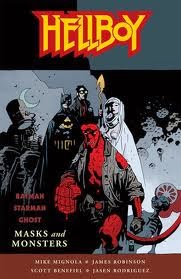
Mike Mignola's
Witchfinder is an unsurprising offshoot of his Bureau For Paranormal
Research and Defense. Sir Edward Grey has been knighted for his role
in saving Queen Victoria from a cabal of witches, and in the first
volume of this series, In The Service Of Angels, he is working
for the government investigating a series of bloody killings in
London. Whatever is doing the killing is linked to an archaeological
expedition that found one of the seven lost cities of the Hyperborean
Age, and as Grey digs deeper he encounters a secret society, the
Heliopic Brotherhood of Ra, who may be allies of a sort, or enemies.
Mike Mignola's
Witchfinder is an unsurprising offshoot of his Bureau For Paranormal
Research and Defense. Sir Edward Grey has been knighted for his role
in saving Queen Victoria from a cabal of witches, and in the first
volume of this series, In The Service Of Angels, he is working
for the government investigating a series of bloody killings in
London. Whatever is doing the killing is linked to an archaeological
expedition that found one of the seven lost cities of the Hyperborean
Age, and as Grey digs deeper he encounters a secret society, the
Heliopic Brotherhood of Ra, who may be allies of a sort, or enemies.
In supernatural
detective stories, the suspense revolves around first discovering
what the danger actually is,
and then in how to defeat it. Grey, interestingly, is as much acted
upon as actor, and Ben Stenbeck's drawing of him emphasises this: he
is not easily surprised, but he does seem very cautious. Which helps
this story work well, because it is the surrounding cast which is
more interesting: think back to the prototypes like Fu Manchu, and
how Nayland Smith is as much as anything a catalyst for the real
horrors or sometimes wonders they encounter. The most fascinating of
whom is Miss Mary Wolf, a psychic whose visions put the story into
perspective. The other thing which works well is Stenbeck's evoking
of the Victorian era; we've seen it so many times it risks being
cliched, but he finds nice little touches to make it new.
What intrigues me
most about the story are the references to other cases which Grey has
already encountered, which, like the throwaway mentions in Sherlock
Holmes, illuminate only slightly, but pique the curiosity. Given that
much of Grey's backstory remains hidden to the reader, that curiosity
is strong.
 But it isn't
answered in the second volume Lost And Gone Forever, written
by Mignola and John Arcudi with art by John Severin. Since the story
is set in the American West a year after the events of the first
volume. Severin was a great artist of westerns in the Silver Age, and
he brings the same sort of background perspective to the story that
Stenbeck did to Victorian London; the details are both realistic and
revealing. The story itself is a bit less focused: Grey is tracking a
Lord Glaren from London all the way across America, and arrives in
Reidlynne, Utah, where there is something strange at the church, and
the locals don't take kindly to questions. He's rescued by a Bill
Hickock type named Morgan Kaler, who's accompanied by a backward
youth named Issac (there was a similar character in Service Of
Angels, Grey is good with the simple-minded) who is older than he
appears.
But it isn't
answered in the second volume Lost And Gone Forever, written
by Mignola and John Arcudi with art by John Severin. Since the story
is set in the American West a year after the events of the first
volume. Severin was a great artist of westerns in the Silver Age, and
he brings the same sort of background perspective to the story that
Stenbeck did to Victorian London; the details are both realistic and
revealing. The story itself is a bit less focused: Grey is tracking a
Lord Glaren from London all the way across America, and arrives in
Reidlynne, Utah, where there is something strange at the church, and
the locals don't take kindly to questions. He's rescued by a Bill
Hickock type named Morgan Kaler, who's accompanied by a backward
youth named Issac (there was a similar character in Service Of
Angels, Grey is good with the simple-minded) who is older than he
appears.
There is also a
white woman named Eris leading a group of Indians intent on some sort
of revival of their gods and a full spectrum of spectres, including
Glaren, wolves and various spirits. It's a full story, perhaps too
full, and Kaler in particular might have been fleshed out a bit more.
It would be too much to say Grey works better, by definition in
Victorian England, but he and his antagonists here seem to be on
different planes.
By the way, there's
a short story at the end of the first volume featuring another
witch-hunter, Henry Hood, in 1667. It's a nice six-pager, but the
interesting thing is the presentation of Hood, who reminds me
immediately of Robert E Howard's Solomon Kane, still to my mind the
best of the witch-hunter characters.
Witchfinder: In
The Service Of Angels by Mike Mignola art by Ben Stenbeck (Dark Horse
Books, £13.50, ISBN 9781595824837)
Witchfinder: Lost
and Gone Forever by Mike Mignola and John Arcudi art by John Severin
(Dark Horse
Books, £13.50, ISBN 9781595827944)