Showing posts with label Montreal. Show all posts

Tuesday, 30 June 2020

BEDTIME STORY: A POEM

I wrote this one in the late summer and early fall of 1975, soon after I'd moved to Montreal. I have a fondness for it, mostly for the darkness underneath its innocence; I have the feeling I was beginning to experience my first real being on my own in a place that was, well, different. It was published in 1977, along with four other of my new poems from a new city and country, in a newspaper format magazine called The Lance, which was published somewhere in Ontario, I think. Return with us now to those stirring days of yesteryear.....


BEDTIME STORY

All the shadows (those
      friendly faces at the top of
      the stairs
      peeking out of the closet
      you’d never dare open
when you were a kid
                          (those
paranoid playmates

had you
whistling
      to yourself
to assure you
you were
      still alive

When you knew all along
deep
       down
                inside
that you shouldn’t
be

scared,
             all
the demons seemed
the same,
                their faces
flew together
like migrating birds

lost &
shrieking
a chorus
 
ended
in silence
echoes 
 
              (those
major themes
of your life.

                     (& still does.

Monday, 3 June 2019

THE PEARLY GATES a poem

This poem is one I've always liked. I wrote it in March and April of 1976, in Montreal, and remember well the Metro ride that inspired it. It really is typical of the kind of style I was working on, in tandem with something similar but more expansive, which would turn into my master's thesis at McGill. I also like the way it seems faith-based, even more so now than it did when I wrote it. It bounced around a bit. At one point I thought it might be paired with 'Basic Training' (which you can find here at IT) in New Poetry 4, the Arts Council of GB's anthology, but it wasn't. It wound up, confusingly enough, being published in issue 47 of New Poetry, a London-based magazine. Ten years later, slightly changed, it appeared in the US, in issue 5 of Brief, from Canyon, California. In 1991 I included it in my chapbook Chump Change, published by Northern Lights. I reckon none of you have it seen in any of those three incarnations.  The line breaks have their purpose: which might be clearer were I to read it out loud....


 THE PEARLY GATES


If there is a man
    there to judge

he will be ugly.

Wars will have been fought
on his face

                    he will be
the man you could never resist
      sneaking quick looks
at
         in the underground

& you will
shudder

                or be polite
& look
               the other way
before you shudder

& already you
      will be in
          trouble.

Friday, 27 April 2018

THE WORD (MONTREAL 1976: A DREAM)

I was poking through an old notebook the other day, and found
this. I scribbled it down a year ago, and hadn't thought of it since,
but when I re-read it the actual dream came back to me. I've changed
the words a little, mostly to include details I took for granted in 
my sleep. I couldn't find a photo that looked right, though I did find
one of the building where I lived. The Word was a wonderful bookshop
just around the corner; run by Adrian and Lucy. It's still there, looking
a lot smarter than it does in that relatively contemporaneous photo.
The Star is long gone. I finally met August Kleinzahler at The Word 
one day in 1981, when I arrived to do a poetry reading at McGill,
after years of missing him in various places. He's not the badly dressed guy in the suit.
I do think the dream may reflect as much about my present circumstances in Britain as it does about Montreal in 1976. Though I note April 15th is the day US taxes are due.
The poem is published here for the first time. 


THE WORD (A DREAM, MONTREAL, 1976)

A man in a cheap gray gabardine suit, black
Fedora and a thin black undertakers' overcoat
Hanging off him like a shroud stops me 
As I clump through the icy drifts interred
On the corner of Milton & Lorne, by The Word.
It's 30 below. I'm wearing desert boots, fleece
Lined denim jacket, my Canadiens toque. He asks,
In flat declarative Midwestern American
English, to see my papers. Qui etes vous? I say.
Your papers, he says. I was just on my way,
I say, to pick up a paper. The Star, or maybe
The Gazette if the Star's sold out. He shivers.
You think you're funny? We know who you are. 

15 April 2017


Wednesday, 27 December 2017

JOHNNY BOWER AND MEMORIES OF AN ERA

Johnny Bower with the Maple Leafs. Glenn Hall in Chicago. Terry Sawchuk of the Red Wings. Eddie Johnston in Boston. Gump Worsley in New York. And Jacques Plante with les Habitants in Montreal.

Six names, six teams, and a rush of memories. It was a simpler time. When I read that Johnny Bower had died aged 93, I almost immediately recited those six names, like some shamanistic incantation. I can't say for sure when all six of those guys played on those teams, but I am assuming they were all together in that alignment for a least a few of my youthful years.

Beyond that, I remember Sawchuk wound up in Toronto splitting time with Bower, an innovation which went against conventional wisdom that one goalie had to play every game to stay sharp. After all, goalies were supposed to wear number 1, and two guys couldn't do that. It was, of course, a move both goalies hated, though it likely helped both immensely. Of course every team was quickly using two goalies, if only to rest their better one occasionally.

I recall too the shock trade when the Canadiens sent Plante to the Rangers for Worsley (there were other players involved—Dave Balon and Phil Goyette among others) Plante who had come up with the goalie's mask, which was originally seen as a sign of weakness, if not fear, was perceived as the sport's mercurial genius, but at odds variously with coach Toe Blake and GM Frank Selke, who would soon be gone himself. Worsley, a native Montrealer, was seen as a steady plugger (despite being one of North American sport's most prodigious drinking men).

But Johnny Bower's was probably the most interesting career of them all. He was born John Kiszkan, and at 15 enlisted in the Army, serving in England during the war until he was discharged because of arthritis in his hands. When his parents divorced he took his mother's name, though later he claimed it was easier for sportswriters to spell.He was already 20 when he played a year of junior hockey in Prince Albert in 1944, then turned pro in the minor league AHL. He played eight seasons for the Cleveland Barons, and was generally considered the league's best goalie, before he got a shot in 1953 with the New York Rangers, where he replaced Worsley, who'd been the NHL Rookie of the Year in 1952. For the next three years he was in effect Worsley's backup, playing most of the time in Vancouver of the WHL or Providence of the AHL. When the Rangers let him go he returned to Cleveland for a year, before Punch Imlach talked him into giving the NHL one more chance.

Bower was 34 when he finally settled into the nets for the Maple Leafs, where he would play for 11 more seasons, his career no doubt extended by sharing time with his fellow Ukranian Sawchuk. He backstopped the Leafs to four Stanley Cups, the first three in a row in 1962-4. After playing just one game in the 1969-70 season, he retired, and at age 45 he was at the time the oldest player to have played in an NHL game.

Nobody looked less like an athlete than Gump Worsley (well, maybe baseball's Smokey Burgess) but Bower was another guy who you would pass in the street never thinking you'd seen a great. Six decades later, most of those six names still appear regularly in arguments about the best goaltenders ever.

Ssx decades on, thinking of Johnny Bower made me nostalgic for those days when you knew the names, and the faces (no masks, no helmets) of all the goalies (if not all the players) in the six-team NHL. Even though you didn't see them much on TV (though I was lucky, being able to pick up Rangers' games out of New York—and falling in love with Montreal as a result). My dad played hockey, so we followed it a bit. I saw the Providence Reds (post-Bower) play in New Haven when the city finally got an AHL team--I had seen the AHL's Baltimore Clippers play the EHL Blades in the old New Haven Arena). Hockey was what first drew me to Montreal; Evelyne, whom I met on the beach in Woodmont, may have been another factor). In many ways my life has balanced itself on the fulcrum of Montreal; had I not wanted to live there I would not have gone to McGill; had I not gone to McGill I would not have met Theresa; had I not met her I would never have moved to Britain. 

Perhaps it was the Christmas season, or the snow that fell this morning, that helped me spin a hockey player's death into un petit coup de nostalgie, but these were very pleasant memories. RIP Johnny Bower.

Sunday, 12 July 2015

THE COLOURS OF CHLOE: A POEM (AFTER EBERHARD WEBER)

I wrote this poem in January 1977, in my hometown of Milford, Connecticut. I had left Montreal in late November '76, having completed my master's thesis in August, to avoid having to register (and pay) for another academic year. I was about to fly to London with Theresa. I can't say I ever imagined I would stay more than a few years.

The title, of course, comes from the title song of Eberhard Weber's first ECM record, which was one of my favourites in the tiny flat Theresa and I shared on Lorne Avenue, and I'm sure I set my simple stereo up on my parents' porch, listened, and wrote. I may have been looking at Maya Weber's cover painting while I did. And it may have been the last thing I wrote before I arrived in England.

It seems it was published in something called Chock, which may have been the same as the Chock Freesheet, in October 1979. I've probably got a copy of it in storage somewhere. But this is its first appearance since then, 35 years ago...


THE COLOURS OF CHLOE      (Eberhard Weber)

Why is she sleeping
           underneath
the rain

while her cello sits
unbowed just out of
the shadows
                         cast aside
by a cypress, reaching down
to touch her?


                         She surrounds
               the sunset in
                                       her eyes.

The path of her dreams can be
followed on her face
                                     by anyone
                who drifts by
& happens to look.

As slowly as the music lures
her back to consciousness

she sees a spectrum
rising, below the horizon

the redness of angry
sky, crackling louder
than the cold blue of crying

          than a yellow straw forgetting

colours

broken in the wind.

Saturday, 25 October 2014

FADE OUT FOR A WESTERN MOVIE: A POEM

Jack Bruce's death reminded me of an afternoon many years ago when I lived in Montreal. I was listening to 'Theme From An Imaginary Western', and I was thinking about Ride The High Country, one of the truly great westerns, and I wrote the lines which became this poem. It was published, if I remember right, in Cid Corman's Origin magazine... I dedicated it to my film teacher, Jeanine Basinger.


FADE OUT FOR A WESTERN MOVIE

two weary
horses carry

empty

saddles into sunset


Friday, 11 April 2014

SURROUNDS (Montreal 1976): A Poem

I wrote this in Wiesbaden, Germany in April 1982, thinking about the lost but recent past . It was published in 1986 in Gil Ott's great magazine Paper Air (Philadelphia) and in 1993 in Tidepool (Hamilton, Ontario). I lived in Montreal from the summer of 1975 through December 1976, and oddly, from the first moment, whenever someone asked me where I was 'from' I would immediately reply 'Montreal'. 


SURROUNDS
                        (Montreal, 1976)

Outside, the whole mountain rises in silence.
Aimed at the East End, the cross shines on,
Sequined and secure. Below, only a few faces
Will remember to look up. I am climbing
The wooden stairs to the overlook while
The city glows, but does not burn.
Small pieces of the sky fall all around me.
A long time after I've reached the panorama,
I stare at heaven being patched with clouds.

Tuesday, 26 March 2013

BEN WEIDER: THE 2008 GUARDIAN OBITUARY

In honour of Joe Weider's obit running in the Guardian, I went back and found my obit of his younger brother Ben, which I wrote for the G in December 2008, just around the time I started this blog, but which for some reason I never included here. You can link to it here

I love the contrast between the brothers. I mentioned in Joe's obit that, where Ben became a scholar of Napoleon, you might accuse Joe of harbouring a not-very-well concealed Napoleonic complex, the complex little man making himself big (in every sense of that word) with drive and ego to match.

They seem a perfectly matched pair: Ben staying in Montreal, becoming a philantropist, marrying a local girl and building the structure of their fitness empire, while Joe moved to California, married a pin-up, crashed Hollywood via Arnold, and constantly sold himself and his lifestyle alongside equipment, dietary supplements, and sage advice.

Both brothers were long-lived, but I wonder if they were the kind of men who would have been regardless of what avenues they'd pursued. I'm almost tempted to read Brothers Of Iron, except I suspect it contains a lot of, shall we say, mythologising--and any book with forewards by both Arnold and Juan A Samaranch can't be all good.

It's a fascinating story, and it makes me want to go back to Montreal and live near Park LaFontaine. The neighbourhood has changed, and I suppose it's too late for that now.


JOE WEIDER: THE GUARDIAN OBITUARY

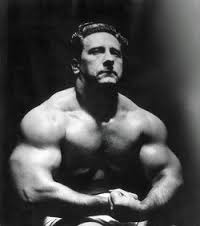
My obituary of Joe Weider, the bodybuilding guru, is up at the Guardian online (link to it here) and should be in the paper paper today or soon. Obviously the big hook for the story was Arnold Schwarzenegger, for whose infliction on the wider world Joe can fairly be blamed. Had I but space enough and time, I might have gone back and rewatched the two films that made Arnold's career: Pumping Iron (my enduring memory is that Arnold's cruelty to Lou Ferrigno makes Ali's to Joe Frazier look tame) and Stay Hungry (my memory is all the faux philosophy doesn't quite work, though Jeff Bridges is great and Arnold seems to be playing himself, all ego, as the documentary had suggested, but also borrowed in large part from Joe, who was once quoted, when asked about his critics, as saying 'lots of people hate God too'.)

As you can see from the photo on the right, Joe practiced what he preached -- and as he grew older you can see the way he served as a walking advertisement for the Muscle Beach lifestyle. And, after all, he did live to be 93. It might also have been good to detail all the various ways Weider's products were under constant assault from regulators, and whether his miracle ingredients were really scraped off the sea bottom. Maybe Jack LaLanne (whose 2011 obit I wrote for the Indy, you can link to that here) held his breath and dived for them. Just kidding. But it's hard to overstate the effect of Weider ads, which were ubiquitous in my childhood, and strangely alluring. The 98 Pound Weakling of Charles Atlas fame was what Joe had been, and he knew how to sell to that adolescent (of all ages) insecurity. I was impressed to see that Joe's ghostwriter on his books about his bodybuilding system was Providence's Bill Reynolds, who's very good. But Joe's guides went beyond bodybuilding guide: I found a picture of the pamphlet on the left, and wonder how I missed this when I was young. It surely might have helped! It makes it pretty clear that the Arnold character in Stay Hungry certainly was modeled on Joe Weider.


Thursday, 31 March 2011

NIKOLAI ANDRIANOV: THE GUARDIAN OBITUARY

My obit of Nikolai Andrianov, the great Soviet gymnast, will be in Friday's Guardian, but it's online now and you can link to it here. I thought it was a terrible irony that the man who was arguably the world's greatest gymnast should die of multiple system atrophy, unable to move his arms or legs, but the published piece plays down that awful coincidence.

Oddly, although I accept Andrianov's place as a great, I watched every moment of all the Olympic gymnastics competitions at the Montreal Forum in 1976, where I was working as a press liason, and I remembered vividly Andrianov's stumble at the end of his floor exercise, and thinking then that the judges treated him quite kindly; it was part of the reason I developed an antipathy for most judged sports, the effect of reputation and expectation (not to mention chauvinism and politics), but I went back and watched the routine on you tube again, and it is absolutely remarkable, as is his performance on the rings. Thrilling, and it's nice to be able to call the pictures up to enhance my memories...