Showing posts with label Northern Lights. Show all posts

Monday, 3 June 2019

THE PEARLY GATES a poem

This poem is one I've always liked. I wrote it in March and April of 1976, in Montreal, and remember well the Metro ride that inspired it. It really is typical of the kind of style I was working on, in tandem with something similar but more expansive, which would turn into my master's thesis at McGill. I also like the way it seems faith-based, even more so now than it did when I wrote it. It bounced around a bit. At one point I thought it might be paired with 'Basic Training' (which you can find here at IT) in New Poetry 4, the Arts Council of GB's anthology, but it wasn't. It wound up, confusingly enough, being published in issue 47 of New Poetry, a London-based magazine. Ten years later, slightly changed, it appeared in the US, in issue 5 of Brief, from Canyon, California. In 1991 I included it in my chapbook Chump Change, published by Northern Lights. I reckon none of you have it seen in any of those three incarnations.  The line breaks have their purpose: which might be clearer were I to read it out loud....


 THE PEARLY GATES


If there is a man
    there to judge

he will be ugly.

Wars will have been fought
on his face

                    he will be
the man you could never resist
      sneaking quick looks
at
         in the underground

& you will
shudder

                or be polite
& look
               the other way
before you shudder

& already you
      will be in
          trouble.

Thursday, 4 October 2018

HUMAN INTERFERENCE: A POEM

In honour of National Poetry Day, let me offer a poem I wrote thirty years ago, just after my birthday, in Geneva. The event it depicts had just recently happened to me, right down to the pigeons jumping on the carriage at Baker Street and off at Edgware Road, where we were being held. It didn't take much revising, and was published in my 1989 Northern Lights pamphlet Homage To Gibbon and then, after some delay, in Tokyo, in the summer 1990 issue of Edge: International Arts Interface. Both times I misspelled Edgware, adding an e, which was appropriate enough given the magazine's title. It is reprinted here for the first time with the name of the station spelled correctly. I've tried out a few other small changes.  TFL, or whatever they call London Transport these days, no longer uses the phrase 'human interference.' 


HUMAN INTERFERENCE

A few pigeons exit the car at Edgware Road.
The platform seems to soften & melt as
We finally pull away. The walls of the tunnel lose
Their blur, become clear as we come to a stop.
We sit. After a while faces move into focus,
Take on expressions, search the car for room or air
Or pigeons or something to read. Eventually
A disembodied someone talks. A person
Has fallen in front of the train. We will have to wait.
London Transport regret this delay, which they say
Is the result of "human interference".
We get in the way.
Many of us are already late.
We are getting later all the time.


Monday, 30 January 2012

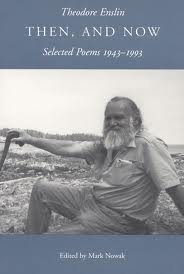
THEODORE ENSLIN: THE GUARDIAN OBITUARY

My obituary of the poet Ted Enslin is up today at the Guardian's website; you can link to it here. Because his passing on 21 November last year went mostly unreported, this appears to be the first large-scale obit anywhere--oddly enough I had written it a number of years ago for the Guardian's files (and went back for some small re-writes and to add the verses today). They also found a wonderful photo which shows him framed by the Maine coastline, which is so important in his work.

I made contact with Enslin through Cid Corman (who died on my birthday in 2004 and which also went relatively unreported at the time) and felt his poems would be a natural for the folded-over six pages of text format I used for the Northern Lights chapbooks. And so it was. We corresponded on the ordering of the Pavanes, and for a while it was a rich back and forth, even after the poems were printed.

Going back through some of the Enslin books that fill my favourite poets shelf, I was amazed at how quickly his voice came back to me, and how much of his work I actually have yet to really discover. He does fit, perhaps too neatly, into my perception as something between Olson and Creeley, though his voice is often more musical but less formal--more like a cross between Robert Duncan and Ed Dorn, if that makes sense. I used to think of him, up in Maine, listening to Mahler while smoking the pipe in front of the wood stove, and somehow transferring the immediacy of his thought into flowing lines on the page. I'm glad the Guardian has given him some of the space he deserves, and glad I was able to write it.