Showing posts with label Paul Newman. Show all posts

Thursday, 1 April 2021

LARRY MCMURTRY: MY GUARDIAN OBIT

My obituary of Larry McMurtry is online now at the Guardian, you can link to it here. It should be in the paper paper soon. It has been cut considerably, because I over-wrote it, and it was a good edit: keeping the most relevant information and the spirit of what I wrote. So this is not a complaint, but an addition.

Because I knew McMurtry's work well, especially his early novels, which I believe are his best and I think, for example, the praise (with some caveats) Jim Harrison gave them was justified; this was in his review of All My Friends Are Going To Be Strangers, which is my other favourite of his books (I'd like to re-read it and see if my older sentimental self still enjoys what my younger romantic self did). It seemed to me that the caveats Harrison mentioned were what drove much of his later work, which I found less interesting: his proclivity for writing too much, for extending ideas into series, came from his ability to create characters, and I would use the word picaresque to describe it. In many ways he was like an 18th century novelist; he would take characters he liked, and introduce them to other unusual characters he created (and understood) and let that all fly. But this is not part of what was trimmed from the piece; it is the spirit underlying what I wrote.

There remain a couple of small points that needed explaining, but because of 'reorganisation' weren't. Thalia, the Texas town that is the setting of his first three novels, is a fictionalised version of Archer City; I thought that really needed to be clear right from the start, because, like the Houston-set books which followed, it showed how he transformed his own experience (for example: his father's running his grandfather's ranch echoes the set-up of Horseman Pass-By (Hud). 

And when he held his Last Booksale, it was from his four remaining Booked Up stores in Archer City. For some reason the Guardian said only one was in his hometown: but I'd actually clarified the point to them. This was important because, in another line excised from the copy, I explained his purpose in putting his stores, which grew into six at their peak, in his hometown was his effort to turn Archer City into a Texas version of Hay-on-Wye. I thought the English reference would have kept it in the piece, but what do I know?

One small loss, which I also couldn't understand, was the name Peter S Beagle from the short list of his Stegner colleagues and friends. Beagle, who is still alive, was a major success at a young age, already a success while he was at Stanford with the would-be novelists. He's published the fantasy novels A Fine And Private Place and The Last Unicorn (which is always in best-of lists still) and I See By My Outfit, his tale of a cross-country journey on a motor scooter, well ahead of Zen And The Art Of Motorcycle Maintence. Maybe I should have dropped his middle initial to save space.

The biggest excision was one I expected, because I included a lot of material about Ken Kesey; on the surface very different from McMurtry, but a close friend whose career had some strong parallels with his until Kesey diverged. If this weren't enough reason, however, the idea that McMurtry then married Kesey's widow, on whom he appears to have maintained a crush for 50 years (he said that at the time Kesey would never let the two of them even talk together!) made it important. Anyway, here is what I wrote: 

... Stanford University’s Creative Writing programme, where his classmates included Peter S Beagle, Wendell Berry and Ken Kesey. Kesey attended the Stegner seminars taught by Frank O’Connor (The Last Hurrah) and Malcolm Cowley (Exile’s Return) only because Stegner, who disliked him intensely, was abroad.

...It may not be a coincidence that in Kesey’s first novel, the best-selling One Flew Over The Cuckoo’s Nest (1962), the main character, played by Jack Nicholson in the Oscar-winning film, is named Randall McMurphy, or that Kesey’s second novel, Sometimes I Get A Great Notion (1964) revolved around a father/son feud within a family logging firm in Oregon; when it was filmed in 1970, Newman again played the rebellious son.

Let me repeat: I was not surprised these bits got cut: it's an obituary, not a literary analysis. But the idea Kesey simply snuck into the Stegner Fellowship seminars is intriguing, if not crucial to understanding McMurtry. But to me the teaching by O'Connor, whose novels tend toward the sentimental family saga format McMurtry used, and Cowley, chronicler of the Lost Generation, seemed a fascinating influence.And the parallels I mentioned are delineated here, and I found them convincing. And then there was the Merry Pranksters.

After Stanford, McMurtry taught creative writing for a year at Texas Christian University in Fort Worth, then back at Rice. In 1964 Kesey and his Merry Pranksters got in their San Francisco school bus driven by Beat icon Neal Cassady, with the Grateful Dead on board for music, and began a cross-country journey to New York. Tom Wolfe’s chronicle of the trip, The Electric Kool-Aid Acid Test, became a best-seller, including the Pranksters’ arrival to visit McMurtry in Houston. As the bus pulled into his driveway, a tripping Cathy Casamo, also known as “Stark Naked”, spotted McMurtry’s son playing on the lawn. Unclothed, she jumped off the bus to hold him. McMurtry recalled "James, in diapers, had no objection to naked people, and the neighbours, most of them staid Republicans, took this event in stride; it was the Pranksters who were shocked". Far from being harmed, James McMurtry grew up to become a country music star.

McMurtry stayed off the bus. He won a Guggenheim fellowship and produced a seminal book of essays about Texas, In A Narrow Grave (1968), whose themes included some of those reflected in his fiction: cowboys “finding it bitter to leave the land...to the strange and godless heirs they had bred.” 

Again, you can understand, as I did, why that basically had to go, but I did suggest re-inserting one sentence about Kesey's visit, if only because Wolfe made such a thing of it. But I loved McMurtry's own later response to it: it clarified difference between him and Kesey, and I thought the early mention of his son's later career fit well right there. I also love the quote about the bitter leaving of the land, because that theme starts in Horseman Pass By and continues through Lonesome Dove.

But the quote from Leaving Cheyenne stayed in.“Nobody gets enough chances at the wild and sweet”, Johnny McCloud says. They aren't quite the story's last words, though. He then wishes he'd had a Kodak, so he could've captured Molly sitting on the steps in her blue and white dress. So memory stays with us all. 

NOTE: I wrote an essay on Leaving Cheyenne/Lovin Molly a couple of years ago. You can link to that here on this blog 

Tuesday, 18 August 2015

LEV A.C. ROSEN'S DEPTH

Simone Pierce is a private eye in New York City, only this is a New York populated only in the tops of buildings which poke above a flooded east coast—the polar ice caps have melted and the city is an island cut off from the now-distant mainland, in effect what we know as Middle America is all that has survived. Simone's got two jobs, one a seemingly routine tail of a wayward husband, the other escorting a Spanish museum curator around a number to the city's tallest buildings, to see what may lie underneath the water. Then the husband she's tailing turns up dead, and her former police colleagues like her for the killing.

Lev Rosen's dystopia isn't unique, but using the setting for a detective novel is a nice touch: there's an innate darkness in the cold water that surrounds the remains of the city, giving the atmosphere, dare I say it? depths of noir. Rosen also uses it in the way the best dystopian fantasies are supposed to: as comment on our present day. Not just the ecological, but more importantly, the social: New York has always been an island home to those who don't fit into the mainstream of society, as well as the HQ for said mainstream: now it's somewhat different, isolated almost completely from a doctrinaire reactionary and puritanical fundamentalist government on the mainland. That Simone's best friend happens to be the mayor's top assistant, as well as part of one of the city's wealthiest families, gives her an interesting entree into both side of the equation.

The setting is remarkably consistent, if the future itself doesn't always catch up: for example devices like mobile phones don't seem to have progressed as far as they seem to have in just the past couple of years, much less a longer time, and you might assume surveillance would be far intensified from the levels it is now. The story itself starts to get very entangled, to the point it needs a somewhat cozy kind of parlour scene to explain things; this is magnified by the character focus being very firmly on Simone: and not always presenting a full-enough picture of those being investigated.

In fact, Depth reminded me of two rather disparate books. The story itself played out like Harper, the movie version of Ross MacDonald's The Moving Target. I kept seeing Paul Newman as Simone, or vice versa. But for the combination of dystopian sf and hard-boiled noir, Rosen may have produced the most satisfying mix since Richard Paul Russo's much uner-valued Carlucci series. Although Rosen delivers a powerhouse set-piece climax, the story does drag in the middle, but there is a lot of depth in Depth, and Simone's return would be welcome.

Depth by Lev AC Rosen
Titan Books £7.99 ISBN 9781783298631

NOTE: This review will also appear at Crime Time (www.crimetime.co.uk)


Thursday, 23 July 2015

E.L.DOCTOROW: THOUGHTS ON MY FRONT ROW DISCUSSION

I was on BBC Radio4 Front Row yesterday, discussing E.L. Doctorow with Samira Ahmed. Although I was saddened by his death, it was a privilege to be able to convey some of my enthusiasm for his work, and for him as a person, to a wider audience. You can link to that broadcast here; our segment starts about 16 minutes in, but really it's worth listening right through from the start, it's that good a programme.

Doctorow's work is always about relations of power—whether class, financial, racial, physical or whatever, and how the imbalance of those relations is at the core of the American experience, if not the core of the American Dream. It is always about the problems of America, the way those at the bottom experience the City on A Hill. It's easy to miss, because the stories themselves are so engrossing, the characters so well drawn: his historical figures blend with his invented ones, reinforcing his insistence that he was not writing historical fiction. Take The March, published when he was 74. It's as good a Civil War novel as anyone had written in a long time, but at heart it's about the way, even before the war was over, the rebellious southerners were being welcomed back into the fold, and the newly 'freed' slaves were being found a status not much different from slavery.

I met Doctorow once, at a debate organised by the New Yorker (with whom I was on good terms at the time, though never good enough to sell them anything) and the Sunday Telegraph at Cheltenham Ladies College, probably about 25 years ago. I was standing by myself at the pre-debate reception, and two guys standing next to me drew me into their conversation. 'Hi, I'm Joe, this is Ed,' one of them said, and a few seconds later I dissolved into fan boy status as I realised I was talking to Joe Heller and Ed Doctorow. It was one of the finest half-hours I've ever spent: the discussion never got near literary gossip; it covered real topics, and had mobile phones been invented I would even now be bombarding you with selfies.

Doctorow was maybe the last of the politically involved novelists from the time writers of fiction (and excellent non-fiction) were considered important pundits, rather than retreating to academia and ceding the high ground to the screeching beltway hacks who now populate the airways and leech into print. He was younger than Vonnegut, Mailer, or Vidal, but like them he accepted a public presence. He and his Kenyon classmate Paul Newman helped keep the Nation, America's pre-eminent left-wing weekly, afloat for years, and Doctorow contributed many fine essays to it. And like Mailer, and Roth (who is two years younger) he may the last of that generation of novelists educated in New York's public schools and then WASPy private colleges. I mentioned on Front Row that Doctorow's academic career reads like a character from a Philip Roth novel (Marcus, from Indignation, actually).

What was important from Doctorow's time at Kenyon was his study with John Crowe Ransom, one of the godfathers of 'New Criticism'. There's an interesting essay to be written about how New Criticism's analysis of Modernism helped generate Post-Modernism. Mailer and Vidal followed the modernist greats, with Vidal picking up a post-modern sort of irony; but Vonnegut and, with less flash but more variety, Doctorow, clearly embraced a post-modern sense of narrative. I mentioned how Doctorow's narrative strategies changed with each book: Loon Lake, perhaps the most extreme example, might be compared with John Hawkes.

But it was Doctorow's sense of history that inevitably defines his writing. John Updike hated Ragtime, saying Doctorow was 'playing with helpless dead puppets...in a gravity-free faintly sadistic game'. But I can't think of a writer less sadistic to his characters. One often has the feeling the author wishes the characters could be something other than what they are, but that what they are is simply too powerful, too real, to change. The famous story about staring at a portrait of J.P. Morgan by Edward Steichen to 'research' his character rings absolutely true. It's also why I like his first novel, Welcome To Hard Times, so much. Many of the obituaries repeated the line that the book started out as parody, but even were that Doctorow's original intent, his sense of parody became one of deconstruction. I look at the book as a precursor to Thomas Berger's Little Big Man, and Berger's novel as a sort of precursor to Doctorow's bigger novels. The film of Welcome To Hard Times isn't great; Burt Kennedy's scripts were always better when someone else directed them, but you can see Henry Fonda gets what the book was about. In passing, it's odd how that great wave of post-modern novelists: Heller, Doctorow, Vonnegut, Mailer, Berger, Barth, Pynchon, were either ill-served or served not at all by Hollywood. I sometimes wonder if too many of Doctorow's novels end in melodrama and violence, and if those genre novels he edited at NAL did affect him, but it occurs to me that an imbalance of power in society is almost always enforced by violence, and protested by violence. Hard Times is about what happens when society is ill-equipped to deal with rampant evil; that's a classic western trope, but Doctorow's idea is that it is really endemic in our society.


I mentioned the New Criticism; Doctorow was a fine editor at New American Library and Dial Press. His obits mentioned the big names he edited, everything from Mailer and Baldwin to the unlikely pairing with Ayn Rand. But Ed Brubaker wrote today about how it was Doctorow who commissioned Jules Feiffer's The Comic Book Heroes; the first serious study of comics, and one that looked wryly at the America those early super-heroes represented. I mentioned to Samira that World's Fair might be my favourite of Doctorow's novels, and I spoke of the sense it gives me of the time in which my parents grew up; but I realised too that part of my pleasure in that book is the way our knowledge of what became of the world since then burnishes our memories of 1939. It was published in 1985, as if to say, look what we came out of, look at how high our hopes were, and now you want to turn the clocks back to the age of greed?

I ought to explain as well that I don't consider Waterworks his best novel, but in its style and structure it may be his best piece of prose writing. I haven't even mentioned Billy Bathgate or The Book Of Daniel, either of which might head many people's list of favourite Doctorow books, but we do mention them in the Front Row talk. I recommend his short stories too, and especially his essays, which approach literature and politics with the same caring that he shows his fictional characters. He gave a graduation address at Brandeis, and after the college edited the copy for its magazine, The Nation published it in full. It was almost a Jeremiad, an effort to remind the students of the world they were about to enter, and remind them more of what they could bring to it with the learning they had just received. Couching his words in almost literary theory, but using an uncharacteristic vituperative approach, he talked about how we were seeing a 'national regression to the robber baronial thinking of the 19th century—nothing less than a deconstruction of America...as if we were not supposed to be a just nation, but a confederacy of stupid murderous gluttons.'

Wednesday, 14 January 2015

ROBERT STONE: THE GUARDIAN OBITUARY

My obituary of Robert Stone is online at the Guardian, you can link to it here and it should be in the paper paper tomorrow or soon. It wasn't until I was writing the piece that I realised how deep Stone went into himself to pull his fictions out; the long spaces between books were likely as much recovery as research. There was the sense too, which I didn't put directly into the piece, that Stone lived before (and while) he wrote, in fact, was driven to live. Whereas so much fiction today is written very well but has no life behind it.

The obit is pretty much as written up through Dog Soldiers, which deserves every bit of praise I gave it, and more. I should have mentioned Stone wrote the screenplay of the movie as well (with Judith Rascoe) and that it was titled Who'll Stop The Rain (after a Creedence Clearwater song) because some executives thought people would think Dog Soldiers was an animal movie. The three leads are all spectacularly good, Richard Masur heads a stellar supporting cast: Gail Strickland, Anthony Zerbe, Ray Sharkey, and I think you could consider it, alongside The Gambler as perhaps Karel Reisz's best films (though he didn't necessarily agree when I posed the point to him once years ago).

When I started to explain what made Stone's writing unique, the paper had a problem with a quote from Stone: 'I like big novels. I really admire the grand slam', fearing their audience wouldn't understand what he meant by grand slam (a phrase used in tennis, rugby, golf and bridge as well as in baseball).

I then wrote: 'His friend Kesey's first novel, One Flew Over The Cuckoo's Nest (1962) featured passages of beautifully unfocused prose, mirroring the effects of the hospital's drugs on its patients; his second, Sometimes A Great Notion (1964) was an attempt at the Big American Novel, in more standard prose style.' This, I thought, explained perfectly the idea of the synthesis Stone created in his writing. It was also interesting that Paul Newman directed and starred in the film adaptation of Sometimes and that it was retitled Never Give An Inch.

The paper also lost one of my points by changing 'actress' to 'actor' in the copy. What made Children Of Light so personal was that the schizophrenic character was a woman, like his mother. It's an odd policy, to use a gender-neutral term for actors, but insist, for example, on the gender-specific coinage 'gay and lesbian'.

The controversy over Outerbridge Reach was something I merely mentioned, but Stone was accused of borrowing heavily from a book called The Strange Voyage Of Donald Crowhurst. This is one of the perils of research; the uses Stone made of the story, as the obit implied, went farther and wider than the Crowhurst did. For which I would cut him some slack.

I don't believe any of Stone's novels could be called best-sellers, though they were very favourably reviewed and nominated consistently for major awards. I probably should have made more of his beat connection; his novels sometimes read like beat writing with more sympathy for the mainstream. His mixing of poetry and realism, while not quite magical as the Latin Americans, or his drug-familiar contemporary Tom Robbins, is probably the most thoroughly and painfully American of any major novelist of my lifetime.


Tuesday, 15 January 2013

EVAN CONNELL: THE GUARDIAN OBITUARY

My obituary of Evan S Connell is in the Guardian, you can link to it here. It is pretty much as I wrote it, apart from North Point Press being called a small 'outfit', which somehow seems lessening the impact of what was one of my favourite smaller publishers (though they would have probably enjoyed it). Interestingly, some of the other obits out there were saying North Point had published Mrs. Bridge in 1959, but they weren't around then, and the novel, like his first book of stories, was published by Viking. The main thing cut out was a reference to one of Connell's relationships, with the singer Gale Garnett, who remained his close friend. I was hoping (without writing it in) that people might make the connection to her hit song, 'We'll Sing In The Sunshine', in the context of his life.

It would have been great to have more space to discuss Son Of The Morning Star, which remains to me the best study of the Battle of the Little Bighorn. I'd also recommend Douglas C Jones' novel The Court-Martial Of George Armstrong Custer, which I believe I read around the same time, although it was published earlier. It's a central story in the American myth--where the greatest tropes are mainly about losses: The Alamo, Custer's Last Stand, Billy the Kid, Wild Bill Hickock, as if to emphasise the violence and somehow portray us as innocents in the face of it.

Mrs. Bridge is a great novel, Mr. Bridge suffers a bit by comparison. The film may actually be a bit better than I implied; Paul Newman is impressive in the way he tries to stiffen his interior, but it makes the character somewhat one-dimensional. Joanne Woodward nails Mrs. Bridge totally. I recall feeling it was the casting of the daughters, particularly Kyra Sedgwick, and Margaret Welsh, that hurt; they play it even more one dimensional (and somewhat anachronistic) than Newman.

But thinking about it, it may be that Connell was a better essayist, even in the long-form, than novelist; you could argue that his fiction is best in the short story form, where the emotional detachment doesn't dominate, keeping the characters at arm's reach from the reader. His talent was at its most impressive in the way he could perceive and analyse, get under the surface of hard-to-see things and render them comprehsenible through beautiful prose controlled as carefully as his most restrained characters. He was a great writer.

Tuesday, 1 January 2013

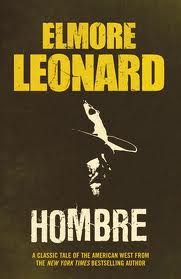
ELMORE LEONARD'S HOMBRE

I'd never read Hombre, probably because I knew the movie so well that it never occured to me to go back and seek it out after I'd exhausted all Elmore Leonard's other westerns, and the magnificent collection of his western stories. But I came a across a copy recently, and read it as a little Christmas treat for myself. It turned out to be more of a Christmas treat, it's a superb novel, whose strong points typify what makes Leonard so good.

The biggest difference from the film version is that Leonard's story is told from the point of view of a young man, whose job with the stagecoach company that's closing down of the local office provides the starting mechanism for the plot. Carl is extremely naive, and not very courageous, and he's the one who has the rifle in the book's climactic scenes, and his version of events that is the only one being told. He's a more dependable narrator than, say, Charles Portis' Mattie in True Grit, which came a bit after Hombre and might well have been influenced slightly by it. The obvious influence on Leonard is Stagecoach, which similarly puts the passengers together on the stage, and includes one figure of authority who's fleeing with an agenda of his own.

John Russell, raised by Apaches, is the hero, and he's a quieter character in Leonard's version, remembering that it's Carl's perception that is passed down to us. In the film, Carl turns into a young man who's leaving with his wife, along with the woman (Diane Cliento) who ran the boarding house Russell inherited and which he's closed down. You can see how the movie involves Russell more in white society even before he gets on the stage--in Leonard's book it's not a decision he's fully embraced yet--and the Cilento character becomes a woman who was kidnapped by Apaches and lived with them for two months. This serves to heighten both the racial tension and debate, and also to emphasise Russell's ultimate decision when it comes to the codes each race lives by. Leonard's Russell is less knowable (again, remember, we are at the mercy of our narrator), and his actions more matter-of-fact than the film's star; Newman plays him far more Christ-like at film's end. But then he is Paul Newman; when you read the description of Russell's blue eyes you realise Newman was almost perfect for the role, and he plays with almost the restraint it requires, although in the end it always seems improbable that Paul Newman would be turned away from anything, even if he were an Indian.

Where the movie is superior in in the villains. Frederic March and Richard Boone are each, in their own ways, hams at heart; March draws out every drop of venal hypocrisy from his portrayal of the corrupt Indian agent Favor. His slickness contrasts perfectly with Boone's sandpaper roughness; just as Boone's bombast and earthiness contrasts with Newman's restraint. Boone's best roles were as likeable villains (see The Tall T), and he injects Grimes (called Braden in the book; the name is shifted to Cameron Mitchell's outlaw in the film), with a perfect mix of cruelty, charm, and slyness. Between them Favor and Grimes define the bit of white civilisation not defined by women. Barbara Rush, as Audra Favor, makes the most of what is a rather thankless role, but the better she plays it, the more difficult and telling Russell's final decision becomes.

Unlike the original film version of 3:10 To Yuma, where an entire backstory was tacked onto Leonard's movie, filling it out brilliantly (what the remake did is another story!), the film follows the book pretty faithfully, and is all the better for that. But it inevitably has to show things Leonard lets you intuit for yourself; he builds his characters by letting them say and do, and letting you compare those things. That you are placed behind the eyes of a naive young man probably tells us more about ourselves, as readers of, or perhaps believers in, the myths of the West than we need to know, and that's what makes Hombre so brilliantly discomforting.

Hombre by Elmore Leonard
originally published by Ballantine in 1961
Orion Phoenix Books, £8.99 ISBN 9780753819111

Thursday, 14 April 2011

SIDNEY LUMET: CRIME, THEATRE, BRAVERMAN AND MOLLY

Tributes to Sidney Lumet have concentrated, and rightly so, on his major pictures and his knack for giving actors real chances to shine. But there is a danger of seeing him, particularly in light of 12 Angry Men being his first film and Network being arguably his best-known, and the one with the best sound-bite clip for obits, as a social realist, if not a satirist, or looking at his work along the lines of many of the other directors who came out of live television in the 1950s and went on to make the kind of earnest, feel-good work Hollywood loves to honour with Oscars (cf The King's Speech). Network has more of an edge than most such films, but at the same time it is far from Lumet's best work; it lacks subtlety, even when considered as a farcical black comedy, and like many of his films it resolves itself mechanically. But there's no question that Lumet deserves to be noted as a major director of crime films, as both 12 Angry Men and The Verdict have to be counted among the top courtroom thrillers, and they are by no means his best crime films.

And while it's important to recall Lumet's grounding in theatre (and the Actor's Studio) that background combined with his work in the early days of live television to produce a style which to many seemed utilitarian, albeit actor-friendly. Live TV offered most of the limitations of theatre (closed sets, limited casts) intensified by the audience's dependence on the single camera's point of view; a dependence which Lumet quickly turned into an asset with use of close-up and very quick cutting to create the illusion of action, or better, to draw the inner action out. Most of his best films let the actors work in extreme close-up, and those close-ups usually come quickly from ensemble shots that define the characters: once they take centre stage; think not just of Peter Finch in Network but say, Henry Fonda in 12 Angry Men or Paul Newman in The Verdict. 12 Angry Men, released in 1957, was actually adapted from an original teleplay; of his next five films, four were adapted from plays. The Fugitive Kind (1960) is pure Tennessee Williams meets Actor's Studio, but Lumet injects Long Day's Journey Into Night (1962) with an energy that transcends O'Neill's words; it remains one of the great filmed plays, and Katharine Hepburn one of O'Neill's greatest interpreters. I haven't seen Lumet's TV version of The Iceman Cometh (1960), with Jason Robards and a young Robert Redford, but it is now available on DVD.

It's interesting to watch him progress through filmed theatre: The Sea Gull (1968) with Vanessa Redgrave, James Mason and Simone Signoret, Robert Marasco's Child's Play (1972) again with Mason, Robert Preston and Beau Bridges, and later smaller productions with big-name actors: Peter Shaffer's Equus (1977) with Richard Burton and Ira Levin's Deathtrap (1982) with Michael Caine and Christopher Reeve, in what is as much a crime film as his Murder On The Orient Express (1974) is a filmed play.

Most of Lumet's best films are those which are set in the corrupt world of New York City politics and policing. Serpico (1973), which is the one people gravitate onto, was the entry point for Lumet, and part of that great revival of New York crime movies sparked by The French Connection. It may be the key film in Lumet's career: it's conducted via close-ups of method acting Al Pacino set against a paranoid world in which he never knows who among his cop colleagues and bosses and politicians is corrupt and a threat. His paranoia turns out to be fully justified. Although Lumet returned to that dark side of New York corruption repeatedly, it seems to me that Serpico and its urban paranoia, make it closer to films like Midnight Cowboy, and as such it and its successor Dog Day Afternoon (1975) are less connected with Lumet's later, more sombre, crime films than they are with Network; all three concerned with frustrations about the mores of society and its institutions, as revealed by almost insane paranoids.

The later crime and corruption films provided Lumet with a different theme, with a framework, and with the perfect way of blending the lead character back into the ensemble, getting away from Pacino and Finch. The best of the films I'd call his 'New York cycle' (and include Serpico and Dog Day if you insist), and maybe the best of all his films, was Prince Of The City (1981), with Treat Williams proving Lumet's skills with actors who never quite became stars. In fact, there are no stars, it's full of lesser-known New York actors, like Jerry Orbach, and the ensemble feel gives it a 'you are there' character (You Are There, hosted by Walter Cronkite, was a series Lumet worked on in the 1950s, which reenacted moments of history in docu-drama fashion). Prince was followed by The Verdict, which I'm tempted to include in this cycle even though its setting is Boston, and even though as a vehicle for one of Paul Newman's absolute best performances, it's closer in some ways to Serpico or indeed Network, though in this case Newman is brought back from the edge. Jack Warden leads a brilliant supporting cast, including James Mason and Edward Binns. If David Mamet's script becomes mechanical as his then-wife Lindsey Crouse cracks up on screen, Newman's rebirth carries it off. However the edge Mamet brings to the tempatations of evil is what is missing from the next two of Lumet's New York cycle: Q&A (1990), with Nick Nolte doing the Newman, Night Falls On Manhattan (1996), like Prince based on a Robert Daley book, and this time with Andy Garcia as Treat Williams/Newman and Richard Dreyfuss chanelling Jack Warden. Lumet's late-career return was marked by the last of this cycle, Before The Devil Knows You're Dead (2007), which is less concerned with institutional corruptions, and more with families, with fathers and sons, but which captures that feeling of uncertainty in relationships that ought to be certain. Or you could look at it as a serious version of the unfunny comedy Family Business, made almost 20 years earlier.

Many critics think of Lumet the way David Thomson described him: a solemn, often humourless adapter with no personal signature. Certainly he has made some clunkers, some in the 80s, more in the 90s, when his choice of material seemed flawed—and sometimes despite getting good performances from people you might not expect to deliver. But looking at some of his more overlooked films tells us something about Lumet's real strengths. Yes, if his sense of humour were better the black comedies might have more edge -- Fail Safe (1964), of course, for all its many strengths, which were never more apparent when George Clooney and Stephen Frears paid homage to it with their live TV version in America, will always be covershadowed by the satirical farce of Dr Strangelove-- but no one seems to remember Bye Bye Braverman (1968) which was very funny indeed. It probably reflects Lumet's upbringing with parents in Yiddish theatre, and indeed the bit I remember best from it is the excellent Godfrey Cambridge as a black, Yiddish-speaking, New York cabbie, and the brilliant Warden, whose career might have been sterling even if he'd never acted in anything but Lumet's movies.

Another film no one seems to recall is Lovin' Molly (1974), his next film after Serpico. It's an odd, almost urban adaptation of Larry McMurtry's excellent novel Leaving Cheyenne, one of his modern westerns like Horseman, Pass By (Hud) or The Last Picture Show which preceded his epic westerns. You might think Lumet was trying to cash in on the success of Peter Bogdanovich's film. The book is Jules et Jim set in Texas; two very different men in love with the somewhat difficult Molly, and is told in three parts, by each character in succession, at twenty year intervals. I call the film almost urban because the casting and indeed the settings do little to suggest the Texas background which is so rich in the novel. Beau Bridges is fine as the easy-going man, and Blythe Danner handles Molly with aplomb, especially if you don't try to believe she's Texan. The same applies in spades to Anthony Perkins. It's not quite the miscasting of Fear Strikes Out, because part of the story is the way his sensitive boy is a disappointment to his father, played with a bit more Texas ornery-ness by Ed Binns, who gets the great quote when explaining to his son (Perkins) why Molly isn't worth worrying about: 'A woman's love is like the morning dew: it's as just as apt to settle on a horse turd as a rose'.

I also have a lingering fondess for Daniel (1983) from EL Doctorow's fictionalised Rosenbergs, again partly for its New York casting, including Mandy Patinkin, Ed Asner, and Tovah Feldshuh. The Morning After (1986), with Jeff Bridges and a surprisingly good Jane Fonda, might be considered a near miss, but among the crime films it's hard to raise much affection for A Stranger Among Us (Melanie Griffith with the Hasidim should have made a great comedy), Guilty As Sin (Don Johnson can't repeat Hot Spot with Rebecca DeMornay) or Find Me Guilty with Vin Diesel. Luckily, Lumet's reputation doesn't have to rest with these films. In fact, it doesn't have to rest on his crime films at all, there is too much else to consider. But considered on his crime work alone, he is a major director.

Friday, 18 March 2011

BROOKLYN'S FINEST: TRAINING DAY TIMES THREE

Not satisfied with whatever he learned from Training Day, in Brooklyn's Finest Antoine Fuqua takes that movie and multiplies it by three. Training Day had a familiar but testy take on police corruption, and here we get three takes, presented in a framework whose stories both parallel each other and eventually intersect, which is quite a clever bIt of writing. And Fuqua, best-known as an action director, is good at wringing as much action mileage out of it as possible. The problem is that each situation's premises are more than just familiar, they border on cliché, in much the same way Brooklyn borders and melds into Queens.

Take Tango (Don Cheadle) who's the undercover guy from Deep Cover, in so deep he's lost his wife and is desperate to get out, and offered the chance to do so only if he'll betray his friend Casanova (Wesley Snipes, for whom this was a welcome return to the screen). And there's Eddie (Richard Gere) who's channelling his Paul Newman as the old veteran cop from Fort Apache: The Bronx, but that was in another borough and long ago. It's an interesting take, because he's still a beat cop, who gets by not as much by ignoring the job as not taking chances with it. And where Newman had a doomed relationship with a nurse who used heroin as her vacation, Gere wants to retire with the hooker Chantal (Shannon Kane) who shows him some compassion but is, after all, a hooker.

Finally, there's Ethan Hawke as Sal, the corrupt drugs cop in desperate need of cash to buy a new house which isn't infected with wood mold, which is killing his asthmatic wife (Lili Taylor), pregnant with twins they have no space for and can't afford. Hawke's first scene is a powerful one, as he executes Vincent D'Onfrio as they talk in his car; he turns out to be a bad cop who's possibly talked too much; Hawke needed the money. The script, by Michael C Martin, is very good in the way the three stories mirror each other, and indeed in the use of mirrors and reflections, because everyone has two faces, everyone is playing a role, and everyone has a different agenda. But none of them can get what they want.

The movie is best when the characters feel pressure; Gere goes stoic and silent when asked to present an acceptable version of his rookie partner's shooting a kid. When Gere's retirement day arrives, his badge gets dumped into a box in a drawer of a desk in an empty room, meaningless tin. Tango may have to act to prevent a gang member from being thrown off a roof; he's been accused of being the informer Tango actually is. Tango is pressured by his handler (Will Patton) and an ambitious tough fed (Ellen Barkin) both of whom are playing roles we know well, and it's thankless; no matter how touch she is, how slimy he is, they can't bring new depth to the parts.

The stories come together, eventually, as Sal seeks the big score he's missed, and Tango seeks revenge for Cas' execution, in the same place, and Eddie starts to act like a cop only after he's stopped being one—following up a missing person he recognises, and winding up in the same place. Here, although it's somewhat sentimental, the movie avoids the worst cliches, and the ultimate resolution doesn't really cut corners. Everyone's reduced to a single role, and pays the price, or gets the reward, for playing out that role.

It's very well done, and very well acted, and you can see why actors like working with Fuqua. But Brooklyn's Finest lacks that small spark of originality which would set it apart from the usual cop movies. Which is a shame, because there is a lot to like about it.

Brooklyn's Finest (2009) directed by Antoine Fuqua, written by Michael C Martin is out on DVD

Tuesday, 5 October 2010

IRVING RAVETCH: THE GUARDIAN OBITUARY

My obit of Irving Ravetch, who along with his wife Harriet Frank, Jr. wrote a number of outstanding movies, particularly those directed by Martin Ritt, is in today's Guardian. You can link to it here. Hombre remains one of my favourite westerns, one I consider considerably underrated, and The Cowboys (directed by Mark Rydell) was probably appreciated less than it should have been because John Wayne was starring in it. Hud is one of the best of the contemporary westerns (The Misfits, Lonely Are The Brave) which were popular in the early Sixties, just as the huge western boom on TV was coming to an end.

The Long Hot Summer
is an odd mix of Faulkner and the Actor's Studio, which makes it seem very much like a Tennessee Williams play. But the Ravetches were very good with Newman (in Norma Rae Ron Liebman does a Jewish Newman, ironically, of course). In my original version of the obit I had actually assigned the Ravetches blame for creating the opportunity for Sally Field's Oscar acceptance speech, but not surprisingly, that was lost along the way...

Friday, 4 June 2010

DEDE ALLEN: THE INDEPENDENT OBITUARY

My obituary of Dede Allen, one of the truly great film editors, is in today's Independent, you can link to it here. Re-reading it, I really should have said how incredibly crucial her work was on some overlooked gems: Arthur Penn's Night Moves is one of the great detective films of the 70s; George Roy Hill's Slap Shot is, underneath the hilarious hockey gooning, a subtle film about male roles and sexuality; and for some reason I've never quite understood, Hill's Slaughterhouse Five has never received the acclaim it deserves. Part of that reason may well be Allen's own fault; her editing is so slick it makes the film seem artless, when it's actually effortless. Paul Newman's Rachel, Rachel and Harry And Son are both very interesting films, like Curtis Hanson's Wonder Boys rather too quiet to be popular.

She certainly deserves credit for her big hits, and I was especially glad to discuss The Hustler, to which she's so crucial, but she was also important to Reds in another way: since the notoriously indecisive Warren Beatty shot eight gazillion feet of film, Allen was literally the only person who knew where every shot, every take could be found. And found them for Warren.

It was a pleasure to write this piece; it's always inspiring to realise, in retrospect, just how much good work someone has done, when they've done so much you've grown to overlook it.