Showing posts with label Rolf Lassgard. Show all posts

Monday, 13 June 2016

HJORTH & ROSENFELDT'S MAN WHO WASN'T THERE


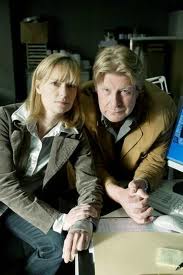
Sometimes it's hard to keep track of where you stand with Sebastian Bergman. Or Rolf Lassgard, who plays Bergman on TV, and who is thanked by the authors for his inspiration in creating the character he plays. The Man Who Wasn't There is the third of the five novels in the Bergman series; there have been two TV series of two 90 minute episodes each, and honestly sometimes I can't remember whether I read a scene or saw it on the screen. This is now also the third novel translated into English, but the English titles of the last two have been styled to remind people of Stieg Larsson: the Swedish title of this book, Fjaellgraven, translates literally to 'The Mountain Tomb', and honestly, the English title may be a better one, apart from having been used recently by the Coen brothers! Of course titles aren't the real confusion with TV adaptations. The bigger problem is that for the reader it becomes increasingly difficult not to see Lassgard's face in the role, and sadly it is correspondingly difficult to actually give most of the other characters any kind of real life of their own. 

And the lives of the characters in the Riksmord elite murder squad really do form the crux of this story. Six skeletons found in a grave in the mountains of northern Sweden bring Riksmord onto the scene, and the story moves relatively slowly for a long time, partly because there are few clues and partly because we are dealing with the lives of these people as much as the deaths of the victims. The main narrative drives comes from two neatly parallel stories: Sebastian is actually the father of his colleague Vanja, something she doesn't know, and she is off to the US and an FBI training course. Meanwhile, an Afghan refugee has contacted Swedish television's investigative unit, still looking for her husband who disappeared years ago, leaving her and their two sons without a word. But although the reader knows there has been an assassination-style killing in the mountains, that investigation seems to be going nowhere.

It seemed as if this novel was very self-referential. There are the crummy meal details, like in Larsson. Bergman has lost his wife and daughter in the tsunami, which reminded me of Johanna Sallstrom the actress who played Linda Wallander in the TV series, who lost her own daughter and later killed herself. Co-writer Hjorth did some Wallander screenplays. And of course Lassgard played Wallander: some people prefer his somewhat grumpier Wallander to Krister Henriksson's more sparkling version (no one I'd trust seems to prefer Branagh) and it occurred to me that there is a certain brilliance at work not only in Bergman, but in the team.

Because most Swedish series are big on teamwork, going back to Martin Beck and his Swedish version of the 87th precinct. The working together is generally rational and practical, as Swedes think they should be, and their relations may be problematic, but there are problems that everyone cooperates to resolves. But Bergman is no Beck or Wallander. He is a profiler, supremely empathetic, which makes him an effective, if heartless womanizer, but he's also conniving and nearly sociopathic. Within his group we have naked ambition, suspicion, and in Ursula a sort of female Bergman who has left her marriage and now wants a break from her lover, Torkel, the one character who would seem to fit the classic Swedish template and seems overwhelmed as a result. It's as if Hjorth and Rosenfeldt are deconstructing the basic structure of what has become known, for marketing purposes, as Nordic noir, and perhaps inserted a little psychological noir into the mix. And it's not just the Riksmord squad; we see similar signs of maladjustment in the media and in the immigrants—perhaps it is that the strictures that held Swedish society together are indeed falling apart, and it's affecting the Swedes most of all.

This is fascinating, but nevertheless I was getting bored; on p.337 a chapter began 'When the team gathered on Monday morning, they quickly established that nothing much had happened.' At that point I formulated the theory above and went and retrieved the book at the bottom of the wall against which I had thrown it. Only to discover a few pages later a hole in the plot. It's not serious, it seems to exist merely to facilitate some information about the villains of the piece, but (without giving away a spoiler) it refers to a DNA test which we have never learned was ordered, because why would they check bodies we already had learned could not have been those found?

But at that point, it was like firing a starter's pistol, and we got to the real story very quickly and from there it moves. Like many Swedish works (and indeed Icelandic) we learn there are outside forces at work, and these are presented in a chilling fashion. It builds to a car-chase kind of climax of the kind which suits TV adaptations, and perhaps that is where the problem with the novel lies: it is as if the description which needs to be added to fill in the characters just isn't enough, as challenging to the genre as it is. The core story is waiting to get out and be filmed in 90 minutes. Having said all that—there is an epilogue which sets us up for the next 90 minutes, and honestly, I can't wait.


The Man Who Wasn't There (Fjallgraven) by Michael Hjorth and Hans Rosenfeldt

Century Penguin £16.99 ISBN 9781780894584

This review will also appear at Crime Time (www.crimetime.co.uk)

Sunday, 2 January 2011

WALLANDER FILMS: GUEST ESSAY BY BOB CORNWELL

NOTE: IT welcomes the New Year with only its second guest essay. Bob Cornwell wrote a version of what follows as a comment following my response to The Man Who Smiled (you can link to that here), but before the post which precedes this one--for some reason the site refused to post it. If you've followed IT's response to Wallander, in books and on film, I think it will interest you. As you'll see, Bob and I have somewhat different takes on the focus of One Step Behind, as I'm more willing to let some of the overt social comment be subservient to the development of the main characters. We're also a little at odds over the Branagh versions; I'm not convinced it's a question of length as much as Branagh's preference for an existential hero, and a diminishing of the ensemble cast of cops. Perhaps we should get together on picking and choosing the best bits of each series--Nyberg and Linda from the TV series, Martinsson from the TV movies, Wallander's father from the Branagh series, and edit them into one killer version!

THE WALLANDER TV MOVIES IN CONTEXT
by Bob Cornwell

I too was puzzled by the ending of the The Man Who Smiled. That final shot, with Lassgård/Wallander grooving along to the Hepcats' ‘Cadillac’, must have sent a shiver down Mankell's spine. Strange that anyone thought that was appropriate, particularly Lassgård (Mankell’s own choice for the role). Or did I detect a certain glee from him, eight years into the series? The adaptation, as you suggest, is pretty free, omitting key parts of what is the book’s central theme, the corrosive effects of untrammelled capitalism, not only on big business (with the book’s link to Robert Maxwell in the UK) but also its effect on individuals and local government. The IVF sub-plot appeared to me as totally gratuitous. The ending was, I thought, a neat compromise, if a little over-idealistic.

I was less happy with the lack of context to Wallander’s anonymous sex with the hotel prostitute, as well as with the scene itself, which shows Wallander out of character, and surprisingly naive for a senior policeman! As you know, in the book Wallander is on leave of absence after the concluding events of The White Lioness, in the depths of despair and considering a possible end to his police career. He knowingly embarks on that brief relationship (it occupies 15 lines in the book) and the character does not recur. Later he takes under his wing the newly arrived younger policewoman Ann-Britt Höglund, a non-sexual relationship which develops innto one that echoes Wallander's relationship with Rydberg, his deceased colleague and mentor) whilst still filled with longing for Baiba Leipa, the Latvian woman he met in The Dogs Of Riga.

Clearly that wasn’t enough for the two scriptwriters you mention, who invented Maja, presumably to spice up the previous film, The Fifth Woman, and beyond: she lasts through to Firewall. I wonder what they do with her in the later The Pyramid, written as a prequel to Faceless Killers? Significantly perhaps in Sidetracked, which markeds the resumption of the Lassgård series after a five year gap, and which according to IMDB, has Mankell as a contributing screenwriter, there is no Maja and Högland appears in her own right.

One issue this series does highlight is the question of runtime. It has always irked me that so many of the facile verdicts on which series is ‘better’, ignore the fact that the Branagh versions are all 90 minute condensations of what are complex 400+ page books, whilst the Hendriksson series, with one exception (After the Frost) are based on Mankell story outlines, not even short stories, and (presumably) lack the careful structure and detail of the books, therefore enabling the screenwriters to produce a product more in accord with conventional series thinking. This is not to decry the Hendriksson series, which has produced some notable episodes, but simply to point out that they are two different beasts.

As is the Lassgård series. Faceless Killers (1995) is a 4-part series running to 209m (again according to IMDB, not always the best source of runtime info) – and this the shortest of the Wallander novels. Later we get 166m for Sidetracked, 127m for The Man Who Smiled, and 180m for Firewall. Such generosity with screentime is surely more likely to produce an adaptation likely to find favour with those who have actually read the books. Wallander’s father appears in these early films, for example, as does Baiba. The exception to the rule is the version of One Step Behind, 90m in the Branagh version, 100m in the Lassgård version. On first viewing, I am far from convinced that the Lassgård version uses its extra minutes wisely (though I think Lassgård’s performance is the superior one). But at least the Branagh version does not ignore Mankell’s underlying theme of the rise of irrational violence in Swedish society, whilst the Lassgård version (though often beautifully directed by Birger Larsen) ludicrously over-emphasises the homosexual aspects of the story to produce a killer who is all-too explainable, and therefore at variance with Wallander’s own post-arrest investigations (ignored in both adaptations). Nevertheless I join you in hoping that the BBC will let us see the earlier episodes in the series, including The White Lioness (1996) to date the only film version of this novel.

WALLANDER FILMS REDUX: FIREWALL AND ONE STEP BEHIND

Following from my watching the Swedish TV film version of The Man Who Smiled (you can link to that review here)I've been locked down on BBC IPlayer over New Year's, plowing through more of Henning Mankell's Wallander. After the two-part Firewall and the excellent One Step Behind, I am now won over completely by Rolf Lassgard's performance in the title role. And I love the way its Swedish DVD package (see right) presents Wallander as an action hero! Lassgard catches the occasional moment of ingratiating humour, but more importantly the detective's essential vulnerability, which is what drives his obsession with solving crime and putting that small part of his universe right. Firewall, in which a cash machine in Ystad's town square turns out to be the trigger for a world-wide cyber-terror plot, is somewhat slow-developing, which in fairness reflects actual police work; it might well have been called One Step Behind. But its real focus is on Wallander's relationship with his colleagues Martinsson (more fine work by Lars Melin), who, lacking the obsession with his police work, is many of the things Wallander is not, and of course Maya. Marie Richardson is very good, but this is a character created to simplify Wallander's complicated relations with female colleagues, but the key feature is is relationship with Elvira, the diabetes therapist, who turns out to be a plant.

The real firewall is the barrier Wallander has erected between himself and others, even between his own feelings and the rest of the world. His hiding of his diabetes is the reflection of this, but the relationships reveal far more, as his private needs affect his work on the case. By alienating Martinsson, who wants a letter of recommendation for a cushier job in Malmo, a letter Wallander is reluctant to write, he creates a persistent critic of his investigation, marginalising himself as the CID arrive from Stockholm. And of course by failing to see through Elvira, he puts the young computer hacker he's brought into the case. Oddly, the hacker, Robin (the engaging Pia Ojansdotter), has been made a young woman in the film, sort of a kinder, gentler Lisbeth Salander, but also a stand-in for his daughter Linda, who doesn't appear in these adaptations. Salander and Wallander, now that's a pairing to consider! But to Wallander, it's the realisation that his own loneliness has blinded his cop instincts which turns out to be the focal point of the film.

Although in fairness, Wallander's police instincts often seem to be fogged by the reality of his life, and by dropping his other obsession, with opera, these films keep that on a very personal level—opera is all about expressing big emotions in a big way, and one of the points of Mankell's books is to examine the way Swedish society and culture discourage just such expression.

That, indeed, is the point of One Step Behind. The focus is not so much on the revelation of that Svedberg was gay, nor that none of his colleagues suspected as much, but the fact that none of his colleagues knew anything about the man away from the job. Wallander is shocked to discover that Svedberg considered him his best friend, indeed, was in love with him. The key scene is when the police gather to watch the peeping-tom videos the killer has taken of all of them, revealing the things that they hide from each other, and the key moment comes when we see Maya with the Danish cop HC (Peter Gantzler). The scene seems gratuitously explicit, but one of the points is the difference between the out-going, fun-loving Dane and his repressed Swedish colleagues. You can even hear it in the faster, slightly slurred Danish contrasting with the more precise Swedish. The other point, of course, is that everybody lies about their personal lives, if only by omission, to keep them secret even from those closest to them.

Birger Larsen's direction of One Step Behind is the sharpest of the three movies BBC4 has shown, he keeps the pace moving in what, once the identity of the killer has been revealed, becomes a fairly standard story. But he is equally as dynamic with the personal stories, and that's what makes this one the best of the three. Interestingly, watching it after Firewall, which preceded it in terms of release, helps put the characters into better, if slightly confusing, context, and noticing that both stories feature killers shooting themselves makes one wonder if it's an easy way out, both in plot terms and for the killer. Certainly, both are justified in the characters' own minds: Solomon has done wrong, and knows it, whereas Ake wants to keep Wallander alive to let him suffer with loss and not give him the satisfaction of bringing him to justice. It would be somewhat perverse to follow these in reverse order, but I suspect the later adaptations may have lent themselves more to foreign sales; needless to say I'm looking forward to the rest of the series appearing in whatever order.

Tuesday, 28 December 2010

WALLANDER: THE MAN WHO SMILED

Kudos to BBC4, who are showing some of the original Swedish Wallander series, nine movies made by Swedish television (SVT) between 1994 and 2007, adapting all Henning Mankell's novels, and starring Rolf Lassgard as Wallander. BBC4, being English at heart, began in the middle, with The Man Who Smiled (2003) the sixth of the nine. It's a fascinating adaptation, both for the way it follows the novel and for the changes it makes.

The core, of course, is Lassgard as Wallander, and he plays the character much closer to his written persona, seeking no sympathy apart from the odd moment of comic appeal. He's a little too sharp-featured, perhaps;  Krister Hendriksson, who starred in the Swedish TV series, comes close too, but often has a bit too much twinkle and empathy, while Kenneth Branagh in the British version is far too jaw-grindingly existentially tormented, and far too dependent on his designer stubble to render the character with nuance. The BBC recently compared Wallander to a Bergman character (an easy assumption to make, since Mankell is married to Bergman's daughter) but there is a difference, in that Wallander's existence is totally wound up in his personal battle to put the world right. In that sense, he's post-Bergman, less concern with questions of why we are here as to what we do finding ourselves in this milieu. Lassgard's performance suggests someone swept up by the overwhelming pressures of his work, the Martin Beck influence coming through clearly. He looks a bit less solid than I imagine Wallander should, somewhat too soft around the edges, especially with his hair parted in the middle, but he makes up for it with the fiery temper that seems unware of who it might be offending, and the highly visible disdain for authority.

The adapters (Klas Abrahamsson and Michael Hjorth, who also did the screenplays immediate before and after this one) have changed the colleague with whom he has an ill-fated affair; now called Maya and played by the excellent Marie Richardson, she's perfect as the exasperated foil trying to balance the private Kurt with the police Wallander. In that sense, The Man Who Smiled was a good place to start, as it shows the relationship running almost full circle. The rest of the supporting cast is good, but not necessarily foregrounded as they are in the TV series. The first series of television shows benefitted from Johanna Sallstrom as Linda Wallander, and a strong ensemble with Mats Bergman seeming to absorb Wallander's dour side from Henriksson as Nyberg. The Branagh version keeps the supporting cast much more in the background, apart from the huge plus of David Warner as Wallander's father, who doesn't appear in the Swedish TV version, and not in this film. The adaptations are similar in style to the second and third Girl Who movies, obviously shot with the smaller screen in mind, but without too many concessions, and even, as we'll see below, eschewing the opportunity for a car chase of sorts!

Here Kerstin Andersson gets the school-mistress role as Wallander's boss, and handles it very well, while Christer Fant is brilliant as Svedberg, playing him something like a Gunvald Larsson from the Beck series, but a tremendous foil for Lassgard. Lars Melin, as Martinsson, plays the cop who'd rather be somewhere else, and Melin reminds me more than a little of John Pankow (best as William Peterson's partner in To Live And Die In LA).

The big changes to the book involve both the tycoon Harderberg and Wallander's pursuit of him. There is a sub-plot added with Harderberg's adopted daughter (and his IVF impregnation of her), and, more significantly, the ending is changed (if you don't want it spoiled stop reading now). In the book Wallander captures Harderberg after an airport runway chase and he is charged with crimes. In the film, Harderberg apparently escapes, but Wallander passes on his files to an investigative reporter. In a way, this is more Wallander than Mankell; the book highlights his obsessive pursuit of the wealthy industrialist who's beyond the law (a real nod to Sjowall and Wahloo's Murder At The Savoy, as I mentioned in my introduction to the Harper Perennial edition of that book) but the film also shows the limitations of his efforts, held back the influence of wealth and the politics of power, and how he goes outside the rule-book in order to get what British crime dramas would call 'a result'. And thus it ends, with Wallander celebrating with a little rock and roll, the one false note in the entire enterprise. Driving away in the car pounding the roof is more Baretta than Wallander; perhaps driving away slowly with opera rising to a crescendo? BBC4 is already showing a two-part version of Firewall and I'm hoping they go back to the earliest adaptations, because it's a well-done series with an intriguing Wallander.