Showing posts with label Kenneth Branagh. Show all posts

Sunday, 4 March 2018

DUNKIRK: OSCAR WATCH III

It isn't hard to understand the popularity of Dunkirk, which comes to us as part of a celebration of Churchill's early days and the eponymous evacuation of British forces from France in the early days of World War II. One could draw the obvious analogy with today's European crisis, Brexit, and Dunkirk is the easiest of this year's four films (Churchill, Darkest Hour and Their Finest) to break down in those terms, but it's more deeply-seated than that. Because what Dunkirk celebrates, and what the event is celebrated for, is British understatement, and the stiff-upper lip.

It's an understated film, especially considering the size of the Dunkirk enterprise, which here is scaled down to one beach, a couple of ships and a handful of boats. Everything goes into narrow focus, even the timeline, which is shifted to allow the three strands of the story to coincide at their climaxes. As with most Christopher Nolan films, time is of the essence, and the structure of Dunkirk, while it seemed to befuddle a number of critics, is not that hard to follow. I am not sure what it adds in terms of story-telling apart from perhaps distracting from the narrowness of the strands, as if to provide them with more collective weight. Those strands are the story of two 'lost' soldiers trying desperately to get off the beach, and contrasted with the officers in charge, one boat's journey across the Channel, and two fliers trying to provide air cover for the evacuees.

Understatement is celebrated along with the stiff upper lip, and they don't come much stiffer, although this, oddly, is somewhat class-conscious. The soldiers on the beach, inured to queueing, occasionally moan about their situation, but the two who are two main figures keep remarkably silent. One for very good reason, and when that reason is revealed, the British soldiers turn on him with remarkable xenophobic vigour. Oddly, the ordinary soldiers are the least convincing in costume: it's hard not to see them as modern actors. In the officer class, however, the stiff-upper lip holds. Kenneth Branagh literally has no upper lip, but as is common with his serious roles, he seems more to be playing Trevor Howard or Noel Coward playing a naval officer, than an actual naval officer.

Upper lips don't come much more stiff than Mark Rylance's from whose lips words emerge only after great effort. Were he to play the lead in a Pinter play I assume time itself might stop. Rylance's pained looks epitomise the British desire to overcome hardship, including the somewhat unnecessary hardship he makes for himself in his handling of the shell-shocked officer he picks up, whose lip has unstiffened to the point of liquidity. This creates a tragedy which Rylance has to let go, a symbol of the sacrifices we all must make, and of the creation of heroic myth (which anticipates Their Finest Hour to a T, or tea.) For all that, Rylance absolutely steals the show. And finally to Tom Hardy, as the last of the Spitfire pilots, whose understated tactic is simply not to talk at all, except for a few brief phrases over the radio to his fellows.

So as an exercise in understatement, Dunkirk is indeed a tour de force, a different sort of war movie which adapts its structure to celebrate defeat, or better, victory in defeat. But to think that it somehow avoids the tropes of war films would be a mistake, and to do so makes certain moments stand out more. Branagh stays behind, ostensibly to aid the French who will be evacuated in the next wave, when he knows full well there will be no next wave. It was tempting to think of him making an appeasement to the age-old antagonisms which have sprung up over Brexit, but I think it was more to give us a sense of the Capt. Scotts, the captain going down with his ship. Think Robert Taylor in Bataan, without the machine gun, the grave, or the Japs crawling toward him.
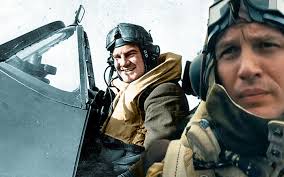
I spent a long time trying to figure the fuel capacity and range of those Spitfires, and at five miles per gallon, Tom Hardy would indeed have had plenty of time to do most of what he does. However the laws of physics make a couple of scenes dubious: the plane floating on the waves, when it's engine would tip it forward and then down very quickly indeed, and Hardy's amazing manoeuvres while in a powerless glide, where English grit proves too much for gravity. Given his ability to move the plane I wondered why he bothered to land away from the evacuation point, and into the middle of the oncoming (somewhat late and without any urgency) handful of Germans. Perhaps he was being a decoy. But if you think of this section of the film within its own chronological order, you see a story-line that is virtually unchanged from Air Force, apart from the Germans strafing a downed pilot, and that makes one wonder if the time-shifting is a sort of sleight of hand aimed at distracting the audience from the familiar tropes the film actually embraces, not denies.

But most instructive was the reaction of the British soldiers to the discovery one of them is actually French, and thus unworthy of being saved. No matter that the French are actually holding back the Germans while all this is happening (though for reasons we still don't understand fully, the Germans mostly held themselves back, including, crucially, in the air). This was Brexit in a nutshell: we're getting out of here and we are not taking any immigrants with us.

When everyone gets back to Britain they discover the full scale of the success of the evacuation (though somehow Kenneth Branagh knows the exact total while he is still on his little beach) and it puts that small story Nolan has shown us into some sort of context.

Writing before the Oscars, I can't see Dunkirk winning, Chariots Of Fire-like, in what would now be an upset. It is apparently the largest-grossing WWII movie, ever, but two-thirds of its takings were outside the US. However I happened to see it in America, and the audience, while not as partisan as a British one, was definitely impressed with the overall dignity and grit of the film's approach. If it were to win it might be because it speaks to certain virtues in a time of chaos, and America shares its own sort of chaos with Britain right now. But I guess that Oscar voters will be split between those who see Dunkirk as an innovation in war films and those who wonder if such a micro-focus really does convey a macro picture after all. And there are other films which get more specifically into our collective malaise, or get away from it.

Monday, 13 June 2016

HJORTH & ROSENFELDT'S MAN WHO WASN'T THERE


Sometimes it's hard to keep track of where you stand with Sebastian Bergman. Or Rolf Lassgard, who plays Bergman on TV, and who is thanked by the authors for his inspiration in creating the character he plays. The Man Who Wasn't There is the third of the five novels in the Bergman series; there have been two TV series of two 90 minute episodes each, and honestly sometimes I can't remember whether I read a scene or saw it on the screen. This is now also the third novel translated into English, but the English titles of the last two have been styled to remind people of Stieg Larsson: the Swedish title of this book, Fjaellgraven, translates literally to 'The Mountain Tomb', and honestly, the English title may be a better one, apart from having been used recently by the Coen brothers! Of course titles aren't the real confusion with TV adaptations. The bigger problem is that for the reader it becomes increasingly difficult not to see Lassgard's face in the role, and sadly it is correspondingly difficult to actually give most of the other characters any kind of real life of their own. 

And the lives of the characters in the Riksmord elite murder squad really do form the crux of this story. Six skeletons found in a grave in the mountains of northern Sweden bring Riksmord onto the scene, and the story moves relatively slowly for a long time, partly because there are few clues and partly because we are dealing with the lives of these people as much as the deaths of the victims. The main narrative drives comes from two neatly parallel stories: Sebastian is actually the father of his colleague Vanja, something she doesn't know, and she is off to the US and an FBI training course. Meanwhile, an Afghan refugee has contacted Swedish television's investigative unit, still looking for her husband who disappeared years ago, leaving her and their two sons without a word. But although the reader knows there has been an assassination-style killing in the mountains, that investigation seems to be going nowhere.

It seemed as if this novel was very self-referential. There are the crummy meal details, like in Larsson. Bergman has lost his wife and daughter in the tsunami, which reminded me of Johanna Sallstrom the actress who played Linda Wallander in the TV series, who lost her own daughter and later killed herself. Co-writer Hjorth did some Wallander screenplays. And of course Lassgard played Wallander: some people prefer his somewhat grumpier Wallander to Krister Henriksson's more sparkling version (no one I'd trust seems to prefer Branagh) and it occurred to me that there is a certain brilliance at work not only in Bergman, but in the team.

Because most Swedish series are big on teamwork, going back to Martin Beck and his Swedish version of the 87th precinct. The working together is generally rational and practical, as Swedes think they should be, and their relations may be problematic, but there are problems that everyone cooperates to resolves. But Bergman is no Beck or Wallander. He is a profiler, supremely empathetic, which makes him an effective, if heartless womanizer, but he's also conniving and nearly sociopathic. Within his group we have naked ambition, suspicion, and in Ursula a sort of female Bergman who has left her marriage and now wants a break from her lover, Torkel, the one character who would seem to fit the classic Swedish template and seems overwhelmed as a result. It's as if Hjorth and Rosenfeldt are deconstructing the basic structure of what has become known, for marketing purposes, as Nordic noir, and perhaps inserted a little psychological noir into the mix. And it's not just the Riksmord squad; we see similar signs of maladjustment in the media and in the immigrants—perhaps it is that the strictures that held Swedish society together are indeed falling apart, and it's affecting the Swedes most of all.

This is fascinating, but nevertheless I was getting bored; on p.337 a chapter began 'When the team gathered on Monday morning, they quickly established that nothing much had happened.' At that point I formulated the theory above and went and retrieved the book at the bottom of the wall against which I had thrown it. Only to discover a few pages later a hole in the plot. It's not serious, it seems to exist merely to facilitate some information about the villains of the piece, but (without giving away a spoiler) it refers to a DNA test which we have never learned was ordered, because why would they check bodies we already had learned could not have been those found?

But at that point, it was like firing a starter's pistol, and we got to the real story very quickly and from there it moves. Like many Swedish works (and indeed Icelandic) we learn there are outside forces at work, and these are presented in a chilling fashion. It builds to a car-chase kind of climax of the kind which suits TV adaptations, and perhaps that is where the problem with the novel lies: it is as if the description which needs to be added to fill in the characters just isn't enough, as challenging to the genre as it is. The core story is waiting to get out and be filmed in 90 minutes. Having said all that—there is an epilogue which sets us up for the next 90 minutes, and honestly, I can't wait.


The Man Who Wasn't There (Fjallgraven) by Michael Hjorth and Hans Rosenfeldt

Century Penguin £16.99 ISBN 9781780894584

This review will also appear at Crime Time (www.crimetime.co.uk)

Saturday, 6 April 2013

HENNING MANKELL'S TROUBLED MAN

Kurt Wallander is 60 years old. He's living in his isolated house with a view of the sea. He's starting to forget things, including one night when he gets drunk and leaves his gun behind in a restaurant. On the home front, his daughter Linda, who followed him into the police, is having a baby, partnered with a Swedish businessman whose father is a naval officer from the old aristocracy. As always with Wallander, he has time to think, especially as he sits out his suspension while the punishment for losing his gun is decided by the odious bureaucratic cop Mattson.

Then Linda's partner's father disappears, and Wallander is drawn into the search—made more personal because Hakan von Enke had previous chosen to share with Wallander the fact that he was troubled, though not the specifics of what it was that was troubling him. Wallander's search eventually involves foreign submarines run aground in Swedish waters, international spying and evasdropping, and even murder. This touches on those keys moments of modern Swedish society—the time of Olaf Palme, and his assassination—which has been at the core of much modern Swedish crime fiction, and which continues to defines the problems of Sweden's view of itself and its place in the modern world. Of course, Wallander's quest is not an official investigation, but that is perfect because it is the detective doing what he has always done best—attempting to solve a mystery, the mystery of human behaviour, the one thing that has always been hardest for him to do.

What develops as he searches for von Enke, and then for von Enke's wife, is something different: it becomes a trawl through Wallander's own past. At times, the devices become a bit strained, as Henning Mankell attempts to cover lots of ground from the past that's been shared through the series, and indeed some that has not. But even if it at times creaks at the edges, the core of it is filled with the rise of emotions, as always restrained and even repressed, in the overwhelmingly Swedish sense, as Wallander and we contemplate his life.

He receives a visit from Baiba, the Latvian woman who was his one true love; he has to deal with Mona,his ex-wife and first love. He is forced to examine himself, and we are given the same opportunity to examine him. It is not always pleasant, but then, it never has been—the reality of Wallander has never been tortured genius, as portrayed by Branagh, or affable insecurity, like Krister Hendriksson. It has been his ordinariness, his restraint, his inability to fit in comfortably with the society he examines as he works. It has been a most Swedish inwardness, made more poignant by the ways in which Mankell has brought the outside world, the modern world, to bear on him. The core of his work has always been Wallander himself, which is what this novel, in its sombre way, celebrates.

For it is Wallander himself who is the troubled man, and his troubles are framed by his past on one side, and his newly-arrived grandaughter on the other. The prospect of tragedy hangs over this entire novel—the reader sits on a sharp edge of fatal anticipation-- but in the end Mankell resolves the Wallander series in exactly the way he has built it over the years, with a simple and, dare I say, Swedish realism or practicality about the nature of our lives themselves. If it isn't optimistic or affirming, neither is it tragic. It is, instead, exactly what it is, and deeply moving, particularly if you have followed the series. This is, obviously, not the place to start reading Wallander—you do not have to have followed the whole series, but the more you know of the man, the more affecting this valedictory novel will be, and the better you will understand Mankell leaving Wallander his last private moments.

Thursday, 7 April 2011

WHY IT'S OK TO BE NOT SO QUEENAN ON ALL-BRANAGH

Last week the Guardian devoted an entire page of their Friday review section to Joe Queenan's discovery that Kenneth Branagh was not the second coming of Laurence Oliver. Since this acclamation is now more than two decades old, and because most of us have long since been disabused of the notion, Queenan's decision to use the upcoming Thor movie for a re-evaluation that turns out to be merely a confirmation of the existing evaluation is an interesting one, more interesting because he seems to miss the essential point of Branagh's original appeal and his career since then.

Where the comparison with Oliver held up best, I believe, is in the transition from stage to film. Oliver understood very well how to convey theatrical effects, and also understood even better the uses of the camera to provide those effects, like close-ups, which could not be delivered on the stage. Watching his Hamlet, Richard, or Harry is to get the best sense of theatrical performance. Branagh had a similar sense of transferring some of the immediacy of the stage, some of the control the lead actor has, to the screen. Problem was, he had much less to work with.

Years ago I wrote about Branagh's Henry V, noting that his was a performance for Thatcherite Britain. Oliver's had been empowered by World War II; Branagh's by the Britain of war in the Falklands ('rejoice!', 'gotcha!') and war against miners. His was a performance full of stature but lacking presence. I called it a cost-accounting prince; the newly upwardly-mobile striver's version of nobility. It's not, as Queenan believes, a question of looks, though Branagh is a potato compared to Oliver, or indeed to most Hollywood action men. It's a question of posture. I never got the sense Branagh's Harry knew what battle, or comradeship, were all about. Olivier got it, even with the bad haircut and dye job. Branagh was more like posing for a photo op, taking a chance to deliver some good PR and move on; Nick Clegg with an army behind him. He was adept at organising, at putting things together with his RSC and Oxbridge stock company, and getting the reflected spotlight onto himself; the actual acting, full of pomp and circumstantial evidence, got lost in the shuffle.

The difference between Oliver and Branagh was exactly the difference between Sean Connery's James Bond and Daniel Craig's hold-em playin', football-supporting, hands clenched in knife-edge sprinting version: not so much dumbed down as aimed down. Craig grabs one note of Bond, technology, and like a junior clerk who's just watched Top Gear, jumps into the role. Branagh avoids one-note by projecting technique; thus he failed miserably in Dead Again because he was unable to tap into the ambiguities real noir would require; instead he and Em did their Footlights thing in the shadows, half-full of sound, some fury, and signifying almost nothing at all.

Branagh fell prey to the same sort of problem when he did BBC's version of Wallander, a dully-hammered one-note sombre based on some English idea of Scandinavian alienation. His Wallander is closer to Jo Nesbo's Harry Hole than to Mankell's detective, and not a patch on Krister Henriksson's more nuanced version.

Queenan notes than Branagh has done some excellent work for television (though he includes Wallander in that) but fails to figure out why. It's mostly that the small screen gets filled with Branagh's actorly emoting, where on the bigger screen it gets overpowered and lost. Interestingly, his two best TV roles have touched on his quintessential strengths as a performer. As Shackleton he got to project beyond and through English reserve; enduring unnecessary hardship and managing to triumph in defeat.

But his greatest performance may well be as Heydrich in the HBO/BBC Conspiracy, the story of the Wannsee meeting at which the logistics of the Final Solution were agreed. Branagh gets to display a little flash, but primarily the performance is a perfectly controlled exercise in bullying petty bureaucracy; the Thatcherite ideal transformed on the wider historical context. He plays off well against the more anguished performances of some of his 'nice' Germans (Ben Daniels in particular), and he gets brilliant support from Stanley Tucci as Eichmann; Tucci understands exactly the mundanity at the heart of the evil on display. Without meaning to take the historical context lightly, the nature of these characters could just as easily have been those at the meeting where Dave Cameron and Nick Clegg drew up their own final solution (the Big Society) for Britain. They are the children of Thatcher, just as Branagh will be remembered as Thatcherism's greatest actor.

Directing Thor is not beneath Branagh's talents; there Queenan has it wrong. Playing him would be. But Loki might well be perfect for him.

Sunday, 2 January 2011

WALLANDER FILMS: GUEST ESSAY BY BOB CORNWELL

NOTE: IT welcomes the New Year with only its second guest essay. Bob Cornwell wrote a version of what follows as a comment following my response to The Man Who Smiled (you can link to that here), but before the post which precedes this one--for some reason the site refused to post it. If you've followed IT's response to Wallander, in books and on film, I think it will interest you. As you'll see, Bob and I have somewhat different takes on the focus of One Step Behind, as I'm more willing to let some of the overt social comment be subservient to the development of the main characters. We're also a little at odds over the Branagh versions; I'm not convinced it's a question of length as much as Branagh's preference for an existential hero, and a diminishing of the ensemble cast of cops. Perhaps we should get together on picking and choosing the best bits of each series--Nyberg and Linda from the TV series, Martinsson from the TV movies, Wallander's father from the Branagh series, and edit them into one killer version!

THE WALLANDER TV MOVIES IN CONTEXT
by Bob Cornwell

I too was puzzled by the ending of the The Man Who Smiled. That final shot, with LassgÃ¥rd/Wallander grooving along to the Hepcats' ‘Cadillac’, must have sent a shiver down Mankell's spine. Strange that anyone thought that was appropriate, particularly LassgÃ¥rd (Mankell’s own choice for the role). Or did I detect a certain glee from him, eight years into the series? The adaptation, as you suggest, is pretty free, omitting key parts of what is the book’s central theme, the corrosive effects of untrammelled capitalism, not only on big business (with the book’s link to Robert Maxwell in the UK) but also its effect on individuals and local government. The IVF sub-plot appeared to me as totally gratuitous. The ending was, I thought, a neat compromise, if a little over-idealistic.

I was less happy with the lack of context to Wallander’s anonymous sex with the hotel prostitute, as well as with the scene itself, which shows Wallander out of character, and surprisingly naive for a senior policeman! As you know, in the book Wallander is on leave of absence after the concluding events of The White Lioness, in the depths of despair and considering a possible end to his police career. He knowingly embarks on that brief relationship (it occupies 15 lines in the book) and the character does not recur. Later he takes under his wing the newly arrived younger policewoman Ann-Britt Höglund, a non-sexual relationship which develops innto one that echoes Wallander's relationship with Rydberg, his deceased colleague and mentor) whilst still filled with longing for Baiba Leipa, the Latvian woman he met in The Dogs Of Riga.

Clearly that wasn’t enough for the two scriptwriters you mention, who invented Maja, presumably to spice up the previous film, The Fifth Woman, and beyond: she lasts through to Firewall. I wonder what they do with her in the later The Pyramid, written as a prequel to Faceless Killers? Significantly perhaps in Sidetracked, which markeds the resumption of the LassgÃ¥rd series after a five year gap, and which according to IMDB, has Mankell as a contributing screenwriter, there is no Maja and Högland appears in her own right.

One issue this series does highlight is the question of runtime. It has always irked me that so many of the facile verdicts on which series is ‘better’, ignore the fact that the Branagh versions are all 90 minute condensations of what are complex 400+ page books, whilst the Hendriksson series, with one exception (After the Frost) are based on Mankell story outlines, not even short stories, and (presumably) lack the careful structure and detail of the books, therefore enabling the screenwriters to produce a product more in accord with conventional series thinking. This is not to decry the Hendriksson series, which has produced some notable episodes, but simply to point out that they are two different beasts.

As is the LassgÃ¥rd series. Faceless Killers (1995) is a 4-part series running to 209m (again according to IMDB, not always the best source of runtime info) – and this the shortest of the Wallander novels. Later we get 166m for Sidetracked, 127m for The Man Who Smiled, and 180m for Firewall. Such generosity with screentime is surely more likely to produce an adaptation likely to find favour with those who have actually read the books. Wallander’s father appears in these early films, for example, as does Baiba. The exception to the rule is the version of One Step Behind, 90m in the Branagh version, 100m in the LassgÃ¥rd version. On first viewing, I am far from convinced that the LassgÃ¥rd version uses its extra minutes wisely (though I think LassgÃ¥rd’s performance is the superior one). But at least the Branagh version does not ignore Mankell’s underlying theme of the rise of irrational violence in Swedish society, whilst the LassgÃ¥rd version (though often beautifully directed by Birger Larsen) ludicrously over-emphasises the homosexual aspects of the story to produce a killer who is all-too explainable, and therefore at variance with Wallander’s own post-arrest investigations (ignored in both adaptations). Nevertheless I join you in hoping that the BBC will let us see the earlier episodes in the series, including The White Lioness (1996) to date the only film version of this novel.

Tuesday, 28 December 2010

WALLANDER: THE MAN WHO SMILED

Kudos to BBC4, who are showing some of the original Swedish Wallander series, nine movies made by Swedish television (SVT) between 1994 and 2007, adapting all Henning Mankell's novels, and starring Rolf Lassgard as Wallander. BBC4, being English at heart, began in the middle, with The Man Who Smiled (2003) the sixth of the nine. It's a fascinating adaptation, both for the way it follows the novel and for the changes it makes.

The core, of course, is Lassgard as Wallander, and he plays the character much closer to his written persona, seeking no sympathy apart from the odd moment of comic appeal. He's a little too sharp-featured, perhaps;  Krister Hendriksson, who starred in the Swedish TV series, comes close too, but often has a bit too much twinkle and empathy, while Kenneth Branagh in the British version is far too jaw-grindingly existentially tormented, and far too dependent on his designer stubble to render the character with nuance. The BBC recently compared Wallander to a Bergman character (an easy assumption to make, since Mankell is married to Bergman's daughter) but there is a difference, in that Wallander's existence is totally wound up in his personal battle to put the world right. In that sense, he's post-Bergman, less concern with questions of why we are here as to what we do finding ourselves in this milieu. Lassgard's performance suggests someone swept up by the overwhelming pressures of his work, the Martin Beck influence coming through clearly. He looks a bit less solid than I imagine Wallander should, somewhat too soft around the edges, especially with his hair parted in the middle, but he makes up for it with the fiery temper that seems unware of who it might be offending, and the highly visible disdain for authority.

The adapters (Klas Abrahamsson and Michael Hjorth, who also did the screenplays immediate before and after this one) have changed the colleague with whom he has an ill-fated affair; now called Maya and played by the excellent Marie Richardson, she's perfect as the exasperated foil trying to balance the private Kurt with the police Wallander. In that sense, The Man Who Smiled was a good place to start, as it shows the relationship running almost full circle. The rest of the supporting cast is good, but not necessarily foregrounded as they are in the TV series. The first series of television shows benefitted from Johanna Sallstrom as Linda Wallander, and a strong ensemble with Mats Bergman seeming to absorb Wallander's dour side from Henriksson as Nyberg. The Branagh version keeps the supporting cast much more in the background, apart from the huge plus of David Warner as Wallander's father, who doesn't appear in the Swedish TV version, and not in this film. The adaptations are similar in style to the second and third Girl Who movies, obviously shot with the smaller screen in mind, but without too many concessions, and even, as we'll see below, eschewing the opportunity for a car chase of sorts!

Here Kerstin Andersson gets the school-mistress role as Wallander's boss, and handles it very well, while Christer Fant is brilliant as Svedberg, playing him something like a Gunvald Larsson from the Beck series, but a tremendous foil for Lassgard. Lars Melin, as Martinsson, plays the cop who'd rather be somewhere else, and Melin reminds me more than a little of John Pankow (best as William Peterson's partner in To Live And Die In LA).

The big changes to the book involve both the tycoon Harderberg and Wallander's pursuit of him. There is a sub-plot added with Harderberg's adopted daughter (and his IVF impregnation of her), and, more significantly, the ending is changed (if you don't want it spoiled stop reading now). In the book Wallander captures Harderberg after an airport runway chase and he is charged with crimes. In the film, Harderberg apparently escapes, but Wallander passes on his files to an investigative reporter. In a way, this is more Wallander than Mankell; the book highlights his obsessive pursuit of the wealthy industrialist who's beyond the law (a real nod to Sjowall and Wahloo's Murder At The Savoy, as I mentioned in my introduction to the Harper Perennial edition of that book) but the film also shows the limitations of his efforts, held back the influence of wealth and the politics of power, and how he goes outside the rule-book in order to get what British crime dramas would call 'a result'. And thus it ends, with Wallander celebrating with a little rock and roll, the one false note in the entire enterprise. Driving away in the car pounding the roof is more Baretta than Wallander; perhaps driving away slowly with opera rising to a crescendo? BBC4 is already showing a two-part version of Firewall and I'm hoping they go back to the earliest adaptations, because it's a well-done series with an intriguing Wallander.