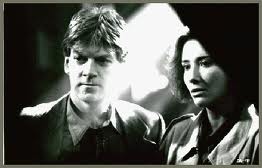
Last Sunday (14 August) I appeared on Radio 4's Open Book (you can link to that here, for at least a few more days, it's the last segment of a very good show) discussing Ira Levin's career with presenter Dreda Say Mitchell. This tied in with the re-issue of Levin's four best-known novels, A Kiss Before Dying, Rosemary's Baby, The Stepford Wives, and The Boys From Brazil; they were all made into successful films, with the last three all remembered well today. Although we delved into many of the things that made Levin successful, I found over the course of re-reading (and, in the cases of A Kiss Before Dying and Boys From Brazil, reading for the first time) and researching Levin that his career raised a multitude of issues.
As a crime writer herself, Dreda was particularly interested in Levin as a 'genre' writer, and I called him a 'genre dilettante', not in a pejorative sense but in the sense of someone whose most successful books address mainstream issues in a mainstream way, with genre elements giving the story its punch. This was only partly true, because it applies to Rosemary's Baby, Stepford, and the much overlooked Sliver, but for example A Kiss Before Dying is a straight-forward suspense novel which draws its most compelling thrills from the difficulty of a fortune-hunting boy resolving his rich girlfriend's pregnancy. This is Dreiser's American Tragedy done as a thriller, and I am convinced that Levin was influenced heavily by the 1951 film adaptation, A Place In The Sun, with Elizabeth Taylor and Montgomery Clift. It is as if he mixed that classic plot with elements of Old Woman, a script of his which had placed second in a CBS competition, and been produced on the US Steel Hour. In that teleplay a young man plots to kill his rich 103 year old aunt, enlisting the help of her nurse. And it would not surprise me if Levin conceived the story as a play or screenplay.
That's because Kiss, the novel, is structured as a three-act play—and it points to one of the keys to Levin's success; he might well be seen as a playwright who, with one notable exception, did his best work on the page. It's one of the reasons his books translate well into film—though the films, even the good ones like Polanski's Rosemary's Baby, usually lack some of the ambiguity of the novels, often as a result of mis-casting or playing roles too broadly.

In Kiss, published in 1953, the first act details Dottie's fate: we know what is going to happen but Levin drags it out beautifully, telling the story from Burt Corliss' point of view. In the second act, Dottie's sister Ellen plays Nancy Drew to solve the mystery from the first act, but it ends in a fiendish twist that would play perfectly onstage. The third act, which starts to strain credibility, as Burt pursues the third sister, Marion, the bland Gordon Gant takes centre stage. It climaxes, inevitably, in melodrama which would be difficult to stage, but ends with the kind of curtain-down brilliance that characterises Levin's best novels. I'm sure Kiss would have been Levin's first successful play, had he been able to work out the climax for the stage. As it was it won him a best first-novel Edgar, but I don't think that was the way he wanted to go – he would not publish another novel for 14 years. He wrote one crime story, 'Sylvia' for Manhunt in 1954, and it was adapted for Alfred Hitchcock's television show four years later, but he would not revisit the crime genre for another quarter century.
The film version of Kiss simply loses the third act, hoping to keep the punch of the second but giving it a 'happy' ending.
 The film might be better if Jeffrey Hunter, as Gordon 'Grant'--a less geeky name than Gant—played the Robert Wagner role, but as Burton Corliss Wagner is good. Yet his character is overplayed as a mama's boy—in the film Mary Astor looks desperate as his mother, with whom he lives on campus, unlike in the book where he's on his own, a war veteran, and seemingly more mature. Kiss would be remade in 1991, again keeping the two-act, two sister structure, with Matt Dillon very effective in the Burt role, and Sean Young playing both sisters (now twins). Her performance reflects the difficulty of adapting to a new era, because Levin's novel is so rooted in the 50s ethos of paying a guilty price for illicit sex. Still any sex with Sean Young is probably by definition illicit.
Levin spent the 14 years between Kiss and Rosemary writing plays. He was lucky, or unlucky enough to have a huge hit with his first, No Time For Sergeants, which he adapted from a novel by Mac Hyman, and which made a star of Andy Griffith. He also adapted it for the US Steel Hour, and a film, and it became an unsuccessful TV series. But in the decade following that hit, Levin wrote five more plays, four of which ran for a week or less, and the fifth, Critic's Choice, with Henry Fonda, ran a moderately successful three months.
So the success of Rosemary's Baby (1967) came as something of a surprise, but Levin appeared to draw on the theatre again, where a single issue can become the hook on which to hang a play. Again, Levinm also drew on his own previous work, a short story, 'Underground Gourmet', published in Ladies Home Journal in 1954. It tells of a woman renowned for her devil's food cake, who gets a visit from the Devil, who wants to check it out. Of course there's nothing new, per se, about the devil as a character, as Dr Faustus might remind us, and 'The Devil And Daniel Webster' is a classic American tale. The dramatic structure is not as pronounced as it was in Kiss, but it's still there: set-up, mystery, reveal—and the horror of the situation comes from the way it builds out of its perverting of the basic family unit.
 As with Kiss, Levin is up to date with the social mores, and the issue of marriage and childbirth is again the hook—the 'choice' of having a child being crucial, as opposed to the accidental pregnancy which drives Kiss. But you can also see the devil worshippers, despite their age, as a metaphor for the sexual licentiouness opened up by the Swinging Sixties and the birth control pill. In many ways, Guy Woodhouse is simply an extension of Burt Corliss, again using his wife for success; what's shocking when you watch the original film of Kiss is how much the young Joanne Woodward, playing Dottie, looks like Mia Farrow as Rosemary. Probably the biggest problem with the film of Rosemary's Baby is John Cassavetes' performance as Guy, which is overladen with menace from the start. Of course, in Levin's world, marriage is an institution laden with menace.
Which becomes clear in The Stepford Wives (1972). Having written a thriller and a horror novel, Levin published his most straightforward genre book, This Perfect Day, in 1970. It was a outright sf dystopian novel, very much in the Brave New World mode, and it made none of the impact of Rosemary. It's not a patch on some of the masters of pulpy sf and their own dystopian worlds—Tom Disch's 334, for example, makes better parallels with widersociety, as did Orwell's 1984, and Levin doesn't have the issue hooks of his previous (or indeed his next) book.

Stepford Wives was a return to form. It has a social mores hook, to the extent its title has become a sort of all-purpose shorthand for suburban housewivery, robotic Barbie Doll wives, and the male desire for pneumatic playthings rather than women. It's an examination of what exactly is meant by the women's liberation slogan 'our bodies, ourselves'. Because the point is that the Stepford husbands' club has a charity which supposedly provides 'toys for needy children', and that's pretty much what they consider their wives bodies should be for, and it's as good a definition of the Playboy philosophy as any. It's no coincidence that Joanna's friend Ruthann does children's books. Levin's hook once more is the family, and specifically the relationship of the sexes within it: 1950s mores gave way to the sexual licence of the pill, which in itself is an sf idea. What often goes unnoticed, and is one of the best features of Bryan Forbes' film version, is the unearthly science-fictional quality of the supermarket--the human reduced to robotic action. Again the novel is more subtle than the film: you can read its ending without considering the idea of killing wives and replacing them with robots: you can take Joanna's pleas to be allowed to go to psychiatry and change her ways as literal, as well as metaphoric. The film version never gets the horror elements of the story down. Casting is a problem: Katharine Ross looks like an almost a perfect Stepford Wife before she arrives in town, while Paula Prentiss is so engaging that she makes a perfect argument for having one. On the other hand, I'm not sure Forbes was making a statement by casting his wife, Nanette Newman, alongside the likes of Prentiss and Tina Louise. Even so, the less said about the 2004 remake, which starred Nicole Kidman, and apparently is intended as a comedy, the better.
The Boys From Brazil was published in 1976, and its influences seem even more apparent than those of Kiss. I don't mean this in a negative way, either: Rosemary's Baby spawned works like The Omen and The Exorcist, and we think no less of them for that. The 1970s was the time when the world started to realise those Nazis not brought to justice would soon be dying off, and this realisation was intensified by the growth of what has been called the 'Holocaust Industry', when the events of the Hitler era began to dominate discussion instead of being left out of the discussion. In any case, the most obvious influences would be the best-selling Odessa File or Marathon Man, which were both turned into successful films. The connection is emphasized by casting: Laurence Olivier, so memorable as the Mengele figure in Marathon Man, plays the Simon Wisenthal character in the film of Boys, with Gregory Peck in one of his best roles as Mengele. But this is Rosemary's Baby meets The Odessa File; instead of Satan, we are seeing the spawn of the next best thing. I missed making that point more clearly when discussing the absence of father-figures with Dreda on Open Book; there is the strict father of the murdered sisters in Kiss, but otherwise your father figures are Satan and Hitler—the Stepford guys are husbands, but not obviously fathers.
I will confess I never read
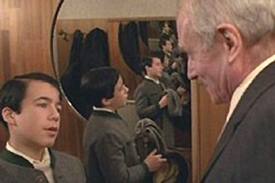 Boys first time around; coming to it now, with my awareness of Levin's theatrical talent, I was impressed by some of the subtle foreshadowing, even to the uise of visual images—as when one of the young sons stands in a hallway with multiple mirrors reflecting duplicate images of himself, a nice metaphor for the cloning which has not yet been revealed. The structure is not quite theatrical—at least not unless you used a revolving stage—but each scene seems structured that way; the climax with 'Wisenthal' and Mengele is set up and plays like theatre, and as with Rosemary's Baby, whose climax with the Japanese satanist photographer I discussed on Open Book, Boys offers an equally chilling coda, which makes the argument between the Wisenthal figure and the Meyer Kahane figure take on added significance. As happens in theatre, Levin manages to anchor his play in the current debate (I once raised the point that perhaps 'serious' theatre's role had been prempted by issue-oriented made-for-TV movies).
After Boys, Levin would take another 15 year hiatus before publishing his next novel. But in 1978 Deathtrap opened on Broadway, where it was an immediate success and one of the longest-running plays in history.
 Again, I see a major influence, Anthony Shaffer's Sleuth, which dates to 1972, and again the connection was made by movie casting: Michael Caine plays the hairdresser in Sleuth, and the old writer in Deathtrap.
Deathtrap is also, in one sense, another re-writing of Old Woman, but from a wider perspective once again examines the American marriage and its reaction to new mores, in this case gay liberation. The 1982 movie, directed by Sidney Lumet, is a good piece of filmed theatre, and certainly the most true to Levin of any of his filmed works.
Two more plays followed, and then another decade's break before Levin published Sliver, which is sort of Rosemary's Baby (in the sense of the hunt for New York housing setting off the plot) meets A Kiss Before Dying. You might also take it as Levin's metaphoric commentary on the taking of sexual mores that one step further, to observation (via video and TV), which is after all a sort of commercialised electronic peeping tomism. The film of Sliver is entertaining, if unconvincing—ironic that Tom Berenger would go on to play in Someone To Watch Over Me, and I wonder where the producers of that one got that idea.
I haven't read Son Of Rosemary (1997), Levin's last novel, and I don't intend to now; I suspect it has not been reissued for a reason.
What's unusual about Levin is not so much his relatively small output, especially from such a successful writer, but the way that output is divided. One novel in 1953, a 14 year gap, then four in nine years, then a 15 year gap, then two in six years. Seven novels in 45 years. In between, he wrote six plays in 12 years; only one of which, an adaptation, was a hit. Then came back with his most successful play after another decade, and followed quickly with two more that came and went. It is as if Levin could put on his commercial hat for books, become a genre dilettante, use the techniques of theatre to great effect, but when he was actually writing for the theatre his focus became less precise, unless the material was structured for him at source (Sergeants) or by genre (Deathtrap). This in no way diminshes his genius, it simply makes one wonder why it only seemed to come out when it was channelled into work unfairly labelled 'genre'.