My essay on the literature of John F. Kennedy's assassination was broadcast on Open Book Sunday, and will be repeated this Thursday, which ironically enough is the 4th of July. But it's already up on IPlayer, and will stay up on the Open Book page of the site. You can link to it here--my piece begins about nine minutes into the show.
It had to be edited from what I originally recorded, and some crucial things are missing. In particular a mention of Anthony Summers' 1980 compendium Conspiracy, which has been re-issued steadily (under different titles) but remains a good one-volume starting point, and more crucially, the non-fiction of the third wave. Ray and Mary LaFontaine's Oswald Talked does an excellent job of demonstrating what Oswald the federal informant might have thought he was doing in Dallas, and thus shows that, as Posner, Mailer and the like unwittingly established, he was a prime candidate to be set up as a patsy.
And James Douglass' 2008 JFK And The Unspeakable is to me the most impressive and convincing argument for a conspiracy, and for that conspiracy being part of an ongoing part of American life. You can link to my review of it via the 'Bullseyes' listing on the right of this page.
I also mentioned the dual dilemma faced by those who believe in the likelihood of a conspiracy--they can disprove the accepted, Warren Report version, but it is difficult to prove any of the alternatives. In fact, if the real assassins were to confess tomorrow, many researchers would dismiss the confessions. More frustrating, if you believe JFK was not killed by a lone, crazed assassin you are deemed to be responsible for any and all crackpot conspiracy theories out there, and not just about the assassination. Whereas those who accept the mainstream solution are never held responsible for governmental or official lies or malfesance, regardless of how many times it can be proven to occur.
I will post my script as originally recorded after the repeat has been broadcast. In the meantime, Open Book's always a good programme to listen to, and it's nice to get in ahead of the coming great wave of assassination literature as the fiftieth anniversary nears.
Showing posts with label Open Book. Show all posts
Showing posts with label Open Book. Show all posts
Tuesday, 2 July 2013


Friday, 28 June 2013
STEPHEN KING GOES BACK TO DEALEY PLAZA: 11.22.63
 Note: I read 11.22.63 (note the title wasn't reordered for British audiences, yet they seemed to buy and read the book without undue perplexity) while writing an essay on the literature of the JFK assassination for BBC Radio 4's Open Book programme. It will be broadcast Sunday (30 June) at 4pm, and repeated on Thursday, which coincidentally is the 4th of July. It should be available on IPlayer. I'll also post the essay itself after the programmes have aired.
It's not surprising
Stephen King should approach John Kennedy's assassination through
time-travel; one of King's recurring themes is a nostalgia for a more
innocent America. His use of the time travel device to alter history
is not a new one; in fact, at its best 11.22.63 feels like a
particularly good Twilight Zone episode, the kind the late Richard
Matheson, one of King's heroes, might have written, and indeed it
carries some of the same themes as Harlan Ellison's City On The Edge
Of Forever from Star Trek. Having said that, inevitably as a JFK
killing novel it disappoints.
Jake Epping is a
recently divorced school teacher in Maine, who is recruited to time
-travel by Al, the dying owner of a local diner, who has discovered a
portal back to 1958, and who wants to prevent Lee Harvey Oswald from
killing JFK five years later. Since you come back from your journey
only minutes older, regardless of how long you've stayed in the past,
this is possible—but because he is dying before he's become
absolutely sure of Oswald's guilt, Al needs Jake, with no ties to the
present, to do the job for him.
The novel is really
Jake's story, not Kennedy's, and it's a very good one. I compared it
to the Twilight Zone but there is one difference—at 700-plus pages,
King's novel lacks the economy of a TV script. Jake's dry runs,
trying to alter the history of a local killing, and his romance in
the past, are King at his best—his strongest point may be in
subjecting human emotions to the relentless twists of fate—and his
prose, while occasionally digressive, moves forward. Because this is
time travel the reader needs to allow some slack for repetition: form
follows function and seeing the same story from slightly different
angles reinforces our sense of time as a dimension,  if not an entity
of its own (which King implies as time itself seems to conspire
against Jake making changes in it).
if not an entity
of its own (which King implies as time itself seems to conspire
against Jake making changes in it).
King's style, which includes setting the scene through intensive use of brand-names, references specifics of the everyday to serve as mundane contrast to the horrors he writes about. It was something adopted by the so-called 'dirty realists' in the mainstream, who used the specifics of working-class life in America as a sort of horror trope to contrast with the safety of their middle-class academic life. I was therefore on the alert for anachronisms in 11.22.63, and spotted only a couple, the most telling being a reference to George Of The Jungle, a Jay Ward cartoon that didn't air until 1967. Being old sometimes has its advantages--but perhaps time itself was just messing with King or me.
Of course, the fabric of time is more fragile than either Jake or Al realise. There is a character whom they encounter as they go through the portal, whom I was convinced was Jake himself, in an ultimate time paradox, but turns out not to be when the final twists of fate are revealed. But King makes much of the butterfly effect, of causality, particularly in relation to JFK—his scenario of the future had Kennedy survived is one of the more fascinating parts of the book.
if not an entity
of its own (which King implies as time itself seems to conspire
against Jake making changes in it).King's style, which includes setting the scene through intensive use of brand-names, references specifics of the everyday to serve as mundane contrast to the horrors he writes about. It was something adopted by the so-called 'dirty realists' in the mainstream, who used the specifics of working-class life in America as a sort of horror trope to contrast with the safety of their middle-class academic life. I was therefore on the alert for anachronisms in 11.22.63, and spotted only a couple, the most telling being a reference to George Of The Jungle, a Jay Ward cartoon that didn't air until 1967. Being old sometimes has its advantages--but perhaps time itself was just messing with King or me.
Of course, the fabric of time is more fragile than either Jake or Al realise. There is a character whom they encounter as they go through the portal, whom I was convinced was Jake himself, in an ultimate time paradox, but turns out not to be when the final twists of fate are revealed. But King makes much of the butterfly effect, of causality, particularly in relation to JFK—his scenario of the future had Kennedy survived is one of the more fascinating parts of the book.
 And King's
characterisation of Oswald and Marina serves as an interesting
counterpoint to Jake's courtship of Sadie, his fellow schoolteacher
in the past. It also provides an explanation, albeit a thin one, of why George
DeMohrenschildt and his white-Russian friends in Dallas might have
befriended the supposed leftist Oswald—because of his wife, and
despite him. Though DeMohrenschild seems to be amused by this version of Oswald, and this hints at a problem.
And King's
characterisation of Oswald and Marina serves as an interesting
counterpoint to Jake's courtship of Sadie, his fellow schoolteacher
in the past. It also provides an explanation, albeit a thin one, of why George
DeMohrenschildt and his white-Russian friends in Dallas might have
befriended the supposed leftist Oswald—because of his wife, and
despite him. Though DeMohrenschild seems to be amused by this version of Oswald, and this hints at a problem.
DeMohrenschildt is the
lynch-pin of King's plot—Al tells Jake he needs to determine if
George is the man behind Oswald's attempt on the right-wing Gen.
Edwin Walker; if he wasn't then Oswald truly is a lone crazed
assassin. The problem is, even in King's scenario, DeMohrenschildt
seems more involved in that plot than not. And in reality, his apparent suicide
just before Gaeton Fonzi was to interview him on behalf of the House
Assassinations investigation (the 'suicide Bill O'Reilly claimed to have heard from DeMohrenschild's front porch, which was a neat trick as it was proven O'Reilly was in Flordia at that time) remains as suspicious as Johnny
Roselli's dismembered body being found floating in a gas drum in
Miami, just before his recall for a second round of testimony before
the same committee.
For King, the question
seems to be more about Kennedy, and us, than about Oswald. Do we
believe that Kennedy's death ended some sort of Camelot, and do we
need to believe that death was not a mere random act, by a willful
malcontent? In trying to answer those questions through time-travel
King actually confuses the issues, because time itself seems to be
acting as if it trying to preserve the act we consider random—in
other words, it is a kind of predestination-- and the Camelot we may
think ended with JFK turns out to be better in many ways than the
world he might have left behind had he completed his presidency. That
is a paradox which renders King's own scenario of the assassination
itself less important than the way time impacts on the lives of his
characters, and what they are and are not able to overcome as people.
So the final reveal, the wider scope of history, and the ultimate denouement, all feel rushed in relation to what's gone before. The bigger future shouldn't be a shadow of the assassination's becoming a narrower concern, but it's a broader one too. It's ultimately not very satisfying as a look at that assassination, though it makes
for an entertaining, if overblown, Twilight
Zone time travel story.
Tuesday, 16 April 2013
THE FIVE BEST BASEBALL NOVELS: THE BROWSER INTERVIEW
 NOTE: About a year ago, I did an essay for BBC Radio 4's Open Book, about baseball novels. You can link to that post here, but the IPlayer link has disappeared, so I will try to find my original script and reprint it.
Shortly after doing Open Book, I was interviewed by The Browser, a literary website, and asked to pick my five favourite baseball novels, something the structure of the Open Book essay hadn't allowed. I went to look at that interview, but it too seems to be suffering from the internet's missing link disease. Luckily, I had the website's rough draft of the interview available, so, with a few small amendations, I offer it here...
Michael
Carlson on Baseball Novels
Why
do you think that baseball forms the basis for so many great American
novels?
In
a sense it is because baseball symbolises something that was at one
point an idealised version of American life. Today I think it is an
idealised version of a fantasy American life which is pastoral,
honest, competitive and entertaining. But the more important reason
is that baseball recreates the quotidian nature of existence.
Baseball is an everyday game. They play one hundred and sixty-two
games a year but at the end of each one you win or you lose and then
you start over, unlike real life. So it gives you a vast canvas on
which to paint an equivalent of real life, but one that is more
dramatic each day and builds to a more dramatic climax as the season
comes to an end.
What
do you personally enjoy so much about the game?
I
think baseball is the most interesting game because of its variations
on a simple theme. It is almost like an enclosed table game in that
you have a very simple structure within which myriad possibilities
take place over and over again. It is also the only sport I can
think of that puts an individual confrontation into the middle of a
team game. Even more so than something like cricket, you have this
battle between the pitcher and the hitter which is the centre piece
of the game. But within that you also have a team sport. If you look
at Japanese baseball, for example, they take the team sport part of it
much more seriously than the Americans do and they look at it as a
team sport in the sense that we might look at American Football or
soccer as being a sport where you have to cooperate with all
nine players together. I worked for Major League Baseball for four
years and during that time I got a lot of exposure to baseball
players and I was constantly fascinated by the depth within the game,
the vast amount of information I just didn't know about it.
I
know you could have chosen from any number of books about baseball so
what made you pick, Robert Coover’s, Universal
Baseball Association?
This
is my favourite of all the baseball books and I actually think it is
one of the great novels of its period. Coover is one of the most
interesting but practically ignored novelists of that period. He was
writing what we now call metafiction in the 60’s alongside people
like John Barth and Thomas Pynchon. What I love about the book is
the idea that someone who is a rather nondescript and average person
uses baseball as a way of elevating himself into being the creator of
a universe
For
those who haven’t read the book what is going on to allow him to do
that?
He
has invented a simulation game of baseball --these existed in the
days before fantasy sport which is a different thing. Fantasy sport
is more or less asset stripping the statistics of the game. But the
simulation games existed because baseball is the best sport for them,
because it is so well documented statistically. The way they
generally work is on probabilities out of a thousand and so in some
games you would roll three dice to get a three digit number (a one in
a thousand probablilty) and you would then use number charts to
get a result which would reflect the baseball statistics. That is
what happens in Waugh's game.
Waugh
has his own teams and players and when the son of one of the great
players of all time comes along as an exciting rookie, Henry – the
character-- rolls his dice and rolls his dice again and the charts say something bad
happens. And at that point as the creator of the universe he is
forced to make a decision! But, I don’t want to give it all away.
Yet
as a character Henry is a normal, not very exciting accountant.
Yes.
He is someone who goes to bars every night when he is not playing his
baseball game. He has a very depressing relationship with a woman
who we might describe as a floozy but he lives within his baseball
fantasy. The full title of the book is, The
Universal Baseball Association Inc.
J. Henry Waugh, Prop and
if you look at what J Henry Waugh anagrams into it becomes obvious
what Coover is doing by calling him Jahweh which of course is the
Hebrew unspeakable name for god. I
went back and looked at the original review of the book in the New
York Times, by Wilfrid Sheed who was a very good writer himself and he
said, “Not
to read this because you don't like baseball is like not reading
Balzac because you don't like boarding houses. Baseball provides as
good a frame for dramatic encounter as any. The bat and ball are
excuses. Baseball also involves a real subculture, a tradition, a
political history that were, in some sense, preordained, …... That
the players and fans might be shadows in the mind of a Crazy
Accountant up there is not only believable but curiously attractive.”
I think he is absolutely right, and
idea of God as a crazy accountant makes as much sense as any other.
This book most definitely deserves to be read even if you are not a
big fan of baseball. There is a mythic element to baseball because in
effect it is a pursuit of dreams, but not just the dreams of the
player. You can look at it almost as a science fiction novel but it
is prescient in the sense that fantasy baseball has taken over the
sports fans universe. He is a wonderful writer in complete control
of what he is doing.
 Next
up you have chosen, Bang
the Drum Slowly
by Mark Harris which stars Henry Wiggin who has been described as
America’s best-known fictional baseball player.
Next
up you have chosen, Bang
the Drum Slowly
by Mark Harris which stars Henry Wiggin who has been described as
America’s best-known fictional baseball player.
Mark
Harris wrote four books where the main narrator is Henry Wiggin. The
first one was called The
Southpaw because
he is a left handed pitcher, and they are baseball's oddballs. It's
no coincidence the lefty's signature pitch is called a screwball!
Bang
the Drum Slowly, which
I think is his best, is the second in the series. The first three
were written in the 50’s and then he came back in 1979 with a book
called It
Looked like Forever in
which the aging Wiggin can't throw as fast anymore, and losing your fastball is a wonderful metaphor for aging.
What
is Wiggin like as a character?
He
is a bit like someone from a Ring Lardner story. And the tone is
very much like Ring Lardner. Ladner wrote stories which were
collected as You
Know Me Al, letters
written by a player to a
friend back home. Wiggin's a sort of cracker barrel philosopher, not
quite as smart as he thinks. This comes out best in Bang
the Drum Slowly. What
happens is that his catcher, whose name is Bruce Pearson, is kind of
dim witted and his teammates make fun of him. Wiggin finds out that
Pearson is actually dying from Hodgkin’s disease and Pearson
doesn’t want him to tell anybody. And Wiggin doesn’t break his
trust but what he does do is to start to integrate Pearson into the
team.
But,
the book is not about what the team does, it is about how we deal
with life. Wiggin is always playing a card game with one of the
coaches called Tegwar and they use it to baffle rookies and newcomers
and they teach Pearson what Tegwar is. Tegwar actually stands for
The Exciting Game Without Any Rules. There aren’t any rules, they
just make them up as they go along and in a sense that is what life
is.
What
is really interesting is that a lot of baseball novels have been made
into movies and there have been a lot of great baseball movies as
well, but not that many novels have translated into fine films. This
one was made into a movie quite successfully with Robert De Niro as
Pearson and Michael Moriarty as Henry Wiggin even though Michael
pitches with his right hand! When the book came out it was done on
television for the US Steel Hour, (note: which were hour long live
dramas, broadcast from 1953-1963) and it had Paul Newman as
Wiggin and Albert Salmi as Pearson. I have never been able to find a
tape to watch but I think it would be fascinating as well.
For
all the reasons you have just given this is widely regarded as one of
the best books in baseball fiction.
Yes,
it is really entertaining. It’s bittersweet and what I really love
are the silly things about it. For example Henry Wiggin’s nickname
on the team is “Author” because he has written this book but
Pearson is so dim he thinks its “Arthur” and calls him that
through most of the book. The book ends with one of the best closing
lines in American literature. Wiggin after Pearson’s funeral says,
“From here on in I rag nobody.”
 Wise
words. Your next choice takes us to Mexico with Mark Winegardner’s
first novel,
The Veracruz Blues.
Wise
words. Your next choice takes us to Mexico with Mark Winegardner’s
first novel,
The Veracruz Blues.
This
book came out in 1997 and isn’t particularly well known. But I like
it an a lot and wanted to include it ahead of some of the better
known books. It's set in the Mexican League, which was run by two Mexican industrialists, the Pasquel brothers, and in 1946 they had a dream. The brother in charge was Jorge
Pasque, and he wanted to go into competition with Major League Baseball. So they started offering big money to steal players from the gringo Majors.
Presumably
they wanted to set up the league as a status thing.
Yes
it was a status thing and baseball is a big sport in Mexico, not to
the level of soccer but it is still big. Winter leagues in Mexico
had always attracted Major League players so they decided to upgrade
the Mexican League. What’s interesting from Winegardner’s point
of view is that the league is integrated like winter baseball was in
the Caribbean so you have black players coming down from the States
who were Major League calibre players but of course barred by the
pre-Jackie Robinson apartheid. And then the white players who jump to
the Mexican league get barred from going back to Major League
Baseball, for violating the reserve clause in their contracts, and
one of them, Danny Gardella filed a law suit against the League which
was kind of a pre-cursor to all the antitrust suits that have gone on
in the last thirty years or so. He lost his law suit.
What
were the reserve clause and antitrust exemptions?
The
reserve clause dates to the early years of baseball. In January 1903,
the American and National Leagues united to form Major League
Baseball. They included a "reserve clause" in their
contracts (as had already been National League practice for 25
years), which bound athletes to the teams that first signed them. If
they refused to sign a new contract, the old one simply rolled over,
and it, of course included a reserve clause too. In effect, players
were indentured servants. They could be released, sold or traded, but
they couldn't simply sign with new teams when their contracts
expired. It was obviously a restraint of trade, but after Major
League Baseball saw off the challenge of the Federal League in 1914,
Congress exempted them from anti-trust laws, so the reserve clause
stood for another 60 years.
Thank
you. So the book includes some real life characters?
Yes
– Gardella is a character in the book and so is Pasquel. It's based
on real events, but narrated by a fictional sports writer named Frank
Bullinger, and through him we meet other real people in it including
Ernest Hemingway, down in Mexico for the bullfights, or the fishing,
I forget which. Hemingway pops up in a lot of fiction these days!
Winegardner is really exploring issues of racism and issues of
capitalism that make the whole story interesting. There is the whole
forced servitude issue that baseball players were faced with in the
1940’s. And you see this effort to get a better deal for themselves
using these crazy Mexican tycoons. Mark Winegardner is an interesting
writer. Recently he has been doing Godfather sequels which is kind
of a hiding to nothing but he does them quite well!
So
did the players who went to Mexico and were then barred realise that
was a possibility?
They
realised it would probably happen but they thought they would be able
to get back into the Major League again. And some were older players
being offered more money than they were likely to make in the entire
rest of their careers. The most famous of them was Sal Maglie who was
known as “the barber” for the way he pitched inside and 'shaved'
players. He was a pitcher for The Giants. It wouldn't be until the
1970s, when Marvin Miller and the players union got the owners agree
to binding arbitration, that they finally did away with the reserve
clause, creating modern free agency.
Harry
Stein's, Hoopla
looks at one of the biggest scandals in baseball history.
This
book is really overlooked. It deals with the Black Sox scandal in
1919. But there is a very good nonfiction book called Eight
Men Out by
Eliot Asinof which deals with the same subject. So this book was kind
of lost particularly when John Sayles made his film of Eight
Men Out
which is one of my favourite baseball movies. John Sayles by the way
has written a baseball book called, Pride of the Bimbos
which
is worth reading too, as is Asinof's baseball novel, Men In Spikes.
 What
happened in 1919?
What
happened in 1919?
Some
of the players from The Chicago White Sox accepted money from
gamblers to throw the World Series, hence the name Black Sox. In the end, despite resevations and second thoughts, and in the face of threats by gangsters,
they lost the series to Cincinnati Reds. A couple of years later, after being acquitted in court, eight of the players were
banned for life by the new Commissioner of Baseball, Judge Kenesaw
Mountain Landis. The White Sox at the time were considered the best
team in baseball by far.
The fix is
also one of the themes of W. P. Kinsella’s novel Shoeless
Joe,
which got made into the movie Field
of Dreams. Shoeless
Joe Jackson was the best player on that Black Sox team. Harry
Stein's novel is told from two points of view. One point of view is
another fictional journalist, Luther Pond who provides the backdrop
to the corrupt nature of baseball in those days and the corrupt
nature of Chicago in those days. The other chapters are narrated by
Buck Weaver who was one of the players on the team. Although he
didn’t throw any games himself he was barred from baseball because
he knew about it and didn’t tell anyone.
Do
you think there is still corruption going on in baseball?
Not
game-fixing, but there is the whole issue of steroid abuse, for
example. Some things never change within the sport. The money is a
lot bigger these days, so gamblers couldn't really afford to make it
worthwhile, but remember Pete Rose was barred from the game simply
because he bet on games. The cheating that still goes on in baseball
is sometimes referred to as gamesmanship. Taking steroids wasn't
against the rules of the game, but it is against the spirit of the
game (and against the law, of course, without a prescription!). I
think baseball is the only sport in America where we still consider
the spirit of the game to be important. When the British say, “it‘s
not cricket” it is that same idea. No-one would ever say anything
is against the spirit of American Football. It’s interesting
because if you think of the film, Field
of Dreams
– there is a speech in the movie which is delivered by James Earl
Jones about how baseball stands for everything good in American life.
But, he is saying it about a bunch of guys that threw the World
Series! So there is certain contradiction that Kinsella and the movie
makers never came to terms with and this is brought out by Harry
Stein who is something of a contrarian writer. He wrote a very
interesting book a few years later about how he became a right wing
Republican after growing up a Leftist. And that attitude is what
gives this book a certain edge. I like the book a lot; he is a fine
writer.
Your
final choice, The
Natural
by Bernard Malamud is a baseball classic which was first published in
1952.
 This
was a tough call because I decided to pick a couple of lesser known
books, so when it came to choosing which one of the real baseball
classics to go for it was between The
Natural
and Philip Roth’s Great
American Novel.
Roth and Malamud share concerns about Jewishness and Americanism as
well. I think The
Natural
wins it simply because Roth's is a very exuberant book and in some
ways an essay about literature. If anyone has readThe
Art of Fielding,
that draws very heavily on Roth.
This
was a tough call because I decided to pick a couple of lesser known
books, so when it came to choosing which one of the real baseball
classics to go for it was between The
Natural
and Philip Roth’s Great
American Novel.
Roth and Malamud share concerns about Jewishness and Americanism as
well. I think The
Natural
wins it simply because Roth's is a very exuberant book and in some
ways an essay about literature. If anyone has readThe
Art of Fielding,
that draws very heavily on Roth.
Malamud's
is sort of a perfect mythic take on baseball in which he plays with
the myth of the Fisher King and the Holy Grail.His character Roy
Hobbs is a Parceval or Lancelot and he succumbs to corruption. The
movie tacks on a happy ending which isn’t there in the book which
kills what is a pretty good movie although Robert Redford really is
too old for the role although he plays it rather well! The book ends
exactly the way you expect those myths to end and he is brought down
by his own hubris.
It
came out in 1952 and a couple of years later a novel called, The
Year the Yankees lost the Pennant came
out which became the musical, The
Damn Yankees.
I think that was inspired by Malamud because it retells the Faust
story as a baseball story. But, Malamud’s novel is much richer and
deeper than that one. What is also interesting is that Malamud was
born in Brooklyn just like Roth was but of immigrant parents. To
people in that generation baseball was a major means of assimilation
in American culture. You find that in all kinds of writing about the
immigrant experience. The
way to become American was to learn baseball.
Why
do you think that the National Football League has become more
popular than baseball?
As
I said at the beginning I think baseball reflects an American ideal
which is now an American fantasy. Football reflects what America
really is.
Which
is?
Mechanised,
militaristic, violent, obsessive, not pastoral and not relaxed. This
has been exacerbated by television and media. Dan Delillo wrote a
story called Pafko
at the Wall about
the famous 1951 playoff game between the Brooklyn Dodgers and the New
York Giants. The story reappeared as the opening segment of his
novel Underworld
which is a great book. As a novel itself it would be a great
analysis of what baseball means to America. But, he also wrote a
novel called End
Zone which in
effect says that the reason that we are in the Vietnam War is because
we love American Football! And oddly enough Robert Coover wrote a
novel about Richard Nixon called, Whatever
Happened to Gloomy Gus of the Chicago Bears?
Which was basically about Nixon’s failures as a football player and
with his sex life. He was a scrub in college but never quit. He
would drive Pat Nixon to dates with other men when he was first
trying to date her!
When
did football become popular in the States?
College
football was always a big thing, but not a pastime, like baseball.
Pro football was a fringe thing, in the industrial north, on autumn
Sundays. The first big thing was the 1958 NFL championship game, the
first to finish with sudden-death overtime. Then the New York Times
and CBS reported on 'The Violent World of Sam Huff', the New York
Giants' linebacker. It really began taking over from baseball with
the Kennedys who were big touch football players, and of course with
the advent of television it was discovered that American Football
fits the television screen better than any sport.
Do
you think there are better baseball novels out there than the ones
about American Football?
Definitely.
And the reason for that is that although there are some very good
novels about football and boxing and some other sports they tend to
be more about the sport itself. They use the sport to show the
characters of the people in them. But even non-fiction about
baseball has more depth. The best baseball novels tend to be about
something bigger than the sport. They are using baseball simply as a
metaphor for life itself.
Sunday, 17 March 2013
ACE ATKINS' THE RANGER
 If you listened to Open Book today (see the previous post) you would have heard Ace Atkins explaining the influence of Elmore Leonard on his new novel, The Ranger, particularly Leonard's western Last Stand At Sabre River, in which a Confederate soldier home from the Civil War has to fight to reclaim his homestead which has been taken by ex-Union men. There's also a respectful TV movie of the book, starring Tom Selleck. Elmore Leonard provides a blurb for Atkins' new novel, and justifiably so, but the influences on this book go far beyond Leonard's work, and come from two directions.
The returning soldier finding the home front different and corrupt enough for him to have lost what is his goes back a long way, and not just in the western (think of film noir, The Blue Dahlia for example). And there are countless films modelled after the original Walking Tall (although in that one Buford Pusser came home not from war but from wrestling), among which Rolling Thunder might be considered crucial.
The home Quinn Colson comes back to Jericho upon the death of his uncle is the hill country of northeast Mississippi. Colson is still in the Army Rangers; in fact he shows up having won a gun a poker game, and bought a truck in Phenix City, Alabama (if you haven't seen Phil Karlson's great noir film, The Phenix City Story, in which ex-servicemen clean up the most corrupt small town in America, you need to, but until you do you'll miss what that signals). Colson doesn't believe his uncle, a sherrif, killed himself, and he finds his uncle's land is being claimed by the local bigwig, Johnny Stagg.
Stagg has his fingers in lots of pies, some legitimate and many less so. This includes meth cooking, which has become the equivalent of train robbing in the new west. Colson encounters, by chance (echoes of Mickey Spillane) a pregnant teen, travelling to Jericho
 to find the baby's father. Along the way Colson will also have to deal with his ex-girlfriend, now married, and his sister, now run off and leaving a bi-racial baby behind for her mother to tend. This may be the new south, but it is the same violent south that has been written about since before the Civil War, the south of Jesse James and Deliverance, of Southern Comfort, of Daniel Woodrell's country noir and James Carlos Blake's In The Rogue Blood, the modern south of Leonard's Justified or Atkins' own novel of 1950s corruption in Tampa, White Shadow (you can find my review, written two years ago, of that novel here).
Colson finds some allies (this isn't quite High Noon), and stands his ground, and it is resolved finally in a shootout which, again if you heard Ace explain this you will already know, bears more than a little resemblance to the gunfight at the OK Corral (Doc Holiday, of course, was a southerner).
So it is a western, and it's done with some penache. It reminds me in some ways of when George Pelecanos turned to echoing western tropes in his novels; the prose is more straightforward than, say, White Shadow's,
moving more forcefully.
 It's closer to Leonard, and it also shows signs of the style which may have prompted Robert B Parker's estate to decide on Atkins to continue the Spenser series. Parker's greatest strength was the ability to set small scenes, through dialogue, that drew portraits of characters quickly and efficiently; there were those in bit parts in the Spenser series whom readers felt they knew, or recognised, in the space of only a few paragraphs. Atkins can do this, and he needs to do it more fully with some of the more major characters, because he has clearly set this up to become a series, and there are already conflicts and ambiguities enough for books to come.
The Ranger is a good start. Again, as he said on Open Book, he'd moved closer and closer to the present day in his novels; it seems to me that by appropriating western themes he also leaves himself some room to do other things within that modern setting. I haven't yet read Atkins' version of Spenser, but since Parker himself also went to westerns, both in Spenser novels and directly in his Cole and Hitch novels, this would seem a rich vein to mine.
The Ranger by Ace Atkins
Corsair, £12.99, ISBN 9781472100313
This review will also appear at Crime Time (www.crimetime.co.uk)
MODERN WESTERNS: MARIELLA, ACE & ME ON OPEN BOOK
 I was on the BBC Radio 4 programme Open Book today, with host Mariella Frostrup and the writer Ace Atkins, to talk about westerns. The hook was two radio adaptations of western novels which will air on R4: Elmore Leonard's Hombre (you can see my take on the book, which I read recently, here), at 2:30 next Saturday 23rd, and Jack Schaefer's Shane the following Saturday. You can find programme on IPlayer here, for at least the next week, and it will be repeated on Thursday 21/3 at 3:30pm --it's a good listen, with Kate Atkinson preceding us, and an interesting discussion of betting on the Womens Prize for Fiction. Which, had I heard it, might have prompted me to note that westerns serve, for America, much the same function as costume drama does for Britain; it's way of reassuring the present by showing its roots in the past.
This was a discussion that was immense fun when we recorded it in the studio, and it's also one that could have go off in any number of directions--I could easily have traced the western through Fenimore Cooper's Deerslayer through Melville's Confidence Man to Nick Carter--the dime novel western hero who becomes Nick Carter the detective later on--but Ace drew the comparison, of 'gunslingers moved to town', which made it unnecessary.
We might also have delved a little further into the connection between movies and novels, in reverse perhaps, because as Ace made clear,
 movies influence writers' own concepts of the west as much as books used to fertilise Hollywood's west. I probably ought to have made clear another distinction: westerns were a major part of the pulpy and slick magazine fictions just as film was coming into being--The Great Train Robbery, after all, was the first narrative film--but the movies' immense appetite for westerns was expressed primarily in B features, serials, and the like--John Wayne made many forgettable westerns in between Raoul Walsh's The Big Trail and John Ford's Stagecoach. Then television did the same thing in its early days--wringing the genre dry to the point that from the middle Sixties onward, we get western films that are in many ways commentaries on the genre and its conventions.
One thing that was cut was the question of what our favourite western novel actually is: Ace chose True Grit (our discussion of which also fell by the wayside) and I was torn between True Grit, Warlock by Oakley Hall and Little Big Man by Thomas Berger. Have a listen to the programme as it stands; you'll like it.
Sunday, 16 December 2012
DON WINSLOW'S KINGS OF COOL
 Don Winslow is a daring
writer. He's not afraid to venture into new territory, and his best
books are as different as the deft subtleties of Isle Of Joy are from
the epic sweep of The Power Of The Dog; as the off-beat California
Fire & Life is from the even more off-beat The Dawn Patrol. With
Savages, Winslow again broke new ground (see my review here)--not
only with his characters, but with the style of writing, a small
masterpiece of form following function as he broke down the drug wars
to a more personal scale than The Power Of The Dog.
Don Winslow is a daring
writer. He's not afraid to venture into new territory, and his best
books are as different as the deft subtleties of Isle Of Joy are from
the epic sweep of The Power Of The Dog; as the off-beat California
Fire & Life is from the even more off-beat The Dawn Patrol. With
Savages, Winslow again broke new ground (see my review here)--not
only with his characters, but with the style of writing, a small
masterpiece of form following function as he broke down the drug wars
to a more personal scale than The Power Of The Dog.
Writing a 'prequel' to
Savages might be looked at as being a commercial decision, the way
his 'Trevanian' exercise, Satori was (you can link to my review here). Oliver Stone has turned Savages into a
movie, and tinkered with the ending, but without giving too much away
suffice it to say a sequel to Savages would have been a difficult
task even without the movie--which I haven't yet seen, by the way, else I would have written this review and that one earlier!
But Kings Of Cool works
as a prequel because it follows up on a couple of
Winslow's ideas about the drug wars and American (or Californian,
which you can see as an outlier or a wind-tunnel for the rest of the
country) which were explicit in Power Of The Dog, and implicit in
Savages. The big one is that the whole miasma of the so-called war on
drugs is a function of demand. Take away the demand for product, and
the 'problem' goes away. But we as a country are so reliant on that
product, that the world's entrepreneurs can hardly resist the
opportunity. Oddly enough, this point became crystal (not meth) clear
to me while reading Dashiell Hammett's stories again for the Open
Book interview I did last month (link here). There are plenty of
hopheads in Hammett's work—most of them are confined to the murky
underworld and skid rows or their like, and the others are primarily
among the very rich and famous. As long as things remained so, even
as usage spread on a large scale within the black community, the drug
'problem' remained under control.
In Savages,  although
Ben and Chon (and their girlfriend O) are new age small-scale
homeland-endorsed entrepreneurs, they find in the end that market
forces have outstripped drug culture boundaries—as pot dealers they
are no longer above or beyond the drugs lords who control heroin or
cocaine (and there's an interesting sidebar to be written about the
place of the other home-grown business, meth cooking, the bootlegging
of the 21st century and it's relation to big-time
organised crime).
although
Ben and Chon (and their girlfriend O) are new age small-scale
homeland-endorsed entrepreneurs, they find in the end that market
forces have outstripped drug culture boundaries—as pot dealers they
are no longer above or beyond the drugs lords who control heroin or
cocaine (and there's an interesting sidebar to be written about the
place of the other home-grown business, meth cooking, the bootlegging
of the 21st century and it's relation to big-time
organised crime).
 although
Ben and Chon (and their girlfriend O) are new age small-scale
homeland-endorsed entrepreneurs, they find in the end that market
forces have outstripped drug culture boundaries—as pot dealers they
are no longer above or beyond the drugs lords who control heroin or
cocaine (and there's an interesting sidebar to be written about the
place of the other home-grown business, meth cooking, the bootlegging
of the 21st century and it's relation to big-time
organised crime).
although
Ben and Chon (and their girlfriend O) are new age small-scale
homeland-endorsed entrepreneurs, they find in the end that market
forces have outstripped drug culture boundaries—as pot dealers they
are no longer above or beyond the drugs lords who control heroin or
cocaine (and there's an interesting sidebar to be written about the
place of the other home-grown business, meth cooking, the bootlegging
of the 21st century and it's relation to big-time
organised crime).
Kings Of Cool shows us
how that came to be. The story begins Ben and Chon setting up their
business in the new century, but quickly flashes back to the
Sixties, with California hippie culture in full bloom and Chon's
father, John (in prison when we meet him Savages) is a skateboarding
kid called Johnny Mac who's taken under the wing of Doc, the Taco
Jesus of the boardwalk in Laguna Beach, and quickly becomes his most
successful drug dealer. We meet O's mother (the so-called
Passive-Agressive Queen of the Universe) when she is just a young
beauty trying to score a rich husband, and we meet Ben's well-meaning
parents, who want to use their pot-selling profits to run their
new-age bookshop. It's a rich mix, and it rings as authentic as
Winslow's late Fifties Manhattan did in Isle of Joy, and it raises
various questions not only about the parenting given our three
marijuana musketeers, but indeed paternity itself.
And then, to put it
simply, coke comes on scene, and everything changes, and, as we
already know with the hindsight provided by Savages, when Ben, Chon
and O finally learn the truth about their pasts, and change their
presents, the consequences are, if not preordained, almost
inevitable. The presence of characters from other Winslow books, like
the hit man Frankie Machine or the legendary drug dealer Bobby Z,
reinforce this point, and make it seem as if Winslow has been
preparing for this moment for a long time.
like
the hit man Frankie Machine or the legendary drug dealer Bobby Z,
reinforce this point, and make it seem as if Winslow has been
preparing for this moment for a long time.
 like
the hit man Frankie Machine or the legendary drug dealer Bobby Z,
reinforce this point, and make it seem as if Winslow has been
preparing for this moment for a long time.
like
the hit man Frankie Machine or the legendary drug dealer Bobby Z,
reinforce this point, and make it seem as if Winslow has been
preparing for this moment for a long time.
What helps it all work
is that Winslow has again altered his style, subtlely, to reflect the
various drugs that dominate the narrative. So that the early sections
have a hazy, sunny feel to them, less precise and forced than what
follows, and both are different from the free-form trippiness
established in Savages (interestingly, O, the most interesting
verbally of the characters, becomes the narrator for Oliver Stone).
I'm not sure where Kings Of Cool sits, depending on whether or not
you've read Savages, and/or seen the movie, but as a feat of writing
it is not far short of a tour de force. The war on drugs is monstrous
and serious enough to deserve a writer like Winslow, who can meet it
head on, but also take it back to its roots within our world. He's a
daring, and tremendous writer.
Kings Of Cool, Random House £12.99
ISBN 9780434022076
NOTE: this review will also appear at Crime Time (www.crimetime.co.uk)
Monday, 19 November 2012
DASHIELL HAMMETT MEETS MARIELLA: OPEN BOOK'S THIN MAN INTERVIEW
 My interview with Mariella Frostrup about Dashiell Hammett was on Open Book yesterday; the show will be repeated Thursday and is available on IPlayer (you can link to it here; it starts 18 minutes in). It's a good programme--Rachel Johnson plugging her novel Winter Games, bright young thing English gels falling for Hitler's Lifestyles of the Reich and Famous, without anyone ever mentioning the Mitford sisters (!) and a discussion of writing sequels to famous novels which immediately precedes my talking about Hammett.
Which is appropriate, given that the hook for Open Book is the publication of The Return Of The Thin Man, a new book presenting Hammett's treatments for the first two sequels to the original Thin Man movie under the guise of two 'recently-discovered' works of fiction. Our discussion of the book itself was edited from the show, sadly, because although I pointed out that this is by no means new
 Hammett fiction, it is very enjoyable indeed. You can see clearly not only his sense of sharp dialogue, but also his visual sense of how movies work, and what will be funny visually as well as (or instead of) verbally. But these are very much film treatments, and the first, and better, of the two, After The Thin Man, is actually a combination of two treatments, the second done after Albert Hackett and Frances Goodrich, MGM's resident sophisticated comedy writing pair, had done a screenplay based on the first version. Presumably the finished product, like the film itself, reflects their contributions too. The discussion of Nick Charles also lost the image of Hammett himself, posed on the original cover of the novel, every bit as elegant and handsome as his detective hero.
Hammett's is a fascinating life, often used as a metaphor for some sort of inevitable artistic failure of American artists--all those lost generation boys, as well as, say, the abstract expressionist painters who followed them in the post-war era. Fitzgerald's career forms an eerie parallel with Hammett's, right down the relationship with a younger woman who would become a more successful writer. They were in Hollywood at the same time, and Fitz seemed to be leery of Hammett, perhaps feeling once shy after Hemingway. But as I say in the programme, I think there's a definite influence, and William Nolan made the interesting point about a Hammett short-story in Colliers 'This Little Pig', which may have influenced Fitzgerald's Pat Hobby stories (Hammett also appeared in the very first issue of Esquire). Hammett was close to Nathanel West, and I don't have any doubt that, as I say, he was a huge influence on West's Miss Lonelyhearts and Day Of The Locust.
A few Hammett stories were also lost along the way; I mentioned that went Gertrude Stein went to Hollywood, she announced the two Americans she wanted to meet were Hammett and Charlie Chaplin. As usual, she didn't get it particularly correct. Dorothy Parker literally knelt and kissed Hammett's hand, and, in one famously unguarded bit of writing, Hemingway himself praised him in a story. Red Harvest was published two years after The Sun Also Rises, but the character and style predate it, and of course it had first appeared in serial form in Black Mask. I went into the parallels between the two writers, who were very much contemporaneous; I don't see a direct influence but I think they were working, in different ways,
 in the same direction at the same time.
The discussion of the films was brief, and didn't make the cut either (it is, after all, a book programme!) but
the Thin Man and Maltese Falcon both benefit from being cast perfectly (in fact, the second of the three Maltese Falcon adaptations, Satan Met A Lady, attempted to turn it into a Thin Man-type story, with Bette Davis and Warren William failing to match Myrna Loy and William Powell. The first Maltese Falcon, with Ricardo Cortez and Bebe Daniels, is a pre-code wonder that messes with the plot in order to preserve its characters' sizzle. The famous and wonderful 1941 version was put together, literally, by John Huston by cutting and pasting passages from the novel into his screenplay (the killer final line, however, is his).
 We also cut short the discussion of Hammett's political career--he was a man who was determined to make a stand, which he did twice for his country, and which he did not only to support his political beliefs, but also to stand up for free speech itself. That was the work of the last part of his life, when he was too weak physically, from the tuberulosis, the emphysema, the venereal diseases, the drinking, and the smoking, to even continue writing, he still found the strength to stand up for what his believed in. That makes him an American hero as much as an American tragedy. That and his great writing.
Thursday, 7 June 2012
BEST BASEBALL NOVELS: THE BROWSER INTERVIEW
Literally a follow-up to the Radio 4 Open Book essay in April (you can link to the posting about that here) I did on baseball novels, here's an interview on my favourite baseball novels I did with The Browser which has just gone online, you can link to it here. It goes into a bit more depth and, because it wasn't necessarily aimed at an audience unaware, if not resistent, to baseball per se, it allowed me to include a couple of books I like a lot, but which generally don't appear on such lists.
Just to shortcut the process, the five are The Universal Baseball Association, J. Henry Waugh, Proprietor by Robert Coover, Bang The Drum Slowly by Mark Harris, The Natural by Bernard Malamud, The Veracruz Blues by Mark Winegardner, and Hoopla by Harry Stein.
Just to shortcut the process, the five are The Universal Baseball Association, J. Henry Waugh, Proprietor by Robert Coover, Bang The Drum Slowly by Mark Harris, The Natural by Bernard Malamud, The Veracruz Blues by Mark Winegardner, and Hoopla by Harry Stein.
Monday, 9 April 2012
BASEBALL NOVELS: THE OPEN BOOK ESSAY
 My essay on baseball novels was broadcast yesterday on Open Book. You can link to it here on IPlayer for a while, or listen to the repeat on Thursday on Radio 4. Obviously it was limited by time (and the relative lack of interest in baseball amongst the R4 audience) so I was concentrating on making the literary link as strongly as possible. There are a number of fine boxing novels, but I can't think of any other sport which can boast more than a couple of noteworthy works of fiction. In this country, of course, sport is not considered a fitting subject for serious fiction--laddish work, like Nick Hornby's, which draws heavily on the idea of fantasy baseball, notwithstanding--but baseball, in America, has always been seen by literati as a metaphor not only for life, but for their work.
It was nice to be able to quote from Eliot Asinof's Man On Spikes, which is fine and overlooked novel--and mentioning Eight Men Out could have led me to discuss the wealth of exceptional non-fiction writing about the game, beyond just reporting (which is also very good). I was happy to mention Harry Stein's Hoopla, another overlooked novel which is the best fiction about the Black Sox scandal. But baseball has been the subject of serious works of history and biography which again I take to be the result of taking the subject itself seriously.
Among the novelists who didn't make the final cut were John Sayles (Pride Of The Bimbos), Mark Winegarten (Vera Cruz Blues), William Brashler (The Bingo Long Travelling All-Stars And Motor Kings) and Michael Bishop's Brittle Innings, which isn't a great novel, but an audacious sf book which resets Frankenstein into the low minor leagues during World War II. Of course Shoeless Joe is an sf novel too, now that I think about it.
And of course I couldn't get into the movies--and although here boxing may edge baseball as the subject of more greats (among other things, boxing's far easier to film, and you always have one strong central character) there aren't any other sports which can match the catalogue of baseball movies, both adaptations of works mentioned and original stories like Bull Durham or It Happens Every Spring.
And one thing you might not get from the readings that accompany my piece, but All-Star Game leads off Philip Roth's Melvillian alphabetical list of the things we note about baseball...it is the 'A' in the list!
Wednesday, 17 August 2011
THE OPEN BOOK ON IRA LEVIN
 Last Sunday (14 August) I appeared on Radio 4's Open Book (you can link to that here, for at least a few more days, it's the last segment of a very good show) discussing Ira Levin's career with presenter Dreda Say Mitchell. This tied in with the re-issue of Levin's four best-known novels, A Kiss Before Dying, Rosemary's Baby, The Stepford Wives, and The Boys From Brazil; they were all made into successful films, with the last three all remembered well today. Although we delved into many of the things that made Levin successful, I found over the course of re-reading (and, in the cases of A Kiss Before Dying and Boys From Brazil, reading for the first time) and researching Levin that his career raised a multitude of issues.
As a crime writer herself, Dreda was particularly interested in Levin as a 'genre' writer, and I called him a 'genre dilettante', not in a pejorative sense but in the sense of someone whose most successful books address mainstream issues in a mainstream way, with genre elements giving the story its punch. This was only partly true, because it applies to Rosemary's Baby, Stepford, and the much overlooked Sliver, but for example A Kiss Before Dying is a straight-forward suspense novel which draws its most compelling thrills from the difficulty of a fortune-hunting boy resolving his rich girlfriend's pregnancy. This is Dreiser's American Tragedy done as a thriller, and I am convinced that Levin was influenced heavily by the 1951 film adaptation, A Place In The Sun, with Elizabeth Taylor and Montgomery Clift. It is as if he mixed that classic plot with elements of Old Woman, a script of his which had placed second in a CBS competition, and been produced on the US Steel Hour. In that teleplay a young man plots to kill his rich 103 year old aunt, enlisting the help of her nurse. And it would not surprise me if Levin conceived the story as a play or screenplay.
That's because Kiss, the novel, is structured as a three-act play—and it points to one of the keys to Levin's success; he might well be seen as a playwright who, with one notable exception, did his best work on the page. It's one of the reasons his books translate well into film—though the films, even the good ones like Polanski's Rosemary's Baby, usually lack some of the ambiguity of the novels, often as a result of mis-casting or playing roles too broadly.

In Kiss, published in 1953, the first act details Dottie's fate: we know what is going to happen but Levin drags it out beautifully, telling the story from Burt Corliss' point of view. In the second act, Dottie's sister Ellen plays Nancy Drew to solve the mystery from the first act, but it ends in a fiendish twist that would play perfectly onstage. The third act, which starts to strain credibility, as Burt pursues the third sister, Marion, the bland Gordon Gant takes centre stage. It climaxes, inevitably, in melodrama which would be difficult to stage, but ends with the kind of curtain-down brilliance that characterises Levin's best novels. I'm sure Kiss would have been Levin's first successful play, had he been able to work out the climax for the stage. As it was it won him a best first-novel Edgar, but I don't think that was the way he wanted to go – he would not publish another novel for 14 years. He wrote one crime story, 'Sylvia' for Manhunt in 1954, and it was adapted for Alfred Hitchcock's television show four years later, but he would not revisit the crime genre for another quarter century.
The film version of Kiss simply loses the third act, hoping to keep the punch of the second but giving it a 'happy' ending.
 The film might be better if Jeffrey Hunter, as Gordon 'Grant'--a less geeky name than Gant—played the Robert Wagner role, but as Burton Corliss Wagner is good. Yet his character is overplayed as a mama's boy—in the film Mary Astor looks desperate as his mother, with whom he lives on campus, unlike in the book where he's on his own, a war veteran, and seemingly more mature. Kiss would be remade in 1991, again keeping the two-act, two sister structure, with Matt Dillon very effective in the Burt role, and Sean Young playing both sisters (now twins). Her performance reflects the difficulty of adapting to a new era, because Levin's novel is so rooted in the 50s ethos of paying a guilty price for illicit sex. Still any sex with Sean Young is probably by definition illicit.
Levin spent the 14 years between Kiss and Rosemary writing plays. He was lucky, or unlucky enough to have a huge hit with his first, No Time For Sergeants, which he adapted from a novel by Mac Hyman, and which made a star of Andy Griffith. He also adapted it for the US Steel Hour, and a film, and it became an unsuccessful TV series. But in the decade following that hit, Levin wrote five more plays, four of which ran for a week or less, and the fifth, Critic's Choice, with Henry Fonda, ran a moderately successful three months.
So the success of Rosemary's Baby (1967) came as something of a surprise, but Levin appeared to draw on the theatre again, where a single issue can become the hook on which to hang a play. Again, Levinm also drew on his own previous work, a short story, 'Underground Gourmet', published in Ladies Home Journal in 1954. It tells of a woman renowned for her devil's food cake, who gets a visit from the Devil, who wants to check it out. Of course there's nothing new, per se, about the devil as a character, as Dr Faustus might remind us, and 'The Devil And Daniel Webster' is a classic American tale. The dramatic structure is not as pronounced as it was in Kiss, but it's still there: set-up, mystery, reveal—and the horror of the situation comes from the way it builds out of its perverting of the basic family unit.
 As with Kiss, Levin is up to date with the social mores, and the issue of marriage and childbirth is again the hook—the 'choice' of having a child being crucial, as opposed to the accidental pregnancy which drives Kiss. But you can also see the devil worshippers, despite their age, as a metaphor for the sexual licentiouness opened up by the Swinging Sixties and the birth control pill. In many ways, Guy Woodhouse is simply an extension of Burt Corliss, again using his wife for success; what's shocking when you watch the original film of Kiss is how much the young Joanne Woodward, playing Dottie, looks like Mia Farrow as Rosemary. Probably the biggest problem with the film of Rosemary's Baby is John Cassavetes' performance as Guy, which is overladen with menace from the start. Of course, in Levin's world, marriage is an institution laden with menace.
Which becomes clear in The Stepford Wives (1972). Having written a thriller and a horror novel, Levin published his most straightforward genre book, This Perfect Day, in 1970. It was a outright sf dystopian novel, very much in the Brave New World mode, and it made none of the impact of Rosemary. It's not a patch on some of the masters of pulpy sf and their own dystopian worlds—Tom Disch's 334, for example, makes better parallels with widersociety, as did Orwell's 1984, and Levin doesn't have the issue hooks of his previous (or indeed his next) book.

Stepford Wives was a return to form. It has a social mores hook, to the extent its title has become a sort of all-purpose shorthand for suburban housewivery, robotic Barbie Doll wives, and the male desire for pneumatic playthings rather than women. It's an examination of what exactly is meant by the women's liberation slogan 'our bodies, ourselves'. Because the point is that the Stepford husbands' club has a charity which supposedly provides 'toys for needy children', and that's pretty much what they consider their wives bodies should be for, and it's as good a definition of the Playboy philosophy as any. It's no coincidence that Joanna's friend Ruthann does children's books. Levin's hook once more is the family, and specifically the relationship of the sexes within it: 1950s mores gave way to the sexual licence of the pill, which in itself is an sf idea. What often goes unnoticed, and is one of the best features of Bryan Forbes' film version, is the unearthly science-fictional quality of the supermarket--the human reduced to robotic action. Again the novel is more subtle than the film: you can read its ending without considering the idea of killing wives and replacing them with robots: you can take Joanna's pleas to be allowed to go to psychiatry and change her ways as literal, as well as metaphoric. The film version never gets the horror elements of the story down. Casting is a problem: Katharine Ross looks like an almost a perfect Stepford Wife before she arrives in town, while Paula Prentiss is so engaging that she makes a perfect argument for having one. On the other hand, I'm not sure Forbes was making a statement by casting his wife, Nanette Newman, alongside the likes of Prentiss and Tina Louise. Even so, the less said about the 2004 remake, which starred Nicole Kidman, and apparently is intended as a comedy, the better.
The Boys From Brazil was published in 1976, and its influences seem even more apparent than those of Kiss. I don't mean this in a negative way, either: Rosemary's Baby spawned works like The Omen and The Exorcist, and we think no less of them for that. The 1970s was the time when the world started to realise those Nazis not brought to justice would soon be dying off, and this realisation was intensified by the growth of what has been called the 'Holocaust Industry', when the events of the Hitler era began to dominate discussion instead of being left out of the discussion. In any case, the most obvious influences would be the best-selling Odessa File or Marathon Man, which were both turned into successful films. The connection is emphasized by casting: Laurence Olivier, so memorable as the Mengele figure in Marathon Man, plays the Simon Wisenthal character in the film of Boys, with Gregory Peck in one of his best roles as Mengele. But this is Rosemary's Baby meets The Odessa File; instead of Satan, we are seeing the spawn of the next best thing. I missed making that point more clearly when discussing the absence of father-figures with Dreda on Open Book; there is the strict father of the murdered sisters in Kiss, but otherwise your father figures are Satan and Hitler—the Stepford guys are husbands, but not obviously fathers.
I will confess I never read
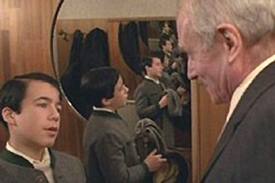 Boys first time around; coming to it now, with my awareness of Levin's theatrical talent, I was impressed by some of the subtle foreshadowing, even to the uise of visual images—as when one of the young sons stands in a hallway with multiple mirrors reflecting duplicate images of himself, a nice metaphor for the cloning which has not yet been revealed. The structure is not quite theatrical—at least not unless you used a revolving stage—but each scene seems structured that way; the climax with 'Wisenthal' and Mengele is set up and plays like theatre, and as with Rosemary's Baby, whose climax with the Japanese satanist photographer I discussed on Open Book, Boys offers an equally chilling coda, which makes the argument between the Wisenthal figure and the Meyer Kahane figure take on added significance. As happens in theatre, Levin manages to anchor his play in the current debate (I once raised the point that perhaps 'serious' theatre's role had been prempted by issue-oriented made-for-TV movies).
After Boys, Levin would take another 15 year hiatus before publishing his next novel. But in 1978 Deathtrap opened on Broadway, where it was an immediate success and one of the longest-running plays in history.
 Again, I see a major influence, Anthony Shaffer's Sleuth, which dates to 1972, and again the connection was made by movie casting: Michael Caine plays the hairdresser in Sleuth, and the old writer in Deathtrap.
Deathtrap is also, in one sense, another re-writing of Old Woman, but from a wider perspective once again examines the American marriage and its reaction to new mores, in this case gay liberation. The 1982 movie, directed by Sidney Lumet, is a good piece of filmed theatre, and certainly the most true to Levin of any of his filmed works.
Two more plays followed, and then another decade's break before Levin published Sliver, which is sort of Rosemary's Baby (in the sense of the hunt for New York housing setting off the plot) meets A Kiss Before Dying. You might also take it as Levin's metaphoric commentary on the taking of sexual mores that one step further, to observation (via video and TV), which is after all a sort of commercialised electronic peeping tomism. The film of Sliver is entertaining, if unconvincing—ironic that Tom Berenger would go on to play in Someone To Watch Over Me, and I wonder where the producers of that one got that idea.
I haven't read Son Of Rosemary (1997), Levin's last novel, and I don't intend to now; I suspect it has not been reissued for a reason.
What's unusual about Levin is not so much his relatively small output, especially from such a successful writer, but the way that output is divided. One novel in 1953, a 14 year gap, then four in nine years, then a 15 year gap, then two in six years. Seven novels in 45 years. In between, he wrote six plays in 12 years; only one of which, an adaptation, was a hit. Then came back with his most successful play after another decade, and followed quickly with two more that came and went. It is as if Levin could put on his commercial hat for books, become a genre dilettante, use the techniques of theatre to great effect, but when he was actually writing for the theatre his focus became less precise, unless the material was structured for him at source (Sergeants) or by genre (Deathtrap). This in no way diminshes his genius, it simply makes one wonder why it only seemed to come out when it was channelled into work unfairly labelled 'genre'.
Subscribe to:
Posts
(
Atom
)

