Friday, 15 July 2011

SHERWOOD SCHWARTZ: THE GUARDIAN OBITUARY

My obituary of Sherwood Schwartz, who created both Gilligan's Island and The Brady Bunch, is in today's Guardian, and you can link to it here. I have to admit I was something of a Gilligan fan, though I had and still have, no time for the Bradys, and when I sat down to think about the reasons it led to my over-writing the piece somewhat. What was cut to shorten it were my reflections on Bob Denver--who also starred in Schwartz's neo-Gilligan Dusty's Trail, and in two other pilots that never got bought as series, though the pilot episode of Scamps is available on DVD and The Invisible Woman appeared as a one-off TV movie.

Some of the obits quoted media studies professors on the significance of Gilligan, and Schwartz himself in later years would attribute simple but universal themes to it. But the key, in my mind is Denver. First off, he offered Schwartz the abilities to do much of the goofy slapstick and idicoy that were the attributes of Red Skelton's comedy, but with none of the star's ego, so in that sense he made the perfect focus for the series, which in that sense can often be seen as an extended series of sketches for Denver.

But when I suggest Gilligan as a proto-hippie, I also mentioned his previous TV incarnation as the work-shy beatnik Maynard G Krebs, on The Adventures of Dobie Gillis. And when you consider that Backus brought persona of the hapless father from Rebel Without A Cause (as well as the voice of the nearsighted eccetric millionaire Mr Magoo) to the role of Thurston Howell, you can an intersection of characters that might have appealled to the emerging 'rebellious' generation.

Or it may just have been because there was Tina Louise to gawk at in every episode.

It's also important to remember that the perception of the Sixties as a decade of turmoil is true, it is even truer that the vast 'silent majority' did exist, and the real cultural change wasn't marked until the Seventies, when the Sixties counter-culture became the accepted over-the-counter culture --at which point The Brady Bunch was definitely being presented as an antidote.

It's also informative to look at what other shows were popular during the era, to realise Schwartz's comedies were not all that different from, say, The Beverly Hillbillies or even Hogan's Heroes, and one might look at Norman Lear's redoing of Til Death Do Us Part as All In The Family as the sort of anti-Brady.

The one antidote I left out, sadly, was the constant friction between Robert Reed and Schwartz. Reed's previous best role had been as EG Marshall's younger partner in the issue-oriented drama The Defenders, and Schwartz had apparently promised him the Bradys would address the cutting edge issues of the time, and for some reason Reed had chosen to believe him.

Schwartz frequently worked with his children, and in many shows there are credits for an Elroy Schwartz--in fact it is Elroy who co-wrote the original, long-lost pilot show for Gilligan--and he is described in some references as Sherwood's son. Yet his none of his three sons were named Elroy, and two are credited under their own names, so either this was the third son, Donald, using a pseudonym, or Schwartz (or someone else) using one for their own reasons. A curious little mystery.

Sunday, 10 July 2011

DEREK JETER: MY 1999 ESSAY ON WHO'S THE BEST SHORTSTOP

Derek Jeter's 3,000 hit yesterday reminded me of an essay I'd written twelve years ago, and I thought I'd go back and look at it to see how accurate I'd been about his position vis a vis the other two great young shortstops of 1999. A little background: after I stopped working for Major League Baseball, and was doing baseball comentary on Sky and other satellite channels (as well as the Olympic finals, twice, for RTE Ireland!) I used to self-publish a baseball preview annual. The following essay appeared in the 1999 edition, along with previews and predictions of each team, and essays on Cuba (the Orioles went to Havana to play and I wrote a piece for the FT), the first-to-worst phenomenon (selling off great players wasn't a new thing in baseball), and an early look at 'weight training' and power hitting titled 'Popeye Arms And The Man'.

The way Jeter reached his 3,000, with a homer at the end of a 5 for 5 day, reminded me that, although the stats have often ranked him below the top, especially in the field, he has had the knack, especially useful playing in New York for the highest-payroll, highest-profile team in baseball, of rising to big occasions where his current teammate ARod has been his virtual opposite. Hence the Yankees leaving Jeter at short, when the younger ARod has more range. But ARod has less of what a NYTimes writer might call 'the right stuff'. Consider the difference in ARod's trying to slap the ball away from Bronson Arroyo, or 'Jeter the Cheater' doing a soccer-style fake of an injury to draw a HBP against Tampa. Jeter (who scored on ARod's slap) isn't tarnished, even after admitting his gamesmanship.

What I couldn't predict, of course, was that Jeter and ARod would become teammates, and ARod would move to third base, thus taking himself out of that 'greatest shortstop' equation. One thing I should point out too, as you watch various stats about Jeter's place in the 3,000 hit club, is that for various reasons there are lots of great hitters who never reached 3,000 hits (especially all those Yankees, plus Ted Williams and Jimmie Foxx) while Craig Biggio, Al Kaline, and Yaz did (Yaz being the first American Leaguer with 400 homers among the 3,000 hits). Longevity is, in itself, a sign of quality, particularly at shortstop (second only to catcher in the way it takes a early toll on bodies). Nomar, whose overly developed frame soon broke down as I speculated it might, is a good example. The length and relative consistency of Jeter's career will argue covincingly for his spot in the Hall of Fame; ARod, with all the side issues, will certainly justify my rating of him, but make the vote a harder call.


I should also point out that I wrote some snide things about Mariah Carey, and eerily anticipated ARod's dating Madonna. All three sportsters have moved on, in a sense, Jeter to Minka Kelly (via Jessica Biel) ARod to Cameron Diaz (via Madonna and whatever), and Nomar to the soccer star Mia Hamm. Why should multi-millionaire star shortstops be attractive to celebrity actresses?

While you ponder that one, here's what I wrote in March 1999:


WHO’S THE BEST OF THE SHORTSTOPS?

There may not have been a time in baseball history when three young shortstops of the quality of Alex Rodriquez, Derek Jeter, and Nomar Garciaparra have emerged together in one league. In fact, based on the past two seasons, you’d be hard-pressed to find three veteran shortstops putting up similar numbers. Most of the great hitting shortstops have stood out by a long margin from their colleagues: Honus Wagner, Ernie Banks, Cal Ripken, Robin Yount, maybe Arky Vaughn. Most shortstops, even the good hitting ones, weren’t there for their sticks anyway. In the American League just after the war you had Lou Boudreau, Junior Stephens, and Eddie Joost (who generally outhit Phil Rizzuto by good margins), but Joost never put two big years in a row together (his 1949 was a dinger, though: .263 23-81, 149bb, 128r). Stephens in 1949 hit .290 39-159 but Boudreau had an off year after his 1948 line of .355 18-106, 98bb and 9k. That’s right, nine.

But right now you’ve got three guys putting up numbers that are close to MVP quality, and they’re doing it every year. Two of them are already their club leaders, and all three are among the wave of new young players who bring back that everyday hard work and respect for the game which many of us believed the NBA/MTV generation had lost forever.

The highest profile, because he plays in New York, belongs to Derek Jeter. The other guys don’t get to date Mariah Carey. To me, she looks about as attractive as Governor Carey, but I’m old and jaded (2011 update: Minka, right, looks much better). Jeter is the middle of the our three guys in terms of age (turns 25 in June) and is already in his fourth year in the bigs. He shows the least power of the three (19-84 last year) but in the offseason this year he has worked on his hands to add more power to his swing, and I’d look for his power numbers to jump. Not that they need to, if Knoblauch becomes a great leadoff hitter again. He’s an excellent base runner (30/36 in sbs, 83%), and he managed a .384 oba despite walking only 57 times (119 Ks). Listed at 6-3 185, Jeter is big for shortstop, but doesn’t look it on the field.

Defensively, Jeter had his best season last year, cutting his errors to an amazing nine, and fielding .986. He’s got the least range of these three, and there are questions about him going to his left, but they aren’t serious ones. Given the pop in his bat, I wouldn’t be surprised if he eventually moves from the shortstop position, to second or third, but that would depend a lot on who the Yankees come up with in the future. Bernie Williams was quoted this season as saying that Jeter was the leader of the Yankees and their MVP. Given the talent on that team, and the quality competitors, that is an amazing compliment.

The oldest of the three is Nomar, who turns 26 in July, and he’s only in his third season. He too is his team’s leader, if somewhat by default since Mo Vaughn lumbered out of town. But from the first day he hit the Red Sox lineup, Garciaparra has breathed a fresh attitude into the team, and moving from leadoff to cleanup hitter he proved he would do what it takes to help the team win.
Unlike Jeter and Rodriquez, Garciaparra is a contact hitter: he walked only 33 times and struck out only 62 last season. He’s the smallest of the three at 6-0 175, but looks bigger because he’s so skinny. His power (35-122) is generated by the whip he gets in his bat, and the more I look at him the more he reminds me of hitters like Henry Aaron. He’s a good baserunner, but batting in the middle of the Sox lineup he’s not going to rack up steals.

Last season Garciaparra made 25 errors, fielding .962, but part of that was because the Sox tried to get him to set before he threw, rather than complete the throw on the run as he likes to do, and once he went back to his own style, his errors slowed down. When you watch him closely, you’ll see his whole approach to picking the ball up is consistent, and lets him get the throw away so quickly he saves at least a step on the baserunner. He’s got more range than Jeter, but like Jeter he uses his arm to make up for the ground he can’t cover. Like Jeter, I see him moving off shortstop eventually (particularly if he’s injured, which he seems likely given his body type). Whether it will be an Ernie Banks type move to 1b or a Rico Petrocelli-type move to 3rd I don’t know: but I’d guess it could be tied into the development of SS Adam Everett in the minors.

Rodriquez is the youngest of the three, turning 24 in July, and has already hit 106 home runs in the majors. He may have quicker hands than Gary Sheffield, which gives him phenomenal ability to punish good pitches by waiting on them. His season, .310 42-124 123r 43sb was an MVP calibre performance, especially from a shortstop, and you could argue that could’ve been his second MVP. And don’t think that ARod is feasting in the Kingdome: last season he hit .286 18-54 at home but .335 24-70 on the road. Defensively, I’m not convinced he’s second to Omar Vizquel in range, but I won’t argue with the strength of his arm, which will keep him at shortstop even if he starts to slow down. He’s 6-3 195, which again is big for a shortstop, and you’ve got to worry when he gets hurt on the step exercises, but basically, he’s done nothing wrong thus far in his career. You’d like to see him stop chasing bad pitches (121Ks, only 43bb) but that will come.

I think we owe a lot to Cal Ripken here. When Earl Weaver was the only person in baseball who thought Cal could play shortstop, everyone laughed. Maybe Earl was remembering Ron Hansen, a big shortstop who’d played well defensively for the Orioles in the early 60s, or Junior Stephens on the Red Sox, or even Ernie Banks. For whatever reason, Ripken proved that positioning, athletic ability, and a strong arm could overcome whatever balletic quickness he gave away to the Ozzie Smiths and Luis Aparicios of the world. Traditionally, the best young baseball players all start off (if they don’t pitch exclusively) as shortstops or, in the old days, as center fielders if they were big. Nowadays, they look at shortstop as a place they want to stay, and the additional offense they provide really can change the game of baseball.

So who’s the best? In the field I’d rate them 1. ARod 2. Nomar 3. Mariah’s boyfriend. At the plate, the rating stays the same. In intangibles, it goes 1. Jeter 2 Nomar 3. ARod, but of course he plays second fiddle to the Paganini of the bat in Ken Griffey Jr. It's so close, I find it hard to drive a wedge between Jeter and Nomar, and I suspect we may have a Ted Williams/Joe DiMaggio type argument going on here for years to come. I’d give the edge to Nomar right now, but I suspect that Jeter’s bat will continue to improve, and he is a year younger with an extra year’s experience as well.

But neither guy is ARod. If this guy played in New York he’d be pushing Madonna out of the way to get to the ballpark (2011 note: or not, we can say now. Boy was that a prophetic line!). I think he’s more valuable this season than either of the other two, and remember, he’s both the youngest of the bunch AND has the most big league experience. He’s probably the guy I’d want to start with if I were building a team from stratch, and that means I consider him the most valuable property in baseball.

Friday, 8 July 2011

GODARD AND FILM NOIR


Books Discussed In This Essay:
Goddard: A Portrait Of The Artist At 70 by Colin McCabe
Bloomsbury, £25, ISBN 0747563187
The Films Of Nicholas Ray by Geoff Andrew
British Film Institute, no price listed, ISBN 1844570010
Nicholas Ray: An American Journey by Bernard Eisenschitz
Faber 1993, £12.99 ISBN 0571178308
Early Film Noir by William Hare
McFarland £29.95, ISBN 0786416297
Hardboiled Hollywood by Max Decharne
No Exit Press, £18.99, ISBN 184243070X
Val Lewton: The Reality Of Terror by Joel E Siegel
Secker & Warburg, 1972, £1.20
Fearing The Dark: The Val Lewton Career
by Edmund G Bansak
McFarland £29.95 ISBN 0786417099


I’ve always been amused at the thought of Jean-Luc Godard, the roaring lion of revolutionary film, playing out his string in Switzerland, strolling to the chocolaterie alongside the other petits bourgeoises. The implicit contradiction of Godard’s choice of a return to cuckoo-clock land (not so surprising, really, as he grew up a Swiss Protestant) is merely the last metaphor for a career more problematic, though not much less important, than Colin McCabe’s study would like to suggest. To McCabe, Godard is the ‘greatest figure’ from the last generation of cinema, both the greatest ‘essayist’ and ‘one of the greatest poets cinema has known’. That’s a lot of greatests. Those terms, poet and essayist, are, for McCabe, linked and not at all contradictory. He means poet not in the film reviewer’s standard sense of being visually lyrical, but in the more absolute sense, of someone working with a language in its purest, most refined state. And indeed, that was the theoretical point Godard the essayist insisted was most important, the language of film, and the one Godard the director was always pursuing, at least theoretically.

Whether Godard the filmmaker ever lived up to Godard the theoretician is a matter of debate. The paradox of film is that it always seems to transcend intentions, a paradox which, while eminently true of Godard's own work, consistently undermines, if not contradicts, his critical efforts. Embarrassingly, some of Godard’s best films work in ways his own theories would insist are invalid. On the other hand, some of his worst films are the most 'pure' cinema, yet even so they often venture into the didactic. There is a very specific reason for this, one which may explain why it’s so easy to think of Godard as a slim-line Orson Welles, indulging his rebelliousness.

There is a conflict in Godard which comes from his detachment from the world of humanity. His is a life overwhelmed by and subsumed in the cinema, and his films reflect a world where everything is expressed in cinematic terms. 'The art of the 19th century, the cinema,' he says toward the end of his Histoire (s) du cinema (1978), 'created the 20th century, which on its own existed only a little.' Well, that is one point of view. This is what makes him exciting as a film-maker, what makes him such a poet, but the world of film will take one only so far. I have friends with whom I will talk in lines from Animal House, our joke being that all human existence can be explained within that sensitive film. We are often unable to communicate to other people using such references. They haven't seen the film, they haven't remembered it, they haven't understood the context or its relation to whatever it is we were talking about. They are, after all, people. But for Godard, it was as if all existence could be expressed only through film, and unless our hearts and brains are made of celluloid he isn't really interested, and that just doesn’t work.

Beyond that concept, Godard also adored American films. All of them. Far more than the French. I don’t think he, or McBride, ever tackle the paradox that Godard’s view of America was of a country composed out of celluloid; like the patrons of the pub I first visited when I travelled to London in 1972, who heard my friend was from Chicago and spontaneously make tommy-gun noises.

For me, the crucial film in all Godard’s oeuvre is Made In USA. Here the lover of film noir takes a Richard Stark (Donald Westlake) novel ready-made for noir adaptation, and turns it into a literary analysis of why the USA is in Vietnam. It’s a lecture, a polemic, a didactic rant, and it expresses, more than Godard’s Marxism or his faith in film, the shattering revelation that the world of American cinema was a by-product of the same American system that created the moral cesspit of Vietnam (or, to put it even more tellingly for Godard's benefit, refined and perfected the quagmire the French left behind). Made In USA is a work of rage that marks the end, I believe of Godard’s most fertile creative period, one which produced half a dozen undisputed great films, and which was followed by a long uneven period of films that, with a few exceptions, repeated past experiments less successfully. And even some of the exceptions, like Sauve qui peut, are successful in a less-involving, more distancing way.

Colin MacCabe never really comes to grips with that, because it doesn’t fit into the picture of the world’s greatest filmmaker. If that sounds like a criticism, I have to say it is not a fault, because the book is so comprehensive that the reader familiar with the films will be able to make his own evaluations. It is comprehensive in other ways, too: MacCabe provides a history of Marxism which is a book in itself, and here, I think there is something of a misreading. Because Marxism, to Godard, was a stick with which to beat not only capitalism and, by extension, America, but also a device with which to approach humanity without having to deal with humans. It gave Goddard a template, beyond cinema, with which he could classify all his relations--and Godard’s Marxism was as soulless and potentially dangerous as Pol Pot’s.

Just as contradictory, in MacCabe’s portrait, is Godard the manipulator, the movie mini-mogul, as cruel to individuals as any capitalist and as vicious within the system as any Hollywood tycoon. One thinks of careerists on a local council, building up a socialist fortune for themselves in a sort of shadow-mirror of the world they claim to despise. One doesn’t expect a parallel morality from artists, but one can ask for it from polemicists.

Geoff Andrew quotes Godard: ‘If the cinema no longer existed, Nicholas Ray alone gives the impression of being capable of re-inventing it, and what is more, of wanting to’. (And full props: what a superb film-critic Godard was!) This re-issue of Andrew’s excellent 1991 study of Ray, with brief materials added to bring it up to date, is welcome, particularly as the original study was followed by an excellent biography two years later, Bernard Eisenschitz’s Nicholas Ray: An American Journey. The biography was particularly enlightening on issues of Ray’s sexuality, and also his background in radio, and hence sound. Viewed together with Andrews’ study, they provide a full grounding in a film-maker whose abilities to tell a story cinematically were exactly what endeared him to the Europeans who came to idolise ‘ignored’ strands of American film in the 50s and 60s. Kudos to the BFI for bringing this book, by one of their own, back into print.

Ray is also an important director in the annals of film noir, an American genre named and more or less identified by the French, which grew out of a confluence of hard-boiled pulp fiction and German expressionist film. I have argued in these pages about the roots of film noir in the intersection of the liberated flapper and the German silent horror film; many of the most important of the film noir directors were refugees from Germany. I‘ve also worried about the dangers of conflating the terms hard-boiled, pulp, and noir. They are related, but they don’t necessary mean the same thing, and one does not automatically lead to the next.

Which is why I’m a little puzzled with Early Film Noir, which also opens up by claiming film noir received its baptism in France just after World War II, when the French recognised the work of Dashiell Hammett and Raymond Chandler. French critics may have defined film noir, but they did it a decade later, and it didn’t take the French (or the British, as Hare further asserts) to recognise Hammett, Chandler, or, in noir terms the purest of his big three, James M Cain. They were best-sellers already: if Hammett hadn’t been a huge success both in print and through the Thin Man movies, the 1939 version of The Maltese Falcon would not have been its second remake!

There’s no real logical progression to Hare’s account of some of his favourite films, and what the British Across The Bridge, released in 1957, has to do with early film noir beats me all to hell, apart from the fact that Hare likes Ken Annakin and Annakin provided a foreword for this book. Hare’s version is very much a middle-of-the-road account of noir, no Detours allowed here, and it won’t add much to your understanding if you’ve previously considered the genre in any detail. It is, however, written with great affection, and its section on Jane Greer and Out Of The Past, which benefits from an interview with the wonderful actress, is worth the price of admission in itself.

Hare would have been better off structuring his book more like Max Decharne’s Hardboiled Hollywood. Again, there’s no systematic study of the genre, but Decharne avoids false labeling, and instead provides a series of vignettes that illuminate the origins of some great crime films. It’s not academic, but it’s a lot of fun, much like some of Woody Haut’s efforts for the same publisher. Decharne’s specific concern is linking the films to their source novels, and examining the kinds of changes the stories underwent along the way, and it also boasts some great book cover illustrations.

Making the point about German expressionism and horror as a major root of film noir ought to have been easy for William Hare, since the director of Out Of The Past, Jacques Tourneur, apprenticed on Val Lewton’s horror unit at RKO, the same studio that made that Mitchum/Douglas/Greer classic. Lewton was the subject Joel E Siegel’s Val Lewton: The Reality Of Terror (1973), still one of the great film books and a remarkable study of the producer as auteur. The budget-conscious techniques of Lewton’s films would be reflected in dozens of classic film noirs, and Cat People, his first, and perhaps best, could be argued an important early noir in its own right.

Fearing The Dark credits Siegel’s book, but goes far beyond, offering a complete biography of Lewton, a fascinatingly pulpy character whose life is reflected in his approach to film-making. Lewton was a creative producer (and writer) who was able to get the best out of his directors and out of his small budgets because he didn't need to let his ego go out of control. At RKO, that probably would not have done him much good anyway. Most of the great noirs owe a lot to the ability to be creative with low budgets: when dealing with stories of failed small-timers, it became a narrative, as well as stylistic advantage. Bansak makes much of the Orson Welles connection: Robert Wise and Mark Robson were RKO editors for Welles who became directors for Lewton; further, David O Selznick tried to get Welles to take Lewton’s job as story editor at RKO. What a team that would have been! Following Siegel, Bansak doesn’t have all that much new to offer in critiquing the films themselves, but his exhaustive detailing of Lewton’s life helps explain both how he came to create a run of small masterpieces in a short period at RKO, and why he didn’t repeat the feat on a larger scale elsewhere.

And the details of his biography highlight Lewton's polyglot background; a creative life filled with a spectrum of experience. That was something many of the great Hollywood film-makers had: they learned their story-telling from many media, and they brought experience from outside the screening room and editing suite to the art of cinema. They saw the world as containing cinema, not being contained within it. It's virtually the opposite of Godard, and extremely instructive, if not corrective, it is.

Thursday, 7 July 2011

CY TWOMBLY: THE INDEPENDENT OBITUARY THAT WASN'T

Yesterday I wrote this obituary of Cy Twombly for the Independent, but because of a glitch in my computer, I never actually filed the copy to them, and as they were unable to reach me later they had to rush to get another piece. This is the kind of mistake I hope I never make again, wasting their time and mine, and losing the opportunity to register my appreciation of Twombly in print.

I first wrote about him after I went to the Tate Modern's 'Cycles and Seasons' exhibition in 2008, the very first post for Untitled: Perspectives, which was intended to be a regular blog about art, but has been somewhat irregular instead. You can link to that essay here. I had always been interested in Twombly, because of the Black Mountain connection, and I took time in this obit to try to explain briefly its importance; but there wasn't really space to link the writing of Olson or Robert Creeley, the music of John Cage, the dance of Merce Cunningham and the art of Kline, Motherwell, or Twombly.

But that Tate show was a revelation to me, because although I had a sort of regard for Twombly, I hadn't realised how beautiful much of his work could be, and I was overcome by its ability to express emotion and move me. I regret messing up that assignment from the Independent, and apologise profusely to my editors there. What I wrote for them follows.


CY TWOMBLY, ARTIST

The American painter Cy Twombly, who has died aged 83, was our last link with the glory days of the Abstract Expressionists, but his work was always an awkward fit with that movement, indeed with any modern movement. It was a mark of his idiosyncratic talents that he abandoned New York for Italy just as Jackson Pollock, Mark Rothko, and Franz Kline were at their peaks of success; moreover, where all of those artists died at the height of their fame, appreciation of Twombly's work progressed slowly, dividing critics and the public alike. Some of the reasons for this became evident in his hugely successful retrospective at the Tate Modern in 2008. Where individual Twombly canvases might seem ephemeral, random, and difficult, presented together their impact was intensified and became clearer. His mix of dripping colour, hand-written notes or fragments of poetry, and chaotic lines for many obscured his mix of classical and modern concerns. Cynical voices accused him of deliberate obscurantism, but Twombly never indulged in flamboyant display for its own sake, preferring to find new ways to express old stories.

If Abstract Expressionism wanted to go beyond the pure self-involvement of abstraction, Twombly's work can be seen as constantly seeking more direct expression, and even in a European context, spoke of a uniquely American perspective. Like the Abstract Expressionists, there is a sense of American pragmatism, but there is also the intellectual curiosity which allowed him to absorb European classism, and meld it into something sui generis.

He was born Edward Parker Twombly, Jr., 25 April 1928 in Lexington Virginia. His nickname came from his father, a pitcher in baseball's major leagues who was called 'Cy' for his resemblance to the great Cy Young. He studied in Lexington with the exiled Spanish artist Pierre Daura, and after finishing high school, he spent a year at a prep school in Georgia followed by brief spells at Washington & Lee University in Lexington, and Boston's Museum of Fine Arts school. In 1950 he got a scholarship to New York's Art Students League, where he met and became close to Robert Rauschenberg. Rauschenberg introduced him to Franz Kline, and persuaded Twombly to enroll at Black Mountain, an experimental college in North Carolina, where Kline, Ben Shahn and Robert Motherwell taught, and where Twombly's affair with Rauschenberg would lead to the breakup of the latter's marriage.

The influence of Kline and Motherwell was apparent in Twombly's first New York shows, one arranged by Motherwell at the Samuel Kootz gallery, and another at Eleanor Ward's Stable Gallery, where he shared the space with Joseph Cornell. But Black Mountain's influence extended beyond painting. The college's rector was the poet Charles Olson, and much of the writing on Twombly's canvases recalls Olson's 'Projective' verse, and his dictum that 'form is never more than an extension of content'. Kline's work is often compared to Chinese written characters, and Olson drew on Ernest Fenollosa's studies of them; we can often see Twombly's graffiti as objects in themselves. John Cage taught music at Black Mountain, and the silences in his work might be seen to have their equivalent in the large expanses of blank canvas in many of Twombly's larger works.

A grant from the Virginia Museum of Fine Arts allowed Twombly to travel to southern Europe and North Africa. 'Virginia is a good start for Italy,' he said, referring to his Southern sense of faded glory, but he returned from that first trip to go into the Army. His service as a military cryptographer also had a profound influence on the writing he would include in his paintings. Moving back to New York, he worked closely with Rauschenberg and Jasper Johns, who were was breaking away from Abstract Expressionism, and would be crucial in the foundation of Pop Art. Twombly left Stable for Leo Castelli, fast becoming New York's most influential modern art gallery, but by then he had moved to Italy, and, in 1959 married Tatiana Franchetti, the sister of one of his patrons.

If his 1959 'Poems To The Sea' show a fusion of Kline's art and Olson's poetry while celebrating the peaceful Mediterrean shore, Twombly was already creating new work which reflected the heat and passion of Italy, such as 'Crimes of Passion' and 'Murder of Passion', as well as more classical influences, including Roman myths, particularly Leda and the Swan. His series based on the Discourses of Commodus, which he painted to reflect the assassination of John Kennedy, received a savage reception from the critics when shown at Castelli in 1964. Although that setback caused his production to slow down, he began returning to the States more often, working both in Lexington and in New York. His painting reflected this part-time change of setting, particularly the series Treatise On The Veil, whose strong brush strokes and serenity remind one of late Rothko. At the same time, the elegaic Nini's Paintings seem an almost violent grief in response to the death of the wife of his Roman dealer.

One can see pieces of Shahn's emotional impact and Cornell's cool found-object commetary co-existing in Twombly, but his scale was always increasing. By the Seventies, massive works like his deliberately-mistitled 'Fifty Days At Iliam', based on the Trojan War had restored his reputation, prompting a retrospective at the Whitney Museum in New York in 1979. He began spending most of his time in the southern Italian coastal town of Gaeta, producing sculptures based on boats and paintings with watery themes, like his version of the myth of Hero and Leandro. Twombly showed at the Venice Biennale three times, thirty-seven years apart, and had retrospectives in Zurich and Paris before the monumental 1994 show at New York's Museum of Modern Art, In 1995 the Cy Twombly Gallery was opened at the Menil Collection in Houston.

One of the highlights of the Tate Modern show, titled 'Cycles And Seasons', was Twombly's two versions of what his arguably his greatest work, 'The Four Seasons'. Although influences of music and poetry abound in the paintings, there is an obvious reference point to Poussin, and just last week the Dulwich Picture Gallery opened 'Arcadian Painters', a joint exhibition of Twombly and Poussin, which does much to answer the still-spiteful voices in the British press who, even after his death, rushed to deflate his reputation. Twombly died in Rome 5 July 2011, after a long struggle with cancer. His wife predeceased him in 2010; he is survived by his son Cyrus Allessandro, and by his long-time companion Nicola del Roscio.

Note: this essay appears also at Untitled: Perspectives (On Art

Tuesday, 5 July 2011

HORROR ON NORTH 40

Let's say HP Lovecraft was born around 1980 and was a big Elmore Leonard and Justified fan, read comics and Stephen King, loved punk music and southern rock. Well, maybe not that last. But posit all that and Lovecraft might well have written something a lot like North 40—an entertaining update of Cthulu for redneck America in the 21st century.

In Conover County, somewhere in America's Dukedom of Hazard, a book is opened by slackers in the town library and with it opens a hole and threatens to await one of those evil sleeping things that horror fiction couldn't die without. Meanwhile, half the county's people are transformed, given strange powers and, some, even stranger appetites, and all this with the big dance at the high school about to happen.

Scripter Aaron Williams not only keeps the action moving, he actually makes all of this make sense, progress in a fashion which never asks us to suspend our disbelief. Like King, he works the inequities and battles of mundane life into the supernatural creatures these people become, and like Lovecraft he imbues his hidden monster with exactly the kind of hidden fears and desires that drive horror, that make Lovecraft, for all his baroque eccentricity, still scary after all these years.

The art, by Fiona Staples, complements the script perfectly; her creatures are inventive and well realised, and always remind us of the people they once were. The sense of this evil merely being an extension of real life is palpable in the art, which is why the story works so well. That its apocalyptic finish is confined to Conover County is a lesson in restraint, but the setting up of a sequel is welcome. This is one of the most engaging comics I've seen in a long time.

North 40 by Aaron Williams art by Fiona Staples
Titan/DC Wildstorm £14.99 ISBN 9780857680501

Friday, 1 July 2011

VIVA RIVA: They Fall Harder in Kinshasa

The Congolese gangster film Viva Riva won six awards, including best picture, at this year's African Academy Awards, a triumph of sorts for what is, unabashedly, a genre picture, and a very knowing one at that. Although it has been compared to City Of God for its raw portrayal of low life in Kinshasa, there is much in this film that will be familiar to devotees both of classic gangster movies and blaxploitation filcks. Director Djo Tunda Wa Munga was educated and went to film school in Belgium, and he and screenwriter Steven Markowitz show their grounding in the classics of the genre, both good and bad. What is surprising is the energy which Munga brings to the film, and the frank honesty with which he presents his protagonist Riva, always engaging if not always admirable.

Riva (played with great enthusiasm by Patsha Bay Mtune) is a small time criminal who rips off a tanker full of gas from his Angolan boss, Cesar, intending to make a killing on the Kinshasa black market. He returns to his hometown, Mariano, and with his best friend in tow hits the Kinshasa night spots, immediately falling for Nora, moll of local big man and hard guy Azol. From this point it is a question of who will catch up to Riva first, whether he will get the payday or the girl, and whether he will survive. All fairly predictable, and laid out in patterns familiar from the Thirties and the Seventies,and shot with that dirty grainy look of 70s B movies. One line, 'Kinshasa la belle, Kinshasa la pourbelle,' (Kinshasa the beautiful, Kinshasa the garbage) might well be the movie's motto, and the look of the film, alternatively seductive and grotesque, reflects that brilliantly.

But two factors lift Viva Riva above its roots. One is the portrayal of Kinshasa la pourbelle as a capital where virtually everyone in authority is corrupt and for sale: politicans, military, police, and even priests. It's a world of organised chaos, in which only someone trying to work the angles appears to be able to get ahead. It's interesting to see the contempt the Angolans have for their Congolese neighbours, and to read the subtleties as the languages switch from Lingala to French to Portugese.

The other factor is Mtune's performance as Riva, which gives the film its hard-edged realism, as well as its pace and humour. Munga never sugarcoats Riva, whose passion for Nora doesn't stop him heading for the local whorehouses as soon as he has the money, nor does it stop his friend Jim from abandoning his own wife and kids for the chance to go with him. Nora herself, played with great dignity by the exquisite Manie Malone, understands her place in the high-priced but violent world she's chosen, and her relationship with Riva is, in effect, the film's biggest challenge to the world-view it presents so well. There is a danger in all this; although Munga would argue he is showing Congolese society as it exists, his camera does linger on the film's sex scenes, pushing us, the audience into Riva's point of view, and that can easily be misinterpreted.

Occasionally, Munga overdoes it, as with Cesar (whose name of course recalls classic gangster flicks just as his wardrobe is straight out of 70s movie Harlem, and who is played with great relish by Diplome Amekindra) but this is always leavened by the less stylised progression of Riva's flight, by the local 'commandant' and the lesbian hooker/informer who is her lover, and, it should be said, by large doses of humour, some of it fiercely black (no puns intended). Riva's 'rescue' of Nora from Azol's fortress is played for slapstick comedy, even as their lives are at stake. And when, at one point Cesar tells his men, who've already cut a bloody swath through Kinshasa, 'we have to be more ruthless, it drew laughter from the preview audience watching the film with me. This, to me, is a sure sign of the kind of movie Viva Riva is celebrating, as well as the kind of movie it is. But most impressively, when it comes to a veritable inferno of a violent climax which threatens to go over the top, Munga again balances the impact with an ending that is ironically both touching and chilling.

In this sense of relentless inevitability, of momentary joy in the face of impending doom, of faith in the power of the big score to liberate, when in reality all it does, and is expected to do, is provide a good time, Viva Riva reminds me less of its gangster antecedents, and more of an African The Harder They Come, with just as flawed but appealling a hero trying to survive and beat a system designed to spit out dozens like him everyt day. It's more polished, but it has all the energy of that film, and is even more entertaining. See it.

ERIC SWENSON: THE GUARDIAN OBITUARY

My obit of Eric Swenson, founder of both Independent Trucks and Thrasher magazine, and a key figure in the resurgence of skateboarding in the late 1970s, is in today's Guardian; you can link to it here.

Swenson was a fascinating figure--his love of street art led to the founding of Juxtapoz, which is now America's biggest-selling art magazine, and he and Fausto Vitello made a true counter-cultural ying and yang, yet were astute businessmen who were successful in the commercial culture as well.

The obit ran as written, except for the last graf, which was lost for space. The obit ends saying Swenson took his own life and his survived by his wife. I thought the circumstances of his suicide, and the speculation about the reasons behind it, told us much about his life. Here's what I wrote:

Early in the morning of 20 June 2011, Swenson sat down in front of the police station in San Francisco's Mission district, put a gun in his mouth, and killed himself. Gwynn Vitello speculated he may have chosen a police station to spare family and friends the trauma of finding him. She said he was 'one of the most independent persons I've ever known. He was like John Wayne. He kept everything close to the vest.' Swenson is survived by his wife, who believes he killed himself because he thought he was becoming a burden to her.And, as professional skateboarder Tommy Guerrero explained, Swenson was 'a doer from the old school. He was the guy who would pull out a wrench and fix it ...this was his whole approach to everything.'

Thursday, 30 June 2011

TOM ROB SMITH'S AGENT 6

Agent 6 is the third, and presumably the last, of Tom Rob Smith's novels about Lev Demidov, the maverick intelligence officer/cop who was the hero of Child 44 and The Secret Speech. It is on the surface an intricately plotted work that risks being over-contrived, ranging from New York City in 1965 to Afghanistan in the Eighties, and back to New York. There is the assassination of a Paul Robseon-ish figure, in which Lev's wife and daughter are involved; there are numerous incidents of the Soviet occupation of Kabul, and there is Lev's ultimate solving of the original killing.

I say contrived because throughout the book the plot threatens to take over, spin out of control, stretch credulity, go all Jason Bournesky on is, especially once it's in Afghanistan, but each time we come back to Smith's real themes, and he pulls us back into the clutches of Demidov's story. IT's risky, in the sense that Demidov's ability to 'beat' the system and continue to function within it is a necessity, but one that threatens to undercut the picture of Soviet society he builds. For example, much is made of the way punishment is visited on the families of those the system decides are enemies—not from vindictiveness but simply because that is the way the system operates. Yet Lev's family is allowed to leave the country and travel to the land of the great enemy, and Lev himself is spared ultimate punishment and sent to Afghanistan instead. Smith is a good enough writer to make sure these things do not challenge our willing suspension of disbelief, but they do gnaw away slightly at the edges of his portrayal of the USSR.

Two things make that portrayal ultimately convincing. One, which will be familiar to anyone who read either of his first two cases, is Demidov himself. To an extent the whole trilogy has been about the battle of an individual's humanity against the collective force of government. Lev is a moving and believeable everyman, a detective as compelling in his obsessive nature and his understanding of people as Harry Bosch or Kurt Wallander. Agent 6 is driven by the original plot, but only picks up steam when Lev takes centre stage. Yet even as the New York story is set up, Lev's human values are already being set against the priorities of the people who represent the two warring systems, the dialect versis the human. In Lev's case, this inevitably boils down to a question of betrayal of trust; a prologue set in 1950 shows us that dilemma acted out with Lev on the wrong side, which will be reflected ironically when his decision not to intrude on his daughter's privacy leaves him unable to protect her.

Which leads to the second reason is compelling, and that is the careful way Smith draws out the affinties between the two sides. The FBI's hounding of the black folk singer Jesse Austin may not be as fatal as the attentions of the KGB, but it is every bit as capricious, vindicative, and inhumane--although Smith does hedge his bets slightly by showing the FBI agent villain as somewhat of a bad apple, whereas he's clear about the institutional evil of his Soviet counterparts--except, as with Lev, they aren't. Which may well be the strongest way to make his point about the system.

And as Smith outlines the realities of the Soviet occupation of Afghanistan it is hard not to recognise the distinct parallels between their Vietnam and the current Afghan mess in which the US and UK have mired themselves, and which has now gone on for a year more than the Soviet's. Smith may be too careful, in the sense of setting up the reminder that the Mujahideen the US backed to irritate the Soviets opened the door for the Taliban, and eventually themselves spawned Al Queda. He doesn't try to spell it out, and shouldn't need to, but sometimes you feel he's aware there may be many who simply won't see it.

It comes to a moving end, though I suppose Lev's fate could be considered somewhat open ended, in the sense that he's been a survivor, and sometimes an unlikely one, throughout the series. But it is more powerful to take the book's climax as it is stated, with human values and relationships triumphing even in the face of the cruelest and ultimate institutionalised repression. In that sense, Lev Davidov is a true everyman hero, who manages to transcend the mechanics of his own stories; Tom Rob Smith's first detective creation is both memorable and meaningful.

Agent 6 by Tom Rob Smith, Simon & Schuster £16.99 ISBN 9781847375674

ORLANDO BOSCH: THE INDEPENDENT OBITUARY

My obituary of Orlando Bosch, the anti-Castro Cuban terrorist protected by a number of US governments, and generations of Bushes, is in today's Indy; you can link to it here. Bosch's story branches off into all sorts of murky areas; one of the keys to understanding it is working out the nature of the involvement of US government, both officially and unofficially, in many of the acts of terrorism and assassination he engineered. Operation Condor certainly could not have proceeded without the backing of America; the Letelier assassination definitely received assistance from the CIA. Linking Bosch to the JFK assassination is more risky--although it would be hard to ignore the likely involvement of both Cuban exiles and CIA agents who'd worked with them, or the idea that Oswald most likely was an informant trying to find out about the theft of weapons supplied to those exiles--but although the Dealy Plaza photo purportedly of Bosch next to the umbrella man bears a resemblance, it also looks more like the older Bosch than his 1963 self, and the testimony linking him to Dallas is not convincing, much less conclusive.

There is no question, however, that Bosch qualified as a bona fide terrorist by any definition the US government used then or especially uses now, but that really didn't matter.

Monday, 27 June 2011

WHAT MAKES THE BRITISH HARDMAN HARD?

NOTE: This essay originally appeared in 2001, in Crime Time 24, linked somewhat belatedly to the release of Sexy Beast and the non-release of Two Days, Nine Lives. That was because it had originally been sold to The Independent, who liked the idea of mocking pseudo-tough guys, but then said 'wait a minute!, you're taking the piss out of BRITISH films, British directors, British actors, and British men! And Guy Ritchie too! This editor was also a fan of Bros and Spandau Ballet. I was oddly prescient too: this was four years before Daniel Craig played James Bond; Craig's Bond is a Texas Hold 'Em playing David Beckham clone. I went back and looked at this essay again after the death of John McKenzie; I remember seeing him present The Long Good Friday when it had its English debut at the London Film Festival, and marvelling at how good it was. I thought most of you would have missed this in CT, or forgotten it by now, and that you might like to read it now, and consider how times have changed.

WHAT MAKES THE BRITISH HARDMAN HARD?

Only a few generations ago the cinema’s epitome of British masculinity wore a dinner jacket, played chemin der fer, and drank martinis ‘shaken not stirred’. Today Bond would be hard put to reclaim his place as a role model for British manhood from his contemporaries, the Krays. If this switch from Sean Connery or Roger Moore to the likes of Ross or Gary Kemp, or a steady stream of middle class actors playing untough toughs in a series of ever more preposterous crime films, British masculinity is being stirred, if not shaken, by gangster chic.

Beneath all the geezer bluster lurks a deep-seated macho unease at what exactly stirs the swizzle stick. Recall that US distributors famously told Harry Salzman they didn’t want the first Bond film because they didn’t think audiences would believe in a British hero as a womaniser. Four decades later it seems that for once the Yanks got it right.

On the surface, gangland would appear to be a perfect metaphor for a generation raised on show-me-the-money Thatcherism. But Thatcher-era gangsters, like Bob Hoskins playing Harold Shand in The Long Good Friday, were hardly role models; indeed, Arthur and Terry were figures of fun in Minder. Was it really only twenty years ago that close-cropped hairdos and glottal cursing were the mark of football hooligans and neo-nazi yobbos, embarrassing rather than aspirational?

The current stampede of luvvies, footballers, pop stars, and stand-up comics into gangster roles resembles a giant casting call for a remake of Bugsy Malone. That film was Alan Parker’s way of saying all this American gangster bluster and violence was, well, childish. Two decades on, men WANT to be called lads and girlie has replaced Greer-y in what British wanabees wanna be.

This might be acceptable were it sui generis. Sadly, it‘s actually nothing more than an endless remake of Quentin Tarantino. If Tarantino hadn’t shown that a mix of the stylish language and imagery from decades of gangster movies could transform such unlikely figures as John Travolta, Steve Buscemi, or even himself into action heroes, it’s unlikely Britain would have ever spawned any of these Reservoir Lads films. After all, it was all Nick Hornby could do to reclaim football for upper middle-class boys a full decade after American baby-boomers had indulged their retro fantasies with fantasy baseball (a craze which spawned such films as Eight Men Out, Major League, and Bull Durham).

Peter Medak’s The Krays began the British movie equivalent, fantasy gangland. In Lock Stock and Two Smoking Barrels, public-school old boy Guy Ritchie established his own street cred by letting Vinnie Jones do his mugging on camera. The hooligans’ football idol became a minor movie star, a real hard man made good. Only Vinnie's hardman rep was made in a sport where tugging shirts is considered tough-guy behaviour, and his own signature act involved caressing Gazza's goolies during a match. But the resurgence in football's popularity, off the back of upper-middle class boys like Hornby rediscovering their childhood fields of dreams, is exactly the same as the more recent surge in gangster films. Jones was the perfect bridge between the two, making it easy for Vinnie to become everyone’s favourite diamond geezer made good. Then, following Vinnie down the tunnel came all sorts of close-cropped singers parading their Oxbridge idea of East-End toughness.

This repositioning of middle-class pop stars as working class tough guys reached its apotheosis in Simon Monjack’s Two Days, Nine Lives, which I saw in a preview and which, months or years later, was flushed down the drain of straight-to-video release. Ostensibly a sensitive tale of nine people experiencing Another 48 Hours of therapy in a posh drug clinic, it couldn't resist larding itself with gangster baggage. In fact, in scenes later cut from the film, Clive the therapist was shown in his previous career, committing shotgun robberies of bingo halls (!) and shooting a cashier whom he crippled. As played by Ralph Arliss, this left him so traumatised he still dressed in a 70s timewarp, like Kevin Keegan guesting in The Sweeney.

Luke Goss starred as Saul, pop music producer with a drug problem. Hair cropped, designer needle tracks covered with a designer scarf, and spitting lines between clenched teeth, Goss is all head-butting aggression, which in the context of psychotherapy gives ‘nutter’ a whole new meaning. He expresses rage by quivering like Daffy Duck trying to pronounce ‘preposterous’. Aggression means a posturing head extended to form a human question-mark, like Frank Gorshin playing the Riddler in the Batman TV show. When he plays scenes with the adoring Danny (Jonathan Bruun, whose name seems to come from the same imaginary country as Haagen-Daaz) they’re like Beavis and Headbutt. If all this seems out of place in a would-be sensitive film, Two Days is at least right in suggesting these geezers need therapy. A better title might have been Barrels, Docs, and Crack Smoking Luvvies.

So why does lad culture need so desperately to appear tough? What do they fear might shatter their fragile macho facade? Why does Luke Goss pronounce Bros “bras”? What is it that really makes British hardmen hard?

For the answer, we turn to Sexy Beast, the most stylish of this current gangster cycle. Because beneath its glossy surface, the kind of style Gore Vidal called “forty commercials looking for a product”, Sexy Beast is really about a gangster’s wish to escape the relentless rage of repressed homosexuality, and be left alone to indulge his feminine nature.

For British hardmen, the all-purpose endearment and ultimate insult of choice is ‘cunt’, equating a man with the passive sexuality of the female organ. Contrast this to any episode of The Sopranos, where the equivalent term is ‘you fuck’ or affectionately, ‘you fat fuck’. The American gangster looks at his colleague as a fellow predator in the sexual jungle, not as an obscure object of desire. After all, where Americans call their male friends ‘buddy’, ‘pal’, or ‘home-boy’ the British Lad’s term is ‘mate’, which to everyone else in the world (except Aussies) connotes two creatures of opposite genders getting it on. “This is my mate” should mean Tarzan has found Jane, not Michael Portillo. It's not so much James Bond as male bond.

Again, a generation of Brits plays craven homage to Tarantino. This time, it’s the Tarantino who, in the otherwise forgettable Sleep With Me, delivered a memorable deconstruction of Top Gun, read as an allegory in which the pilots led by Ice Man try to pull Maverick over to ‘the gay side’, where he can learn exactly what those heat seeking sidewinder missiles finding your flaming red exhaust chute actually symbolise. In Sexy Beast, Ray Winstone has already gone over to the gay side, and his former mates are trying to pull him back to the straight side, while revealing their own repressed desires.

The film opens with a suntan-oiled body glistening in the Spanish sun, like a Christmas turkey basting in a roasting pan. In his bikini, bedecked in gold jewellery (gangsters quickly adopt female rules of display), we can’t tell at first whether Ray Winstone is male or female. We see he’s male when he applies ice cubes to his balls, a symbolic scrotum-shrivelling de-manning. His name is Gary Dove. He’s a retired gangster, growing, as his name suggests, peaceful and soft. His friends call him “Gal”. I didn’t say this was going to be subtle.

As the camera eyes lasciviously the young Spanish pool boy, Gal contemplates his good life, like Joe Orton and Kenneth Williams on a Moroccan vacation checking out young Arabs. A giant testicle of a boulder flies over his head, landing in the pool, drenching him in an explosion of liquid, enough to unfreeze anyone’s cojones. It’s an Omen, because big balls Don Logan (Ben Kingsley) soon arrives, intending to pull Gal back to London for a big job. Logan has a permanent hard on for the world (Logan equals “log on”, geddit?). The epitome of designer tough, after literally marking his territory (he deliberately misses the loo while pissing), he actually practices tough guy faces in the mirror, method actor given a scene stolen from Travis Bickle. We soon learn that Logan and Jackie, the wife of Gal’s mate H, were once an item, until Jackie put a finger up his bum during sex. This is wrong, Don tells Gal, and worse, he liked it.

Dumped by Don, Jackie then married H, who’s presumably unflustered by digital probes (Preparation H is, after all, a popular haemorrhoid remedy). Don’t laugh. Remember, the guys who wrote Sexy Beast also wrote Gangster No. 1, an exercise in models playing gangsters, and if we think about what children sometimes call their bodily functions we can only be glad they don’t make a sequel called Gangster No. 2, which is basically what reviewers should have called Gangster No 1.

Don also reveals that Gal’s wife Dee Dee used to be a porn actress. This makes sense, since it gives her extensive experience of pretend sex with disinterested men. Married to a porn star, with (Prep) H for a mate, and far from Britain, Gal is presumably free to indulge in anal stimulation and eye pool boys to his fat heart’s content.

But this won’t do for Don, who is so upset at revealing his inner, so to speak, self, that he breaks his tough guy routine, and flees to the airport. Finally regaining his composure, he gets himself removed from the flight and blackmails the airline into letting him go by claiming a steward touched him up, doing a very convincing impersonation of a homophobe. Returning to Gal, he gets killed by Dee Dee, the woman forced to brandish the inevitable lock stock and phallic smoking barrel. Adding insult to fatal injury, Don gets buried in the hole left in the swimming pool by the giant testicle.

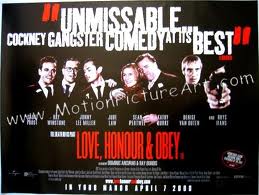
Dee Dee’s big swinging shotgun dick contradicts the analysis of gangster movies offered in Love, Honour, and Obey, a cross between a gangster film and Four Weddings And A Funeral which marks, arguably, the nadir (to date) of this British cycle. Ray Winstone in this one found himself among an absurd cast of would-be tough guys like Jude Law and Rhys Ifans, and luvvie molls Sadie Frost and Denise Van Outen. As one so-called hardman explains: “Women fuck it up in the end,” no double entendres intended, but all of them understood. L,H, & O also featured Kathy Burke dragging Ray Durdis’ impotent gangster to sex therapy. You couldn't make it up, except they did!

Back in Sexy Beast Spain, despite DeeDee’s taking care of business, Gal still must return to London. The big caper has been organised by crime lord Teddy Bass (Ian McShane, who's the most convincing thing in the film), in elaborate revenge for being buggered by bank chairman Harry at some Cliveden-style society orgy. Harry is played by James Fox, who’s wandered in from a remake of Performance, and we all know what that signifies. And did you happen to notice that the working class crime lord so offended by the upper class’ polymorphous perversion is named Teddy Bass, or Teddy Be Ass. I warned you.

How do Teddy Be Ass’ villains revenge themselves on gay Harry? They assemble, naked in a Turkish bath. Do I need to draw you a picture? In case I do, they penetrate the backside of the bank with a giant dildo of a power drill, shades of Thunderbolt and Lightfoot, an American buddy picture which wore its sexual role reversals on the sleeves of the dress Jeff Bridges had to wear. When Teddy B. Ass's boys break through into the vault, it releases a huge spurt of water. The naked gangsters swim up the tube and grab Harry’s jewels. Gal stuffs some earrings for DeeDee into his bikini, thus providing himself with the set of the family jewels he lacks. Teddy, having raped Harry’s vault, then shoots Harry in a needless bit of literal overkill. He drops Gal at a bus stop, paying him a tenner like a used hooker, knowing the secret of his shame is safe with a Gal. It’s a buddy movie gone haywire. Having, like Teddy, proved he’s NOT homosexual, Gal can now return to Spain, give DeeDee the family jewels, and enjoy a eunuch's retirement, accepting his femininity, frolicking on top of Don’s body in his pool.

Far-fetched? Director Jonathan Glazer claimed the eponymous Sexy Beast was money, but I think he was having us on. The Guardian’s critic Jonathan Romney, without a hint of irony, described Sexy Beast avoiding “the usual gangster geezerisms”. He noted that “above one hard man there is another, then another, then another….”, then pointed out Ian McShane as Teddy Bass played the ultimate man on top, “with a curiously prissy walk”. He thought Glazer might be “trying to cram too much in”. Some of us might suggest that’s the whole point. As I said before: DO I HAVE TO DRAW YOU A PICTURE?

Saturday, 25 June 2011

RANDY SAVAGE: THE INDEPENDENT OBITUARY

My obit of the Macho Man, Randy Savage, is in today's Independent; you can link to it here. The paper gave it lots of space, but had I had more there are a few things I would have liked to write about in more detail; admittedly it would have been more information than most of the readers wanted or needed to know. It was easy to write, and I found that simply relating the highlights of Savage's career made the point about the insanity of the wrestling business and its appeal to 12 year old boys of all ages. So I didn't feel I could waste space explaining the details of George 'The Animal' Steele's retard character. Put it this way: writing about Jake 'The Snake' Roberts disrupting a wedding by putting a cobra (and why it wasn't his boa constrictor, Damien) in the wedding cake is best done deadpan.

One thing left out was his baseball career: Savage tried to fashion himself into a Pete Rose figure, willing to do anything in order to advance, including learning to throw ambidextrously. His talent was limited, however, which eventually became clear, and he devoted himself to wrestling. I might have gone further into Savage's influences beyond Gorgeous George, like Freddie Blassie (who was also a huge influence on the young Cassius Clay), and into the way Angelo Poffo was able to set up a whole promotion with the express purpose of pushing his sons, and avoiding having them spending years in the wrestling equivalent of the minor leagues.

The love-hate relationship between Savage and Vince McMahon, who inherited the WWWF and turned it into today's WWE, was another topic I didn't have the space to explore--Savage got a quick and deserved push, but today remains outside the WWE's own hall of fame. In one sense McMahon always seemed to side with Hogan, who had been his meal ticket, but there is also the persistent rumour that Savage had a relationship of some sort with the very young Stephanie McMahon, but I felt that was speculation I didn't need to get into in the context of an obit.

I would have liked to devote some space to 'Team Madness' as well, Savage's three-woman entourage which included his then-girl friend, a much younger stripper named Stephanie Bellars, whom he rechristened 'Gorgeous George'. The other two were Madusa Miceli, probably the most talented American woman wrestler of her generation, and Miss Madness, Nora Greenwald, who went on to become Molly Holly. Again I would have been speculating, but it seemed to make some sort of life-change when Savage stopped dating young strippers and settled into a relationship with his old baseball first love, who of course was his own age.

The one bit that did get cut was more speculation, about the possible role of long-term use steroids and other drugs in precipitating Savage's heart attack; I noted the amazing list of wrestlers from that era who have died early, and especially a number, like Brian Pillman or Savage, who were smaller guys pumped up to the kind of dimensions and physiques McMahon desired and pushed. I also mentioned that Miss Elizabeth died in 2003, while living in a tumultuous relationship with Lex Luger, of an overdose of painkillers and alcohol.

But Savage's legacy will remain in the ring, where he was one of the great performers of the biggest boom wrestling is likely ever to enjoy. Unlike many of the superstars of that era, he went out and gave his all in the ring most of time; unlike most of them, he got out before the business killed him, or turned him into self-parody. And at his peak he had some of the greatest matches, and was certainly one of the greatest acts, ever.

Wednesday, 22 June 2011

HUBERT SCHLAFLY: THE GUARDIAN OBITUARY

My obituary of Hubert 'Hub' Schlafly, who invented the telepromter (or autocue, as it's called in Britain) is in Thursday's Guardian, or you can link to it here.

It is printed pretty much as
filed, except that when I filed
the story, I had actually
written the first graf in short
lines, like you'd read off
a teleprompter, just like this.

I was not surprised to see it in a more usual format. The desk did, however, point out to me that I'd managed to write the entire story while misspelling his name as Schafly, like the right-wing anti-feminist Phyllis. Hmmm.

I was very pleased while writing the piece to be able to get in a plug for my old boss at ABC, Peter Dimmock, who for me was a one-man education in the business of television sport. He really was the first person to use an autocue in this country. I love the way the BBC was always at the forefront of new technology--note the state of the art telephone foregrounded in the studio shot of Peter presenting Sportsview.

One thing that was lost was the point of the story about Herbert Hoover at the Republican convention: because of his stopping to ask that the machine be restarted, it became public knowledge for the first time that such devices were being used, which was a breakthough of sorts. But people still seem to believe those talking heads on TV are making it up. Though nowadays they're more likely to be being fed clever lines through their earpieces. Maybe we ought to make everyone watch Network again!

Oddly enough, when I started doing NFL on Channel 5, we added a green screen, like weather people use, to our analysis--and besides learning to do my telestrating backwards, like in a mirror, I also had to deliver my analysis to camera. Just after I started doing it, I was talking my friend Paul Shienfeld, who's spent his life working in television sports, and after commisserating with me about the difficulties of green screening, Paul commented that I read autocue better than anyone he'd ever seen. Your eyes never move. I laughed because our show couldn't afford an autocue: the entire sequence was ad lib, week after week. I offered to let him hold up cue cards for me if he wanted to.

Schlafy's portable satellite dish may well have been more important for television, and his pay per view system was probably more important in the minds of the guys who actually run the business. But those are three absolutely essentials parts of the business, necessities on every level, and it's amazing that one guy came up with all three. Just the kind of guy you'd nickname 'Hub'.