Saturday, 22 February 2014

ALEX GIBNEY'S THE ARMSTRONG LIE

Last month I discussed Alex Gibney's documentary The Armstrong Lie on BBC Radio 4's Front Row, and because I never did get to make my main point, I meant to write in more detail then. As is common with documentaries, the film doesn't seem to have spent a lot of time on a lot of cinema screens, which is a shame, because its an entertaining and involving story, with a compelling protagonist who can bend the audience just as surely as he bent the truth.

The important thing about The Armstrong Lie is its title, which was borrowed from the French sports newspaper L'Equipe, long-time sponsors of the Tour De France. It is not The Armstrong Cheat, because the 'lie' isn't the fact that Armstrong was cheating. The lie is rather the persona Lance Armstrong built up and sold to the world—the cancer survivor who won seven consecutive Tours, who used his success to fuel a huge enterprise centered on his Livestrong cancer charity. He was the ultimate underdog, an American dominating an event only one other American had ever won, racing for a team, US Postal Service, with minimal funding and facilities. It was a lie the world not only believed, but wanted to believe.

Gibney came to the story in 2009, given access to film a documentary about Armstrong's ill-fated 2009 comeback. He seems to have thought of his story, at least partially, in terms of sporting economics. Early on in the film he mentions that most racers come from modest, working class backgrounds, and later in the film he details the financial bonanza Armstong generated, and pointedly shows him on a private jet reading the marketing section of the Wall Street Journal, wearing a silly hat the may remind you how you can't ever totally lose your roots. But it's an observation that doesn't really go anywhere—echoes of the old Olympian amateur ideal are very faint indeed.

That's because the history of cycling in general, and the Tour in particular, is impossible to tell without reference to performance-enhancing drugs. Going back to the early days, where cyclists took strychnine, nitroglycerine, and cocaine; drank wine or beer to help kill the pain. It's an event that tests human endurance beyond its normal limits, and each time a 'scandal' arises, it is pushed under the carpet until the next bio-chemical advance comes along.

What's fascinating about Armstrong, and his association with the notorious Italian Dr. Michele Ferrari is the way the cyclist's cancer opened the door to his use of PEDs. Because his muscles had been broken down completely during his illness, Ferrari was able to bio-engineer a new Armstrong—and on a level playing field he might well have been just as unbeatable as he was anyway. This is not to justify his elaborate cheating, merely to point out that his feeling, which appears quite honest when he answers Oprah Winfrey's question, that he didn't 'cheat', in the sense of gain an 'unfair advantage' over his competitors, is true. Look at the men who stood on the podium with Armstrong in his seven tour wins and you'll find only one who hasn't either been caught or confessed to cheating.

As Gibney details Armstrong's history, and as he ruthlessly fights to protect his lie, you get a convincing picture of a sociopath, a bully, someone who is aware of his prowress and his appeal, and uses it against his critics. The pathos of his teammate George Hincapie, who can't help but protect Armstrong even after he's confessed, pointed fingers, and been cast into the metaphorical wilderness, is sad. Indeed, by the time of his comeback it appeared as if everyone on the tour, and everyone on his teams, had been cheating, except Armstrong

Which makes his decision to come back even more incomprehensible. And the wonder of Gibney's film is that, as he tracks Armstrong on that comeback Tour, he seems to believe Armstrong is racing clean,  and as a result we actually find ourselves rooting for him to succeed. Even having seen everything, knowing in retrospect the lies are lies, understanding the unpalatable nature of his personality, we cannot resist hoping Armstrong reaches the podium—it's as much against the odds as his first Tour win. Thus, when he's found to have blood-doped (removed blood before the race, and transfused it back into his body before the final stage) and the elaborate facade of lie starts to fall apart, we find ourselves doubly disappointed.

As is Gibey. In one sense, the Armstrong Lie is the one he fed Gibney, the one an experienced documentary maker found himself believing, and it's Gibney's talent that passes that sense of disappointment on to us. That, in the end, is the enthralling point of this film. Armstrong's attempt to come back, to win a Tour at nearly 40, and win it 'clean' is the most incredible act of hubris, one almost unmatched in sport, and hardly matched outside it. Armstrong alone among the major racers was still publicly clean. He could have stayed retired and kept his seven titles, and every time someone testified they'd helped him or seen him use drugs, he could have continued to beat them down.

It is the stuff of classic tragedy—whom the Gods would destroy they make stronger with Epo, or HGH, or steroids. Believing he could get away with it was the greatest Armstrong lie of all.

Tuesday, 18 February 2014

COMMENTARY AS EMOTIONAL INQUISITION: WINTER OLYMPIC NOTES III

In America, Olympic broadcasting faces a slightly different problem of pitching winter sport than the BBC's, because the Olympic format of building soap-opera 'up close and personal' storylines for every event is a tradition more than half a century old. NBC also has the advantage/problem of doing much of the games on tape delay. This allows them to hold a good story as long as they'd like, up to the very end of their prime-time broadcast, but it also tempts them into playing with the narrative.

In 1992 NBC had come up with the phrase 'plausibly live' to describe their tape delayed coverage from Barcelona, and fair enough, if you keep away from the news and the net you can watch as live. But in Atlanta in 1996 they famously redid their gymnastics commentary to re-order the competitors, thus increasing the tension. They provided new commentary, which I watched them record in the now-empty Georgia Dome (I was in charge of the basketball coverage in the other half of the Dome). I also talked to one of the commentators, Elfie Schlegel, as she and John Tesh walked in to do their voice-over. I wrote about this for the Herald-Tribune after the games, and NBC's Dick Ebersol wrote an indignant letter of protest denying what was obvious to anyone who watched the show. Apart from the order, you could hear the basketball horn go off. Ebersol claimed disingenuously that the horn was being tested, which was true; what he didn't say was that we were not allowed to test it until after the gymnastics was finished! Our half of the Dome was required to be both dark and silent throughout actual gymnastics competition.

Anyway, this time NBC gave into temptation on the men's figure skating. With no American left in the running, the story was Russian veteran Evgeni Plushenko, but he unfortunately had tweaked an injury during warmups, and withdrawn from the event. But when, many hours later, NBC went on air in prime time, they not only teased Plushenko's performance throughout the night, but when it came to the moment they actually feigned surprise at his withdrawal. Obviously it's not like re-editing events' it's just a cynical exercise in manipulating the audience to sit through more commercials; eminently cynical. Though probably not as cynical as the bits that were cut from the Opening Ceremony speeches, in particular IOC President Thomas Bach's call for the games to be held 'with tolerance and without discrimination for any reason,' NBC probably feared tolerance and non-discrimination might have offended much of their audience.

But the biggest controversy reflected NBC's overweaning determination to cast this sporting event into the template of human-interest. Bode Miller, who's now 36 and nearing the end of a magnificient, if sometimes controversial career, had just taken a bronze in the Super Giant Slalom, salvaging a medal after a disappointing downhill. He had told NBC, in an interview with news anchor Tom Brokaw, that he was racing at this Olympics for his brother Chalone, a snowboarder, who had died last year, aged 29. During the race, NBC even had Miller's wife miked up, and after the finish he was interviewed by Christin Cooper (left), a former US skier whom I'd met a few times in the 80s.

Miller's answer to Cooper's first question said he had a 'lot of emotion riding on it', and she then followed up with a question that was classic action news at 8 stick the microphone into the crying victim's face and ask: 'Bode, you’re showing so much emotion down here, what’s going through your mind?' I don't think Christin, who was friendly, articulate and smart as a skier, was wrong to ask that question—she commented on his emotion. But the question itself is far too lax—what's going through your mind?—to necessarily get a good answer. Bode's answer was general, so Cooper had to press on, trying to get him to mention his brother. And as tears began to appear, Miller produced an amazing response: he didn't know if the emotion was for his brother or for himself.

Done, brilliant, he's given you gold, he's crying, now move on, or out. Instead, Cooper started fishing for an angelic moment—Miller had been looking into the sky before his run. She was asking him to become part of a daytime TV movie. Miller was unable to answer, but the camera zoomed in on him, and his tears, holding him in extreme close up as if trying to focus on each individual droplet. They then followed Miller as he went off to be by himself, and Dan Hicks picked up and tried to explain the situation. Hicks did his best not to pander, but having built up a soap-opera scenario, there was no way NBC were going to desert the soap opera money shot: tears are the currency of voyeurism, the ultimate proof of 'real' emotion on the screen, and they need to be seen up extremely up close and personal.

I'm not criticising Christin Cooper for what was Oprah-esque overkill—and neither did Miller, who defended her afterwards and spoke of being caught up in the emotion of the moment. NBC, of course, immediately used that as a justification, saying that they supported 'the line of questioning' (no mention of sticking with his reaction) and claiming Miller had been 'supportive of ...the overall interview', which he wasn't.

The producer in the truck could have left the scene gracefully, dissolved to Miller's run perhaps, or simply moved on to the next story.  Cooper got a human reaction from Miller, but no one was content with that. There had to be more, so the audience could get their vicarious pleasure. It was great TV for an instant, and it became embarrassing for a lot longer.

Monday, 17 February 2014

COMMENTARY AND CHEERLEADING: WINTER OLYMPIC NOTES II

The Winter Olympics is a good way for us to test the quality of commentators, because in both the UK and USA most of the sports are not things television covers regularly, and they are not sports with which the audiences are familiar. Figure skating has a wide appeal; when I worked for ABC and we were programming the Calgary games, we aimed for figure skating and the US hockey team for our prime times every night. The skating would rate about 50% higher—remember hockey is basically a regional thing in the US, while skating has the broad, cross-gender appeal that made gymnastics such a big thing in the post-Korbut, Comaneci era.

Figure skating is basically bowling alley ballet, a sport with the dual drawbacks of first requiring make-up, sequinned costumes, music and choreographers to perform and second being subject to judging, with all its attendant history of corruption and fraud. Yet if anything, skating is more popular now than ever, thanks to 'talent' shows like Dancing On Ice. When you think about it, the Olympic format is almost as close to Ted Mack's Amateur Hour as Dancing, or Strictly, or X Factor. The biggest difference being the figure skating judges are locked into a 1950s aesthetic, and susceptible to bribes, but are not fed clever lines by the producers for the audience's entertainment. If anything though, the 'kiss and cry' area at the Olympics is even more OTT than X Factor.

When I covered Lake Placid, there were 35 medal events; in Sochi there are 98. Sports have been expanded, not often for the better (cf: classic vs freestyle cross country skiing; 'team' figure skating) and new sports have been added, including more judged sports, like freestyle skiing and snowboarding. Of course there are also a couple of events that excite me the way roller derby did when I was 11 years old: short track speedskating and snowboard cross, which are basically the same kind of Ben Hur races, one on ice and the other on snow. But with new sports has come a new, younger audience and a problem for commentators, as I've been discovering watching the BBC coverage.


Snowboarding is analogous to surfing, and the lingo seems to have been built on a gnarly surf base. But surfing has never been in danger of reaching the Olympics. Snowboarding is one of the few sports at the Winter Olympics where the competitors don't dress in lycra bondage gear, and the only one where a competitor (in Vancouver) was barred from the games after testing positive for marijuana, which would imply that it is the only sport where pot is a performance enhancing drug. So it's a young, groovy thing, which means BBC commentators appear to be determined to do the verbal equivalent of a 1440 Yolo flip on every routine. This Jonathan Pearce approach might work on radio, and attract a lot of attention, but it doesn't do much to enlighten the audience. On the other hand, I once asked a snowboarder, while I was doing commentary at the 2005 Winter University Games, what 'huge air' meant, and he said, 'well, like, the air, it was huge'. So now we knew.

On the other hand, you'd think curling would be a natural fit, partly because the Scottish (whoops, I mean British) teams are quite good, and partly because it has the same sort of appeal as snooker, lawn bowls, or even darts. Which means the BBC commentators approach each end with a sort of genteel calm, regardless of how tight the competition is, and even in celebration of a British win have all the reserve of Phil Drabble commiserating with the second place finisher at a sheepdog trial. What would be instructive would be to swap the snowboarding and curling commentary teams around, if only for a day.

Meanwhile, Great Britain & Northern Ireland picked up its first gold medal Friday, in skeleton, and I watched Lizzy Yarnold's impressive win to prepare myself for chat on Saturday morning's World Service Weekend programme. Skeleton bob is basically going down a bobsled run on a sled, head first the way you would on your own Flexible Flyer as a kid. It's been in the Olympics before, on the Cresta run in St. Moritz, and it's probably the most accessible and human of the bob run events: the bobsled itself being conducted inside a bumper car, while the luge, in Tony Kornhesier's great phrase, resembling Dracula going downhill in his coffin.

I caught the last of the four skeleton runs, and it was gripping stuff—with the difference of third and fourth places coming down to .04 seconds (four one-hundreths of one second) over the combined FOUR runs. But when it got to Yarnold and the final run, there was little grip left. She had built up a huge (0.78 seconds!) lead over the first three runs: all she really needed to do was get to the bottom without crashing to win.

This was pointed out, hesitantly by Amy Williams, the skeleton expert commentator, which then set Colin Bryce off into a mad effort to rebuild the tension. Fair enough, because the pair had been pretty good in explaining how the event worked, and the way in which Britain, just like East Germany thirty years ago, had identified athletes to draft into the sport and concentrated on sled technology, so despite not having a track of their own to practice on they had achieved remarkable success. They also drifted into those areas that make you wonder what 'experts' are for. Yes, the racers will enjoy the podium, they will be happy, and yes, they'd really like to win. You do not have to have raced at Olympic level to provide such insights. But once the race started, all explanation was off anyway. 'Speed will be crucial here,' said Bryce, which was self-evident enough, but actually wasn't the most crucial thing. Then he pulled out the commentator's greatest enemy, the cliché's cliché, just before the start. 'Lizzie GOES FOR GOLD FOR BRITAIN' he said, a verbal tabloid headline simple enough for any audience to understand.

The rest of the run was basically Amy Williams cheering Lizzy down the course. This raises the interesting point of why you need an expert commentator to cheer. Why not have Lizzie's husband, or grandmother, or next-door-neighbor, or Brian Blessed instead? At one point Bryce interjected 'she's flying now', which was daring in the sense that he didn't have David Vine's Ski Sunday tape delay to prove him hundreths of a second right, but basically anyone going down a bob run on a skeleton is figuratively flying. It is a difficult thing: momentum means some bumps will slow you down less than you might think, and there's no way for the naked eye to calculate how many hundreths of a second may have been gained or lost. Yarnold won by almost a full second (0.96) but remember that's a full second after FOUR runs. And as she celebrated, Amy Williams was 'crying for her, crying for everyone' which maybe Brian Blessed could not have done better, and I appreciated her tears for me.

Yarnold herself seems completely likeable, a great person for a great story, and I suppose we can expect the Seoul Hockey Syndrome to mean she will appear on a lot more BBC in the future than she has in the past. But I was amused by her nickname, which is 'The Yarnold'. I have written before about the remarkable flatness of British nicknames. If Mean Joe Green had been British, his nickname would have been 'Greeners'. Cool Papa Bell would have been 'Bellsy'. And Broadway Joe Namath would have been lucky to be 'Joe'. Or maybe 'The Namath'.

Sunday, 16 February 2014

SOCHI AND SOCHI: SELLING THE WINTER OLYMPICS

I was on BBC World Service Weekend yesterday, (one can find it with great difficulty at the new look IPlayer for the rest of this week) and one of the topics we discussed was the Winter Olympics--the focus was on the language of snowboarding and freestyle skiing, and I was able to describe my experience working with a barely articulate snowboarder as my analyst at the 2005 Winter University Games (this is the only Olympic sport where a competitor has been banned for testing positive for marijuana as a performance enchancing drug) and I also mentioned how many changes to the programme there have been since I first covered the games, shooting on 16mm film, at Lake Placid. To prepare for the show, I'd also made sure to watch Britain's Lizzy Yarnold win the skeleton bob.

Then I managed to get home, despite the best efforts of South West Trains, in time to watch the last period, overtime, and shootout of the Russia-USA hockey game, which was the kind of brilliance that reminded me why I've loved hockey, which my dad played, for most of my life. A friend who was watching her first-ever game was texting me with questions (and score updates) on the train, and the sport picked up at least one more fan.

So for the next few days I'll post a few thoughts on the Winter Olympics,starting with an overview now....

THE WINTER OLYMPICS:

The ten Olympics I've covered include three winter games (Placid, Sarajevo, and Calgary). I also did hockey commentary on a fourth Olympics from a studio in Paris, as well as virtually all the sports at those University Games in Austria. I worked on the 1980s full spectrum of winter sports for ABC, everything from the downhill at Kitzbuehl to ice speedway to a Brian Boitano/Katarina Witt version of Ice Capades (ah, the stories I could tell...)

Before every Olympics the media's stories are always the same, especially because the huge press corps descending (or ascending, in the case of skiing) on the games is made up of people who aren't necessarily used to covering such events. Hence the usual pre-Olympic make-news stories, like accommodation (none for the public, substandard for the press), weather (too hot in summer, either too hot or too cold but never just right in winter), snow (too much/not enough/artificial), security (the increase in Sochi reminds me of the steps 'forward' in Sarajevo, and ties in nicely with the NSA/GCHQ trend of modern life) and of course transport (traffic nightmares that didn't happen in LA and Seoul, malfunctioning press buses most memorably in Placid and Atlanta) are intensified. That a giant bus system has teething problems its first day, especially in winter conditions, is never an excuse. Dick Young of the New York Daily News was so incensed by having to wait half an hour in frozen Lake Placid the day before the games opened he was still writing about it when the Miracle On Ice happened!

Winter sports have a limited universe, and winter games often took place in small ski resort areas used to providing skiers with a good time (cf Lillehammer). But when I covered Lake Placid, there were 35 medal events; in Sochi there are 98. This proliferation demands more facilities and more infrastructure, and insures more journalists venturing into territory like biathalon or luge for the very first time. There are sports like speed skating or bobsled where competitors in bondage costumes race against the clock, there are others where awards for best make-up, choreography, or costumes, if not congeniality, ought to be worth separate medals.

Sometimes, before a games, there is political coverage of the host nation--though it has to be said that historically the IOC has always welcomed what Jeanne Kirkpatrick would call 'authoritarian governments' to host games--allocation of resources is so much easier, specially when they're being allocated to various IOC dignitaries with their hands out and pockets open. Although Russia's repressive anti-gay laws have been a focus of coverage, though rarely with reference to figure skating, the actual presentation of Putinesque politics has been very lean, and in America they've been heavily tinged with Cold War overtones. Maybe they were trying to make the Russia-USA hockey match seem more interesting.

But the odd thing is how quickly that coverage disappears once the sport actually begins. Horrible hotels, bumbling buses, civil rights for gays, Chechen terrorists, all get buried under an avalanche of frenzy as each nation's athletes compete (or 'go for gold' as you are required to say in Britain), and everyone falls in love briefly with slope style, or in the case of Britain, skeleton, which, if Seoul Hockey Syndrome is any guideline, will now slide into BBC TV schedules for the next four years, until disappointment at the next winter games drives it out. After the usual stories about transport, weather, hotels and so on repeat themselves.

Friday, 14 February 2014

ROBERT B PARKER'S IRONHORSE BY ROBERT KNOTT

Ironhorse is the first of the continuations of Robert B Parker's Virgil Cole and Everett Hitch series of westerns, and as with the Jesse Stone novels, the Parker estate chose someone connected with the on-screen adaptations of the books to continue the series. Robert Knott is an actor who appeared with Ed Harris in Pollock, and co-wrote (with Harris) and co-produced the movie Appaloosa. Unlike TV producer Michael Brandman's version of Jesse Stone (see my review here), which reflects the Tom Selleck films as much as Parker's, Knott sticks much closer to the characters of Cole and Hitch. But he has a harder time than Brandman of matching both Parker's tone and his narrative drive. This is not to put down either of the screen adaptations, which work fine on their own terms. But it's no coincidence that the best of the post-Parker Parkers has been done by Ace Atkins, charged with continuing Spenser (see my review here), not just because he's a novelist, but because he brings no previous adaptation to the table.

Ironhorse begins on a train, with Cole and Hitch returning from transporting two Mexican conmen back to their own country. As they pass through the Indian Territory, the train is held up, by a well-organised gang who are unaware of what a deadly mistake they have made in their choice. After being driven back, they uncouple Cole & Hitch from both the engine and the rear carriages, making a temporary getaway. With them are the governor, and his two daughters, one of whom has already thrown up sparks with Hitch.

So far so good, but from this point the story complicates greatly, moving back down the line to a corrupt mining town with a cat house on every corner, then back up the line, with sidetracks for shooting various varmints as they appear or re-appear. The problem is not so much the prolix detail about trains and engines, or indeed about Virgil and his cigars---at times it feels like he's posing for a 19th century version of Esquire—but more Knott's inability to draw in these many characters with the same broad but telling strokes that characterise Parker. Although many of them appear fascinating—not just the villains but two women and an Indian working on the railroad, a seemingly corrupt sheriff, a particularly adept whore named Rose, and of course the governor's daughters, a pair that matches perfectly Col. Munro's offspring in Last Of The Mohicans.

Instead of giving the villains, or these characters, the space they need to interact, the story bogs down in the middle, as our heroes plan, and get everything explained to them when one of the villains turns out to carry his press-cuttings with him. When the confrontations come, all of them, with the exception of the ultimate, become matter of fact—whereas Parker's shootouts are generally tests of personality.

Knott is good with Cole and Hitch, but once they get into analysis of Cole's relationship with Allie, who may or may not have taken up with a deputy while Cole has been away on marshal's business, there's something a bit too sensitive: Parker's Cole is another of the antitheses to Spenser; he's much closer to Stone, but without the ability to express whatever self-awareness he might have in regard to the opposite sex. There is no reason behind his love for Allie, yet he accepts its reality and thus acts as if there were, which for him is natural in the basic sense of the word. I'm not sure Knott gets that, or can follow the precision of Parker's portraits. But if he could maintain the tone and focus of his first third, he could produce a more fitting adaptation.


Robert B Parker's Ironhorse by Robert Knott

Berkeley Books, $9.99, ISBN 9780425267707

Wednesday, 5 February 2014

MAX ALLAN COLLINS' TARGET LANCER

The blurb on the front cover, for once, says it all. 'November 1963, and they're going to kill JFK...in Chicago'

It's been thirty years since the first Nate Heller novel, but in an afterword Max Allan Collins says he'd always intended to have Heller 'delve into' the JFK assassination. But before he can deal with Dallas, Collins first realised that the abortive attempt on Kennedy, who was supposed to attend the Army-Air Force football game at Soldier Field in Chicago, gave a natural point of entry for Heller—whose long time connection to the mob was established in his early days as a PI in Chicago. As was his relationship to Jake Rubenstein (aka Jack Ruby).

Collins had set the scene neatly in some of the 13 earlier Heller novels, establishing his connections with the Kennedys, Jimmy Hoffa, and mobsters like Johnny Roselli—making Heller the perfect go-between for Operation Mongoose, the CIA/Mafia plot to kill Fidel Castro, which for better or worse is tied into the JFK killing. And in Target Lancer, Collins blends in real characters with fictional stand-ins and composites. The result is a very believable fictionalisation of a story told by a black Secret Service agent, Abraham Bolden, who spent years in jail as a result. If you've followed Irresistible Targets you'll know the Chicago plot was an important part of James Douglass' JFK: And The Unspeakable (see the review here), and it was one of Max's sources. The Chicago plot is instructive, and chilling, in that it was a virtual carbon-copy of the shooting in Dallas.

But he's turned it into a good story, full of confrontations that seem to ask repeatedly exactly on which side of the street Heller wants to stand. This has always been the most interesting part of his character, the ambiguity which Collins has built into him, which has enabled him to move in and out of so many key crimes in the past century. Many key beds as well, and Sally Rand, another of Nate's old Chicago friends, makes another welcome appearance here. It's a different kind of confrontation—but I really like the way this story moves through a series of scenes which speak of controlled violence, and then a couple of set pieces which bring real violence to the fore. This Heller would make an easy transition to the screen and I'd love to see that, not just because it appears Max and I are on the same page in terms of the JFK killing.

Target Lancer by Max Allan Collins
Forge $7.99 ISBN 9780765361479

Note: This review will also appear at Crime Time (www.crimetime.co.uk)

Thursday, 30 January 2014

MIKE CAREY'S THE GIRL WITH ALL THE GIFTS

Melanie is a bright ten year old, a bright girl who lives to learn and adores her best teacher, Miss Justineau. Every morning she's taken to classes; taken from her cell by armed soldiers; strapped up like Hannibal Lecter; transported in a wheelchair. Melanie has never been outside, but she lives in an old air base, and isolated fort in a Britain overcome by a deadly spore that has turned much of the population into 'hungries': zombie-like humans who remain listless until the smell of human flesh sends them into a piranha-like feeding frenzy. The uninfected are clustered in a city on the south coast and in this isolated research centre. Going out means facing the hungries, and also the 'junkers', humans who chose not to retreat, but live out in the world avoiding or battling the hungries.

I haven't enjoyed an sf/horror novel so much in ages. It's a take on a number of familiar tropes, but Mike Carey's novel works in two sections, and draws on two strands of modern speculative fiction. The first, and obvious strand, is dystopian, apocalyptic science fiction, something which has been particularly attractive to British writers at least from the days of HG Wells. Why the British have proved so ultimately resistant to utopias, something Americans have always found tempting, might have something to do with innate pessimism, or disdain for the idea that one's life or station in life can be improved, or maybe simply an expression of what George Mikes identified as the greatest joy in English life: enduring hardship, and the most satisfying hardship to endure was unnecessary hardship.

This dystopian Britain recalls elements of our present day too, and remember that our present day is one dominated by fantasies of vampires and zombies. The former, which is easier to understand, given the obvious sexual undercurrent of vampirism, has given way almost naturally to the latter—why are zombies so popular in modern culture? Do they show us something about ourselves, something lacking perhaps? Or something about a society with only one major value? Certainly when Mrs Thatcher said there is no society, only people with interests, she could be describing a world of hungries.

In the first part of this novel, Carey sets the scene, bit by bit explaining what has happened and exactly what is going on in Britain and at the base, and what the secret of Melanie and her fellow children is. The other part of the story is a more standard race against the inevitable, survival in a world of destruction, but the brilliance of the tale is that there are issues beyond the survival of the people that keep the conflicts alive.

It's a superlative piece of writing. Carey is just as effective with his military men, his mad scientists, as he is with Melanie, who is the lynch pin of the narration as well as of the story. She is a wonderful creation, a 10 year old coping with curse of unfulfilled intelligence, and ultimately having to figure things out and make huge decisions herself. It's both thrilling in the knuckle-whitening horror sense, and in the sense of the larger personal dilemma, and it is resolved in a way that reminds you that Carey is a comic book writer of some note (I don't mean this in a deprecating way, as I recall particularly his writing on Lucifer, but simply because graphic stories do tend to have endings that work out--I also wonder why the need be M.R. Carey for this book, thought the name does suggest something in the way of Victorian fantasy). So what I meant to say was the resolution is clever enough to please everyone from old-fashioned sf readers who want their science believable to those who've become invested emotionally with Melanie, and are rooting for her survival. Which should be anyone who reads.

The Girl With All The Gifts by M.R.Carey
Orbit, £12.99 ISBN 9780356502731

Saturday, 25 January 2014

THE LONELIEST: BRUCE ELLIOTT'S ONE IS A LONELY NUMBER

I knew Bruce Elliott's work, because he is one of the writers who filled in for Walter Gibson on The Shadow, when Gibson needed to slow down from the two novels per month schedule of being Maxwell Grant. Like Gibson, Elliott was a magician, and apart from the Shadow his published fiction is anything but prolific. His Shadow novels are relatively easy to spot, especially the ones that concentrate more on Lamont Cranston as a character, and less on the caped avenger himself-- there are three in which The Shadow doesn't even appear. So in my mind he was a footnote, and there was nothing to prepare me for the impact of One Is A Lonely Number, a pulp paperback written a few years after his adventures with The Shadow.

One Is A Lonely Number is published now by Stark House alongside Elliott Chaze's better-known and regarded Black Wings Has My Angel, which I wrote about in my previous post. It is sort of an all-Elliott pulp bonanza. One Is A Lonely Number was originally published in 1952 by Lion Books, reprinted in Justice Magazine in 1956 as The Cocktail Jungle, and then in 1961 by Tower Books as A Woman. If that spinning array of titles confuses you, that's the fate of stuff pounded out for quick cheap publication—Lion was a good step down from Gold Medal, who published Black Wings, and you can see some of the difference right away.

Elliott's prose isn't as penetrating as Chaze's, he hasn't set up situations and characters as carefully to reflect the action. No one is going to call One Is A Lonely Number astonishingly well-written' the way Barry Gifford described Black Wings. But I'd argue that Elliott's novel is, if anything, even more down and dirty, and the gritty flatness of the prose works even better to keep up the frantic downhill pace of the story.

Larry Camonille is on the run after a jailbreak in Illinois, and determined not to make the same mistakes that get his fellow escapees caught. He's operating on only one lung, the kind of defect that stands, in a Hemingway kind of way, for a flaw in his character, but he's doing just fine until he's picked up hitching by Vera Pool, and set up with a job at the Welcome Inn somewhere in Ohio. He's working with a teenager named Benny, who's got a girlfriend, Jan, who's got everyone's eye at the Welcome Inn. But she has an eye for Larry.

When you're a popular guy in this kind of noir, it's usually because someone wants something from you. And Vera Pool has a mother in law who's standing in the way of her happiness with the estate left her by her late husband. She's offering Larry five, then ten thousand dollars to kill her. But Larry has an eye for a set-up. He also has an eye for Jan, and Jan figures out who he is. But she doesn't want anything except to run away with Larry. And have him collect her inheritance for her, an inheritance which is being bled away from her by a crooked lawyer and his greedy wife. And she can't touch it herself, because she's only 14.

As the blurb on the front of the original paperback says: 'An escaped con seeks refuge-- finds jail bait!'

The small Ohio town is so corrupt and steamy it could be set in the deep south, and the pull of sexual attraction with Jan might have been written by James M Cain. Obviously, 1952's pulp fictions don't share our sensitivity to sex with underaged women, but even so, you know that it cannot end happily. And Elliott throws in a few twists, along with the almost requisite moment when the careful and smart Camonille makes one stupid mistake, with unforeseen but inevitable consequences.

Where this falls short of Black Wings is that Chaze's novel has two characters, on a relatively equal footing, and Chaze writes each of them with a distinct fatalism. Here the story is Larry's, and the escape he seeks he gets, but not the way he planned. This is a surprising, and surprisingly powerful pulpy read, and Stark House's double is a remarkable read.

One Is A Lonely Number by Bruce Elliott (b/w Black Wings Has My Angel)
Stark House 2012, $19.95 ISBN 9781933586434

BLACK WINGS HAS MY ANGEL BY ELLIOTT CHAZE

Black Wings Has My Angel (aka One For The Money) is one of the most legendary of the early original novels published by Gold Medal Books (in this case in 1953), when Gold Medal was the acme of the pulp paperback lists, and just a few pages in you can see why. The narrator is washing off four months worth of roughnecking on an Atchafalaya River when the hooker is delivered to his room in a cheap hotel in a cheaper town called Krotz Springs. She's a looker, and even he can see she's well beneath her class in Krotz Springs. And when he makes a joke she says, 'Never joke with a tired tramp. No one gets as tired as a tired tramp.' It's love, or something like it, at first sight.

He tries to leave her behind, and she tries to leave him, even taking his money, but they cannot stay apart He calls himself Timothy Sunblade, and she's Virginia but the names don't matter, except as metaphor, because neither person is what their names say they are. He's got a plan, for a big heist in Denver, and eventually she comes along for the ride, and they shack up in a suburban tract house, playing young marrieds while he cases the job and sets it up.

This has everything there is to love about noir and pulp. The terms are often misused and confused for each other, but here the mix of the elements is perfect: the inevitability of bad luck and fate is as powerful as Greek tragedy, but the characters are out of the darkness beneath that post-war American dream. When Chaze sticks them into 50s suburbia, it's like pouring acid into a volatile mix about to explode. And it does. The only thing worse than waiting for the job to happen, and risking the murder that goes with it, and the betrayal that lurks within the natures of these characters, the only thing worse than that is having the job succeed, and then trying to live out your dreams, knowing the nightmares that were tailing you are still on your tail.

Chaze's prose is relentless, delivered in a first-person narration with surprising sensitivity to nuance, but with no gift-wrapping of the narrator's own character. In best pulp fiction mode, he's rendered almost helpless by Virginia's femme fatale, but he's the master of his own fate to some degree, and that is precisely the degree to which he cannot escape from his desire for her. It ends as you might expect, with storms and a mine shaft down which dreams plummet to their death. Compulsive reading.

Black Wings Has My Angel (b/w One Is A Lonely Number by Bruce Elliott)
Stark House 2012, $19.95 ISBN 9781933586434

Thursday, 16 January 2014

THE NIGHT OF THE HUNTER: THE FILM PROGRAMME ON RADIO 4

I was on BBC Radio 4's Film Programme today, discussing the re-release of The Night Of The Hunter with host Francine Stock and the estimable Nick James, editor of Sight and Sound. you can listen to the show on BBC IPlayer (link here), and you'll also hear a fine interview with Thelma Schoonmaker, about editing Wolf Of Wall Street and digital vs. film editing in general, as well as with that film's co-star Jonah Hill. Ours was a lively discussion, the only negative being we all admire the film, so there wasn't the usual diagreement which might have made it a bit edgier! Much of the best talk, as it so often does, took place before the tape was rolling, or had to be lost for space considerations, so I thought I'd just make a few general points about the film.

I know it isn't everyone's cup of tea even today, when it's considered a work of genius—some people find Robert Mitchum's performance theatrical and over the top, and many find the mix of noirish expressionism and fairy tale oddly disconcerting in a Southern Gothic thriller. At the time it must have, as I said on the show, confused people: look at the poster left and ask yourself if you're getting a thriller, a romance, or a western?

I had some of those feelings myself when I first saw the film, but was won over the way great films often do: by getting you to suspend your disbelief, and accept the story the way it is told, the way it appears, on film, as film. And this is where Laughton is so good. There are borrowings, from Griffith as much as Expressionism, from the Grimm Brothers as much as film noir, but it drags you into that world and gives you a child's perspective of it. We are all children in the cinema anyway, and Laughton reminds us of that.

I mention Mitchum's performance, which I think reflects Laughton's own bombast and flamboyance. I'd recalled his Rembrandt, who as played by Laughton became a two-fisted bar-room brawler, a he-man figure who would put Pollock to shame. Laughton was lucky, because Mitchum brought his own brooding sexuality to a role built on fear and hatred of that sexuality, and he played it with a cunning that worked against the somewhat passive character we remember from film noir, from Out Of The Past, helpless in the web of the spider woman.

But Loughton as a theatre director specialised in getting to the disturbed underneath an actor's surface: just before he made his only film as a director, he was coming off a great success with The Caine Mutiny Court-Martial, in which Lloyd Nolan, no method actor, played Captain Queeg. I think Mitchum took the freedom Laughton offered and ran with it.

We talked a lot about influences, which got lost apart from my mention of Flannery O'Connor, Wise Blood, and John Huston. But you can't have children on the river without Huckleberry Finn springing up, and it's hard to have any southern fiction in the 20th century without the cadence and tone of Faulkner seeping through. You see Davis Grubb in Harper Lee, for example, and you see Hazel Motes in Harry Powell. There's a lot of Erskine Caldwell (Tobacco Road) too, and at the other end of the spectrum, you might note the epigraphs from Moby Dick which Grubb used in the novel, and think of Melville's other great novel, this one set on a river boat: The Confidence Man: His Masquerade. Which describes Powell perfectly. It's significant too that the film is set specifically on the Ohio River, which marks the northern boundary of the South.

We talked about the influence of this film, and I tried to make the wider point of the steamy South as a natural setting for noirish tales of greed and passion. We should have mentioned Winter's Bone, based on Daniel Woodrell's fine novel, in which the dead body underwater plays such a part. You can see the effects of Laughton's style perhaps in David Lynch or Jim Jarmusch. And I see a lot of Mitchum and a bit of Laughton in The Beguiled; not that Don Siegel strove for much in the way of expressionism, but you can compare Eastwood the seducer to Mitchum working on Ruby, the eldest and most vulnerable of Lilian Gish's strays. That scene is shot in an ice cream parlor: even the sign above their heads seems lascivious in context, and Gloria Castilo could be auditioning for Baby Doll or Lolita. In many ways she is the central character in terms of the film's morality: she is the one Lilian Gish may save from the fear of his own need for love.

More doubling: of course Ruby is the opposite reflection of Pearl, whose name recalls Hester Prynne's illegitimate but pure daughter in The Scarlet Letter. I'd mentioned how perfect Sally Jane Bruce is for the role: her's is a doll-like face, Elizabeth McGovern or Molly Ringwald, and of course her doll is central to the story. A few other cast notes: Shelley Winters was in Laughton's acting class in Los Angeles, one senses he knew what he was getting from her. James Gleason, who is so good as Uncle Birdie, actually replaced Emmett Lynn in the role. And Peter Graves is excellent as Ben Harper; he's playing the same sort of character he played in Wagonmaster, only softened by his children, as you might expect in a fairy tale.

And of course there is Lilian Gish, who nearly turns the film into a fairy tale by herself. She brings the echo of the silents, of Griffith, and of a certain timelessness that invites the viewer to accept the tale the same way he would accept her bible reading at the start. It is, for adults, a tale of the vicious repression of sexuality to God and to Mammon, something Gish rises above. I still recall vividly Gish coming on stage at the Dominion Theatre after a screening of The Wind, and that same ageless presence was still there.Stanley

The work of Stanley Cortez, the cinematographer, is magnficient. Cortez, born Stanlislaus Krantz, was the brother of the heartthrob Ricardo Cortez, one of the best of the homegrown Valentinos. Stanley didn't shoot many 'big' films, but made them count when he did (Magnificent Ambersons being the best-remembered). He has a catalogue of odd B movies to his credit, but he achieved something memorable here. And the set designer, Hilyard Brown, did Creature From The Black Lagoon, and what else is this film but that one with the monster being a human? 

And finally, may favourite of all the photos I found while I was writing this piece: Laughton, Winters and Gish out for dinner in Hollywood, 1955. Why are these people smiling? Or trying to smile?


Wednesday, 8 January 2014

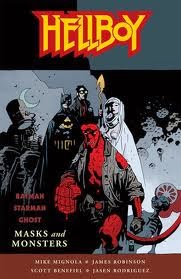
MIKE MIGNOLA'S HELLBOY: MASKS AND MONSTERS

Masks and Monsters consists of two team-up stories. In the first, written by James Robinson and drawn by Mignola, Hellboy meets Batman, but actually teams up with the modern Starman, in a tale which involves modern day Nazis and a plan for world conquest set in the rainforest jungles of the Amazon. The original Starman has been kidnapped, because his research is crucial to the Nazi plan, and it is a tale of rescue, both of a father and the planet. It also reminds us who our real monsters are.

The second story, written and laid-out by Mignola, but drawn by Scott Benefiel and inked by Jasen Rodriguez, teams Hellboy up with Ghost, a spirit avenger armed with two non-spectral .45s, to fight another plan for world domination. This one comes from a resurrected spirit of an ancient Babylonian god, but derives from some brutal murders back in 1939. Since Hellboy is the world's greatest paranormal investigator, this is paranormal worthy of his talents.

Both stories are entertaining, showing different sides of the Hellboy character, which is a facinating one: The Thing combined with a hard-boiled detective perhaps. But I couldn't escape the idea that they would have been better had the drawing assignments been switched. Benefiel's art works best with highlighting the combination of spectral qualities and pin-up looks of Ghost, but might have been even better suited to the rumble in the jungle, although I accept the early part of the story set in Gotham City is perfect for Mignola's own art. Mignola's darkness, the hard-angles shadows and hard-edged almost abstract figures, is in a line that goes from Kirby through Steranko, and Chaykin, and I couldn't help but feel it might have adapted itself to the almost Dr Strange quality of the Ghost tale.

But the other thought which I couldn't escape was that the better team-up of these characters might have been Batman and Ghost. They are both driven by the urge for venegeance, to an almost sociopathic level (of course Ghost is a ghost). The Ghost's costume aims more at the flesh than the ectoplasm, but you see the point. It's a natural team-up, and a woman already dead is perfect for The Batman, if not Bruce Wayne. But when I looked at her twin .45s I could not help but thinking of The Shadow, the most obvious stylistic precursor of The Batman. And I discovered quickly that Dark Horse had indeed done a team-up with them: that's something I now will have to check out.

Hellboy: Masks and Monsters by Mike Mignola et al
Dark Horse Books 2010, $17.99,  ISBN 978595825674

Tuesday, 7 January 2014

ARNALDUR INDRIDASON'S OPERATION NAPOLEON

On the surface, the glacial surface, Operation Napoleon is very different from the Erlendur novels which have been so successful for Arnaludur Indridason. It's a fast-moving thriller, about a Nazi bomber lost in an Icelandic storm in 1945, which the Natnajoekull glacier gives back in 1999. And it's an airplane that the US wants desperately to retrieve, and retrieve in absolute secrecy.

Indridason handles the thriller neatly, building the plot elements slowly, with the same misdirection thrown out by the authorities—the thriller element, will the Americans get the plane, and more important get away with what they do to protect their secrecy, is well done, but the real thrill is in the mystery, as we weave our way through the misdirections thrown out by the authorities.

But the real story is the struggle of a young woman, an Icelandic bureaucrat called only Kristin, to find out what has happened to her brother, leading a rescue party, who stumbled across the recovery operation, phoned her, and was tortured and left for dead. And that struggle illuminates, in stark detail, some of the differences between the Icelandic and America character, in the wake of the whole debate about Iceland's role as a key point in the military web of the USA. It is a case of simple versus complicated, nuanced against simple, straight-forward against very crooked indeed. And it's one Indridason obviously relishes.

He stacks the deck somewhat, in a playful way that for me undercut the suspense. The two intelligence agents chasing Kristin are called Ripley and Bateman, who are of course two of American fiction's most memorable sociopaths. Which makes a comment, in its way. The original commander, trying to recover the plane back in the Forties, is called Miller, which suggests the simplicity of the so-called 'greatest generation'; and the two Icelandic brothers who originally witnessed the crash seem to share some values. While his replacement in 1999 has a Lithuanian name, Vytautus Carr, which kept me thinking of Red October, while the man he puts in charge on the ground is called Ratoff, which seems a bit of overkill.

If the secret, once revealed, is a little anti-climactic, and somewhat unconvincing (it all happened, obviously, despite the crash) it's an audacious plot that reflects back on the roots of our modern malaise; perhaps the greatest generation weren't all so great after all. It's impressive to see Indridason turn from the slow build of tone in the Erlendur series to something far more staccato, and do it so well.

Operation Napoleon by Arnauldur Indridason
translated by Victoria Cribb
Vintage, £7.99, ISBN 9780099535638