Thursday, 30 January 2014

MIKE CAREY'S THE GIRL WITH ALL THE GIFTS

Melanie is a bright ten year old, a bright girl who lives to learn and adores her best teacher, Miss Justineau. Every morning she's taken to classes; taken from her cell by armed soldiers; strapped up like Hannibal Lecter; transported in a wheelchair. Melanie has never been outside, but she lives in an old air base, and isolated fort in a Britain overcome by a deadly spore that has turned much of the population into 'hungries': zombie-like humans who remain listless until the smell of human flesh sends them into a piranha-like feeding frenzy. The uninfected are clustered in a city on the south coast and in this isolated research centre. Going out means facing the hungries, and also the 'junkers', humans who chose not to retreat, but live out in the world avoiding or battling the hungries.

I haven't enjoyed an sf/horror novel so much in ages. It's a take on a number of familiar tropes, but Mike Carey's novel works in two sections, and draws on two strands of modern speculative fiction. The first, and obvious strand, is dystopian, apocalyptic science fiction, something which has been particularly attractive to British writers at least from the days of HG Wells. Why the British have proved so ultimately resistant to utopias, something Americans have always found tempting, might have something to do with innate pessimism, or disdain for the idea that one's life or station in life can be improved, or maybe simply an expression of what George Mikes identified as the greatest joy in English life: enduring hardship, and the most satisfying hardship to endure was unnecessary hardship.

This dystopian Britain recalls elements of our present day too, and remember that our present day is one dominated by fantasies of vampires and zombies. The former, which is easier to understand, given the obvious sexual undercurrent of vampirism, has given way almost naturally to the latter—why are zombies so popular in modern culture? Do they show us something about ourselves, something lacking perhaps? Or something about a society with only one major value? Certainly when Mrs Thatcher said there is no society, only people with interests, she could be describing a world of hungries.

In the first part of this novel, Carey sets the scene, bit by bit explaining what has happened and exactly what is going on in Britain and at the base, and what the secret of Melanie and her fellow children is. The other part of the story is a more standard race against the inevitable, survival in a world of destruction, but the brilliance of the tale is that there are issues beyond the survival of the people that keep the conflicts alive.

It's a superlative piece of writing. Carey is just as effective with his military men, his mad scientists, as he is with Melanie, who is the lynch pin of the narration as well as of the story. She is a wonderful creation, a 10 year old coping with curse of unfulfilled intelligence, and ultimately having to figure things out and make huge decisions herself. It's both thrilling in the knuckle-whitening horror sense, and in the sense of the larger personal dilemma, and it is resolved in a way that reminds you that Carey is a comic book writer of some note (I don't mean this in a deprecating way, as I recall particularly his writing on Lucifer, but simply because graphic stories do tend to have endings that work out--I also wonder why the need be M.R. Carey for this book, thought the name does suggest something in the way of Victorian fantasy). So what I meant to say was the resolution is clever enough to please everyone from old-fashioned sf readers who want their science believable to those who've become invested emotionally with Melanie, and are rooting for her survival. Which should be anyone who reads.

The Girl With All The Gifts by M.R.Carey
Orbit, £12.99 ISBN 9780356502731

Saturday, 25 January 2014

THE LONELIEST: BRUCE ELLIOTT'S ONE IS A LONELY NUMBER

I knew Bruce Elliott's work, because he is one of the writers who filled in for Walter Gibson on The Shadow, when Gibson needed to slow down from the two novels per month schedule of being Maxwell Grant. Like Gibson, Elliott was a magician, and apart from the Shadow his published fiction is anything but prolific. His Shadow novels are relatively easy to spot, especially the ones that concentrate more on Lamont Cranston as a character, and less on the caped avenger himself-- there are three in which The Shadow doesn't even appear. So in my mind he was a footnote, and there was nothing to prepare me for the impact of One Is A Lonely Number, a pulp paperback written a few years after his adventures with The Shadow.

One Is A Lonely Number is published now by Stark House alongside Elliott Chaze's better-known and regarded Black Wings Has My Angel, which I wrote about in my previous post. It is sort of an all-Elliott pulp bonanza. One Is A Lonely Number was originally published in 1952 by Lion Books, reprinted in Justice Magazine in 1956 as The Cocktail Jungle, and then in 1961 by Tower Books as A Woman. If that spinning array of titles confuses you, that's the fate of stuff pounded out for quick cheap publication—Lion was a good step down from Gold Medal, who published Black Wings, and you can see some of the difference right away.

Elliott's prose isn't as penetrating as Chaze's, he hasn't set up situations and characters as carefully to reflect the action. No one is going to call One Is A Lonely Number astonishingly well-written' the way Barry Gifford described Black Wings. But I'd argue that Elliott's novel is, if anything, even more down and dirty, and the gritty flatness of the prose works even better to keep up the frantic downhill pace of the story.

Larry Camonille is on the run after a jailbreak in Illinois, and determined not to make the same mistakes that get his fellow escapees caught. He's operating on only one lung, the kind of defect that stands, in a Hemingway kind of way, for a flaw in his character, but he's doing just fine until he's picked up hitching by Vera Pool, and set up with a job at the Welcome Inn somewhere in Ohio. He's working with a teenager named Benny, who's got a girlfriend, Jan, who's got everyone's eye at the Welcome Inn. But she has an eye for Larry.

When you're a popular guy in this kind of noir, it's usually because someone wants something from you. And Vera Pool has a mother in law who's standing in the way of her happiness with the estate left her by her late husband. She's offering Larry five, then ten thousand dollars to kill her. But Larry has an eye for a set-up. He also has an eye for Jan, and Jan figures out who he is. But she doesn't want anything except to run away with Larry. And have him collect her inheritance for her, an inheritance which is being bled away from her by a crooked lawyer and his greedy wife. And she can't touch it herself, because she's only 14.

As the blurb on the front of the original paperback says: 'An escaped con seeks refuge-- finds jail bait!'

The small Ohio town is so corrupt and steamy it could be set in the deep south, and the pull of sexual attraction with Jan might have been written by James M Cain. Obviously, 1952's pulp fictions don't share our sensitivity to sex with underaged women, but even so, you know that it cannot end happily. And Elliott throws in a few twists, along with the almost requisite moment when the careful and smart Camonille makes one stupid mistake, with unforeseen but inevitable consequences.

Where this falls short of Black Wings is that Chaze's novel has two characters, on a relatively equal footing, and Chaze writes each of them with a distinct fatalism. Here the story is Larry's, and the escape he seeks he gets, but not the way he planned. This is a surprising, and surprisingly powerful pulpy read, and Stark House's double is a remarkable read.

One Is A Lonely Number by Bruce Elliott (b/w Black Wings Has My Angel)
Stark House 2012, $19.95 ISBN 9781933586434

BLACK WINGS HAS MY ANGEL BY ELLIOTT CHAZE

Black Wings Has My Angel (aka One For The Money) is one of the most legendary of the early original novels published by Gold Medal Books (in this case in 1953), when Gold Medal was the acme of the pulp paperback lists, and just a few pages in you can see why. The narrator is washing off four months worth of roughnecking on an Atchafalaya River when the hooker is delivered to his room in a cheap hotel in a cheaper town called Krotz Springs. She's a looker, and even he can see she's well beneath her class in Krotz Springs. And when he makes a joke she says, 'Never joke with a tired tramp. No one gets as tired as a tired tramp.' It's love, or something like it, at first sight.

He tries to leave her behind, and she tries to leave him, even taking his money, but they cannot stay apart He calls himself Timothy Sunblade, and she's Virginia but the names don't matter, except as metaphor, because neither person is what their names say they are. He's got a plan, for a big heist in Denver, and eventually she comes along for the ride, and they shack up in a suburban tract house, playing young marrieds while he cases the job and sets it up.

This has everything there is to love about noir and pulp. The terms are often misused and confused for each other, but here the mix of the elements is perfect: the inevitability of bad luck and fate is as powerful as Greek tragedy, but the characters are out of the darkness beneath that post-war American dream. When Chaze sticks them into 50s suburbia, it's like pouring acid into a volatile mix about to explode. And it does. The only thing worse than waiting for the job to happen, and risking the murder that goes with it, and the betrayal that lurks within the natures of these characters, the only thing worse than that is having the job succeed, and then trying to live out your dreams, knowing the nightmares that were tailing you are still on your tail.

Chaze's prose is relentless, delivered in a first-person narration with surprising sensitivity to nuance, but with no gift-wrapping of the narrator's own character. In best pulp fiction mode, he's rendered almost helpless by Virginia's femme fatale, but he's the master of his own fate to some degree, and that is precisely the degree to which he cannot escape from his desire for her. It ends as you might expect, with storms and a mine shaft down which dreams plummet to their death. Compulsive reading.

Black Wings Has My Angel (b/w One Is A Lonely Number by Bruce Elliott)
Stark House 2012, $19.95 ISBN 9781933586434

Thursday, 16 January 2014

THE NIGHT OF THE HUNTER: THE FILM PROGRAMME ON RADIO 4

I was on BBC Radio 4's Film Programme today, discussing the re-release of The Night Of The Hunter with host Francine Stock and the estimable Nick James, editor of Sight and Sound. you can listen to the show on BBC IPlayer (link here), and you'll also hear a fine interview with Thelma Schoonmaker, about editing Wolf Of Wall Street and digital vs. film editing in general, as well as with that film's co-star Jonah Hill. Ours was a lively discussion, the only negative being we all admire the film, so there wasn't the usual diagreement which might have made it a bit edgier! Much of the best talk, as it so often does, took place before the tape was rolling, or had to be lost for space considerations, so I thought I'd just make a few general points about the film.

I know it isn't everyone's cup of tea even today, when it's considered a work of genius—some people find Robert Mitchum's performance theatrical and over the top, and many find the mix of noirish expressionism and fairy tale oddly disconcerting in a Southern Gothic thriller. At the time it must have, as I said on the show, confused people: look at the poster left and ask yourself if you're getting a thriller, a romance, or a western?

I had some of those feelings myself when I first saw the film, but was won over the way great films often do: by getting you to suspend your disbelief, and accept the story the way it is told, the way it appears, on film, as film. And this is where Laughton is so good. There are borrowings, from Griffith as much as Expressionism, from the Grimm Brothers as much as film noir, but it drags you into that world and gives you a child's perspective of it. We are all children in the cinema anyway, and Laughton reminds us of that.

I mention Mitchum's performance, which I think reflects Laughton's own bombast and flamboyance. I'd recalled his Rembrandt, who as played by Laughton became a two-fisted bar-room brawler, a he-man figure who would put Pollock to shame. Laughton was lucky, because Mitchum brought his own brooding sexuality to a role built on fear and hatred of that sexuality, and he played it with a cunning that worked against the somewhat passive character we remember from film noir, from Out Of The Past, helpless in the web of the spider woman.

But Loughton as a theatre director specialised in getting to the disturbed underneath an actor's surface: just before he made his only film as a director, he was coming off a great success with The Caine Mutiny Court-Martial, in which Lloyd Nolan, no method actor, played Captain Queeg. I think Mitchum took the freedom Laughton offered and ran with it.

We talked a lot about influences, which got lost apart from my mention of Flannery O'Connor, Wise Blood, and John Huston. But you can't have children on the river without Huckleberry Finn springing up, and it's hard to have any southern fiction in the 20th century without the cadence and tone of Faulkner seeping through. You see Davis Grubb in Harper Lee, for example, and you see Hazel Motes in Harry Powell. There's a lot of Erskine Caldwell (Tobacco Road) too, and at the other end of the spectrum, you might note the epigraphs from Moby Dick which Grubb used in the novel, and think of Melville's other great novel, this one set on a river boat: The Confidence Man: His Masquerade. Which describes Powell perfectly. It's significant too that the film is set specifically on the Ohio River, which marks the northern boundary of the South.

We talked about the influence of this film, and I tried to make the wider point of the steamy South as a natural setting for noirish tales of greed and passion. We should have mentioned Winter's Bone, based on Daniel Woodrell's fine novel, in which the dead body underwater plays such a part. You can see the effects of Laughton's style perhaps in David Lynch or Jim Jarmusch. And I see a lot of Mitchum and a bit of Laughton in The Beguiled; not that Don Siegel strove for much in the way of expressionism, but you can compare Eastwood the seducer to Mitchum working on Ruby, the eldest and most vulnerable of Lilian Gish's strays. That scene is shot in an ice cream parlor: even the sign above their heads seems lascivious in context, and Gloria Castilo could be auditioning for Baby Doll or Lolita. In many ways she is the central character in terms of the film's morality: she is the one Lilian Gish may save from the fear of his own need for love.

More doubling: of course Ruby is the opposite reflection of Pearl, whose name recalls Hester Prynne's illegitimate but pure daughter in The Scarlet Letter. I'd mentioned how perfect Sally Jane Bruce is for the role: her's is a doll-like face, Elizabeth McGovern or Molly Ringwald, and of course her doll is central to the story. A few other cast notes: Shelley Winters was in Laughton's acting class in Los Angeles, one senses he knew what he was getting from her. James Gleason, who is so good as Uncle Birdie, actually replaced Emmett Lynn in the role. And Peter Graves is excellent as Ben Harper; he's playing the same sort of character he played in Wagonmaster, only softened by his children, as you might expect in a fairy tale.

And of course there is Lilian Gish, who nearly turns the film into a fairy tale by herself. She brings the echo of the silents, of Griffith, and of a certain timelessness that invites the viewer to accept the tale the same way he would accept her bible reading at the start. It is, for adults, a tale of the vicious repression of sexuality to God and to Mammon, something Gish rises above. I still recall vividly Gish coming on stage at the Dominion Theatre after a screening of The Wind, and that same ageless presence was still there.Stanley

The work of Stanley Cortez, the cinematographer, is magnficient. Cortez, born Stanlislaus Krantz, was the brother of the heartthrob Ricardo Cortez, one of the best of the homegrown Valentinos. Stanley didn't shoot many 'big' films, but made them count when he did (Magnificent Ambersons being the best-remembered). He has a catalogue of odd B movies to his credit, but he achieved something memorable here. And the set designer, Hilyard Brown, did Creature From The Black Lagoon, and what else is this film but that one with the monster being a human? 

And finally, may favourite of all the photos I found while I was writing this piece: Laughton, Winters and Gish out for dinner in Hollywood, 1955. Why are these people smiling? Or trying to smile?


Wednesday, 8 January 2014

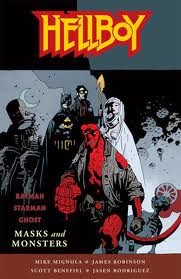
MIKE MIGNOLA'S HELLBOY: MASKS AND MONSTERS

Masks and Monsters consists of two team-up stories. In the first, written by James Robinson and drawn by Mignola, Hellboy meets Batman, but actually teams up with the modern Starman, in a tale which involves modern day Nazis and a plan for world conquest set in the rainforest jungles of the Amazon. The original Starman has been kidnapped, because his research is crucial to the Nazi plan, and it is a tale of rescue, both of a father and the planet. It also reminds us who our real monsters are.

The second story, written and laid-out by Mignola, but drawn by Scott Benefiel and inked by Jasen Rodriguez, teams Hellboy up with Ghost, a spirit avenger armed with two non-spectral .45s, to fight another plan for world domination. This one comes from a resurrected spirit of an ancient Babylonian god, but derives from some brutal murders back in 1939. Since Hellboy is the world's greatest paranormal investigator, this is paranormal worthy of his talents.

Both stories are entertaining, showing different sides of the Hellboy character, which is a facinating one: The Thing combined with a hard-boiled detective perhaps. But I couldn't escape the idea that they would have been better had the drawing assignments been switched. Benefiel's art works best with highlighting the combination of spectral qualities and pin-up looks of Ghost, but might have been even better suited to the rumble in the jungle, although I accept the early part of the story set in Gotham City is perfect for Mignola's own art. Mignola's darkness, the hard-angles shadows and hard-edged almost abstract figures, is in a line that goes from Kirby through Steranko, and Chaykin, and I couldn't help but feel it might have adapted itself to the almost Dr Strange quality of the Ghost tale.

But the other thought which I couldn't escape was that the better team-up of these characters might have been Batman and Ghost. They are both driven by the urge for venegeance, to an almost sociopathic level (of course Ghost is a ghost). The Ghost's costume aims more at the flesh than the ectoplasm, but you see the point. It's a natural team-up, and a woman already dead is perfect for The Batman, if not Bruce Wayne. But when I looked at her twin .45s I could not help but thinking of The Shadow, the most obvious stylistic precursor of The Batman. And I discovered quickly that Dark Horse had indeed done a team-up with them: that's something I now will have to check out.

Hellboy: Masks and Monsters by Mike Mignola et al
Dark Horse Books 2010, $17.99,  ISBN 978595825674

Tuesday, 7 January 2014

ARNALDUR INDRIDASON'S OPERATION NAPOLEON

On the surface, the glacial surface, Operation Napoleon is very different from the Erlendur novels which have been so successful for Arnaludur Indridason. It's a fast-moving thriller, about a Nazi bomber lost in an Icelandic storm in 1945, which the Natnajoekull glacier gives back in 1999. And it's an airplane that the US wants desperately to retrieve, and retrieve in absolute secrecy.

Indridason handles the thriller neatly, building the plot elements slowly, with the same misdirection thrown out by the authorities—the thriller element, will the Americans get the plane, and more important get away with what they do to protect their secrecy, is well done, but the real thrill is in the mystery, as we weave our way through the misdirections thrown out by the authorities.

But the real story is the struggle of a young woman, an Icelandic bureaucrat called only Kristin, to find out what has happened to her brother, leading a rescue party, who stumbled across the recovery operation, phoned her, and was tortured and left for dead. And that struggle illuminates, in stark detail, some of the differences between the Icelandic and America character, in the wake of the whole debate about Iceland's role as a key point in the military web of the USA. It is a case of simple versus complicated, nuanced against simple, straight-forward against very crooked indeed. And it's one Indridason obviously relishes.

He stacks the deck somewhat, in a playful way that for me undercut the suspense. The two intelligence agents chasing Kristin are called Ripley and Bateman, who are of course two of American fiction's most memorable sociopaths. Which makes a comment, in its way. The original commander, trying to recover the plane back in the Forties, is called Miller, which suggests the simplicity of the so-called 'greatest generation'; and the two Icelandic brothers who originally witnessed the crash seem to share some values. While his replacement in 1999 has a Lithuanian name, Vytautus Carr, which kept me thinking of Red October, while the man he puts in charge on the ground is called Ratoff, which seems a bit of overkill.

If the secret, once revealed, is a little anti-climactic, and somewhat unconvincing (it all happened, obviously, despite the crash) it's an audacious plot that reflects back on the roots of our modern malaise; perhaps the greatest generation weren't all so great after all. It's impressive to see Indridason turn from the slow build of tone in the Erlendur series to something far more staccato, and do it so well.

Operation Napoleon by Arnauldur Indridason
translated by Victoria Cribb
Vintage, £7.99, ISBN 9780099535638


Monday, 30 December 2013

MAX ALLAN COLLINS' WRONG QUARRY

The Wrong Quarry is the latest of Hard Case Crime's revival of Max Allan Collins' novels featuring the hired killer Quarry, who now has become a hitman with a difference: Quarry tracks other hitmen, identifies their targets, and then gets himself hired to kill the killers, before they kill the victim. And for a extra fee, he can eliminate the person who hired the hit in the first place.

This time he is stalking a killer named Ronald Mateski into a small town in Iowa, where a popular high school beauty queen has disappeared, and where someone appears to have hired Mateski to take out the police's top suspect. So Quarry, posing as a journalist, starts investigating the disappearance, and decides the killer's target is someone worth saving. For a price.

When the Quarry books first appeared in the 1970s, they were Collins' second attempt at criminal protagonists with single names, following the Nolan novels, about a professional thief clearly influenced by Donald Westlake (Richard Stark) and his Parker. What made Quarry different was the fact that he wasn't a thief who would kill when he had to, but a killer, who killed for a living. This is a step further along the road anti-heroes walk, and Collins upped the ante by doing the books in the first person, the classic private eye narration he would later use to such good effect with his Nate Heller novels.

The problem, obviously, is that the reader inevitably is drawn into identifying with the protagonist, seeing the world from his point of view, and the viewpoint of a psychopathic killer is a difficult one with which to engender empathy. So Quarry, in some ways is a kinder, gentler sort of killer—his current twist on the hitman business indicates that—and occasionally his tastes and world view seem very mundane for such a hard man. With Nate Heller, we know we aren't dealing with someone detached from the reality of the mundane world. But we don't imagine Parker browsing the wire racks of stores for western paperbacks, much less sharing the authors' names with us, as Quarry does. But Collins does a slick job of never letting us forget what Quarry really is all about—and the conflict between what he is and what we might want him to be is the key to the tension which animates the novel.

The second strong point is the period setting, in the mid 1970s, and the style, which is drawn from the Gold Medal and other paperback originals whose heyday was ending in those times. Collins is excellent in establishing not just the milieux, but also the world-view of the era—so when Quarry gets seduced by a sweet high-schooler it comes in a sort of garish overkill of wanton lust that surprises and even shocks a modern reader, as if that reader were back in the more modest world of those lurid paperbacks. There are a number of twists to the tale, and the eventual resolution actually reveals a character who's very much a modern-style villain, a serial killer who in effect hides in plain sight, behind the camouflage of the era's attitudes toward sex. It may be set in the 70s, but Collins is writing with the real flavour of pure 50s and 60s pulp, and The Wrong Quarry works brilliantly on those terms.


The Wrong Quarry by Max Allan Collins
Titan Books/Hard Case Crime, £7.99, ISBN 9781781162668

NOTE: This review will also appear at Crime Time (www.crimetime.co.uk)

Saturday, 28 December 2013

ARBITRAGE: RICHARD GERE PLAYS WALL STREET

As Arbitrage opens, hedge fund manager Robert Miller has it all. He's being interviewed about his successful investment career, he's headed back from a meeting to arrange the merger of his company with a major British bank (whose head is played by Vanity Fair editor Graydon Carter, no less) and he heads home for a birthday celebration, surrounded by his family in a setting that reflects warmth.

But we learn quickly that things are not the way they seem. Robert heads off to see his mistress, a young French woman for whom he's bought an art gallery. The merger is not progressing as it should, and we discover he's had to take a $400 million loan to cover a bad investment in Russian copper mines. And then, late for the opening of a show at the gallery, Robert takes his mistress for a drive upstate, falls asleep, and crashes the car. She is dead, and he needs not to be involved. He finds a pay phone, and calls James, the son of his former driver, who owes him for the way he helped the family, and him with his own criminal charges, and gets picked up. He gets home, with bruises and maybe internal injuries, at 4:30 in the morning. The police, suspicious of the crash scene, soon track him down, and the pressures start to mount.

Written by first-time director Nicholas Jarecki, Arbitrage could be looked at as an indictment of the rich, or of the system that rewards betting against people (Miller made a killing forecasting the collapse of the housing bubble). But Jarecki is not following in the footsteps of his documentarian brothers Andrew (Capturing the Friedmans) and Eugene (Why We Fight); he already did that with his first feature, the doc The Outsider. At times the film recalls an older era of financial excess, reminding me of Wall Street or Bonfire Of The Vanities, but despite the fraud and the accidental death you cannot escape, this film is far more about the character himself, and about the way an audience cannot resist taking the side of a handsome hero who has the odds stacked against him, even when he is guilty, and even when he is revealed almost soulless underneath his charm.

He's lucky, in this sense, to have Richard Gere in the lead. Gere's always been underrated—his Golden Globe nomination for Best Actor for this film was his fourth nomination for a Globe (he won, oddly enough unless you recall it's the Golden Globes, for Chicago), but he's never been nominated for an Oscar or a Bafta mask. Perhaps it's because of his looks, or the slightly ingratiating way he plays nice. In fact, there's a lot of Edward Lewis from Pretty Woman, in Miller at the start. But what Gere brings out are the same qualities that made his performances in American Gigolo and Internal Affairs so powerful—a combination of self-absorbed interest and ruthlessness under the surface. It's his real strength--conveying a reality different from the handsome surface that suggests likeablility, either the blankness of American Gigolo or the true venom of Internal Affairs.

Jareck is also helped by the cinematography of Yorick LeSaux, which sets the feelings in contrasts, of cold glass offices, warm family rooms, harsh police rooms, and then blends them all together bit by bit. And it's bit by bit we see him lose his allies and his family: when his daughter (Brit Marling), who is CFO of his company and from whom he's concealed the book-cooking that hid his losses, finds out, he corrects her. They are not partners, he says. She works for him. He is a patriarch, he says, and he does what is best for everyone. All she needed was an apology, not a demonstration that all the platitudes were just platitudes.

There are moments when some feeling shows through, and because this is a thriller, he is allowed a triumph. After all, his first instinct, overcome, was to call 911 after the crash. He is about to turn himself in, and save James (a nice performance from Nate Parker) from jail for obstruction, when he has an idea which throws a monkey-wrench into the evidence the police have cooked against him. He realises his deal is being held up simply to lower the price, so he forces the issue, makes a deal he can life with, and guarantees his childrens' jobs. It's win-win.

And then, the one base he hasn't covered comes back to bite him in the neck. His wife (Susan Sarandon) who cannot forget the way he brought his affair nearly into the house, but who even more cannot forgive the way he treated their daughter. It's a neat twist, because the very family values he was trying to protect prove his downfall.

But the movie ends at a charity gala, his wife's work, where his daughter introduces him as her 'mentor, friend, and father'. He has lost everything, but everyone is smiling. The charity is the Robert Miller Oncology Center. It is as if he is a cancer himself.

Arbitrage (2012 US 2013 UK) written and directed by Nicholas Jarecki, is on DVD release

PHANTOM LADY: THE NOIR FUNHOUSE

I watched Phantom Lady tonight, marvelling yet again at the way Robert Siodmak and cinematographer Woody Bredell create a series of weird shadow-worlds, as if Manhattan were a kind of fun-house, and we're looking at it in a distorting mirror, except when we see beautifully clearly, and it becomes threatening, scary. They would work their magic again two years later on The Killers, where the noir world is starker and harsher, more fixed into what we now imagine it to be. There's a fascinating comparison to be made here too: the fatalism of Swede at the start of The Killers and in the Hemingway story is matched by the fatalism of Scott Henderson, once he's convicted of his wife's murder. He tells his loyal secretary that he can finally sleep, now that he knows his future. This is perfect noir fatalism, helped by the fact that Curtis is perfect as a noir hero, nowhere near as smart as he thinks he is, including not being able to see the perfect woman right before his eyes. In the novel by Cornell Woolrich, you come to believe that Scott may be deluded, and the woman may not exist. In The Killers, Burt Lancaster as Swede is a different sort of fatalist—he's smart enough to know he made a mistake with a woman, and he knows he has to pay for it. There's no question of delusion, just of fatalistic judgement.

The story of Phantom Lady, in case you don't recall or haven't seen it (and there will be spoilers of a sort later) is that Henderson and his wife argued, he went to bar, met an unhappy woman in a funny hat, spent the evening with her, and came home to find the cops all over his flat and his wife murdered. He needs to establish his alibi, but the woman can't be found, and the witnesses deny she was ever with him. So his secretary Carol (or 'Kansas', as Scott calls her, because she's from Topeka) goes on the search.

Between Scott's gloomy night on the town and Carol's search, we are presented with a cross between an odyssey and sideshow (when you think about it, isn't the original odyssey a bit of freak show too?). The city takes on the character of a nightmare world, and the population turns out to be seriously unbalanced. Carol stalks the bartender who served Scott and the woman, shot brilliantly at the end of the bar, staring at him. In cheap disguise, she becomes a 'hep kitten' and hooks up with the drummer (Elisha Cook, Jr.) who gave the woman the eye when she and Scott went to a show—Cook takes her to an after-hours jam session playing Gene Krupa hophead drums completely out of time, occasionally out of all semblance of dubbing the Krupa solo. Ella Raines is superb as Carol—not just in her disguise but in the way she hides her feelings from her boss, and the way, the first time she actually calls him 'Scott' it simply zips past him but satisfies her.

Thomas Gomez, always so threatening in noir, is good as the cop who tries to help her but the top-billing in the film went to Franchot Tone as Scott's best friend, who of course is the killer, though they try to make his entrance into a shock. The mere fact he's top-billed in such a relatively small is all the clue you need. Tone is well cast as a psychopath, because he looks more like Jiminy Cricket than a leading men, and he does overplay the twitches of his killer; it reminded me of a bigger version of Tim Robbins doing a retard in Mystic River. There's a sense, though, that Tone would have made a brilliant Cornell Woolrich, had anyone ever done a movie about him—and you could use those sleazy sets from Phantom Lady to shoot it: maybe this was Woolrich exploring the neighbourhood of his own imagination.

Watching the film though, I wondered for the first time why Raines needed to find the woman in the hat at all. In the trial montage scenes, the prosecution fixes the time of the killing at 8pm, and we know from the bartender he was in the bar at 8:05. He doesn't need the woman for an alibi. By the same template, his friend's alibi, that he was on boat sailing for Brazil at 8:30 should not have eliminated him either. I'm sure there's a reason why it doesn't that is just as convincing as Cook's drumming, or Tone's twitching. It doesn't matter—Phantom Lady is a film you can get lost in, at your own peril.

One other note: I watched the film on You Tube, where there's a sort of time-code bar at the bottom of the player. When Raines goes to visit Curtis, the guard tells them they can have only five minutes. It's 9:40 into the film. He comes back to tell them time's up at 11:40 into the film. No cuts or dissolves.That's only two minutes, anyway you shake it. That guard could get a job as timekeeper at the Royal Rumble.

Sunday, 22 December 2013

ROBERT CONROY'S 1862

Following on from the anniversary of the Gettysburg Address, I chased down this alternate history novel I'd been meaning to read for a while. There's a long and distinguished tradition of alternate Civil War books; when I was a kid I read MacKinlay Kantor's If The South Had Won The Civil War—Grant dies in a horse fall just after Vicksburg, the South wins at Gettysburg, and the two separate nations become three when Texas seceeds from the Confederacy. Lee, as President of the Confederacy, frees the slaves, and eventually the US is reunited. I read Ward Moore's time-travel novel, Bring The Jubilee, in which the Union, again having lost at Gettysburg, is weakened and much industrial progress never happens (except, of course, for time travel). Harry Turtledove has approached the question from both angles; I've read his time-travel version, Guns Of The South, in which South Africans travel back in time to supply the Confederacy with automatic weapons to ensure a slave nation persists.

Robert Conroy's 1862 is a straight-forward alternate history, in which the blowback from the Union's seizing of the British mail packet Trent, carrying two Confederate ambassadors, grows into a declaration of war against the US, helped by an aggressive Lord Palmerston and a nebulous 'promise' from Jefferson Davis that the South would abandon slavery.

Conroy's take on the ensuing conflict is ingenious, helped by Lincoln and Winfield Scott recognising early the unique abilities of Ulysses Grant. How realistic this is, given the political troubles Lincoln faced, as set out in T. Harry Williams' Lincoln And His Generals. Grant's ambiguous standing within the regular army, is another interesting question, but there is no doubt it makes a huge difference. Grant leads a force against Canada, while the Union forces are able to hold back Lee's Army of Northern Virginia, and the judicious use of snipers has disastrous results for the Confederacy. Thus, the British entry, rather than speed up a Confederate victory, has unexpected results.

Some of this depends on a relative and surprising degree of inaction from Davis and Lee, in effect the opposite of his take on Lincoln. One might wonder whether the Confederate plan would have been so passive when joined by their British allies. But Conroy has thought out his alternate scenario well, and it is for the most part convincing. Even his story framework—because you need a relatively neutral (and usually fictional) character through whom the story can be told—works well: Col. Nathan Hunter winds up in the exact centre of the Union decisions, and at the fronts when it matters, without the reader feeling he's been manipulated excessively.

Where the novel is let down is in the writing, which is rarely more than utilitarian, and sometimes lapses into a general sort of anachronism. It's not so much the modernity of Nathan's love-interest, which doesn't actually seem that much out of place—though the introduction of a lascivious French ambassador's wife helps lubricate the narrative—but the tone of conversation, rather less formal than we might have thought. But that is secondary, because Conroy's concern is with background and facts, and he takes great pains with the details. Once the book gets going, it proceeds at great pace, and is an extertaining diversion, and one of the best of the war's alternate histories.


1862 by Robert Conroy
Ballantine, 2006, $7.99 ISBN 0345482379

Wednesday, 18 December 2013

THE PRICETAG OF TRAGEDY: THE NEW YORK TIMES & CANTOR FITZGERALD

In a New York Times article today about the $135 million settlement of Wall Street investment firm Cantor Fitzgerald's lawsuit against American Airlines for negligence on 9/11 the reporter, Benjamin Weiser, led his third paragraph thus:

'No amount of money, of course, could compensate Cantor or its families for the losses on Sept. 11'.

While the platitude may be, in the sense of all platitudes, true, in the context of a newspaper story, it's statement stands as opinion, not reporting. Indeed, were the platitude true in any but the abstract sense, no one would file such lawsuits at all, since the compensation received would be worthless.

But the reality is that Cantor, who had offices in the North Tower of the World Trade Center, and lost 658 employees, about two-thirds of their work force there, claimed they had suffered 'unspeakable losses' and went on to delineate the unspeakable at sums as much as $1 billion, after insurance recovery, specifying $800 million for 'interruption of business' (that is, because of losing their employees) and the other $200 million for property damage. Unspeakable indeed. Currency, it turns out, is America's real currency of grief.

Judge Alvin Hellerstein noted that New York law does not allow an employer to sue for the wrongful death of its employees, and otherwise limited the companies damages. In a separate case, Hellerstein also dismissed a suit by World Trade Center Properties, who apparently had already received more in insurance settlement than they had already lost.

Cantor employees were already compensated either from the federal fund set up for 9/11 victims, or from their own lawsuits. Hellerstein has been the point-man for suits filed by victims' families, survivors, responders, property owners, and the like, all seeking compensation for things which, as Mr. Weiser reports, cannot be compensated. And many, like illnesses caused by the dust raised by the towers' crash, that can.

Had any suits against American Airlines gone to trial, they would have had to prove that the airline had been negligent in preventing a terrorist attack; American would have argued they had done everything expected and required by government experts (ie: by law) before the 9/11 gang used the planes themselves as weapons. The blame might have spread, from that point, to the Federal Aviation Adminstration, or indeed to various government agencies charged with fighting terrorism.

It's also curious that Cantor employees hadn't thought to sue the World Trade Towers, for not constructing a building that would better withstand collapse, or Cantor, for not providing better facilities and training for escape in emergencies. In the 20/20 hindsight world of victims, grief and compensation, it would seem only fitting.

Thursday, 28 November 2013

MICHAEL CONNELLY'S GODS OF GUILT

The Gods of Guilt, Mickey Haller's mentor 'Legal' Siegel reminds him, was Haller's father's term for the jurors in a trial, but, as he says 'there are plenty of people out there judging us every day of our lives for every move we make. The gods of guilt are many. You don't need to add to them.'

Mickey has just won a mistrial by using in court a manoeuvre that has nothing to do with justice and very little to do with law, one that he learned from Legal. He's just smuggled a french dip sandwich into Siegel's room at the old folks home, bending or ignoring the rules just as surely as they would have done in the courtroom. But Haller is about to have his own guilty gods visit him, when he gets called on to defend an accused murderer, an internet pimp named Andre LaCosse. LaCosse has been referred to him by the victim, whom Haller knew and defended under a different name, but who always called him her 'Mickey Mantle', the New York Yankee baseball star. Haller thought he'd saved Gloria Dayton, as he knew her, and helped her start a new life in Hawaii. Now she's lying dead in an LA apartment, and Haller can't escape feeling the obligation guilt invokes.

Even worse, he realises quickly that LaCosse is innocent, and as we know well Haller's worst nightmare is an innocent client. There is a great comparison to be drawn here with his half-brother Harry Bosch: Bosch is driven by his sense of justice, while Haller, the Lincoln Lawyer, is driven by a chaffeur in his town car. Harry is concerned with the result, Haller with the process. It's like the TV series Law & Order, which got it backward: the cops aren't the 'law' part, that's the lawyers. It's the cops who seek to establish order, and the lawyers who manipulate the law, sometimes in the name of justice, but more often simply to win their battle.

Mickey has another god of guilt driving him; his relations with his daughter are at an all-time low after the events of The Fifth Witness, and he needs for her to see him doing the right thing. Which means that Haller needs to prove his client's innocence, and that means he must become a detective himself. Which becomes both difficult and dangerous, as he discovers Gloria's death may be tied into her testimony against another of his clients, and may drag cops and federal agents into the mix.

It's a story that weaves deeper and deeper, with Haller and his team functioning like a 21st century version of Perry Mason and Paul Drake, in a far more dangerous world. The pace is frantic, and sometimes chaotic, just as you'd expect from the Lincoln Lawyer, but it works primarily because of the motivation: the plot is driven by Haller's own drives, and it is from his perspective that we see it. Connelly's greatest talent may be his ability to convey his stories through his characters, and to remain honest with their point of view, and he does that superbly here.

In my interview with Michael (see the previous post), he made one interesting comment. The producers of The Lincoln Lawyer movie remain interested in doing a sequel, but none of his follow-up books have seemed right to them, because they didn't have Haller himself feeling a sense of a mission, feeling that elusive need for justice which I mentioned at the start. This book does that, which is why Haller seems to move a bit into Harry Bosch territory. People have noticed that Connelly writes courtroom thrillers to match the best of them, but this isn't as much a courtroom novel as a real detective novel, with Mickey Haller needing to prove himself a detective. The pieces do fall together in the end, without gimmick, but it's the getting there that marks Michael Connelly's real talent as a writer.

The Gods Of Guilt by Michael Connelly
Orion £18.99 ISBN 9781409134343

note: This review will also appear at Crime Time (www.crimetime.co.uk)