Saturday, 19 November 2011

THE THREE TINKER TAILORS

In 1938, E.M. Forster wrote that, if asked to choose between 'betraying my country and betraying my friend, I hope I should have the guts to betray my country'. You might look at John LeCarre's work, particularly the books now known as the 'Smiley novels' as a profound examination of that point of view, and Tinker, Tailor, Soldier, Spy as its apotheosis. The novel was published in 1975, and the justifiably renowned television adaptation was shown in 1979. It may strike some as foolhardy to make a film of Tinker Tailor now, but in three decades our world has changed. The wars fought by our spies are no longer symmetrical and our perception of the home team in that battle, that nebulous entity called Britain/England, depending on who's speaking and in what context, has taken a battering from years of Thatcher/Blairism. Most importantly, our feelings about the nature of loyalty and betrayal have altered, and that change of our perspective may be the most notable thing in the new version.

The film is a fine adaptation, too, so good it drove me to re-read the book, and then to watch the TV series, which, oddly enough, I had never seen (in my early years in London I eschewed television, in part because I was working at ITN and got enough of it there). The screenplay (by Bridget O'Connor and Peter Staughan) sacrifices, as it must, character for plot, but the way it re-structures that plot, leading with the shooting of Jim Prideaux, not only makes the story flow more like a thriller, and less like a parlour mystery, but also foregrounds the novel's central concern with betrayal. It jettisons some of the supporting cast to simplify things. Where it differs most from the previous versions is in its attitude toward what drives that betrayal, and in its nostalgia for something very different than the things LeCarre wrote about.

It's too facile to say that being directed by a Swede (Tomas Alfredson) means the film falls onto the side of neutrality, but when Bill Haydon justifies his treason on the grounds of aesthetics, the film seems to accept the statement as if he were offering a critique of design, and makes you wonder if Haydon had ever been to the USSR. But in the book and on TV it is clearer that Haydon's aesthetic is his self-view; after all he is an artist, even if not a very original one, and rather than submit to the failed aesthetics of the world in which he grew up, which his paintings represent, he found it more aesthetically pleasing to create his own world, no matter how unreal, which in secret mocked that one. I've always found it odd that Ian Richardson played Bill; he's hardly a charmer, especially to the opposite sex; in my mind he was playing Anthony Blunt (whose own treason was revealed just before the TV series came out). But Blunt's own betrayal was indeed for aesthetic reasons, like those I've just described, and LeCarre was either prescient or imbued with deeper knowledge when he wrote his book.

The other big difference is that the film seems nostalgic for the era in which the book was set, but only to a point. It misses an important nuance there; the book itself was nostalgic for an earlier time—either the pre-war innocence of England or the years of the war itself, when these men were heroes and not so much bureaucrats. Haydon's art speaks to the thirties, and the suits worn by the Circus' leaders speak of that era: chunky tweeds and garish pinstripes, whereas the film's version of the 70s boast thinner materials, thinner ties, thinner lapels. Everything is more sleek, including the Circus itself. Critics praised its grainy reconstruction of its era, but a few moments with the TV series renders that praise hollow. Theirs is a far more shoddy world, one that still speaks of rationing and second-class status. In the film version, gone is the ramshackle HQ of a small British overseas business, stuck into tiny rooms in old buildings—its Circus is a cross between the many warehouse sets of Spooks and the control room of Get Smart.

There are other odd changes too: Smiley is moved from Pimlico to Hampstead (though the address on his letters, strangely, is a building in Kings Cross used for Spooks); he even swims in the pond on the Heath every morning. Gary Oldman's Smiley is a stronger and silenter character than Alec Guiness'; his performance reminded me most of Toni Servillo as Andreotti in Il Divo; Smiley as determined bureaucrat. The Circus' bureaucratic in-fighting is presented along those more European, less English lines as well. This is highlighted by some of the mis-casting, which you see around the Circus 'board room': Toby Jones is too young to be Alleline, and though he catches the ambition he doesn't get the clubbable fatuousness, nor the hint of incipient fascism, both of which were captured perfectly in Michael Alridge's TV performance. David Dencik's Toby is too weak; Bernard Hepton's was a more mysterious character. And although Terrence Rigby's Bland looks the part more than Cieran Hands, both are wasted; Hands' role reduced to a few sinister closeups and threats to maintain your suspicions. Which is the real problem: in the novel and the TV series, the identity of the mole is still a mystery—even though, like Smiley and Prideaux, we intuit it must be Haydon. But in the film, Colin Firth is really the only possibility; none of the others, bar Dencik, are given a chance to establish themselves, but Dencik plays the character too weak to be the traitor. That the film manages to be far more a thriller than the TV series is a tribute to the structure of its script and the pacing of the direction.

The novel is clear about the nature of betrayal, as an outgrowth of secrecy, and sexuality is part of that secrecy; its clarity recalls the Forster quote. Its deeply understated sense of friendship grows from the world of schoolboys to which LeCarre traces the English proclivity for both loyalty and betrayal. For LeCarre, sex is a side issue, a motivator, not a determining factor, and the TV series reflected that. For example, in the novel the relationship between Haydon and Prideaux is explained, if you can call it that, by innuendo—small comments about being close, reports from their university days, all of which require you to read between the lines, and much of which might have been missed by, say, a young American like myself with no grounding in British society. In the TV series, you are almost shocked to see the slight reaction from Ian Richardson when Ian Bannen (an excellent Prideaux) shows up. It should be noted that in LeCarre the only sexual relationship that is actually out in the open, discussed and mentioned freely, is Smiley's, or more specifically, Anne's serial adultery. In other words, only betrayal makes sex an open subject. In that context, Smiley's loyalty to Anne becomes a mirror, if not an explanation, of his loyalty to Britain, and the Circus.
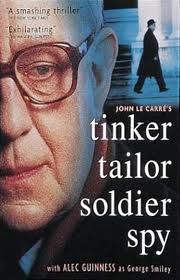
And of course Smiley's own deepest relationship (apart perhaps from Control—and consider the meaning of his service being run by 'control', English self-control, self-restraint, stiff upper lip and all that) is with Karla, whose woman's name is no coincidence. Smiley 'gives' Karla the lighter Anne has given him, inscribed with the ironic-in-context 'all my love', and that becomes a key to identifying Karla's machinations behind the Circus' problems.

All this is grounded in hidden sexuality, but our world today, at least on film, requires that we give sex a more straightforward approach. In the movie, Colin Firth and Mark Strong exchange smouldering glances that leave little in doubt. This is the reason they are there, although  they are,strictly speaking, too young;  it would be a stretch, in the time of the story's setting, to see them as veterans of World War II. In this light, it is odd that they chose to give Peter Guillam (Benedict Cumerbatch) a gay back-story; there is no hint of that in the earlier versions, and there seems no point to it, unless they were worried they needed to balance off the image of gays as traitors. The film's sexuality does work much better on one level, however, and that is in the relationship between Ricki Tarr and Irina, who is far more beautiful in the film than she was on TV, and whose fate is shown in a moment that helps condense the plot. Moving Prideaux's betrayal from rural Czechoslovakia to a Budapest cafe is fine for its time-saving, but moving the Tarr scenes to Istanbul is a fine change that allows fewer religious overtones to Irina's conversion, and more standard spy intrigue. Interestingly, Tom Hardy's Tarr is probably the single role in the film that comes closest to the interpretation in the TV series (by Hwyel Bennett) while Svetlana Khodchenkova's Irina is very much a figure of sexy glamour, where Susan Kodicek's had been partly religious and partly non-glamorous in exactly the same way the service is presented throughout.

This ties in with the decision not to show Mrs. Smiley, which is pretty much true to the book, although it ends with Smiley anticipating her return to gather him up. The TV film added a postscript of sorts—with Sian Phillips perfect as Anne—which uses her to sum things up: Bill 'loved being a traitor', and she misses one opportunity when Smiley asks if she loved Bill, where she could have echoed ironically Smiley's earlier answer 'not really', but she also sums him up. 'Poor George,' she says, after telling him she didn't love Haydon. 'Life's such a puzzle to you isn't it?' Meanwhile Smiley fiddles with his glasses, and resets them over his eyes, perhaps seeing straight again. Anne is very much a presence in the film, but in a very clever way, seen only from behind, and with a flower in her hair to symbolise some sort of exotic and old-fashioned glamour, perhaps someone trying to retain their youth.

The film adds a few other inventions which are improvements, not all simply because they're needed in the restructuring which turns it into a literal thriller. John Hurt is particularly over the top as Control, and that works. The Christmas party scene is the one contrivance which actually harkens back to the LeCarre point of view, the one time you get that sense of the Circus as a second-rate British overseas corporation. And the moment Santa enters as Lenin and everyone sings the Soviet anthem in full voice is brilliant. The modern ethos seems reflected too in Connie's new status: from a dump of a flat she has moved up the property ladder to a lovely detached house in Oxford, and though Kathy Bates needs to be more crucial in this condensed plot, it is hard to top Beryl Reid's Connie for pathos.

And although Haydon's artistic career doesn't play the part in the film it did before—hence the problem with the 'aesthetic' argument; Haydon is not, after all, a very good artist—it is a signal that he is off-kilter. Colin Firth's performance is exceptional, particularly in catching what LeCarre described as the 'pewter' tone of Haydon's eyes after his interrogations. His louche pose, slipping on chukka boots, would be something Richardson would not do. He wouldn't wear chukka boots! But of course much of the rest, including the looks exchanged with Mark Strong's Prideaux, is stuff we've seen before from both actors; for that Firth could have wandered in from the set of A Single Man.

But the most telling re-doing is Prideaux's relationship with the schoolboys. Prideaux, after all, is the key character, the one who is personally betrayed by the man he idolises and loves, the man with whom he has the exact sort of schoolboy relationship envisaged by EM Forster. In the novel and TV series his car is something old fashioned, 'best of British,' an icon which represents the illusions of a lost past which he is conveying to the boys he teaches. LeCarre is pretty clear about this: in the novel we again intuit that Jim has killed Bill because the manner of death has been foreshadowed a couple of times, most notably when he kills a bird in front of the schoolboys. On TV we see it, but it's a face to face killing, a small discussion of betrayal followed by anger. And although there is no discussion between Jim and Bill in the film, the face to face is reduced to Jim's seeing him through a sniper scope, the look on Colin Firth's face is one of what, resignation? Perhaps invitation? And we sense Jim may even be doing him a favour.

We know the myopic Jumbo could well be the schoolboy Smiley—the kind of boy who could grow into Alec Guiness' huge spectacles. But he can't really become Gary Oldman's Smiley, and that is probably why there is such a significant change in Strong's Prideaux, whose car is a junker and who, after killing Bill, reacts to Jumbo with fury. In LeCarre, traditions carry on, and public schools will continue to produce men increasingly unsuited for the non-imperial world—Camerons and Osbornes and even non-men like Stella Rimington. For Alfredson, it's different. You might read Strong's rejection of Jumbo as a rejection of the weak or you might read it as a rejection of the system. In the latter reading, Prideaux becomes a sort of disillusioned hero, the only one in the game willing to give it up because it's at heart corrupt, or at least disfunctional. But I prefer to see it as Alfredsson's way of suggesting the circle has been broken here, and Prideaux will no long participate in grooming boys for the system that feeds the Circus. I love the ambiguity here, but it bothers me because of what follows.

Which is the triumphalist ending, undercut by the ironic use of 60s pop song 'La Mer' as Oldman's Smiley sits in the control seat in the Get Smart set. It doesn't really work. Smiley is in charge, but as we know from LeCarre, this is not really a triumph: it is only the first step in his becoming what he is closest to. For me, coming back to the 1970s versions, artefacts of the time I arrived in this country, but with the knowledge I have learned over all this time, the depths of its predecessors seem something the film cannot match. But I am also acutely aware that there is a generation of film-goers now as ignorant of that Britain as I was when I arrived here, and this is a film pitched for them, and, as I have said, an excellent one, for me too. I am not criticising the film for not recognising what is after all outside its purview; but I wonder if, even within its own terms, that was way it ought to end.

Tuesday, 15 November 2011

THE NIGHT THEY DROVE THE CANDIDATES DOWN

Sometimes it really does seem like you couldn't invent this stuff...but while reading about Herman Cain's defenses of both his past as an employer of women and his present as a tabula resa in terms of Libya and other parts of the rest of the world, the opening line of The Band's 'The Night They Drove Old Dixie Down' ('Virgil Cain is my name/and I served on the Danville train') and the resentment which provides the emotional core of that song seemed to fit our current Tea Party world, that the rest of this just happened, as they say...so peace out

THE NIGHT THEY DROVE THEM DEEBATES DOWN
Herman Cain is my name
and I worked on the pizza chain
til Bachmann's insanity came
and tore up the prim'ry campaign
in the winter of 2011
I was trailin, barely made news at seven
Then came the babes with the stories to tell
It's a time I remember oh so well

The night I drove her forehead down
Liberal media grinnin
The night she claimed I felt around
Fox News pundits were spinnin
They went, gag gaga gag gaga
Gaga gag gag gaga gag gaga....

Back on the stump in Tennessee
Politico says to me
Herman quick come see
We've got the testimony
And one week later when it all came out
Said I don't know what you're talkin about
Don't remember that woman, not at all
And the settlement's somethin' else I don't recall

The night they drove the candidates down,
And it's just beginnin
The night they drove the candidates down
Why can't we do our own spinnin
Goin gag, gaga gaga gag
Gaga gag gag Gaga gaga gag

Out on the stump in Richmond town
Said 9-9-9'll bring your taxes down
Tea party they gave a frown
said it's just 666 upside down
Now it may be the devil who made me grope
But for tax policy there still must be hope
If I'm President, I'll make the country fine
And if I dont, at least I got mine

The night they drove them deeates down
The tea party was grinnin
The night they drove them candidates down
Cause Mitt Romney weren't winnin
They go, gag gaga gag gag
Gaga gaga gag gag gaga gag

Met with the papers in Milwaukee
And what did they say to me
Herman, do you agree
With Obama's take on Gaddafi?
Well, OK, so I answered slow
And I had to admit that I didn't know
WTF, it's only President,
Bush knew shit from Saddam and look where that all went...

The night they drove them deebates down
What was it they expected?
They night they drove them candidates down
Jes tryin to get elected
They went gag gaga gaga gag
Gaga gaga gag gag gaga gag

Like Rick Parry before me
I forget and smile
Unlike Mitt Romney longside of me
I'll hold a view for a while
Now I don't mind choppin Michelle
Santorum? Already gone to hell.
But if the voters notice what I lack
I'll say it could be worse, cause I could be Barack!

The night they drove them candidates down
Liberal pundits all grinnin
The night they drove us candidates down
Fox News says I'm winnin
they're all hah hahaha haha, haha haha hahahaha ha

Tuesday, 8 November 2011

SMOKIN' JOE FRAZIER: IN MEMORIAM

It was Joe Frazier's blessing and curse that he shared center stage in the squared circle with Muhammad Ali, and their rivalry may be the greatest of the sporting 20th century, better than Bill Russell and Wilt Chamberlain, Palmer and Nicklaus, Borg and McEnroe, because it took place in the one setting most revealing of a man's character, courage, and self-awareness.

It helps that Frazier and Ali were perfect complements to each other. Out of the ring Ali was pretty, loud, egotistical—a presentation he'd learned studying pro wrestlers. He often had another agenda, and he played it out perfectly. Joe was rugged but not beautiful, softly spoken, and straight forward in what he said and what he did.

The same applied inside the ring. It's not enough, nor is it true, to say they epitomised the 'boxer versus the puncher' matchup—you want a classic for that watch Kenny Buchanan against Roberto Duran. Rather, it was that their behaviour in the ring echoed perfectly their characters outside it.

Ali's boxing style kept his face from being hurt. He was the quickest heavyweight any of us had ever seen, both with his dancing feet and his ability to pull his head back out of range in a flash. His punches, with their twist on the end, weren't knockout blows, but damaging in their own way.

Smokin' Joe, by contrast, was willing to sacrifice himself to get into punching range, taking a beating in order to give one, and once he got close enough he inflicted hammering drill-press pain, with a left-hook that destroyed right-handed punchers. He was Rocky Marciano, in a lot of ways, and once Eddie Futch taught him to bob and weave coming forward, he was as close as boxing gets to an irresistible force.

The shame of their three meetings is that Ali, having been stripped of the title, didn't get to work his way through the other contenders, and face Frazier with his hand and foot quickness intact. When they met at the Garden for the first time, a few days before my 20th birthday, I listened to the fight on the radio. I was a war-protesting pseudo hippie jock trapped into a love of competitive sports, and Ali of course symbolised the meeting of those two worlds so I was cheering for him. But even in the radio commentary I could tell that Joe was dominating, coming forward, taking the fight to Ali. The beauty of their fights is that Ali proved he had the courage to match Frazier at his own game, enduring inhuman punishment, until in the monumental rubber match, it was Futch who threw in the towel after the fourteenth round.

People remember that Ali won the gold medal at the Rome Olympics in 1960 (but often forget it was at light-heavy) but not that Joe won the heavyweight gold in Tokyo four years later. His path to the medal wasn't easy, because he lost at the Olympic trials to Buster Mathis, who drove Joe crazy in the amateur ranks. When Joe lost to Mathis at the Olympic trials he complained that the Baby Huey-shaped Mathis pulled his trunks so high ('up to his titties') that he was penalised two points for a low blow that went right into Buster's ample midsection. But Mathis pulled out of the '64 Olympics, and Joe, despite breaking his left thumb in the semifinal, won the heavyweight gold. He would later destroy Mathis when they met as pros.

Frazier's pro career is odd, in that, having come up later than Ali, he never fought Liston or Patterson, he missed Ernie Terrell and Cleveland Williams, and after Ali he somehow never got in the ring with Ken Norton. His best fights, apart from Ali, were probably his first against Oscar Bonavena, who knocked him down twice, the stoppage of George Chuvalo (both those guys made Joe look like Ali), the first win over Jerry Quarry, which was probably Quarry's best fight, and the first over Jimmy Ellis, the Ali sparring partner who won the 'tournament' to replace him as champ, a tournament Joe refused to fight in. Joe Bugner gave him a tough fight losing a 12 round decision, and the one I remember well is Frazier's quick win over Bob Foster, the exceptional light-heavyweight, who was tall and skinny and nearly knocked horizontal in mid-air by a Frazier punch. But here's the rub: Ali had half a dozen fights besides the ones with Frazier that were legendary, or close to it. Frazier really had only the ones with Ali.

He lost twice to Ali, and twice to George Foreman, who was an immovable object if ever boxing produced one. Ali watched Frazier's irresistible force rendered useless and figured out what he'd have to do to beat Foreman, and he knew, having survived three fights with Joe, he could take the punishment. He paid the price down the line, as we all know. Joe saw Ali extending his career for big paydays, but his own comeback lasted only one fight, an awkward draw with Jumbo Cummings, and he retired for good.

Joe's legacy will always be entwined with Ali's, and it's important to remember how badly Ali treated him. Joe refused to participate in the WBA's tournament when Ali was stripped, and he wrote to President Nixon asking that he reinstate Ali. He actually loaned Ali money to keep him going when he wasn't boxing, and making a living speaking on college campuses. He thought they were friends, and he'd stood by his friend.

Then, when the time came for them to be matched, Ali launched into his full pre-fight hype mode, calling Joe an Uncle Tom, a gorilla, dumb, and all the rest, which not only infuriated Frazier, but hurt him. You could see his anger in the first fight, which otherwise he might have approached with some reluctance, in a business-like way. But Ali had made it personal, and both guys took a lot of punishment as a result.

Smokin' Joe was pretty fine as a singer too, with that Philadelphia sound—something that is often overlooked. He wasn't dumb by any means; but there was still a lot of rural Beaufort, South Carolina rather than urban Philly (or Louisville, for that matter) in him. He was funny and quick-witted in interviews, but that side of his personality would always be overshadowed by Ali. As would Joe's entire legacy. There is no shame in that—Ali is undoubtedly the biggest worldwide sports personality ever-- but there is shame if we don't remember just how good, how straight-forward, and how important Joe Frazier was. He was everything heavyweight boxing was supposed to be, and, since the days of Ali and Frazier, has not really been for a long time.

Monday, 7 November 2011

LONDON FILM FESTIVAL: IDES OF MARCH

Sometimes it seems as if George Clooney wants to single-handedly re-interpret America's last great Golden Age in terms of the paranoid politics of today, as if to make the world safe for an heroic sort of Kennedy liberalism. Although he reached back to the Fifties to recast TV newsman Edward R Murrow as the forefront of the campaign against McCarthy-ism in Good Night And Good Luck, it's more instructive to see the CIA reduced to a Chuck Barris gong show, or Fail Safe's Col. Jack Grady given a conscience but still carrying a full payload of paranoia strong enough to conclude both the President and his own son are Soviet dupes.

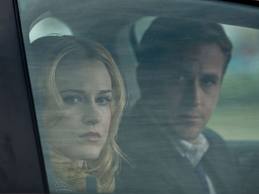
His latest film, Ides of March, which received its world premiere at the London Film Festival is really a reimagining of The Candidate, which highlight the differences between Clooney the director/star and the approaches of both Michael Ritchie, a sharp social critic, as the Candidate's director and Robert Redford as its star. Ides transfers the focus from the candidate, Governor Mike Morris, played by Clooney, to his number two campaign chief, played by Ryan Gosling. In a neat transfer from The Candidate, here it is the political pro who is the idealist, who believes in the candidate, and the candidate himself is, at best, already a seasoned pol. But just as crucially, we can imagine Ides Of March's storyline beginning exactly at the point The Candidate ends, with Redford as Bill McKay, exchanging glances with the young campaign worker slipping into a hotel room. That moment symbolised McKay's corruption in the way American political films—and I extend this to documentary as well as fiction-- see their politics: in personal terms.

The difference between the two films is primarily that Clooney starts from an assumption that we all know our institutions are corrupt; he is building on the revelations which spawned films like The Candidate. That the professionals are running the show, that ideals are sacrificed on the altar of vote-getting expediency, a revelation in The Candidate, here is taken for granted. The play on which the film is based was called Farragut North, after a Washington DC street off K Street where lobbyists and consultants make their lairs. Therefore the crucial change of focus is from the candidate himself as idealist to the campaign manager as idealist—the somewhat contradictory idea that Ryan Gosling's Stephen Meyers is a ruthless professional who could be in this sleazy business for idealistic reasons. That he is out-smarted by Morris' opponent's campaign chief, Tom Duffy, played by Paul Giamatti reprising Allen Garfield/Goorwitz's brilliant performance from The Candidate, is not a surprise; that the weakness on which Giamatti preys is Meyers' boss Paul Zara's (Phillip Seymour Hoffman) sense of loyalty—Hoffman in a sense is playing the Peter Boyle character from The Candidate, but he is playing it as PSH in standard mode. Although the term 'anorak' doesn't really exist in America, he wears one, and plays it as one; the most predictable scene in the film is the one where he gets the push from Morris. It's a shot of the car in which the dagger is being used, and when Hoffman gets out, and the car drives away, you can predict the slump of the body within the anorak.

Because this is America, the crucial betrayals are not political but personal—and it's hard to figure out whether Meyers is more incensed because Morris is shown to have sexual feet of clay, or because Molly, the campaign intern he's sleeping with (Evan Rachel Hunter) has 'cheated' on him. Intern sex reflects the post-Clintonian reality of political morality, which is specifically referenced twice: first when we learn the Republicans are more ruthless, better organised than the democrats-better at the process of politics, the perennial lament of the headed-for-extinction liberal. And second when we learn that the one unforgivable political mistake is 'fucking an intern'--all else, including starting wars, pales into insignificance.

That Meyers first lets Molly down and then appears to threaten her with exposure causes her suicide, and puts him in the position to be able to blackmail Morris indicates the key thrust of the film. Although Clooney the actor handles Morris' 'reveal' brilliantly. It's always fascinating to me how powerful Clooney can be playing against type. He's our Clark Gable, but he has darker depths. And like Gable, he's not very good at comedy, though unlike Gable he keeps trying. Clooney the director isn't so subtle about the reveal: both Morris and Gosling's Steven are cast in half-shadow, to emphasize the duality of their positions, the choices they make. It's shot wonderfully by Phedon Papamichael, who alternates the styles of campaign documentary and neo-noir with aplomb. The film reveals its origins as a play – it is opened up but everything of importance takes place in small encounters, and the mobile phone plays an important role in delivering outside news. But the real point of the film is never politics, but love.

This is born out by Marisa Tomei's turn as Ida Horowitz, the obnoxious (and Jewish—pointedly so) reporter for the New York Times, who keeps telling people she loves them and reminding them that love means nothing. In that sense, we see Giamatti's seduction of Gosling as more telling than Molly's seduction of him, and we realise that Molly's weakness may well be believing in love more than politics. It is interesting that the scene in which Gosling rings least true in his role comes in the bedroom, where he's revealed to be far more buff male beefcake than you'd expect from a campaign manager—more American Psycho than American Politico. But again, that may be the point. And the reversion of Molly to helpless girl, female victim of morality (her family is Catholic) may well be more a comment on the false morality of American politics than an attempt to send the women's movement back to the Sixties.

There are a few practical problems. That Molly is the daughter of the Democratic Party's chairman means that Mike Morris would know her as well as Paul Zara says he does, and Stephen would likely be at least aware of who she was. Would Morris thus choose her to sleep with? After her death would no one do an autopsy that would reveal her recent abortion, and then check local clinics? Did no one ask Stephen why he happened to go to her room where she was found dead? Did no one try to trace her phone? But those are the kinds of question you'd ask in a crime film, not a political drama.

The revelation that politics are corrupt, or hypocritical, is hardly earth-shaking. It's easy to see Ides Of March as longing for some more innocent reality, but such innocence may never have really existed, we George Clooneys just believed it did because the media (and movies like The Candidate) hadn't revealed all to us. This film is earnest in its liberal way, well-played and well-made, but it really reveals very little.

Ides Of March directed by George Clooney
screenplay by Clooney & Grant Heslov and Beau Willimon,
based on Willimon's play, is on general release

Friday, 4 November 2011

JOKERS ARE WILD

When Bob Kane and Bill Finger were producing the Batman, the villains were influenced heavily by Chester Gould's Dick Tracy. They were often bizarre, barely human creatures which reflected a perception that criminality was an aberration, out of pace with normal human behaviour. In one sense, they were ogres from children's bedtime stories; think of the Riddler, the Penguin, or Catwoman, yet not really threatening in a real-world sense. Yet even in those days of more straightforward comic books, and even through the Sixties rebirth of the Batman as an icon of ironic camp culture, there were a few villains who hinted at darker depths, and touched more sensitive areas. Two Face is a brilliant creation, a basic psychological trauma personified, but the key adversary for every version of the Batman has always been the Joker, and no matter how camply the caped crusaderwas portrayed, no matter how comic the Joker became, he was the one villain who can never quite hide the basic frightening instability that serves as the perfect foil to the Batman's obsessive quest for revenge against crime itself. He was and is the one villain who personifies the chaos which is what we all ultimately fear.

This is the spirit which is captured brilliantly in Batman: Going Sane, written by JM DeMatteis and drawn by Joe Staton and Steve Mitchell, in which the Joker, having 'killed' the Batman, discovers both 'normal' life and love. DeMatteis' story pulls no punches, but is based on the perilous ying and yang between hero and villain; without the Batman, the Joker remains haunted by an emptiness even love cannot fill, while the 'reborn' Batman cannot conceive of a world in which a Joker reborn as an ordinary man can exist. The artwork plays this dichotomy well: often harkening back to the simplicity of 'comic' books, but always bordered with darkness that occasionally is allowed to take centre stage, as in the dramatic moment when the Batman announced to Jim Gordon 'I'm back'. But the studied plainness of the Joker's life as a citizen makes a strong contrast, and the way he edges back to his Joker-madness is an intercut sequence of rough brilliance.

The real key to the modern Joker is the embrace of his madness; some of the artists who've approached him recently assume there is no top over which they cannot go. But he's such a brilliant creation, such a representation of the appeal of the madness, that they may be right. But notice the story's title: this is not really the story of the Joker's 'going sane', it is the struggle of the vengeance-stoked Batman to regain his sanity, and not surrender to the Joker's world. Mitchell's heavily-inked lines remind me of Frank Robbins, and serve here to remind us of the harsh borders of the world these two antagonists inhabit, and the equally wide lines that delineate order from chaos. It's that response to chaos that makes this such a touching, and indeed powerful, story.

Appended to it is a story called 'Gotham Emergency', written by From Hell artist Eddie Campbell and Darren Sears, and drawn by Bart Sears in a style nearly as dramatic but somewhat slicker as Going Sane, which draws on the thing that has lain at the centre of all Joker stories—the Batman's need to inhabit the Joker's mind in order to defeat him—this is Will Graham and Hannibal Lecter stuff, and like Lecter the Joker is the more flamboyant character. The other connection with Going Sane is the presence of an attractive woman doctor who is drawn to the Batman, and who can be used, if only for an instant, to establish his own somewhat tenuous humanity.

With the Joker stowed away safely at Arkham Asylum, it was another stroke of brilliance to make him the narrator of short stories. These stories work best when we remember, or indeed forget but are reminded, that they are told from the Joker's own unstable and untrustworthy perceptions. In Volume Two of Joker's Asylum the most impressive tale features the Mad Hatter, and is drawn by Keith Giffen and Bill Sienkiewicz in a wonderfully tormented style that only dimly recalls Tenniel. Like Going Sane, it revolves around the Hatter's efforts to make himself 'normal' through love, and of course it fails for the same crazy reasons the Hatter is what he is. What brings it to a bravura conclusion, however, is the Joker's own presence as narrator, as writer Landry Quinn Walker catches his function perfectly. In other stories the Joker presents you with a riddle in a story about the Riddler and leaves you to figure it out...or not. Penciller Andres Guinaldo reminds me a lot of Gil Kane. There's also a little comic relief from James Patrick and Joe Quinones, when Harley Quinn breaks out of her asylum to spend Valentine's Day with the Joker, and a rather familiar film noir version of Beauty and the Beast with Killer Croc playing, of course, the Beast. I was also taken with Kelly Jones' art in Kevin Shinnick's tale of Clayface, 'Midnight Madness'. But it's the Joker who unifies all these stories, and makes them work.

Batman: Going Sane DC/Titan Books 2008 £9.99 ISBN 9781845768638
Joker's Asylum, Volume 2, DC/Titan 2011 $10.99 ISBN 9780857681676

Monday, 31 October 2011

LONDON FILM FESTIVAL: LATIN LOVES

LATIN LOVE AT THE LONDON FILM FESTIVAL
Las Acacias (Argentina)
Karen Cries On The Bus (Columbia)

An Argentinian truck driver picks up a load of lumber in Paraguay. On his way back to the border, he stops and waits for a woman whom his boss has paid him to take with him to Buenos Aires. When the woman arrives, she is carrying an infant daughter, which was not part of the deal. But it was his boss' request. They drive on, he nearly leaves her behind, but finally he gets her across the border, takes her all the way to the capital, and slowly warms to her and her daughter. They get to Buenos Aires, where she's greeted warmly by her relatives, and goes inside. He waits. Eventually she comes back out. They agree they might meet. He drives away.

That's all that happens in Las Acacias, at least on the surface of things. But as a study in the hesitant return of a shut-down man to humanity, in the power of optimism, and as a slow-building maybe love story, it is as touching and convincing a film as I have seen in some time. Yes, it is a two-hander, and yes, it is a road movie, and we know how these elements constitute almost a special genre in independent film. But a number of things make Las Acacias stand out from such works—and justified fully its winning the Sutherland Award, for 'most original and imaginative first feature' at the London Film Festival.

The most important is the way director Pablo Giorgelli uses the road not as a device, but as a metaphor, for the narrow confines of truck driver Ruben's life. He is more than a loner, or a creature of the road; he exists within the boundaries of the highway, within the claustrophobic spaces of his truck's cab. His links are to his sister, to whom he delivers a birthday present many months late, and to his son, who exists in a picture, taken the first time he ever met him, when the boy was eight. He is living in an existential wilderness, his rituals of gear shifting and drinking mate, guarani, or fizzy water are the sort of rituals of theatre of the absurd.

Into this existence comes Jacinta and her daughter, added to his truckload of acacias. There are parallels: he has a son he doesn't see and a mother who's never mentioned; she has a daughter she carries with her and her bags, and says the baby has no father. But she has hope; for her the road is simply a way of getting from one place to a more promising alternative, one where she and her daughter will have a better future.

Eventually, Ruben's gruff, hardened exterior begins to bend, and it is here that German DeSilva's performance is extraordinary. He shows the way Ruben has internalised the strict boundaries of his world, he implies the self-protection that forms the foundation of that attitude. And he shows the hesitation, the almost self-bewilderment, with which Ruben begins to emerge, dares to take the chance. Hebe Duarte, as Jacinta, has to play straight-man at times, to this impassivity, which she does with great sensitivity—and the beauty of the film is we watch waiting for the worst to happen, for the fragility under Ruben's hard exterior to crack, and for Jacinta to pay the price. But it doesn't happen, and the film ends on a small note of hope, even as Ruben drives his truck away, still shifting gears. It was probably my favourite of all the films I saw in the Festival, and it's rare I find myself in such whole-hearted agreement with the LFF awards.

Karen Cries On The Bus exchanges types of vehicles, opening with Karen, indeed, sitting on a bus in tears. It is the story of a woman who leaves her husband in search of herself. Karen finds herself with few skills and little money, with a room in a shabby boarding house, and quickly reduced from optimistic job-seeking to begging at the bus station and stealing food and basics. It's also a familiar tale, and this Columbian film stays truer to the tropes than Las Acacias; the husband is a charming boor, Karen finds a somewhat iffy friend with a heart of gold, and she meets a man who is much closer to her ideal—all of it very predictable, and not really going anywhere new. But Angela Carrizosa Aparicio is absolutely brilliant as Karen, flashing intelligence beneath her seeming helplessness in the face of life on her own in the big city. The way she adjusts, or doesn't, to the filthy and barely working communal shower in her boarding house acts as a metaphor for that adjustment, but even better is the way she appears to first shrivel and then blossom, and sometimes both, almost a more demonstrative version of Ruben. In fact, her performance is yang to da Silva's yin; were the Festival presenting best actor and actress awards, those two would likely have been my picks.

Writer/director Gabriel Rojas Vera handles the men in the story brilliantly too: her husband Mario makes the right gestures, but we soon she exactly why she lost in marriage to him, and when she meets a more sensitive and encouraging man, he reveals, to her and to us, the almost ingrained macho attitude which is at the core of what she must overcome to find herself. If it's a little black and white in its juxtapositions, and if her new-found friend is even more a caricature than the men, and her 'conversion' a bit forced, Maria Angelica Sanchez's performance plays off Carrizosa's restraint very well. What's even more impressive is the way scenes are staged, the use of locations, and the way they are shot, with the photography reflecting and amplifying Karen's emotions, draw the audience into her dilemma, and though it is very much a womens' film, none but the Marios in the crowd would fail to be drawn is as well. The film ends as it began, but now Karen is watching another woman on the bus in tears...there are eigh million stories in the naked Bogota, and hers will be another of them.

Las Acacias (Argentina-Spain 2011) directed by Pablo Giorgelli, written by Girogelli and Salvador Roselli
Karen Cries On The Bus (Columbia 2011) written and directed by Gabriel Rojas Vera
both premiered at BFI London Film Festival

FRANK KAMENY: THE GUARDIAN OBITUARY

My obituary of Frank Kameny, the gay rights activist, is on-line at Guardian.co.uk now, and ought to be in the paper tomorrow (Tuesday 1 November). You can link to it here. There was much to admire about the way Kameny went about his fight for equal rights; and I thought the analogy with the civil rights movement was a good one. But he was also confrontational when he felt he needed to be, and with his bellowing, unmodulated public voice, sometimes seen as overbearing or impolitic. But he deserves to be placed at the forefront of those 'average' people who turned themselves into activists, or were turned into activists rather than submit to prejudice and fear from society. There is a lesson there that still needs to be learned. And just to be clear: the Supreme Court didn't rule on his equal rights case; they heard his arguments, but refused to review the lower court decisions...Kameny had a day in court, but not the day he needed. It didn't stop him.

Saturday, 22 October 2011

MC SQUARED: MICHAEL CONNELLY INTERVIEWED LIVE ON STAGE BY MICHAEL CARLSON

I will have the distinct pleasure and privilege of interviewing Michael Connelly at a public event at the Prince Charles Cinema, just off Leicester Square, Tuesday 25 October, at 7pm. Tickets are available at Waterstones as well as via the Prince Charles, and I hope to be able to post a report of the event here at IT soon afterwards. I first met Michael long ago, at a reading he gave in Melbourne, Florida, soon after I'd reviewed Trunk Music for the Spectator, and I was lucky enough to write an afterword to Crime Beat, a collection of his reporting published a few years ago. He's a great interview, a superb crime writer, and well worth listening to.

MICHAEL CONNELLY'S DROP

The Drop pits Harry Bosch against an acronym; the drop in this case referring to Deferred Retirement Option Plan. When Bosch was brought back onto LAPD and assigned to the Open-Unsolved Unit, he knew it would be for a limited time, but now he's hoping to get the maximum extra time allowed before being forced to retire. But as usual with Michael Connelly and with Bosch, there are ambiguities: The Drop might also refer to the drops of blood from a long-unsolved rape-murder which provide a link with a convicted rapist—only he was only eight years old at the time. If someone messed up with the DNA, any number of convictions could be overturned as a result.

Or The Drop might the dive taken by LA political fixer George Irving, found dead beneath the balcony of the room he'd just taken at the Chateau Marmont. Did he fall? Did he jump? Was he pushed? Irving's father is Irvin Irving, a city councilman whose enmity Harry earned when they were both on the force. Irving's now a thorn in the LAPD's side, but he wants Harry as the investigator, and so does the Chief: putting Harry in his usual position between a rock and hard drop.

If that sounds relatively complicated, rest assured it is. George Irving made his living peddling his father's influence, and he was involved in fixing a city licence for taxi services, and might have bent a cop or two to do it. Harry's former partner Kiz now works in the chief's office, and the politics of the department's battle with Irvin Irving lurk over every move Harry makes. The two cases are not connected, but as Harry investigates the rapist whose DNA was identified, now living in a halfway house, he becomes involved with one of the workers there, someone who believes people can be helped to change, that evil is not a permanent state of being. Someone who brings a palette of grays to Harry's more black and white, or shall we say noirish, world.

That has always been the strong point of the Bosch novels, the way that Connelly can meld the format of the police procedural with the noirish, if not hard-boiled, detective. Because Bosch works outside the subtleties and compromises of politics, he fights against his own demons, which tend to make those on his side, but without his morals, almost as guilty as the criminals he chases.

The Drop is Bosch at his complex best, and if anything Connelly weaves a web so tight that the series of revelations at novels end function like a stone skipping across water—and leave enough uncertainty about Harry's future to make his own drop, or Drop, ambiguous. It's Connelly at his best, and there aren't many better.

The Drop by Michael Connelly
Orion, £18.99 ISBN 9781409134282

Saturday, 15 October 2011

ASA LARSSON'S UNTIL THY WRATH BE PAST

The thaw is a crucial part of life above the Arctic Circle, and it is a dangerous life, so when the body of a young woman surfaces in a river, it is going to be written off as an accident or suicide until prosecutor Rebecka Martinsson has a vision in a dream, and realises she is dealing with a case of murder.

Asa Larsson's first two novels both won awards in Sweden, so it is interesting to see the chances she takes and different directions she pursues in her third. Martinsson is a compelling lead character, drawn to life in Kiruna (full disclosure here: my grandfather came from a nearby town, and I have never really felt the urge to settle there) despite the prospect of success in Stockholm, That Wilma Persson (a nice choice of name), the dead girl, participates in the story as a ghost, isn't new; it's a device that's won awards for mainstream writers in the English-speaking world, and ghosts have factored in Johan Theorin's work (set in Oland, oddly enough, because it's the other end of Sweden and it's where my grandmother was born). As a devide it frees Larsson from having to worry about making her book into a 'whodunit', but what makes it really effecticve here is the idea that a character as rational and driven as Martinsson, trying to come to grips with the irrational love she has for the area where she was born, it becomes particularly effective as part of the draw of the north.

Martinsson's romantic relationship with her former boss forms one of the one of the sub-plots here, and Larsson contrasts his handsome charm and city slickness with the more homey virtues of one of the male characters. The other big contrast is between Martinsson and Anna-Maria Mella, the police inspector, who has her own problems with men, including her police partner, which were detailed in the previous novel. It's no coincidence that Scandinavian work examines the pressure of work on the domestic lives of women (think about the Danish TV drama The Killing as a recent example, though it factored in the Martin Beck series 50 years ago) because they have long been established as equal in the workplace, yet the inbuilt prejudices are brought out most strongly in this extreme rural setting. Which leads to Until Thy Wrath Be Past's other real strength: its setting.

By setting I don't mean, in this case, the landscape or weather of the north, although Larsson's descriptions are often telling. Rather, it is the rural background; this novel could be transposed into the American south say, fitting somewhere into the territory of Erskine Caldwell or James Dickey's Deliverance, or perhaps more closely into the Maine of Stephen King, John Connolly or Michael Kimball. It is the people, and in the Krekula brothers Larsson creates two frighteningly vivid villains who are recognisable to anyone who has spent time in those rural areas with their undercurrent of repressed violence. Although Hjalmar, the oversized adolescent, a violent savant, seems familiar from other stories, but he is drawn with depth and sympathy, while the viciousness of Tore, the brother in control, is palpable, and made more so when it is unleashed in a very modest way, on Anna-Maria.

It's also fascinating, because the brothers are trying to protect a secret which has remained hidden for many decades, and which relates back to a time of what in Sweden was divisive (I'm thinking of how America's Southern gothics refer back to the Civil War). In the far north of Sweden, during World War II, the plight of the 'plucky Finns' was very close at hand, as were the Nazi trains moving men and materiel between Finland and Norway. The changing allies in the years between 1939 and 41 made choosing sides difficult all over the world, but the quiet role many Swedes (and indeed some Norwegians)and their businesses enjoyed while supporting the Germans has been a feature of many books, not least Asa Larsson's namesake Steig. That it should remain a somewhat contentious issue seven decades later speaks to its power.

Until Thy Wrath is a many-layered novel, deftly written and as best I can tell, well-translated by Laurie Thompson. And if the ghost story is indeed resolved, and the past revealed, it leaves enough of Martinsson's life unsettled to make readers look forward to the next one.

Until Thy Wrath Be Past by Asa Larsson
Maclehose Press, £12.99, ISBN 9780857050724
NOTE: This review will also appear at Crime Time
www.crimetime.co.uk

PETE GENT: THE INDEPENDENT OBITUARY

My obit of Pete Gent, Dallas Cowboy receiver and author of North Dallas 40, is in today's Independent, you can link to it here. It was, of necessity, short, but there was a lot more I would have liked to say about both the man, and his book and film. It is probably the best novel about football, but there are other contenders. What it did was to come along, as I said in the obit, after Jim Bouton's Ball Four; a time when writer George Plimpton's Paper Lion and Green Bay Packer star Jerry Kramer's Instant Replay had offered insider looks at the NFL, while Dave Meggesey's Out Of Their League was critical of it from much the same perspective as Gent. But Gent's fiction carried with it an aura of reality, as well as a situation where the intrinsic hypocricsy of those who ran it could be highlighted.

Phil Elliott is forced out of the game he loved because he won't conform, and, unlike Seth Maxwell, the team's good ol' boy star quarterback, he flaunts his non-conformity. He delivers on the field, but that isn't enough, because in the computerised Dallas system, there is always going to be someone bigger and/or faster. In Gent's case it was Lance Rentzel, whom Dallas had identified as a potential flanker to replace Gent, and who available from Minnesota because he'd been caught exposing himself (he was married to the TV starlet Joey Hetherton, which made the story even more bizarre). It had been covered up in Minnesota, but when he was caught again in Dallas it became a cause celebe, and again, as Gent's book makes clear, there is a double standard implicit in the morality of America's Team.

I made quite a bit of the Cowboys' scouting: Bob Hayes, of course, considered himself a football player who happened to run, but most NFL teams didn't take that seriously. Cornell Green, who was a very good corner for a long time, was, like Gent, a college basketball player, and the Cowboys specialised in finding guys at small black colleges or the by-then passe Ivy League. The NBA wasn't as rich an option in those days; John Havlicek was the last player cut by the Cleveland Browns before become a star for the Boston Celtics, but as a 6-4 shooting forward Gent was a long-shot, so to speak, for an NBA career.

Dallas' computerised judgement of talent was a metaphor for our dehumanising era, and in the film--which I said unequivocally is the best ever made about American football--Steve Forrest, as the team's owner, and Dabney Coleman as his brother, who has personal issues with Elliott and who has his job because of nepotism, are the real enemy. They are eerily accurate, except perhaps for the extent of their control (though look at Dallas now) and the way Phil perceives that the coach is merely a tool of the ownership is both perceptive and prophetic, if you think what happened after Jerry Jones bought the Cowboys.

There are many other twists to admire in the film: Charles Durning's smarmy assisstant coach, and the born-again quarterback who is the coaches' favourite, and wears number 9, and who drops the extra-point snap that would have tied their cruicial game, sent it into overtime, which Phil and Seth would surely win. Eerie foreshadowing of Tony Romo in Seattle! The film deals with the medical issues every bit as strongly as Any Given Sunday would many years later (you have read my Pocket Essential Oliver Stone, haven't you?). If it ends with less blackness than the novel, well, the metaphoric ending still works.

Gent wasn't a great writer--his other novels are sometimes heartfelt, sometimes revealing, but never as compelling as his first. But his first novel was a great book, coming at just the right time, making just the right message, in just the right way. He then became part of a group of Texas cynics, many of them transplanted, like Gent, from other areas, that included singer Jerry Jeff Walker and writers Dan Jenkins and Bud Shrake, who also wrote good books about football. But his heart probably lay in small town Michigan, to which he returned in the 1990s. The Bangor High School state championship in basketball was a Hoosiers-type story--exactly the sort of sporting triumph which no amount of profit or corporate pressure can take away from an athlete.

Thursday, 13 October 2011

LONDON FILM FESTIVAL: LET THE BULLETS FLY

It might be hard to imagine Sergio Leone with a Chinese sense of humour, but if you can, you will probably enjoy Let The Bullets Fly, which plays in this year's London Film Festival and is one of the most entertaining movies on offer. With its knowing combination of plot twists, characters unwilling to take themselves too seriously, and homage, it turns 1920s China into a half-gangster, half-western romp.

Although it's based on a story by a Sihuanese writer, the screenplay's immediate model would appear to be Fistful of Dollars. In this case a bandit, 'Pocky' Zhiang, having blown up a luxury train carrying a con-man named Ma who had been appointed the new governor of Goose Town, takes over Ma's role. But Goose Town is controlled totally by a warlord, Huang. Zhiang, in effect, plays Ma off against Huang, in the tradition of Red Harvest and Yojimbo, but and former governors have found both little profit and short life-expectancy. In this case, the plot's twisting is, if anything, more intricate than its models, especially because Ma's wife continues to play governor's wife, with Zhiang. The Leone-ine roots are made apparent in the scene set of Goose Town, especially its clock tower, but also in the script itself, where the characters have to explain the English word 'dollars'--a knowing wink too at Chow Yun-Fat, who plays Huang, and of course is well known in the west, where he has made a lot of dollars.

What makes it work is the interplay between the three leads: Jiang Wen, who directed and co-wrote the screenplay, plays Zhiang as half thug half philosopher—not that there isn't a casual sort of violence and indifference, which is part of both the Leone and Chinese traditions. As Huang, Chow gets to indulge his great talent for comedy, playing against the expectations he brings to characters. He also plays Huang's double, recruited for his safety, and not the firmest noodle in the bowl—it reminded me of Chow in God of Gamblers, where he played his character regressed to childhood after being wounded in the head: a performance that conceded nothing to, say, Tom Hanks in Big. The beauty of the film is that Zhiang isn't really the man in the middle, it's the conman Ma, played by You Ge with a brilliant combination of cunning and weakness. He's played off brilliantly against his wife, played by Carina Lau (right), who turns out to be the real brains behind the operation, and even more adept than he is at changing sides, at least on the surface. Yun Zhou tries as Flora, who drums the ceremonial drums and is a prostitute charged with spying for Huang, but the role doesn't really allow her much room except as a putative love interest. Added to the mix of ambiguity is a fake Pocky, complete with pockmarks (which the real Zhiang of course doesn't have), with the result that all the action is played out as part of a battle of wits, exactly the dynamic that drove Fistful and its sources.

Is Zhiang really in it for the money? Is he after revenge, once his number one 'son' is killed? Will he be betrayed by Ma? Loaded with slapstick humour to playoff against its action, with martial arts and gun battles, and with the sort of twists that culminate in two groups of fake bandits wearing identical masks facing off against each other in a shadowy street, Let The Bullets Fly is immense fun, and remarkably satisfying. It is, apparently, China's biggest-grossing film ever, not least because Jiang needed a hit after his first film as director didn't do well, and it's easy to see why it was a hit. It played well at the Tribeca Film Festival (where Yun Zhou stole the show), and it should do the same here as well.

Let The Bullets Fly (China/Hong Kong 2010)
directed by Jiang Wen, screenplay by Jiang, Zhu Sujin, Shu Ping based on a story by Ma Shitu, plays the London Film Festival 19/20 October