Monday, 15 April 2013

ARNE DAHL'S BLINDED MAN

I haven't yet watched BBC4's broadcasts of the TV adaptation of Arne Dahl's novel, but when I read the book a few months ago I was struck by how firmly it was anchored in what I consider the classic Swedish tradition, which flows from Maj Sjowall and Per Wahloo's Martin Beck, and how consciously it seems to address modern society, while still maintaining its suspense as a police procedural.

The Blinded Man begins with two seemingly unconnected events—a well-planned bank robbery and a hostage situation in an immigration office. The first is unexplained. In the second, we follow Paul Hjelm, whose day begins with yet another instance of missed communicaton with his wife. Hjelm then has to deal with the Kosovar Albanian who's been let down by the system in the only way he can figure out how, by shooting him, non-fatally. For that, he is suspended and investigated for misconduct, but in the meantime he is recruited to join a new elite task force being assembled to deal with the murders of two of Sweden's leading businessmen.

You can see familiar elements already: while Hjelm is not quite as depressive as the popular image of Scandinavian detectives dictates, he is serious, inward, and finds communicating a challenge. Most of the best Scandinavian detectives function within a team—which serves as a microcosm of the society and its ethos in which they function. In Hjelm's case, this microcosm is a sort of rainbow coalition: an almost equally serious woman; an aggressive body-builder, who once in roid-rage turned wife beater; a Finnish intellectual (which plays on some Swedish ethnic stereotypes); a plodding Norrlander called Norlander (which plays on others of the same) and a 'new Swede' of Latin American decent. What is particularly interesting is the way Dahl plays, within the group, on generational differences in traditional Swedish values—particularly racism, and not only in regard to immigration. Perceiving minute differences in their own native society, Swedes have been both open to immigration and felt swamped by it, and this is an important side issue throughout the novel.

Meanwhile, the hunt for the serial killer has a somewhat clockwork feel to it—there is actually an Agatha Christie reference which seems somewhat self-conscious. There are secret societies and a clue built around an obscure jazz tape, Monk recorded live, that would be worthy of Michael Connelly or John Harvey had they ever worked in that fashion. Slightly less self-conscious is the analysis Arto Soderstedt, the braniac left-wing Finn, presents of what makes serial killers in the first place. It's worth quoting: 

'Plenty of magazines in the United States make heroes out of serial killers and mass murderers. It's related to the fact that their society is on the verge of collapse. A widespread feeling of general frustration makes it possible for an entire nation to empathise with extremists and sick outsiders...their disregard for all social rules exerts a strong fascination...we need to ask ourselves what sort of effect this sort of mess could have on the national soul of the Swedish people. There's no such thing as a simple act.'

This resonates within the book's approach to Swedish society, if you go back to Beck the whole idea of serial killing hasn't occured, while in Wallander it is a particularly bizarre crime. But it's also crucial
that both Beck (in Murder At The Savoy, to which I wrote the introduction to the Harper Collins edition) and Henning Mankell's Wallander (in The Man Who Smiled) were brought face to face in confrontation with Sweden's upper crust businessmen—Hjelm faces the same challenges, made more intriguing because the businessmen themselves are the targets.


Hjelm reminds me a bit of Leif Persson's Lars Martin Johnsson (who is a Norrlander himself) in that he's not, as previously suggested, as depressive as a Beck or Wallander or Harry Hole. Hjelm is decent, relatively good with people, but, as with most good Nordic detectives, finds his real battles come within the bureaucracy he faces—and that, again, echoes the society the police are supposedly serving.

Hjelm's relationship with his wife Cilla, however, is pure Beck, though Dahl writes it with more emotion than Sjowall and Wahloo. Here's their marriage, and their lives, in a nutshell: 'Did those few moments in the kitchen draw them closer together? Or had the final chasm opened up between them? It was impossible to say, but something decisive had taken place; they had looked right into each other's naked loneliness.'

These are the things television would find hard to adapt. In some ways, I expected The Blinded Man would find its way to television—more along the lines of the Danish Those Who Kill. The ensemble playing can be managed, and the plot itself works well. As with all police procedurals, the question of reveals, and thus managing tension, becomes crucial. But what made the novel most interesting was the inward-looking part, as with the above, and that would be the hardest to transfer to the small screen. I found The Blinded Man a worthy, if unspectacular addition to the line of Scandinavian police procedurals, and Hjelm potentially a major figure. I will turn to the adaptation with keen interest.

The Blinded Man by Arne Dahl, translated by Tiina Nunnally
Vintage £7.99 ISBN 9780999575689 

Note: This review will also appear at Shots (www.shotsmag.co.uk)

Wednesday, 10 April 2013

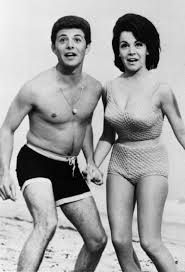
IN MEMORIAM: ANNETTE FUNICELLO

It was as if Annette had died, at least in part, to provide spiritual relief from the media psychodrama and political point-scoring gush around Margaret Thatcher's passing. That was what Annette did for us, when we were kids, provided a sort of marker toward a different sort of life. Of course, I was about five when I was keen on the Mickey Mouse club—so keen I can recall begging Miss Molloy, our kindergarten teacher, not to keep me after school because it was Mickey Mouse night and my mother wouldn't let me watch the TV if I'd stayed after. It wasn't to watch Annette, and in retrospect I wonder if the Spin and Marty stories were really that intriguing. My memory tells me I liked Gunga and Rama on Andy's Gang more.

But Annette, even then, was a step or two ahead—the older sister (or her friend), the baby-sitter just discovering older boys, the only one of the Mouseketeer girls who actually looked like the girls we knew. She was a Funicello, just like the Bonessis, Montaltos, Volpes, or Aquilinos we grew up with. She came from Utica, not California, though I didn't find that out until I read it in an obituary.

Which was ironic, because it was Annette who became the ultimate beach-bunny in those Disney movies. Uncle Walt had spotted her dancing, and in retrospect we can see both Graham Greene's appraisal of Shirley Temple and a touch of the Humbert Humbert in his appreciation of her. She was remarkably adult in her appeal, even before she astounded us younger males by hitting puberty full-force while we were just becoming aware of the difference in the sexes. Again, I say this recalling that the MMC went off TV when I was seven, so I may be applying some retro-analysis to my emotions when I say forget Darlene and Cubby and all the other goodie-goodies with their names written across their white T-shirts. And don't get me started on the adults. Jimmie? He was the kind of guy our parents should've been warning us about.


The explosion of breasts beneath the 'Annette' was like someone throwing a great switch on the libidos of millions of American baby boom boys. It was probably also the signal that the Mickey Mouse club was about to exceed its sell-by date. How big was the impact? A full decade after their last show, at a Yale football game, the marching band did a tribute to Annette, and in honour of her most lovable attributes formed two circles around two upturned tubas, signifying, as the stadium announcer intoned, 'her big brown eyes'.

By that time, she was another generation's sexpot. Her modest bikinis, and the equally modest Frankie Avalon, were soppy compared to what was happening, and Walt Disney's world-view was getting overtaken by times—it would come back when Annette's generation and the ones that watched her started looking for those comfortable childhood fantasies again.

Annette gave up the industry. Of course she did so to marry her agent—which must've made 'Uncle Walt' jealous. She took being the all-American mom very seriously indeed, and when she came back into the public eye it wasn't as a faux-moralist, like Anita Bryant, but as a spokeswoman and fund-raiser for the disease that afflicted her, muscular dystrophy. In the end, Annette wasn't our pre-pubescent fantasy; she became the kind of mother we watched in the Fifties—not so much on the Mickey Mouse Club, but on Donna Reed, or Beaver, or Father Knows Best. But it's hard not to look at those pictures, with the mouse ears and the bespoke T-shirt, and think about the kind of innocence we like to pretend the world had then.

Saturday, 6 April 2013

HENNING MANKELL'S TROUBLED MAN

Kurt Wallander is 60 years old. He's living in his isolated house with a view of the sea. He's starting to forget things, including one night when he gets drunk and leaves his gun behind in a restaurant. On the home front, his daughter Linda, who followed him into the police, is having a baby, partnered with a Swedish businessman whose father is a naval officer from the old aristocracy. As always with Wallander, he has time to think, especially as he sits out his suspension while the punishment for losing his gun is decided by the odious bureaucratic cop Mattson.

Then Linda's partner's father disappears, and Wallander is drawn into the search—made more personal because Hakan von Enke had previous chosen to share with Wallander the fact that he was troubled, though not the specifics of what it was that was troubling him. Wallander's search eventually involves foreign submarines run aground in Swedish waters, international spying and evasdropping, and even murder. This touches on those keys moments of modern Swedish society—the time of Olaf Palme, and his assassination—which has been at the core of much modern Swedish crime fiction, and which continues to defines the problems of Sweden's view of itself and its place in the modern world. Of course, Wallander's quest is not an official investigation, but that is perfect because it is the detective doing what he has always done best—attempting to solve a mystery, the mystery of human behaviour, the one thing that has always been hardest for him to do.

What develops as he searches for von Enke, and then for von Enke's wife, is something different: it becomes a trawl through Wallander's own past. At times, the devices become a bit strained, as Henning Mankell attempts to cover lots of ground from the past that's been shared through the series, and indeed some that has not. But even if it at times creaks at the edges, the core of it is filled with the rise of emotions, as always restrained and even repressed, in the overwhelmingly Swedish sense, as Wallander and we contemplate his life.

He receives a visit from Baiba, the Latvian woman who was his one true love; he has to deal with Mona,his ex-wife and first love. He is forced to examine himself, and we are given the same opportunity to examine him. It is not always pleasant, but then, it never has been—the reality of Wallander has never been tortured genius, as portrayed by Branagh, or affable insecurity, like Krister Hendriksson. It has been his ordinariness, his restraint, his inability to fit in comfortably with the society he examines as he works. It has been a most Swedish inwardness, made more poignant by the ways in which Mankell has brought the outside world, the modern world, to bear on him. The core of his work has always been Wallander himself, which is what this novel, in its sombre way, celebrates.

For it is Wallander himself who is the troubled man, and his troubles are framed by his past on one side, and his newly-arrived grandaughter on the other. The prospect of tragedy hangs over this entire novel—the reader sits on a sharp edge of fatal anticipation-- but in the end Mankell resolves the Wallander series in exactly the way he has built it over the years, with a simple and, dare I say, Swedish realism or practicality about the nature of our lives themselves. If it isn't optimistic or affirming, neither is it tragic. It is, instead, exactly what it is, and deeply moving, particularly if you have followed the series. This is, obviously, not the place to start reading Wallander—you do not have to have followed the whole series, but the more you know of the man, the more affecting this valedictory novel will be, and the better you will understand Mankell leaving Wallander his last private moments.

Monday, 1 April 2013

TED WILLIAMS: THE LOST GUARDIAN OBIT

NOTE: Tonight I am doing a broadcast on BBC Radio, of the Red Sox season-opening game at Yankee Stadium against the Evil Empire. If you are a Red Sox fan, as I am, you will appreciate the appropriateness of April Fools Day to start the Sox' season, but in the eternal spirit of hope, I thought I'd post this obit, which I recently found in my files, of the greatest Red Sox of all, Ted Williams.

This one was written for the Guardian,with a British audience in mind, as a stock piece for their files before Williams died. But when Ted did finally pass away, on 5 July 2002, the Guardian's news desk thought it was important enough to run a short wire-service piece in the news pages, and the obits desk decided that was enough attention for one baseball player, although, of course, Williams was much more than that. I've left it as I wrote it, except to fill in his age when he died. The Red Sox did finally win another World Series, in 2004, and then again in 2007, but in the process somehow found themselves morphing into the Yankees-lite, anathema to old-school Sox fans like me. I've since written, though the Independent hasn't yet published it, an obit of Richard Ben Cramer, whose tremendous piece in Esquire's June 1986 special issue, The American Man: 1946-1986, is one of the best profiles ever written (you can link to it here). Look at the picture of Ted in the follow through of his swing.  That's the Ted Williams I will always remember, though I never actually saw him play.


TED WILLIAMS was born in 1918, the last year the Boston Red Sox won baseball’s World Series. The next winter, the Sox sold Babe Ruth to the New York Yankees, where he became the game’s greatest star, and launched a dynasty of Yankee championships that continues to this day. Boston fell under the so-called Curse of the Bambino, which not even stars as great as Williams were able to overcome. Now Williams has died aged 83, and his Red Sox are still without another championship.

Williams was America’s real-life John Wayne: baseball prodigy, war hero, record-holding fisherman. How many men could make reasonable claims at being the world’s best at three different things? He embodied a masculine image which became deeply unfashionable, yet in recent years a society which lavishes huge rewards on mediocrity came to re-evaluate his accomplishments, understand, and even embrace his uncompromising personality. What was brash in a youngster becomes lovable in an aging icon. In this he came to symbolise Boston, where he was destined to play tragic hero: the young god whose hubris was repaid by the denial of World Series glory with his cursed Red Sox. 

Williams epitomised some classic New England values, working with dedication to become prodigiously skilled at his craft. Using a narrow cylinder of wood to hit a baseball bearing down at your head at speeds above 95mph is arguably the single most difficult task in sports, but no one made it look easier than Williams. Ruth may be the sport’s greatest player, but for pure hitting talent, Williams is the only man who could argue he was Ruth’s better. He could also sacrifice. Although he was accused at one point of dodging military service (he was his mother's sole support) he eventually lost much of his baseball prime to military service. And he was loyal. Despite his feuds with the Boston press, the so-called 'knights of the keyboard' he despised, and despite his love/hate relationship with Boston's fans, he played all 22 seasons of his career with the Red Sox.

But Ted never possessed another New England trait: self-restraint. He never learned the grace, the taciturn style, the faux-worldliness, of New York’s glamorous Yankees like Joe DiMaggio or Mickey Mantle. He debuted for the Red Sox in 1939, a 21 year old rookie calling himself “the Kid”. He resembled Wayne playing the Ringo Kid, tall, lean, and impossibly handsome: a combination of youthful innocence and lethal skill. He could count the stitches on a baseball hurtling at him, and uncoil his slender body like a finely-wound spring to make contact with it. Great players demand multiple definitions: soon they were calling him “The Splendid Splinter", later he would add "The Thumper".
 
His perfectionism contrasts with cricket’s equally obsessive Geoffrey Boycott. Like Boycott, Williams waged a career-long battle with the press, who accused him of placing individual success above his teams’ goals. When Cleveland manager Lou Boudreau shifted his fielders to pack the right side of the diamond, Ted refused to alter his technique and hit the opposite way. It would have stopped him taking his perfect swing. But unlike Boycott, Williams was exuberant in his abilities, generous with his chosen art to both teammate and opponent. His childish glee as he danced around the bases after winning the 1941 All-Star Game with a late home run earned him yet another nickname, “Teddy Ballgame”. “Jeffy Cricket-match” lacks the same ring. But Williams steadfastly refused to compromise for acceptance: he wouldn’t wear ties and he couldn’t pander to public relations; he never had an empathy for those who lacked the absolute sense of security his ability gave him.

Williams’ came by obsession naturally. His father abandoned his mother, a fanatical organiser for the Salvation Army. She in turn left him to his own devices; he haunted San Diego’s sandlots, hitting baseballs whenever he could persuade someone to pitch them. He was already playing semi-pro while still a high-school star, and at 18 turned pro with the San Diego Padres, then a top independent minor league team, in the Pacific Coast League, who eventually sold him to the Red Sox.

In 1941 Williams became the first player in almost 20 years to hit over .400 for the season. Where three safe hits every ten at-bats (.300) is considered excellent, the .400 barrier is regarded as nearly impossible. Before the season’s final day, Williams’ average stood at .3995. He refused his manager’s offer to sit out the final two-game double-header to protect his average, which would have been rounded up to .400. Instead, he stroked 6 hits in 8 at-bats, raising his mark to .406. No one has reached .400 since. Typically, however, 1941 was also the season DiMaggio hit safely in 56 consecutive games, and the Yankee Clipper captured the Most Valuable Player award. The two engaged in a triumphant reunion tour fifty years later, still New York chalk and Boston cheese. But by then, both they, and America, had learned to relish the contrast.

Williams’ career statistics fall short of many of the game’s greats, mostly because he lost five peak seasons to wars. He was so skilled a Marine fighter pilot that he was forced to spend World War II as an instructor. Recalled to Korea, he flew as John Glenn’s wingman. The future astronaut, Senator, and “right-stuff” test pilot called Williams the best combat flyer he had ever seen. 
 
In private Williams, whose ne’er do well brother died at age 39 of leukaemia, was a driving force behind the success of the Jimmy Fund, the Red Sox “pet” charity for children’s cancer research. In public, he used his induction into baseball’s Hall of Fame as a platform to call for the inclusion of Negro League stars, denied by segregation their chance to play in the majors.
But if baseball was his obsession, fishing was his passion. He retired to Florida where he could indulge himself with deep-sea fishing, where he held a number of world-record catches, and was equally adept with a fly rod, the same vision, coordination and patience that made him a great hitter of baseballs made him a great caster of lures.

Aged 38, and slow afoot, Williams still batted .388. Two years later, he retired. John Updike chronicled his final game in a famous New Yorker magazine essay, “Hub Fans Bid Kid Adieu”. In his final at-bat in Boston’s Fenway Park, Williams hit a home run. After he took his place in left field, he was replaced, allowing the fans the chance to give him one final ovation. He trotted back into the dugout, without tipping his cap, and disappeared. Despite prolonged cheering, he never returned. As Updike explained, “Gods do not reply to letters”.

Sunday, 31 March 2013

ROBERT CRAIS' SUSPECT

There is a theme running through Robert Crais' work, whether it's the Elvis Cole and Joe Pike novels or not, and that is relationships. Familial, romantic, partnerships are the currency of Crais' characters, and for him character is indeed, as F. Scott Fitzgerald famously observed, action. Though his books often seem fast-paced, when you look at them closely you'll see him weave myriad plot strands together and, as befits someone who was a highly successful writer of episodic television, usually resolve them quickly. What isn't resolved quickly is whatever series of questions Crais has made his characters face about their relationships; sometimes that resolution mimics the high-speed finales, sometimes it runs parallel, and sometimes it is resolved in quite an opposite way altogether.

In Suspect, the relationship in question is between Scott James, an LA cop who lost his partner, was severely wounded himself, in a massive shootout, and his new partner, a German shepherd named Maggie who herself lost a partner and was severely wounded in Afghanistan.

It takes a brave writer to try not to have animals upstage his story, and Crais makes it work almost immediately; the prologue in Afghanistan is superbly judged. He makes Maggie a real character with some of the most touching writing I've read in the crime field in ages. Using animal point of view is equally risky, but again, Crais pulls it off, and it's necessary in the sense that we are dealing with two damaged beings, whose path to each other reflects that damage even as they heal. So Scott has to prove himself as a dog handler, in order to remain what he wants to be, a working cop, but he also has to try to solve the mystery of the shooting that killed his former partner, Stephanie, to stop his feeling he left her behind.

It works well. As Scott gets closer to the truth, he finds himself ensnared. Perhaps it would have been good to see the ultimate villain fleshed out a little more fully, or foreshadowed slightly more strongly, and perhaps Scott could have been left hanging out in the wind for a longer, more suspenseful, time. In an afterword, Crais acknowledges a certain amount of compression of time in the dog training, but it's easy to see why he wanted to maintain the pace as he does, to in effect force the new partnership to a point of crisis, to see if the bonding sticks, and to see if both partners can begin to trust the world again. It is a bravura piece of writing, and it seems a natural for a movie—after all, it's been too long since we've seen heroic dogs on our screens. 


Suspect by Robert Crais
Orion, £12.99, ISBN 9781409127703

NOTE: This review will also appear at Crime Time (www.crimetime.co.uk)

Friday, 29 March 2013

DOING WHAT YOU'RE TOLD: COMPLIANCE, LONDON FILM FEST HIT ON RELEASE

Compliance, which has just opened this week, was one of the best films in the 2012 London Film Festival. The strange thing about it is that, even among an audience less film literate, less armed with press kits, and less dedicated than the one I saw it with at the LFF preview, everyone seems to know the premise going in (and if you don't know it, stop reading right now, and come back after you've seen the movie!).

The premise is that the manager of a fast-food branch gets a call from the police telling her that they've had a complaint from someone who's had money stolen from their purse by one of the Chick-Wich counter staff. The manager, Sandra, is told to in effect take the girl, Becky, into custody, and from that point the voice on the telephone manipulates a series of more and more serious humiliations for Becky, involving other staff members and even Sandra's boyfriend.

Now we all know what's going on; we've heard about the film and/or about the real events that inspired it. Some of us knew about the Stanley Milgram experiments, conducted at Yale in 1961, which involved testing people's obedience to authority by requiring them to administer electrical shocks to subjects in an experiment. If you knew the procedure of that, you would recognise the gradually increasing resistance being overcome by an equally increasing assertion of authority, playing on submissive doubt.

Compliance accepts all that, and copes with it very well. It adopts a sort of thriller format—yet the reveal is relatively early in the film, making the thriller aspect the question of just how far the staff will go, and how far the perpetrator will push, and indeed, whether he will get away with it, even to the point where Becky gets spanked—a sort of literal Milgram shock. The format only works on its own terms but also serves to put the audience into the same frame of mind as the staff: they are constantly checking their own reactions, perhaps, but not necessarily aware, that they are being manipulated in a manner not that far removed from the staff. After all, we surrender to the film-maker's authority and believe their version of reality.

It's also helped by some fine casting, particularly Ann Dowd as Sandra. This is also a movie about work, and the pressures of minimum-wage life in America; fear of losing a job is a great way to create a docile work-force, a reinforcement of obdience to authority in itself. Sandra may be one of life's losers, an adult dressed in a child's outfit, but she is also one of life's believers—a clear contrast to her workforce, who realise they are in a dead-end and are slackers as a result. She's matched perfectly by the hangdog features of Bill Camp as her 'fiance' Van, he conveys a 'not quite there' aspect that makes him perfect, particularly as he uses in all the wrong ways the sudden influence of authority granted him. Dreama Walker as Becky is also very good, conveying the right mix of not-quite beauty and not-quite confidence.

Pat Healy as 'Officer Daniels' is interesting. He's presented carefully as a kind of cliched Nazi, a Dr Mengele by phone, and he smokes, always a sign of extreme detachment from society's mores nowadays. But his voice is very much like the comedian Bob Newhart's, and Newhart's most famous routines involved his doing one side of phone calls between famous people, God and Noah, or Elizabeth I and Walter Raleigh. It's almost like sending the audience (at least that part old or savvy enough to recall Newhart) an additional reminder something else is going on.

Craig Zobel, who both wrote and directed, brings out the flatness, the primary colour drab, of his characters' lives, and cinematographer Adam Stone reinforces that with his use of shadowy spaces which signal an existential dilemma: when Becky is in the office/store room, it's a like a situation from a Sartre play. Their detachment from each other, the gap into which the phone cop intercedes. It takes the outsider to the group, Van, to realise what's going on. And when they do, the real cops seem too close to the pervert for comfort. In the end, we feel, the perversion and the experimentation are themselves too similar, and the movie and the events as well.

A postscript shows us what happens in 'real' life. Sandra lost Van, and her job. The fast-food chain was sued for not 'protecting' and employee, as if there were a training session or seminar that would be relevant to a fast-food manager's career. The suit further drove the staff apart, but it was the experiment that had already done that. And when asked, in the ugfaux-psychology of TV chat shows, whether she was 'brain-washed', Sandra replies, 'I did what I was told to do'.

Tuesday, 26 March 2013

BEN WEIDER: THE 2008 GUARDIAN OBITUARY

In honour of Joe Weider's obit running in the Guardian, I went back and found my obit of his younger brother Ben, which I wrote for the G in December 2008, just around the time I started this blog, but which for some reason I never included here. You can link to it here

I love the contrast between the brothers. I mentioned in Joe's obit that, where Ben became a scholar of Napoleon, you might accuse Joe of harbouring a not-very-well concealed Napoleonic complex, the complex little man making himself big (in every sense of that word) with drive and ego to match.

They seem a perfectly matched pair: Ben staying in Montreal, becoming a philantropist, marrying a local girl and building the structure of their fitness empire, while Joe moved to California, married a pin-up, crashed Hollywood via Arnold, and constantly sold himself and his lifestyle alongside equipment, dietary supplements, and sage advice.

Both brothers were long-lived, but I wonder if they were the kind of men who would have been regardless of what avenues they'd pursued. I'm almost tempted to read Brothers Of Iron, except I suspect it contains a lot of, shall we say, mythologising--and any book with forewards by both Arnold and Juan A Samaranch can't be all good.

It's a fascinating story, and it makes me want to go back to Montreal and live near Park LaFontaine. The neighbourhood has changed, and I suppose it's too late for that now.


JOE WEIDER: THE GUARDIAN OBITUARY

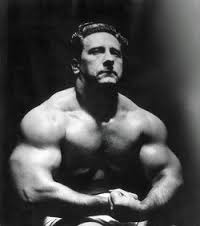
My obituary of Joe Weider, the bodybuilding guru, is up at the Guardian online (link to it here) and should be in the paper paper today or soon. Obviously the big hook for the story was Arnold Schwarzenegger, for whose infliction on the wider world Joe can fairly be blamed. Had I but space enough and time, I might have gone back and rewatched the two films that made Arnold's career: Pumping Iron (my enduring memory is that Arnold's cruelty to Lou Ferrigno makes Ali's to Joe Frazier look tame) and Stay Hungry (my memory is all the faux philosophy doesn't quite work, though Jeff Bridges is great and Arnold seems to be playing himself, all ego, as the documentary had suggested, but also borrowed in large part from Joe, who was once quoted, when asked about his critics, as saying 'lots of people hate God too'.)

As you can see from the photo on the right, Joe practiced what he preached -- and as he grew older you can see the way he served as a walking advertisement for the Muscle Beach lifestyle. And, after all, he did live to be 93. It might also have been good to detail all the various ways Weider's products were under constant assault from regulators, and whether his miracle ingredients were really scraped off the sea bottom. Maybe Jack LaLanne (whose 2011 obit I wrote for the Indy, you can link to that here) held his breath and dived for them. Just kidding. But it's hard to overstate the effect of Weider ads, which were ubiquitous in my childhood, and strangely alluring. The 98 Pound Weakling of Charles Atlas fame was what Joe had been, and he knew how to sell to that adolescent (of all ages) insecurity. I was impressed to see that Joe's ghostwriter on his books about his bodybuilding system was Providence's Bill Reynolds, who's very good. But Joe's guides went beyond bodybuilding guide: I found a picture of the pamphlet on the left, and wonder how I missed this when I was young. It surely might have helped! It makes it pretty clear that the Arnold character in Stay Hungry certainly was modeled on Joe Weider.


Monday, 25 March 2013

FOOL ME TWICE: MICHAEL BRANDMAN'S ROBERT B PARKER

Considering that this is Michael Brandman's second outing with Robert B Parker's Jesse Stone, it was bold to title the novel Fool Me Twice. But if anything, Brandman is making Stone his character, not Parker's. As I mentioned when I reviewed his first Stone novel, Killing The Blues (you can link to that review here), Brandman's Stone is more of a loner, more aggressive, and somewhat darker than Parker's Stone was. Parker could make Stone's sometimes flippant attitude work because he was a master of quick scenes and sharp patter, he also delineated supporting characters quickly and with far more efficiency than Brandman's able to do.

Instead, Brandman has blended together three stories, and in each of them Stone is able to crack wise with pompous figures of authority. A movie production has come to town, and the leading lady fears she's being stalked by her soon-to-be-ex husband. A spoiled teenaged girl is driving while using her mobile and Jesse, as is his wont, takes her on as a personal project (though he never refers her to a shrink, as Parker's Jesse might have). And most bizarrely, what starts out as a nuisance call from an old busybody, about her water bills getting bigger, turns into something far more complicated. The stories don't cross over, but their concerns reinforce each other to some extent, keeping the plotlines going. And of course there is a bit of romance for Stone, but this Stone has no pesky ex-wife haunting him, no Sunny Parker either, and we quickly learn that the last novel's entanglement has disappeared.

Jesse has always been Parker's most problematic lead character—he's Spenser in many ways, but with more id and less ego (or super ego), and more of a lone wolf. Spenser kept him entertaining with his baseball past, his drinking, and his multi-layered problems with the opposite sex, but Brandman has eliminated most of that, and Jesse's sessions with his shrink. He's gained a more forward-driven plot, but lost some of the relative complexity of the character, and in terms of women, frankly, turned him into Tom Selleck on TV.

Here he brings back Parker's Crow, a figure much like Spenser's Hawk, only without the repartee. Crow was more a construct than a character, and his backstory with Jesse's deputy Molly is ignored, partly because Molly has become a different sort of character too. Crow doesn't do much except play his part in the plotline, which is OK since he'snot very interesting, but with the state cop Healy rendered one-dimensional as well, it leaves only Jesse and his verbal sparring partners as characters.

Taking over someone else's character is a thankless task. Stick too close to the established formula and you're riding coattails, change it and you're messing with the master. I wrote about this with Don Winslow's taking over Trevanian (link here), but it seems to me that what Brandman is trying to do is gently make this Stone his own, or better, the Stone who was already there in the TV movies which he and Parker collaborated on. It's not a bad way to proceed, but he needs to go all the way, and fill in the missing blanks of character around Stone to really make it work.


Fool Me Twice by Michael Brandman
Quercus £18.99 ISBN 9781782064763

NOTE: This review will also appear at Crime Time (www.crimetime.co.uk)

Sunday, 17 March 2013

ACE ATKINS' THE RANGER

If you listened to Open Book today (see the previous post) you would have heard Ace Atkins explaining the influence of Elmore Leonard on his new novel, The Ranger, particularly Leonard's western Last Stand At Sabre River, in which a Confederate soldier home from the Civil War has to fight to reclaim his homestead which has been taken by ex-Union men. There's also a respectful TV movie of the book, starring Tom Selleck. Elmore Leonard provides a blurb for Atkins' new novel, and justifiably so, but the influences on this book go far beyond Leonard's work, and come from two directions.

The returning soldier finding the home front different and corrupt enough for him to have lost what is his goes back a long way, and not just in the western (think of film noir, The Blue Dahlia for example). And there are countless films modelled after the original Walking Tall (although in that one Buford Pusser came home not from war but from wrestling), among which Rolling Thunder might be considered crucial.

The home Quinn Colson comes back to Jericho upon the death of his uncle is the hill country of northeast Mississippi. Colson is still in the Army Rangers; in fact he shows up having won a gun a poker game, and bought a truck in Phenix City, Alabama (if you haven't seen Phil Karlson's great noir film, The Phenix City Story, in which ex-servicemen clean up the most corrupt small town in America, you need to, but until you do you'll miss what that signals). Colson doesn't believe his uncle, a sherrif, killed himself, and he finds his uncle's land is being claimed by the local bigwig, Johnny Stagg.

Stagg has his fingers in lots of pies, some legitimate and many less so. This includes meth cooking, which has become the equivalent of train robbing in the new west. Colson encounters, by chance (echoes of Mickey Spillane) a pregnant teen, travelling to Jericho to find the baby's father. Along the way Colson will also have to deal with his ex-girlfriend, now married, and his sister, now run off and leaving a bi-racial baby behind for her mother to tend. This may be the new south, but it is the same violent south that has been written about since before the Civil War, the south of Jesse James and Deliverance, of Southern Comfort, of Daniel Woodrell's country noir and James Carlos Blake's In The Rogue Blood, the modern south of Leonard's Justified or Atkins' own novel of 1950s corruption in Tampa, White Shadow (you can find my review, written two years ago, of that novel here).

Colson finds some allies (this isn't quite High Noon), and stands his ground, and it is resolved finally in a shootout which, again if you heard Ace explain this you will already know, bears more than a little resemblance to the gunfight at the OK Corral (Doc Holiday, of course, was a southerner).

So it is a western, and it's done with some penache. It reminds me in some ways of when George Pelecanos turned to echoing western tropes in his novels; the prose is more straightforward than, say, White Shadow's,
moving more forcefully. It's closer to Leonard, and it also shows signs of the style which may have prompted Robert B Parker's estate to decide on Atkins to continue the Spenser series. Parker's greatest strength was the ability to set small scenes, through dialogue, that drew portraits of characters quickly and efficiently; there were those in bit parts in the Spenser series whom readers felt they knew, or recognised, in the space of only a few paragraphs. Atkins can do this, and he needs to do it more fully with some of the more major characters, because he has clearly set this up to become a series, and there are already conflicts and ambiguities enough for books to come.

The Ranger is a good start. Again, as he said on Open Book, he'd moved closer and closer to the present day in his novels; it seems to me that by appropriating western themes he also leaves himself some room to do other things within that modern setting. I haven't yet read Atkins' version of Spenser, but since Parker himself also went to westerns, both in Spenser novels and directly in his Cole and Hitch novels, this would seem a rich vein to mine.

The Ranger by Ace Atkins
Corsair, £12.99, ISBN 9781472100313

This review will also appear at Crime Time (www.crimetime.co.uk)

MODERN WESTERNS: MARIELLA, ACE & ME ON OPEN BOOK

I was on the BBC Radio 4 programme Open Book today, with host Mariella Frostrup and the writer Ace Atkins, to talk about westerns. The hook was two radio adaptations of western novels which will air on R4: Elmore Leonard's Hombre (you can see my take on the book, which I read recently, here), at 2:30 next Saturday 23rd, and Jack Schaefer's Shane the following Saturday. You can find programme on IPlayer here, for at least the next week, and it will be repeated on Thursday 21/3 at 3:30pm --it's a good listen, with Kate Atkinson preceding us, and an interesting discussion of betting on the Womens Prize for Fiction. Which, had I heard it, might have prompted me to note that westerns serve, for America, much the same function as costume drama does for Britain; it's way of reassuring the present by showing its roots in the past.

This was a discussion that was immense fun when we recorded it in the studio, and it's also one that could have go off in any number of directions--I could easily have traced the western through Fenimore Cooper's Deerslayer through Melville's Confidence Man to Nick Carter--the dime novel western hero who becomes Nick Carter the detective later on--but Ace drew the comparison, of 'gunslingers moved to town', which made it unnecessary.

We might also have delved a little further into the connection between movies and novels, in reverse perhaps, because as Ace made clear, movies influence writers' own concepts of the west as much as books used to fertilise Hollywood's west. I probably ought to have made clear another distinction: westerns were a major part of the pulpy and slick magazine fictions just as film was coming into being--The Great Train Robbery, after all, was the first narrative film--but the movies' immense appetite for westerns was expressed primarily in B features, serials, and the like--John Wayne made many forgettable westerns in between Raoul Walsh's The Big Trail and John Ford's Stagecoach. Then television did the same thing in its early days--wringing the genre dry to the point that from the middle Sixties onward, we get western films that are in many ways commentaries on the genre and its conventions.


One thing that was cut was the question of what our favourite western novel actually is: Ace chose True Grit (our discussion of which also fell by the wayside) and I was torn between True Grit, Warlock by Oakley Hall and Little Big Man by Thomas Berger. Have a listen to the programme as it stands; you'll like it.

SODERBERGH'S SIDE EFFECTS: JUDE LAW & DISORDER

There was a point in Side Effects where I realised that what I was watching was an episode of Law & Order with compressed air pumped into it; perhaps it was as I started to envisage Elaine Stritch arguing to Sam Waterston that Rooney Mara had been driven beyond rational understanding by having to watch Jude Law act (call it Jude Law & Disorder?). Then the film began to morph, and starting trying to become an episode of Law & Order as it might have been directed by Alfred Hitchock, or someone thinking maybe he could be the next Hitch.

That may be somewhat harsh to what is an entertaining enough movie that I assume picked up a lot of serious cred because the critics and the Hollywood community saw it as an 'issue' film, and maybe because they were able to compare notes on their own prescriptions. Soderbergh has show he can keep this sort of movie moving along, playing with time sometimes, and, in this case, playing with style as well—imitating commercials, setting New York City backgrounds to reflect characters, and even recreating a perfect Edward Hopper shot. It is a pleasure to follow.

In effect, it's a film of two halves, as Law's British-educated psychiatrist, Jonathan Banks, first finds his career and life falling apart when a patient of his murders her husband while she's suffering side effects of drugs he's prescribed. Then it switches pace as the now rock-bottom Law begins to see a different pattern in what has happened, and manages to outwit the people who have outwitted the law as well as Law. That second half becomes very mechanical, and since some of it has been telegraphed – Catharine Zeta Jones seems always to be shot in a sort of dark-grained Seventies look that is the visual equivalent to those four bass notes on the movie-house organ – not least because horn-rimmed glasses do not a psychiatrist make; she's the least-likely shrink since Barbara Streisand in Prince Of Tides.

Law is actually perfect for the first part of the movie; he's got the classic film noir combination of being too cute for his own good and not half as smart as he thinks he is. He needed to pay attention when Emily tells him 'I thought sick people sometimes make things up.' Thus, as his life collapses around him, he's a break-down about to happen. It is also interesting the way his support system: wife and partners, desert him so quickly—this seems to be one of Soderbergh's major concerns, and indeed when the film is resolved it is with the family put back together, like a Disney film. The point seems to be that New York is rougher than Durham University. And in fact, Vinessa Shaw, as Banks' wife Deidre, seemed to be playing the wife in the film version of Jo Nesbo's Headhunters.

But in the second half, Law somehow manages to outsmart the two women who thus far have shown themselves to be smarter than him, and, in the case of Rooney Mara's Emily, capable of acting him under the table too. He seems to be morphing, with his devil's peak, into Kaiser Sosay. Mara's performance is somewhat flashy, in the sense that, like Tim Robbins in Mystic River, there's a lot of shuffling around, but it's at the edges that she really shines—the character isn't that far removed from Lisbeth Salander, but Mara is probably the challenger to Jennifer Lawrence right now.

Worth noting, however, is the lesbian undercurrent, another similarity with the Salander role. I kept thinking this was some kind of double-level play with Michael Douglas and Fatal Attraction, but it was pretty obvious rather early on that there was something going on, and it was a little disappointing to see that kind of Jerry Falwell male fantasy that has women lovers become husband-killers. Channing Tatum, the husband who's gone to jail for insider trading, and becomes the victim, seems almost as doped up as his wife, whether that's freedom, prison, or the effects of big financial business in New York I could not say. And I'm not sure why Mara's Emily would have to teach Dr Seifert about derivatives if what she were doing was simply shorting pharmaceutical stocks.

But the finish rings false until it gets to the single successful Hitchockian moment, Banks' revenge on Emily, by keeping her medicated in a facility. There are moments of late Fifties Hitch: the interview with Russell Jones excellent as the medical ethics investigator, or even Michael Nathanson's strangely detached DA. But there are others redolent of Law & Order, especially Polly Draper's scene-stealing turns as Emily's boss. In the end, however, as you watch Banks' partners, or the drug company reps, or the characters in the commercials, you begin to wonder if this is Soderbergh's foray into David Cronenberg territory, and how it would have played out had it gone in that direction. Side Effects proves yet again how facile and effective a genre director Soderbergh can be--you get the sense he looks at a script and breaks it down, then puts it back together in his own way, hopping genres. He would have been excellent in the old studio system, if he were allowed to be.